



Artikel: Why use cosmeceuticals for better skin results

Why use cosmeceuticals for better skin results
TL;DR:
- Cosmeceuticals are skincare products containing clinically relevant bioactive ingredients that induce measurable biological changes in the skin. Unlike regular cosmetics, they penetrate deeper and utilize advanced delivery systems, enabling targeted therapeutic effects. Proper formulation, consistency, and professional guidance are essential for maximizing their skin health benefits.
Cosmeceuticals are defined as skincare products that combine cosmetic formulation with bioactive ingredients capable of producing measurable, therapeutic changes in the skin. Unlike standard moisturisers or cleansers, they contain clinically relevant concentrations of actives such as retinol, Vitamin C, niacinamide, and peptides, which work at a cellular level to address specific concerns. The term sits in a regulatory grey area, particularly in the US where the FDA does not recognise cosmeceuticals as a distinct product category, yet dermatologists and clinicians worldwide recommend them as a credible step between over-the-counter cosmetics and prescription treatments. Understanding why to use cosmeceuticals means understanding this distinction clearly.
What differentiates cosmeceuticals from regular skincare?
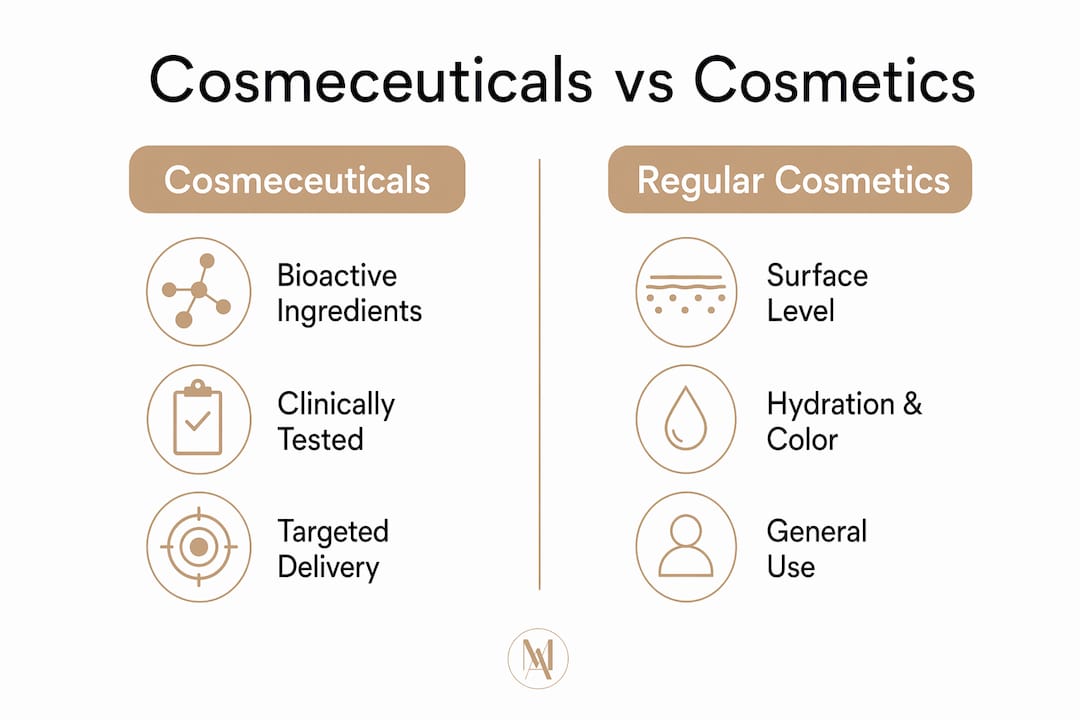
Regular cosmetics are formulated to sit on the skin’s surface, delivering hydration, colour, or fragrance without altering its biology. Cosmeceuticals, by contrast, are designed to penetrate deeper and interact with skin cells, triggering processes such as collagen synthesis, pigment regulation, and barrier repair. This is the core of the cosmeceuticals vs skincare debate, and the difference is not merely marketing.
The distinction comes down to ingredient type, concentration, and delivery. Consider the comparison below:
| Feature | Regular cosmetics | Cosmeceuticals |
|---|---|---|
| Active ingredient concentration | Low or absent | Clinically relevant levels |
| Skin penetration depth | Surface only | Deeper dermal layers |
| Targeted therapeutic effect | Minimal | Specific and measurable |
| Regulatory classification | Cosmetic | Grey area (not pharmaceutical) |
| Examples | High-street moisturisers | Retinoid serums, AHA treatments |
Key bioactive agents found in cosmeceuticals include:
- Retinoids (retinol, retinaldehyde): accelerate cell turnover and stimulate collagen production
- Vitamin C (L-ascorbic acid): a potent antioxidant that brightens skin and reduces oxidative damage
- Niacinamide: supports the skin barrier, reduces inflammation, and addresses hyperpigmentation
- Peptides: signal proteins that promote collagen and elastin synthesis
- Alpha hydroxy acids (AHAs): exfoliate and improve skin texture and tone
- Hyaluronic acid: draws moisture into the skin at multiple depths
The bioactive ingredients and clinical formulations used in cosmeceuticals require more rigorous stability and efficacy testing than standard cosmetics. This is precisely why they deliver results that a basic high-street product cannot replicate.
How do cosmeceuticals work to improve skin health?
The effectiveness of cosmeceuticals depends on two things: the quality of the active ingredient and the sophistication of the delivery system used to get it into the skin. Without the right delivery technology, even the most potent compound will degrade or fail to penetrate past the stratum corneum, the skin’s outermost protective layer.
Advanced delivery systems used in cosmeceutical formulations include:
- Liposomes: lipid-based vesicles that encapsulate actives and fuse with skin cell membranes for targeted release
- Nanoparticles: microscopic carriers that transport ingredients deep into the dermis with precision
- Microemulsions: stable oil-water systems that improve solubility and absorption of hydrophobic actives
- Encapsulation technology: protects volatile ingredients like L-ascorbic acid from oxidation until they reach the skin
Liposomes, nanoparticles, and microemulsions are employed specifically to enhance ingredient stability and enable targeted release deep into skin layers. Without these systems, volatile ingredients degrade rapidly, losing effectiveness before they can act. This is why a well-formulated Vitamin C serum from a clinical brand will outperform a cheaper alternative with the same listed ingredient.
Once delivered effectively, cosmeceutical actives work through distinct biological mechanisms. Retinoids bind to nuclear receptors in skin cells, directly influencing gene expression to accelerate renewal and increase collagen production. Niacinamide inhibits the transfer of melanosomes between melanocytes and keratinocytes, visibly reducing dark spots over time. Peptides act as messenger molecules, signalling fibroblasts to produce more structural proteins. Each mechanism is specific, measurable, and backed by peer-reviewed research.

Pro Tip: When selecting a Vitamin C product, look for L-ascorbic acid in an anhydrous (water-free) or encapsulated formula. Exposure to air and light degrades this ingredient quickly, so packaging matters as much as concentration.
What are the main benefits of using cosmeceuticals?
The benefits of cosmeceuticals extend across a wide range of skin concerns, making them suitable for most skin types when chosen correctly. The globally growing cosmeceutical market focuses on anti-ageing, pigmentation correction, acne reduction, and skin texture improvement, reflecting both consumer demand and clinical validation.
Here is what consistent use delivers in practice:
- Improved skin texture and tone: AHAs and retinoids accelerate surface cell turnover, smoothing rough patches and evening out discolouration over weeks of use
- Reduction in fine lines and wrinkles: retinoids and peptides stimulate collagen synthesis, producing measurable improvements in skin firmness and depth of lines
- Hyperpigmentation correction: Vitamin C and niacinamide reduce melanin production and post-inflammatory pigmentation, including marks left by acne or sun damage
- Acne management: salicylic acid and niacinamide reduce sebum production, clear pores, and calm inflammation without the systemic side effects of oral medications
- Barrier strengthening: ceramides, hyaluronic acid, and niacinamide reinforce the skin’s protective function, reducing sensitivity and transepidermal water loss
- Post-procedure support: cosmeceuticals reduce healing time and inflammation after professional treatments such as laser resurfacing, chemical peels, or microneedling
That last point is particularly significant. Clinical guidelines from 2026 recommend cosmeceuticals to support post-procedural recovery, meaning they are not just a standalone option but an adjunct to professional aesthetic treatments. At Them-ethod, we see this regularly with clients who combine SkinPen microneedling or Profhilo with a targeted cosmeceutical regimen, achieving faster recovery and longer-lasting results.
Cosmeceuticals also occupy a middle ground in potency between over-the-counter products and prescription medications. This makes them particularly valuable for individuals who need more than a basic moisturiser but are not yet candidates for prescription-strength retinoids or hydroquinone.
What should you consider when choosing cosmeceuticals safely?
Choosing cosmeceuticals without guidance is where many people go wrong. The market is saturated with products making impressive claims, and ingredient lists can be difficult to interpret without a trained eye. Selecting the right formulation for your skin type and concern requires more than reading a label.
Consider the following before adding a cosmeceutical to your routine:
- Consult a clinician or dermatologist first: a tailored cosmeceutical regimen based on your skin type, concerns, and tolerance will always outperform a self-selected product. The role of a dermatologist in guiding your choices is not optional for complex concerns
- Evaluate ingredient concentration, not just presence: a product listing retinol at 0.025% will not deliver the same results as one at 0.5%. Effective concentrations matter
- Patch test new actives: introduce one new active at a time and test on a small area for 48 hours before full application, particularly with AHAs, retinoids, and Vitamin C
- Assess formulation stability: look for airless pumps, opaque packaging, and encapsulated actives to confirm the product has been designed to preserve efficacy
- Be consistent: cosmeceuticals require regular, sustained use. Most retinoid studies measure outcomes at 12 weeks minimum. Sporadic application produces negligible results
Pro Tip: Avoid layering multiple high-potency actives in the same routine without guidance. Combining retinoids with AHAs, for example, can compromise the skin barrier and cause significant irritation. Build your routine incrementally.
The 2026 clinical skincare trends reinforce the importance of personalisation. One-size-fits-all approaches to cosmeceuticals are increasingly being replaced by regimens tailored to genetic skin type, microbiome profile, and lifestyle factors.
Key takeaways
Cosmeceuticals deliver measurable skin improvements because they combine clinically relevant active concentrations with advanced delivery systems that standard cosmetics cannot match.
| Point | Details |
|---|---|
| Definition matters | Cosmeceuticals are distinct from cosmetics due to bioactive ingredients that alter skin biology, not just surface appearance. |
| Delivery technology is critical | Liposomes, nanoparticles, and encapsulation protect actives and enable deeper skin penetration for real results. |
| Benefits are specific and clinical | From collagen stimulation to pigmentation correction, each active ingredient has a defined, researched mechanism of action. |
| Professional guidance improves outcomes | Clinician-led regimens tailored to your skin type and concerns consistently outperform self-selected products. |
| Consistency is non-negotiable | Most cosmeceutical actives require a minimum of 8 to 12 weeks of regular use before visible improvements are measurable. |
Why cosmeceuticals have changed how I think about skincare
I have spent years working with clients who arrive frustrated after spending significant money on premium-looking products that simply did not perform. The pattern is almost always the same: beautifully packaged, well-marketed, but formulated without the ingredient concentrations or delivery technology needed to produce change. That experience shaped how I approach cosmeceuticals today.
What strikes me most about the current generation of cosmeceutical formulations is not the ingredient list itself, but the science behind how those ingredients are stabilised and delivered. A retinol product in a jar exposed to air every morning is not the same product after two weeks. Encapsulation and packaging integrity are where the real quality gap lies, and most consumers never think to ask about it.
The regulatory ambiguity around cosmeceuticals is often cited as a weakness, but I see it differently. It means the burden of proof falls on formulation quality and clinical evidence rather than regulatory approval alone. Brands that invest in peer-reviewed research and transparent ingredient disclosure are the ones worth trusting. That is the standard we apply at Them-ethod when curating our product range.
My honest advice: do not approach cosmeceuticals as a shortcut to prescription-strength results. Approach them as a precision tool. Used correctly, with the right guidance and realistic expectations, they are genuinely one of the most effective things you can do for your skin between professional treatments. The science behind clinical skincare continues to advance rapidly, and cosmeceuticals are at the centre of that progress.
— Jess
Explore cosmeceuticals curated by Them-ethod
At Them-ethod, every product in our range is selected against clinical criteria: verified active concentrations, proven delivery technology, and dermatologist endorsement. For those managing acne and congestion, the PCA Clearskin acne serum combines niacinamide, salicylic acid, and retinol in a formulation designed to reduce breakouts without compromising the skin barrier. For pigmentation and skin health, the NEOSTRATA collection offers scientifically validated AHA and antioxidant formulations suited to a range of skin types. If you are unsure where to begin, our virtual skin consultations connect you directly with a clinician who can build a regimen matched to your specific concerns and goals.
FAQ
What are cosmeceuticals, exactly?
Cosmeceuticals are skincare products formulated with bioactive ingredients at clinically relevant concentrations, designed to produce measurable changes in skin biology beyond surface-level cosmetic effects. Common actives include retinol, niacinamide, peptides, and Vitamin C.
Are cosmeceuticals effective for ageing skin?
Yes. Retinoids, peptides, and antioxidants such as Vitamin C have strong clinical evidence supporting their ability to reduce fine lines, improve skin firmness, and correct pigmentation associated with photoageing. Results typically require consistent use over 8 to 12 weeks.
How do cosmeceuticals differ from prescription skincare?
Cosmeceuticals sit between over-the-counter cosmetics and prescription medications in terms of potency. They contain effective concentrations of actives without requiring a prescription, making them accessible while still delivering therapeutic benefits.
Can cosmeceuticals be used alongside professional treatments?
Clinical guidelines recommend cosmeceuticals as adjuncts to professional procedures such as laser resurfacing, chemical peels, and microneedling, as they reduce healing time and inflammation while supporting skin repair post-treatment.
How do I know if a cosmeceutical product is high quality?
Look for transparent ingredient disclosure, clinically validated concentrations, stable packaging such as airless pumps or opaque bottles, and brands that reference peer-reviewed research. Consulting a dermatologist or clinician before purchasing remains the most reliable way to identify products suited to your skin.