





Role of Dermatologist in Skincare: Prescription Power
One-size-fits-all routines rarely satisfy those who demand exceptional results for their unique skin. For discerning clients in the United Kingdom and Greece, achieving luminous, youthful skin means moving beyond generic solutions and seeking true personalisation from specialists. Dermatologists now use advanced DNA-based analysis and AI-powered tools to design protocols that address everything from stubborn pigmentation to the earliest signs of ageing, delivering highly individualised care no off-the-shelf product can match.
Table of Contents
- Dermatologists’ Expertise in Personalised Skincare
- Prescription Treatments for Pigmentation and Ageing
- How Dermatologist-Recommended Regimens Work
- Safety, Monitoring, and Long-Term Skin Health
Key Takeaways
| Point | Details |
|---|---|
| Personalised Skincare is Essential | A tailored approach considers individual skin genetics, lifestyle, and concerns, leading to more effective outcomes. |
| Prescription Products Provide Superior Results | Dermatologists can prescribe higher concentrations of active ingredients that address pigmentation and ageing more effectively than over-the-counter options. |
| Regular Monitoring Enhances Treatment Efficacy | Ongoing assessments allow dermatologists to adjust protocols based on how skin responds, ensuring safety and optimal results. |
| Consultation is Key for Personalisation | Discuss your unique skin history and concerns with your dermatologist to develop a precise and actionable skincare regimen. |
Dermatologists’ Expertise in Personalised Skincare
Your skin is utterly unique. Genetics, lifestyle, environment, and biology all shape how your skin behaves, which is precisely why a one-size-fits-all skincare routine simply cannot work for everyone. Dermatologists recognise this fundamental truth and leverage it to craft truly tailored skincare solutions.
When you consult a dermatologist, you’re not just getting product recommendations. You’re receiving a comprehensive analysis of your skin’s individual needs, concerns, and long-term potential. This is where prescription-strength skincare truly shines.
The Science Behind Personalisation
Dermatologists use cutting-edge diagnostic tools and clinical expertise to assess your skin at a cellular level. DNA-based analysis and AI-powered technologies now allow dermatologists to identify genetic predispositions to conditions like hyperpigmentation, melasma, and premature ageing. This means your dermatologist can intervene before problems fully develop.
Your personalised approach typically includes:
- Assessment of your skin barrier function and sensitivities
- Evaluation of pigmentation patterns and risk factors for melasma
- Analysis of your collagen production and elasticity levels
- Identification of inflammatory triggers specific to your skin
- Real-time monitoring of how your skin responds to treatment
Personalised skincare isn’t a luxury—it’s the most efficient path to lasting results because it addresses your specific skin biology, not a generic skin type.
Prescription Products: Where Real Change Happens
This is where dermatologists unlock their true prescription power. Over-the-counter products have concentration and formulation limits. Prescription options do not.
Hydroquinone remains the gold standard for treating stubborn hyperpigmentation and melasma. At prescription strength (typically 4%), it works by inhibiting tyrosinase, the enzyme responsible for melanin production. Results appear in 4 to 8 weeks when used consistently under dermatological supervision.
Tretinoin (retinoic acid) addresses ageing skin comprehensively. At prescription concentrations, it stimulates collagen remodelling, increases cellular turnover, and visibly reduces fine lines and hyperpigmentation simultaneously. Your dermatologist will adjust the strength and frequency based on your skin’s tolerance.
Obagi Nu-Derm Rx systems combine prescription-strength actives with clinically formulated supporting products. When prescribed by your dermatologist, these protocols deliver transformative results for ageing and pigmentation concerns that resist standard skincare approaches.
Key advantages of prescription skincare:
- Higher active concentrations for measurable results
- Formulations refined through clinical trials
- Professional monitoring to prevent adverse reactions
- Customised strength adjustments as your skin adapts
- Combination protocols targeting multiple concerns simultaneously
Building Your Personalised Protocol
Your dermatologist constructs a protocol based on your specific concerns. For melasma and hyperpigmentation, this might combine hydroquinone with tretinoin and protective sun protocols. For ageing skin, tretinoin might be paired with complementary prescription serums and clinically validated moisturisers.
The personalisation extends beyond product selection. Your dermatologist determines optimal concentrations, application frequencies, and progression timelines. This tailored approach minimises irritation whilst maximising efficacy.
When you work with your dermatologist at consultations—whether virtual or in-clinic—be specific about your concerns. Discuss previous skincare attempts, sensitivities, and your lifestyle. The more detailed your history, the more precise your personalised solution becomes.
The most effective skincare protocol is one you’ll actually use consistently, which is why dermatologists prioritise tolerability alongside potency when personalising your prescription recommendations.
Pro tip: Request a personalised skincare timeline from your dermatologist—knowing when to expect visible results (typically 4-12 weeks) helps you remain consistent and realistic about your treatment journey.
Prescription Treatments for Pigmentation and Ageing
Pigmentation and ageing are two of the most persistent skin concerns affecting affluent UK and Greek clients seeking professional solutions. Over-the-counter products simply cannot deliver the results you need because they lack the potency, formulation precision, and clinical backing that prescription treatments offer.
Board-certified dermatologists understand the science behind these concerns and prescribe evidence-based treatments that actually work. This section explores how prescription medications address stubborn pigmentation, melasma, and visible signs of ageing.
The Gold Standard Prescription Ingredients
Tretinoin remains the dermatologist’s first choice for addressing multiple concerns simultaneously. This prescription retinoid increases cellular turnover by up to 300%, stimulates collagen synthesis, and visibly reduces fine lines, hyperpigmentation, and post-inflammatory marks. Strength ranges from 0.025% to 0.1%, allowing your dermatologist to match potency to your skin tolerance.
Hydroquinone (4% prescription strength) is the gold standard for melasma and stubborn hyperpigmentation. It works by inhibiting tyrosinase, the enzyme controlling melanin production. Clinical studies show visible lightening within 4-8 weeks when combined with sun protection.
Vitamin C at prescription concentrations (typically 15-20%) offers antioxidant protection whilst brightening hyperpigmented areas. Evidence-based treatments including vitamin C work synergistically with retinoids and sunscreens to maximise results.
Key prescription treatment advantages:
- Clinically validated concentrations not available over-the-counter
- Professional guidance on application protocols and progression
- Combination therapies targeting multiple skin concerns
- Real-time adjustments based on your skin’s response
- Safety monitoring to prevent adverse reactions
Comprehensive Treatment Protocols
Your dermatologist rarely prescribes a single ingredient in isolation. Instead, they design protocols combining multiple actives with supporting products.
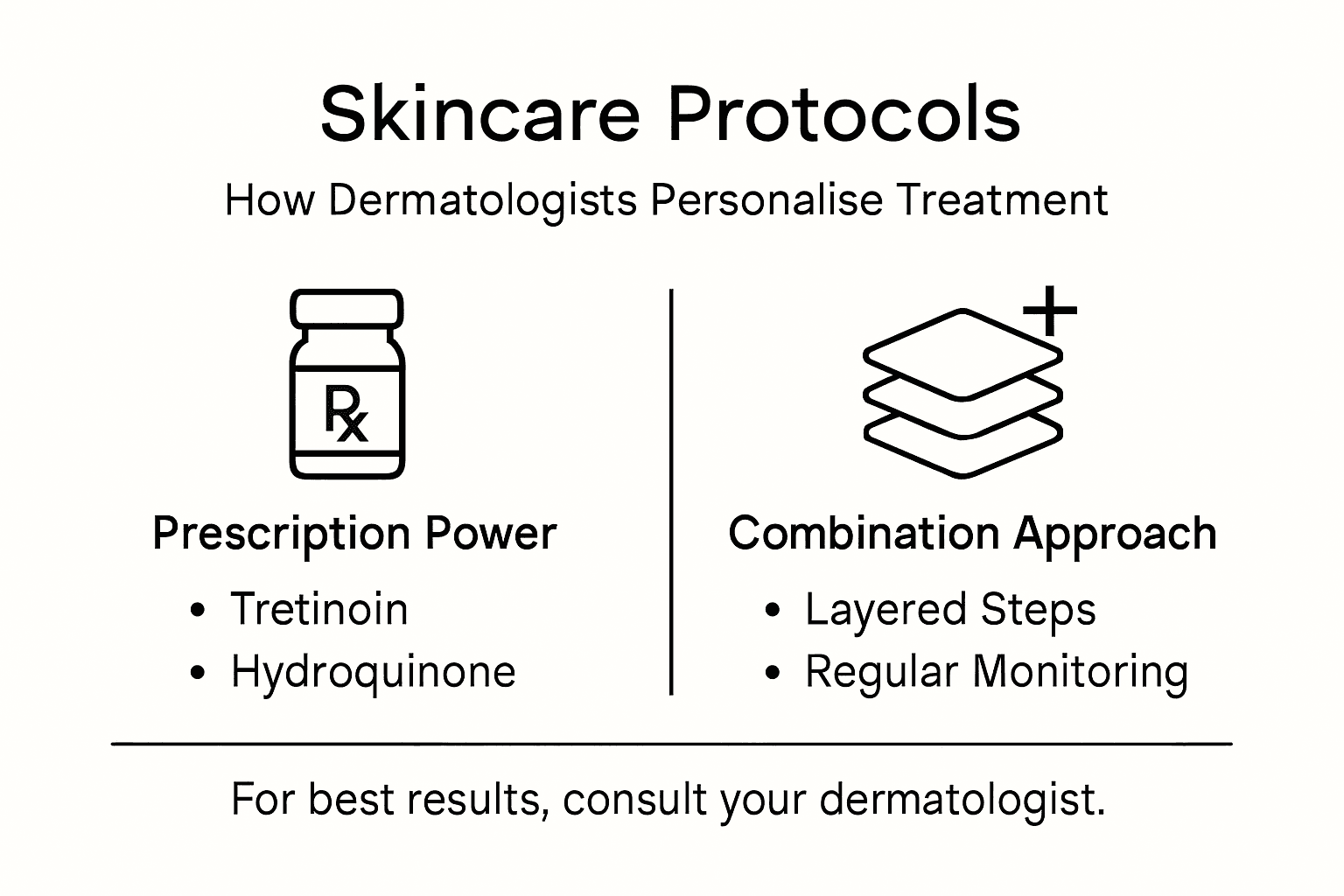
For melasma and hyperpigmentation, the approach typically combines hydroquinone with tretinoin and strict mineral sun protection (SPF 50+). This triple therapy addresses melanin production, cellular turnover, and UV damage prevention simultaneously.
For ageing skin, tretinoin forms the foundation, often paired with prescription-strength vitamin C serums, peptide complexes, and medical-grade moisturisers. Prescription and topical skincare combining retinoids with mineral sunscreens creates a comprehensive anti-ageing strategy addressing both prevention and correction.
Prescription treatments work fastest when paired with strict sun protection—UV exposure directly undermines pigmentation treatments and accelerates ageing, making SPF non-negotiable.
Treatment Timeline and Expectations
Prescription treatments require patience paired with consistency. Most clients notice initial improvements within 4 weeks, but dramatic results emerge between 8-12 weeks of regular use.
Hydroquinone typically shows visible lightening by week 6-8. Tretinoin requires 12-16 weeks to fully demonstrate anti-ageing benefits, though skin quality improves noticeably earlier. Your dermatologist will establish realistic timelines specific to your concerns and skin type.
Here’s how prescription skincare ingredients target pigmentation and ageing concerns:
| Ingredient | Primary Action | Typical Prescription Strength | Expected Results Timeline |
|---|---|---|---|
| Tretinoin | Boosts collagen, turnover | 0.025–0.1% | 8–16 weeks |
| Hydroquinone | Reduces melanin production | 4% | 4–8 weeks |
| Vitamin C | Antioxidant, brightens skin | 15–20% | 6–12 weeks |
| Mineral Sunscreen | Prevents UV pigmentation | SPF 50+ | Immediate |
Consistency matters more than anything else. Missing applications slows progress significantly. This is why dermatologists emphasise tolerability when selecting your initial prescription strength—treatments you’ll actually use daily outperform stronger formulations abandoned due to irritation.
Pro tip: Start prescription treatments during autumn or winter when UV intensity is lower, allowing your skin to adjust safely whilst maximising the benefits of sun protection without daily heat and perspiration.
How Dermatologist-Recommended Regimens Work
A dermatologist-recommended regimen is far more sophisticated than simply applying products in sequence. It’s a carefully orchestrated system where each product serves a specific function, timing matters, and synergistic interactions between actives amplify results far beyond what individual ingredients could achieve alone.
Understanding how these regimens function helps you appreciate why consistency and compliance matter so profoundly for your skin transformation.
To clarify the difference between standard and dermatologist-prescribed skincare protocols:
| Protocol Type | Product Selection | Monitoring & Adjustment | Expected Longevity |
|---|---|---|---|
| Generic Over-the-Counter | Self-chosen, limited actives | No supervision, rigid routines | Moderate, inconsistent |
| Dermatologist-Personalised | Tailored actives and strengths | Regular follow-up, bespoke tweaks | High, sustained improvement |
The Synergistic Approach
Dermatologists don’t prescribe isolated ingredients. Instead, they layer skincare ingredients that work together synergistically to address multiple skin concerns simultaneously.
Consider a typical pigmentation protocol. Hydroquinone blocks melanin production. Tretinoin accelerates cellular turnover, promoting faster skin renewal and allowing hydroquinone to work more effectively. Vitamin C provides antioxidant protection whilst brightening. A mineral sunscreen prevents UV-induced pigmentation recurrence. Each ingredient amplifies the others’ effects.
This layering strategy means your dermatologist prescribes products in a specific sequence for a reason. Morning application differs from evening. Some actives require buffers before application. Others need time to absorb before additional products layer on top.
How Each Product Layer Functions
Your dermatologist-recommended regimen typically includes these functional categories:
- Cleansing phase: Removes impurities without disrupting your skin barrier
- Preparation phase: Hydrates and preps skin for active ingredient absorption
- Active treatment layer: Prescription or clinical-strength actives addressing your primary concerns
- Support phase: Complementary ingredients enhancing active efficacy
- Protection phase: Barrier repair and UV defence
- Overnight phase: Intensive treatment and collagen-supporting actives
Personalisation Through Data
Modern dermatologists increasingly employ advanced assessment methods to optimise regimen selection. Personalised skincare regimens use data analysis to match ingredients to individual skin profiles, ensuring your specific actives, concentrations, and product combinations work optimally for your unique skin biology.
This means your regimen differs from someone else’s because your skin’s characteristics are genuinely different. Your dermatologist analyses your skin barrier function, pH balance, melanin patterns, collagen density, and sensitivity threshold. The regimen they prescribe reflects this detailed assessment.
Dermatologist-recommended regimens work because they’re built on your individual skin biology, not generic skin type categories that miss crucial nuances affecting treatment success.
Implementation and Progression
Your dermatologist establishes a specific implementation timeline. Initial protocols often start conservatively—lower concentrations applied fewer times weekly—then progress as your skin acclimates. This prevents irritation whilst allowing your skin barrier to strengthen.
Progression typically follows this pattern: introduce actives slowly, monitor tolerance for 2-4 weeks, then increase frequency or concentration based on skin response and your comfort level.
Consistency drives results more than anything else. Missing applications breaks the treatment momentum. Your dermatologist designs regimens expecting daily use, so adherence directly correlates with visible outcomes.
Pro tip: Request a written regimen schedule from your dermatologist specifying exact application sequences, timing, and progression milestones—having this documented reference prevents confusion and ensures you’re maximising your prescription investment.
Safety, Monitoring, and Long-Term Skin Health
Prescription skincare delivers transformative results, but only when safety remains paramount. Your dermatologist’s role extends far beyond prescribing potent actives—they’re responsible for protecting your skin’s long-term health whilst achieving visible improvements. This requires ongoing monitoring, careful assessment, and adaptive protocols.
Understanding how dermatologists prioritise safety helps you appreciate why regular follow-ups aren’t optional extras but essential components of your skincare journey.
Safety Assessment Before Treatment Begins
Before prescribing any regimen, your dermatologist conducts comprehensive safety evaluation. They assess your complete medical history, current medications, allergies, and previous skin reactions. This isn’t bureaucratic—prescription actives can interact with oral medications or trigger adverse responses in susceptible individuals.
Your dermatologist evaluates skin barrier integrity, sensitivity levels, and tolerance thresholds. Someone with severely compromised barriers requires different prescription strengths than resilient skin. This individualised assessment prevents irritation, sensitisation, and compromised skin health.
Board-certified dermatologists evaluate patient history and potential treatment risks to minimise adverse effects before recommending any prescription protocol.
Ongoing Monitoring and Adjustment
Your dermatologist establishes a monitoring schedule aligned with your treatment complexity. Initial follow-ups occur every 4-6 weeks, allowing assessment of tolerance, efficacy, and any emerging concerns.
During these consultations, your dermatologist evaluates:
- Active ingredient tolerance and skin response patterns
- Visible progress towards your stated skin goals
- Signs of irritation, sensitisation, or barrier compromise
- Need for protocol adjustments or progression
- Emerging side effects requiring intervention
- Overall skin health trajectory
This isn’t cosmetic vanity monitoring—it’s clinical oversight ensuring treatments strengthen rather than compromise your skin.
Long-Term Safety Through Data Tracking
Modern dermatology increasingly relies on systematic patient monitoring. Continuous patient monitoring optimises safety and efficacy of dermatologic treatments00535-2/fulltext), enabling dermatologists to track outcomes longitudinally and make informed adjustments supporting sustained skin health.
Your dermatologist maintains detailed records of your skin response, treatment progression, and outcomes. Over time, this data reveals patterns specific to your skin biology. Perhaps you tolerate tretinoin extremely well but respond poorly to certain preservatives. Maybe your melasma responds dramatically to hydroquinone but requires extended treatment. These individual patterns inform long-term strategy.
Safe prescription skincare requires dermatologist oversight throughout your treatment journey—monitoring isn’t an inconvenience but the mechanism ensuring your skin thrives long-term.
Managing Side Effects and Complications
Prescription actives occasionally trigger temporary side effects. Tretinoin causes initial dryness and peeling. Hydroquinone might trigger mild irritation during adaptation phases. Your dermatologist distinguishes normal adjustment responses from genuine adverse reactions requiring protocol modification.
When complications emerge, your dermatologist adjusts rapidly. They might reduce concentration, decrease application frequency, introduce buffering steps, or recommend complementary products supporting barrier repair. These adjustments prevent minor issues from escalating into significant skin damage.
Supporting Long-Term Skin Health Beyond Actives
Your dermatologist’s monitoring extends beyond prescription ingredients. They assess whether your skin barrier remains healthy, whether sun protection remains consistent, and whether complementary skincare supports rather than undermines your prescription protocol.
For long-term success, dermatologists often recommend periodic post-procedure skincare strategies and barrier repair protocols that maintain skin integrity during intensive treatment phases.
Pro tip: Schedule your dermatology follow-ups in advance and maintain them rigorously—consistent monitoring appointments allow early detection of tolerance issues before they escalate, ensuring your prescription regimen remains both effective and safe throughout your treatment journey.
Unlock the Power of Personalised Prescription Skincare Today
Struggling with persistent pigmentation or premature ageing despite countless over-the-counter products is a common frustration. As the article emphasises, true transformation in your skin requires tailored prescription-strength treatments carefully crafted and monitored by dermatologists. Hydroquinone, tretinoin, and advanced protocols form the cornerstone of effective skincare that directly addresses your unique skin biology instead of generic routines.
At The M-ethod Skin, we take this personalised approach to the next level by offering exclusive access to dermatologist-recommended prescription skincare products, expert virtual consultations, and bespoke treatment plans designed for your distinct needs. Whether you seek professional guidance on managing melasma, tackling signs of ageing, or building a regimen with clinically validated ingredients, our curated selection and experienced clinicians ensure safe, sustainable and visible results.
Experience the confidence of a skincare regimen that truly understands your skin. Visit The M-ethod Skin now to explore our premium prescription brands and book your personalised consultation. Start your journey with expert oversight and immediately benefit from treatments prescribed precisely for you. Don’t wait to reveal healthier, radiant skin that reflects your individuality.
Frequently Asked Questions
What is the importance of personalised skincare based on dermatologist recommendations?
Personalised skincare, crafted by dermatologists, targets individual skin concerns, ensuring effective treatment and avoiding one-size-fits-all solutions. This customisation leads to better outcomes by directly addressing unique skin biology.
How do prescription skincare products differ from over-the-counter options?
Prescription skincare products contain higher concentrations of active ingredients and are tailored to meet specific skin needs, whereas over-the-counter products often limit ingredient potency and formulation, which may not address persistent issues effectively.
What types of skin concerns can dermatologists treat with prescription products?
Dermatologists can effectively treat a range of skin concerns, including hyperpigmentation, melasma, signs of ageing, and other conditions requiring stronger actives unavailable in over-the-counter products.
How long does it typically take to see results from prescription skincare?
Results from prescription skincare typically begin to show within 4 to 12 weeks, depending on the specific treatment and skin concern. Hydroquinone usually provides visible improvement by 4-8 weeks, while tretinoin may take 12-16 weeks for full benefits.