




Types of professional peels: which is right for your skin
Professional chemical peels fall into three depth-based categories that clinicians use to match treatment to concern. Superficial (light) peels use agents such as glycolic acid, salicylic acid, and Jessner solution to refresh the epidermis with minimal downtime — ideal for mild acne, uneven tone, and general maintenance. Medium peels, most commonly performed with trichloroacetic acid (TCA), reach the papillary to upper reticular dermis and address moderate pigmentation, fine lines, and superficial scarring with roughly a week of recovery. Deep peels, typically the phenol-based Baker-Gordon formula, penetrate to the mid-reticular dermis for significant photoageing and deep rhytides, but require weeks of healing and physician-only administration.
- Superficial agents: glycolic acid (20–50%), salicylic acid (10–30%), lactic acid, Jessner solution
- Medium agents: TCA (20–50%), Jessner + TCA combinations, glycolic 70% + TCA
- Deep agents: phenol (Baker-Gordon formula with croton oil)
- Downtime varies typically from hours to a few days for superficial peels, around one week for medium peels, and multiple weeks for deep peels
- Fitzpatrick consideration: superficial peels are generally suitable across all phototypes; medium and deep peels carry a higher risk of dyschromia for Fitzpatrick III–VI and require careful priming
Key takeaways
Professional chemical peels are most effective when depth and agent are matched precisely to the skin concern and phototype — serial superficial or medium peels often deliver safer, more durable results than a single deep procedure.
| Point | Details |
|---|---|
| Match depth to concern | Superficial peels suit acne and mild pigmentation; medium peels address photoageing and scarring; deep peels target severe rhytides. |
| Fitzpatrick type matters | Medium and deep peels carry higher dyschromia risk for Fitzpatrick III–VI; priming is mandatory, not optional. |
| Downtime is real | Expect hours to days (superficial), approximately one week (medium), or two to three or more weeks (deep) before skin is settled. |
| Sun protection preserves results | Broad-spectrum SPF 30–50 daily is non-negotiable after any peel to protect new skin and prevent PIH. |
| Them-ethod offers expert guidance | Virtual consultations and in-clinic treatments in London and Athens help you choose and manage the right peel safely. |
Table of Contents
- What is a chemical peel and how does it work?
- How are professional peels classified by depth?
- Which peeling agents do clinicians actually use?
- Which skin concerns does each peel type treat best?
- Who should perform each peel type?
- What happens during a professional peel session?
- Downtime and aftercare by peel depth
- What are the possible complications?
- How much do professional peels cost in the United States?
- How clinicians match peel depth and agent to each patient
- The case for starting conservatively
- Personalised peel consultations and medical-grade support at Them-ethod
- Sources
What is a chemical peel and how does it work?
A chemical peel is a controlled chemical exfoliation that deliberately injures the skin to a precise depth, triggering epidermal and dermal regeneration. The result is new collagen synthesis, improved texture, and more even pigmentation. The depth of that controlled injury determines everything: which conditions it can address, how long recovery takes, and who should be performing it.
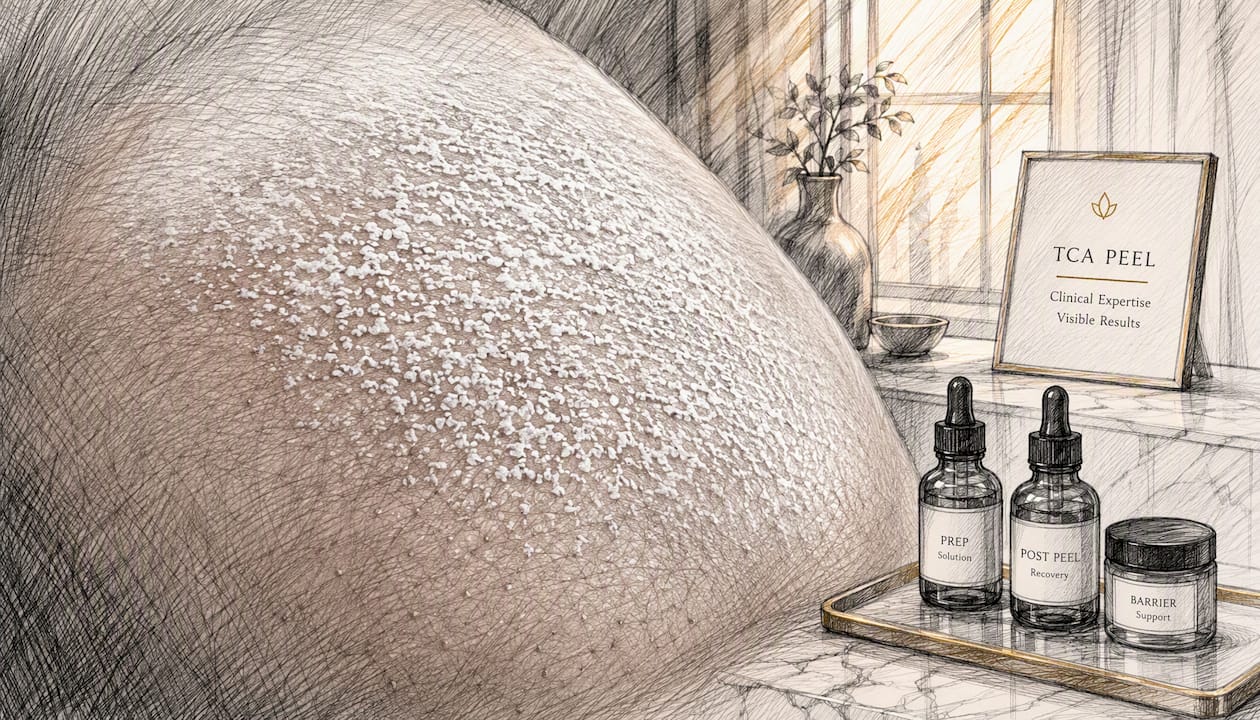
Peeling agents fall into two broad functional groups. Keratolytics — alpha-hydroxy acids (AHAs) such as glycolic and lactic acid, and beta-hydroxy acids (BHAs) such as salicylic acid — work by loosening the bonds between corneocytes, promoting gentle, progressive exfoliation. Protein denaturants — TCA and phenol — work more aggressively by denaturing epidermal and dermal proteins, producing a visible white “frost” on the skin that signals depth of penetration. According to StatPearls via the NIH, an agent’s pKa, pH, and concentration all influence its potency, which is why two products containing the same active ingredient at different pH levels can produce very different clinical outcomes.
In functional terms:
- Superficial peels remove the stratum corneum to the lower epidermis, producing mild desquamation and a refreshed appearance
- Medium peels reach the papillary to upper reticular dermis, stimulating meaningful collagen remodelling
- Deep peels penetrate to the mid-reticular dermis, producing dramatic but high-risk structural change
How are professional peels classified by depth?
Depth classification is determined by the agent, its concentration, pH, application technique, and individual skin factors — not by the agent name alone. This is precisely why professional administration matters.
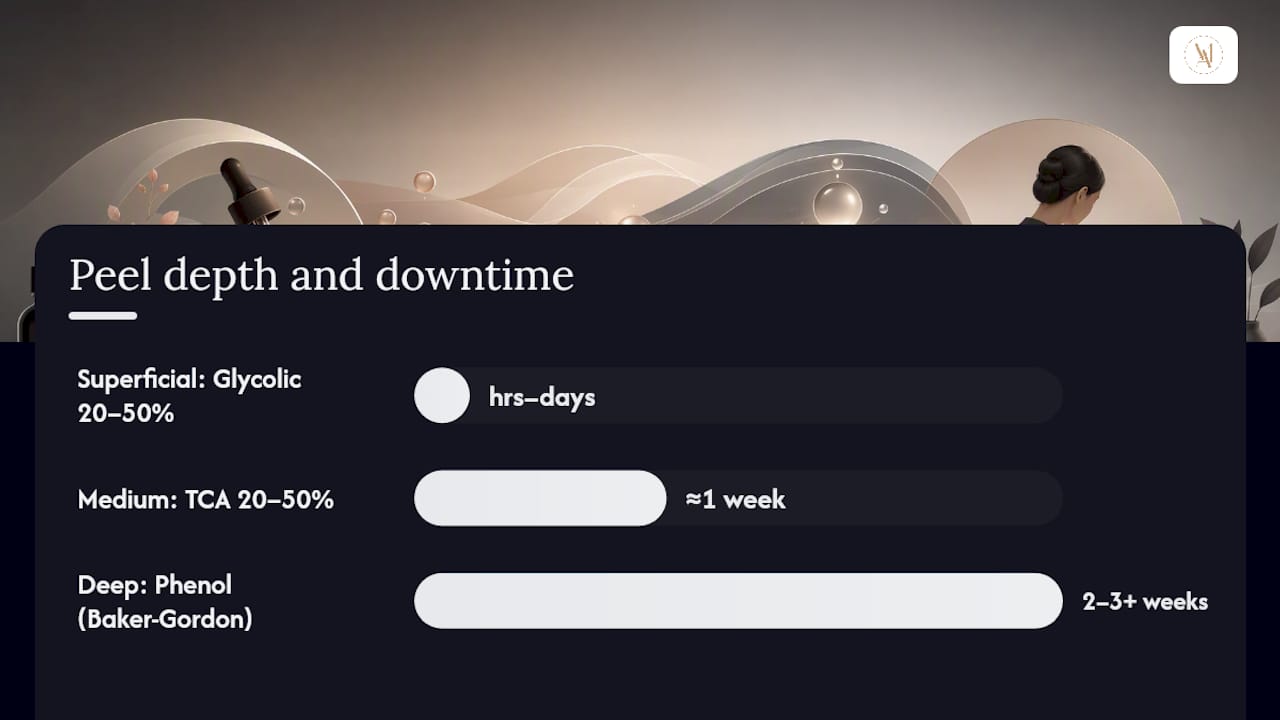
| Depth | Tissue layer reached | Typical agents | Downtime | Who performs |
|---|---|---|---|---|
| Superficial / light | Stratum corneum to lower epidermis | Glycolic 20–50%, salicylic 10–30%, lactic acid, Jessner solution | Hours to a few days | Aesthetician, nurse, physician |
| Medium | Papillary to upper reticular dermis | TCA 20–50%, Jessner + TCA, glycolic 70% + TCA | Approximately one week | Nurse, physician |
| Deep | Mid-reticular dermis | Phenol (Baker-Gordon formula) | Two to three or more weeks | Physician only |
Recovery times vary significantly by depth: superficial peels may need only hours to a few days; medium peels commonly need about a week or more with redness and crusting; deep peels require significantly longer recovery and are typically single, intensive procedures. For medium peels specifically, desquamation typically occurs over approximately five days, with most people returning to work around one week post-treatment.
Key clinical point: A light or medium peel may need repeating to achieve the desired result, while a deep peel is usually a one-off procedure. Serial superficial treatments often deliver safer, cumulative improvements than a single aggressive session.
Which peeling agents do clinicians actually use?
Understanding the individual agents helps you ask the right questions at your consultation. Here is how each one behaves in a clinical setting:
- Glycolic acid (20–50%): The most widely used AHA. Water-soluble, small molecular weight, and fast-penetrating. Lower concentrations (20–35%) suit maintenance and mild pigmentation; higher concentrations (50%+) approach medium depth. Requires neutralisation with water or sodium bicarbonate to stop the reaction.
- Salicylic acid (10–30%): A BHA with anti-inflammatory and comedolytic properties, making it the preferred choice for acne-prone and oily skin. Self-neutralising, which gives it a slightly more forgiving safety profile. Commonly used at 20–30% in clinic.
- Lactic acid: A gentler AHA with larger molecular weight, slower penetration, and additional humectant properties. Well-suited to sensitive or dry skin types and to those new to peels.
- Mandelic acid: Derived from bitter almonds, with an even larger molecular weight than lactic acid. Penetrates slowly and evenly, making it a good option for reactive or darker skin types where a more controlled result is needed.
- Jessner solution: A classic combination of resorcinol (14%), salicylic acid (14%), and lactic acid (14%) in ethanol. Produces reliable, controlled superficial to light-medium exfoliation. Many aesthetic professionals favour it for its predictable results and generally manageable downtime.
- Trichloroacetic acid (TCA, 20–50%): The workhorse of medium-depth peeling. TCA is widely used for medium-depth peels, and its effect varies with concentration and number of coats; combinations such as TCA + Jessner solution or TCA + glycolic 70% are standard clinical approaches. At concentrations above 50%, TCA approaches deep-peel territory and is rarely used at that strength.
- Phenol (Baker-Gordon formula): The deepest option, combining phenol with croton oil, water, and soap. Produces mid-reticular dermal injury and dramatic improvement in deep rhytides and severe photoageing. Carries the highest risk profile of any peel agent and requires physician-only administration.
- Combination peels: Layering agents (for example, Jessner solution followed by TCA 35%) allows clinicians to achieve medium depth with greater control than TCA alone. PCA SKIN is one professional brand line commonly used in clinical settings for light to medium combination protocols.
Pro Tip: Application technique matters as much as concentration. The number of coats applied, contact time, and whether the skin is occluded all influence how deeply an agent penetrates. This is why the same product in untrained hands can produce a very different outcome than in a skilled clinician’s.
Which skin concerns does each peel type treat best?
Chemical peels can address acne vulgaris, photoageing, melasma, actinic keratoses, and superficial scarring, but the right match depends on the depth of the concern and the skin type being treated.
- Active acne and congestion: Salicylic acid peels (superficial) are the first-line choice. Their lipophilic nature allows penetration into the follicle, clearing sebum and reducing inflammation.
- Post-inflammatory hyperpigmentation (PIH): Serial glycolic or salicylic peels at superficial depth, or low-concentration TCA series with thorough priming, work well. Avoid aggressive depths on Fitzpatrick III–VI without priming.
- Melasma: Superficial to light-medium peels combined with a pre-treatment priming regimen (hydroquinone, retinoids, sun protection) are safer and more sustainable than a single deep treatment.
- Fine lines and mild photoageing: Medium-depth TCA or Jessner + TCA combinations produce meaningful collagen stimulation and textural improvement.
- Deep wrinkles and severe photoageing: Phenol-based deep peels deliver the most dramatic improvement but carry the highest risk and longest recovery. Reserved for appropriate candidates under physician care.
- Actinic keratoses: TCA at medium depth is clinically effective for treating these precancerous lesions. This is one of the few indications where insurance coverage may apply — worth confirming with your provider.
- Superficial scarring: Medium peels (TCA 35%) can produce notable improvement in texture and shallow atrophic scars. Deeper ice-pick scars generally require additional modalities.
Where serial superficial or medium peels are the safer route, they typically are. A staged approach to pigmentation or mild photoageing almost always outperforms a single aggressive treatment in terms of both safety and long-term outcome, particularly for those with Fitzpatrick III–VI phototypes.
Who should perform each peel type?
The level of training required scales directly with peel depth and the systemic risks involved.
- Superficial peels (glycolic, salicylic, lactic, Jessner at standard concentrations) can be performed by licensed aestheticians and nurses in most US states, within their scope of practice.
- Medium peels (TCA at higher concentrations, Jessner + TCA combinations) typically require a nurse practitioner, physician assistant, or physician, depending on state regulations.
- Deep peels (phenol/Baker-Gordon) are physician-only procedures. Phenol carries a risk of systemic absorption affecting cardiac rhythm, requiring cardiac monitoring during the procedure.
Licence requirements vary by state across the United States, so it is worth verifying your provider’s credentials before booking. Questions worth asking:
- What is your training and certification in chemical peels specifically?
- Do you perform a full skin assessment and patch test before treatment?
- What emergency protocols do you have in place for adverse reactions?
- Who is medically responsible if a complication arises?
- Do you have experience treating my skin phototype?
For anyone with Fitzpatrick III–VI skin, a clinician with documented experience in treating darker phototypes is not optional — it is a safety requirement.
What happens during a professional peel session?
Preparation begins weeks before the appointment. For medium and deep peels especially, a pre-treatment priming regimen — typically including topical retinoids, a brightening agent such as hydroquinone, and strict sun avoidance — promotes uniform penetration and reduces the risk of post-inflammatory hyperpigmentation. Antiviral prophylaxis (for example, aciclovir) is prescribed when there is any history of oral herpes simplex, since peeling can trigger reactivation. You can read more about building a professional skincare regimen that supports pre- and post-peel skin health.
A typical session follows this sequence:
- Cleansing and degreasing: The skin is thoroughly cleansed and degreased with acetone or alcohol to remove oils that would otherwise block uniform penetration.
- Protective measures: Eyes and lips are protected. Sensitive areas may be masked off.
- Application: The agent is applied with a brush, gauze, or cotton applicator in controlled, even strokes. Timing begins immediately.
- Monitoring: The clinician watches for frosting (a white precipitate indicating protein denaturation) and assesses depth in real time.
- Neutralisation (if required): AHAs require neutralisation with water or sodium bicarbonate. TCA and phenol are self-neutralising.
- Immediate post-care: A soothing, occlusive product is applied. Aftercare instructions are given before you leave.
What to bring: loose, comfortable clothing; no make-up; a hat for sun protection on the way home; and a driver if you are having a medium or deep peel.
Expect stinging and warmth during application — this is normal. Frosting during a TCA peel is a clinical endpoint, not a cause for alarm, but it should be assessed by the clinician, not guessed at.
Downtime and aftercare by peel depth
Recovery is not just about aesthetics — it directly affects your results. Picking, sun exposure, or using the wrong products during healing can undo the treatment entirely.
By depth:
- Superficial: Mild redness and flaking for a few hours to a few days. Most people return to normal activities the same day or the next.
- Medium: Redness, swelling, and crusting for approximately five days, with most people comfortable returning to work around one week post-treatment.
- Deep: Significant swelling, oozing, and crusting for two to three weeks or more, with prolonged erythema that can persist for months.
Essential aftercare steps:
- Cleanse gently with a fragrance-free, non-foaming cleanser twice daily
- Apply a bland, occlusive moisturiser consistently to support barrier repair
- Use a broad-spectrum SPF 30–50 every morning without exception — and reapply if outdoors
- Avoid picking, rubbing, or peeling skin manually; let it shed naturally
- Take prescribed antivirals if indicated for your history
- Attend all follow-up appointments
Do not use during the healing window:
- Retinoids or retinol
- AHA or BHA exfoliants
- Physical scrubs or abrasive devices
- Benzoyl peroxide at full strength
- Vitamin C serums (until the clinician clears you)
Detailed, step-by-step guidance on chemical peel aftercare is available for those who want a practical reference to follow at home.
What are the possible complications?
Every peel carries risk. The key is understanding which risks apply to which depth and skin type, and knowing the red flags that warrant contacting your clinician promptly.
Common complications:
- Post-inflammatory hyperpigmentation (PIH): The most frequent complication, especially for Fitzpatrick III–VI. Priming and strict sun avoidance significantly reduce the risk.
- Prolonged erythema: Redness lasting beyond the expected window, more common with medium and deep peels.
- Infection: Bacterial or viral (herpes simplex reactivation). Antiviral prophylaxis before deep peels is standard practice.
- Hypopigmentation: Permanent lightening of treated skin, a particular concern with phenol peels.
- Scarring: Rare with superficial peels; more possible with medium and deep peels if aftercare is not followed or if the wrong depth is chosen for the skin type.
Serious risks with phenol:
Phenol can produce mid-reticular dermal injury and carries a risk of systemic absorption that may affect cardiac rhythm. This is why phenol peels must be performed by a physician with cardiac monitoring in place — not in a spa or aesthetician setting, regardless of the provider’s experience level.
Contact your clinician immediately if you notice signs of infection (increasing redness, warmth, pus, fever), unexpected blistering, or skin that is not healing within the expected window.
How much do professional peels cost in the United States?
Cost varies considerably depending on peel depth, the provider’s credentials, and the clinic’s location.
- Superficial peels: Broadly in the range of $100–$300 per session in most US markets
- Medium peels: Typically $300–$800 per session, reflecting the higher level of clinical oversight required
- Deep peels: Often $1,000–$3,000 or more, given the physician-only administration, monitoring requirements, and extended aftercare
Sessions and maintenance:
- Superficial peels are typically performed in a series of four to six sessions, spaced two to four weeks apart, with maintenance treatments every one to three months thereafter
- Medium peels may be repeated after several months, depending on the indication and response
- Deep peels are generally a single procedure, with results that can last years when combined with diligent sun protection and a medical-grade maintenance regimen
Insurance rarely covers cosmetic peels. The exception is treatment of actinic keratoses, where medical necessity may apply — confirm directly with your insurance provider and treating physician. A light or medium peel may need repeating to achieve the desired result, while a deep peel is usually a one-off procedure, which is worth factoring into the total cost calculation.
How clinicians match peel depth and agent to each patient
Selecting the right peel is a clinical decision, not a product choice. A structured approach looks like this:
- Identify the primary concern: Is it acne, PIH, melasma, photoageing, fine lines, or scarring? The concern determines the minimum effective depth.
- Assess skin phototype (Fitzpatrick I–VI): Higher phototypes (III–VI) require more conservative depths and mandatory priming to reduce PIH risk.
- Review active conditions and contraindications: Active rosacea, open wounds, recent isotretinoin use (within six months), pregnancy, and known keloid tendency are all reasons to pause or modify the plan.
- Confirm previous treatments: Prior peels, laser treatments, or topical retinoid use affect skin sensitivity and penetration rates.
- Select depth and agent: Match the above to the appropriate peel class, then choose the specific agent based on the skin’s tolerance and the clinician’s experience.
- Plan priming and aftercare: For medium and deep peels, a multi-week priming regimen is not optional — it is part of the treatment.
Example profiles:
- Fitzpatrick IV with active acne and PIH: Serial salicylic acid (20–30%) or glycolic acid peels at superficial depth, combined with a priming regimen of hydroquinone and retinoids. Low-concentration TCA series only after the PIH is stabilised.
- Fitzpatrick II with moderate photoageing and fine lines: Jessner + TCA 35% combination, with full pre-treatment priming and physician oversight.
- Fitzpatrick I–II with deep rhytides unresponsive to medium peels: Phenol (Baker-Gordon) under physician care with cardiac monitoring.
The Jessner pre-treatment disrupts the stratum corneum, enabling the TCA to penetrate more uniformly. This layering approach is particularly useful for patients with uneven skin texture or a prior treatment history.
The case for starting conservatively
There is a persistent assumption in aesthetic medicine that deeper equals better. It does not. The most effective peel is the one that matches the depth of the concern — not the one that produces the most dramatic frosting or the longest recovery.
We see this play out most clearly with pigmentation. A phenol peel on a patient with melasma and Fitzpatrick IV skin is not a bold treatment choice; it is a clinical misjudgement. The same patient, treated with a series of salicylic acid peels alongside a properly managed priming regimen, will often achieve more durable, safer results. Staged treatment plans with measurable goals at each stage give both clinician and patient the feedback needed to adjust. A single aggressive session gives you one data point and a much longer recovery if something goes wrong.
The clinicians we respect most are those who are willing to say “not yet” — who prime thoroughly, start conservatively, and escalate only when the skin has demonstrated it is ready. That mindset is what separates a good outcome from a complicated one.
Personalised peel consultations and medical-grade support at Them-ethod
Choosing the right peel from a list is one thing. Having a clinician assess your skin, phototype, and specific concerns before making that decision is another entirely. Them-ethod offers virtual skin consultations with expert clinicians who can guide you through the full range of chemical peel options — from superficial maintenance treatments to medium-depth protocols — and recommend the prescription-strength products needed to prime and protect your skin before and after treatment. For those in reach of our clinics in London and Athens, in-person peel treatments are available with full physician oversight for medium-depth procedures.
Whether you are managing acne, pigmentation, or early photoageing, our PCA SKIN Clearskin Acne Treatment Serum is a clinician-recommended option for maintaining clear skin between peel sessions. To explore the full range of professional peel guidance and book a consultation, visit Them-ethod.
Sources
The following sources underpin the clinical guidance in this article. For personalised advice, always consult a qualified clinician.
- Chemical Peels: Types of Peels, Conditions Treated, What to Expect
- Chemical Peels for Skin Resurfacing - StatPearls - NCBI - NIH
- Chemical peel - Mayo Clinic
- Chemical peels: A review of current practice
This article is general information, not a substitute for advice from a qualified doctor. Consult a qualified healthcare professional about your own circumstances before acting on anything here.


%20peels%20use%20agents%20such%20as%20glycolic%20acid,%20salicylic%20acid,%20a...)