





Off-label skincare prescriptions: what you need to know
TL;DR:
- Off-label skincare involves using approved medications beyond their original indications, which dermatologists widely prescribe for various skin conditions. This practice is based on scientific evidence and requires professional supervision to manage risks and improve outcomes. It enables personalized treatment and faster access to emerging therapies that licensed options may not cover.
An off-label skincare prescription is the clinical use of an approved medication beyond its licensed indications, dosage, or patient group. Regulatory bodies such as the FDA and the European Medicines Agency (EMA) approve drugs for specific conditions, but dermatologists routinely prescribe them outside those parameters when standard treatments fall short. This practice is far more common than most people realise, and it sits at the heart of personalised, results-driven dermatology. If you are researching what is off-label skincare prescription and whether it applies to your skin concerns, this guide covers the clinical rationale, safety considerations, and what to expect from treatment.
What is an off-label skincare prescription in dermatology?
Off-label skincare prescribing is defined as using FDA-approved drugs outside their initial registration parameters, including the condition treated, the age group, the dose, or the route of administration. The term “off-label” refers to regulatory status, not clinical legitimacy. A drug can have decades of published evidence supporting a particular use and still carry no formal marketing authorisation for that indication.
Dermatology is one of the specialties where off-label prescribing is most prevalent. Standard licensed treatments do not cover every skin condition, and many patients present with complex, overlapping concerns that require a more tailored approach. Conditions such as atopic dermatitis, psoriasis, acne vulgaris, and rosacea are frequently managed with off-label therapies when first-line options prove inadequate.
The clinical justification for off-label use rests on published evidence. Regulatory authorities including the FDA and EMA require drugs to be approved for marketing, but off-label use extends beyond official registration based on scientific literature, clinical experience, and emerging research. This distinction matters: off-label does not mean experimental or unproven.
How is off-label skincare prescribing applied in dermatology?
Dermatologists apply off-label prescribing across a wide range of skin concerns. The examples below illustrate how common and clinically grounded this practice is.
- Tretinoin for photoaging. Tretinoin is licensed for acne, but it is widely prescribed off-label for fine lines, skin texture, and photoaging. Consistent use over 6–12 weeks produces measurable clinical improvements in collagen production and cell turnover.
- Adapalene for melasma and post-inflammatory hyperpigmentation. Adapalene, a third-generation retinoid, is licensed primarily for acne but prescribed off-label to address pigmentation concerns, often in combination with other actives.
- JAK inhibitors for inflammatory dermatoses. Medications such as upadacitinib are prescribed off-label for inflammatory skin conditions including alopecia areata and certain forms of eczema. A review across 136 articles found good efficacy with mostly mild, transient adverse effects.
- Spironolactone for hormonal acne. This antihypertensive is prescribed off-label in women with hormonal acne, with strong real-world evidence supporting its effectiveness at reducing sebum production.
The evidence base for these uses varies. Some, like tretinoin for photoaging, are supported by decades of clinical data. Others, like JAK inhibitors for rare dermatoses, rely on smaller cohorts and case series. In both cases, the prescribing clinician weighs the available evidence against the individual patient’s needs.
Pro Tip: Ask your dermatologist specifically whether your prescription is off-label and what published evidence supports it. This is not a red flag. It is a sign of personalised, evidence-informed care.

The role of a dermatologist in selecting and monitoring off-label treatments is not optional. It is the mechanism by which the risk is managed and the outcome is optimised.
What are the benefits and risks of off-label skincare prescriptions?
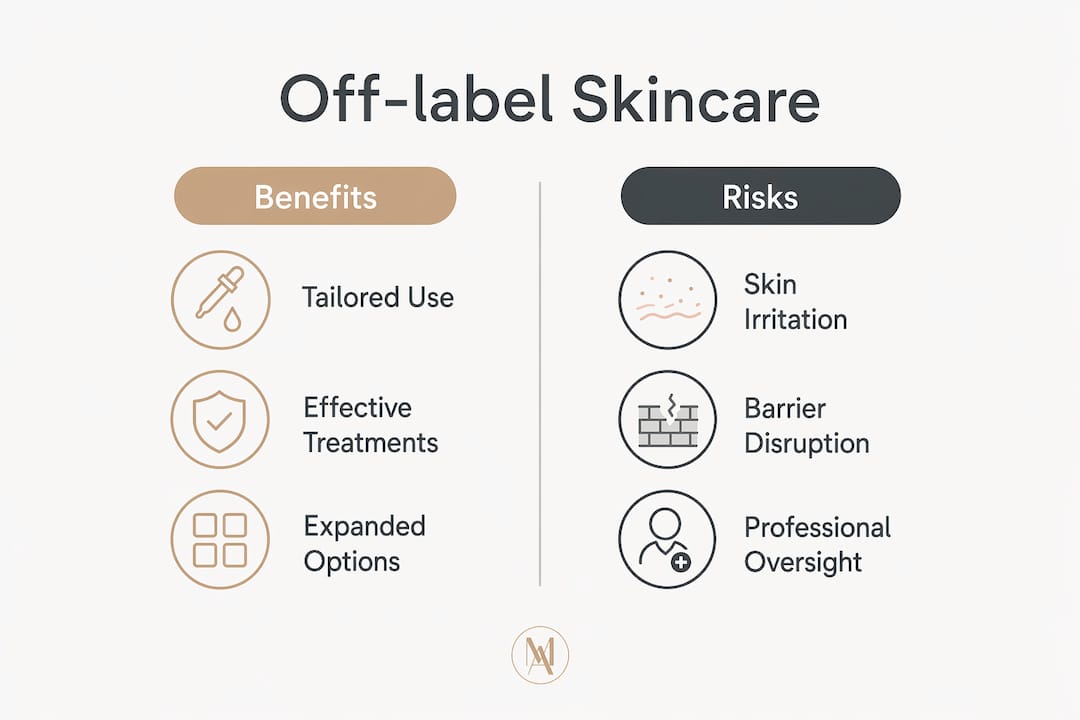
Off-label prescribing addresses unmet patient needs that standard therapies cannot meet. That is its primary benefit, and it is a significant one.
Benefits worth understanding
- Access to more effective treatments. When licensed options fail, off-label prescribing gives clinicians access to a broader pharmacological toolkit. Patients with treatment-resistant acne or complex pigmentation disorders benefit directly from this flexibility.
- Personalised care. Off-label prescribing is inherently individualised. The clinician selects the medication, dose, and formulation based on the specific patient rather than a one-size-fits-all protocol.
- Faster access to emerging therapies. Regulatory approval takes years. Off-label use allows clinicians to apply emerging evidence before formal licensing catches up, particularly for rare or complex conditions.
Risks and how they are managed
Off-label does not mean risk-free. Side effects include skin irritation and barrier disruption, particularly with potent actives like retinoids and exfoliating acids. The critical point is that these risks are manageable under professional supervision.
Dr Shendy Engelina notes that off-label use requires professional oversight precisely because of these risks. Self-treating with prescription-strength ingredients purchased without a consultation removes the safety net entirely. A clinician monitors your response, adjusts the dose, and intervenes early if irritation or adverse reactions develop.
The most common misconception is that “off-label” signals danger. The benefits of prescription skincare are well-documented, and off-label therapies form a significant part of that evidence base. The risk is not in the medication. The risk is in using it without guidance.
Pro Tip: Never layer a new prescription active with exfoliating acids, vitamin C, or multiple retinoids simultaneously. Introduce one product at a time and allow your skin barrier to adapt before adding anything else.
How does off-label prescribing differ from medical-grade and OTC skincare?
This is one of the most misunderstood areas in skincare. The three categories, prescription, medical-grade, and over-the-counter (OTC), are not interchangeable, and the differences have real clinical consequences.
| Category | Regulatory status | Ingredient strength | Requires clinician? |
|---|---|---|---|
| Prescription (including off-label) | Regulated medicine, FDA/EMA oversight | Highest; pharmaceutical grade | Yes, always |
| Medical-grade | Marketing designation, not a legal term | Higher than OTC, but variable | Not legally required |
| Over-the-counter (OTC) | Regulated cosmetic or drug product | Lower concentrations | No |
“Medical-grade” is a marketing designation, not a legal or regulatory classification. It differs legally and clinically from a prescription product, which is a regulated medicine requiring medical oversight. Many people assume that buying a product labelled “medical-grade” from a clinic or boutique is equivalent to receiving a prescription. It is not.
Prescription skincare products, including those prescribed off-label, contain higher-strength ingredients regulated by agencies such as the FDA and EMA. The concentration of tretinoin in a prescription formulation, for example, is significantly higher than any retinol product available OTC. That difference in potency is precisely why clinical supervision matters.
OTC products serve an important role in maintenance and adjunctive care. They are not designed to treat clinical skin conditions. If your concern is acne scarring, melasma, or inflammatory skin disease, an OTC product is unlikely to deliver the clinical result you need.
What should you expect when using off-label skincare prescriptions?
Setting realistic expectations is one of the most important parts of starting any prescription skincare regimen. Prescription and off-label treatments are not instant fixes.
- Allow 6–12 weeks for initial results. Consistent application over 6–12 weeks is the minimum timeframe for most prescription actives to produce measurable improvement. Collagen remodelling and pigmentation correction take time at a cellular level.
- Do not discontinue early. Premature discontinuation leads to relapse. Many patients stop using a treatment the moment they see improvement, which removes the active before the skin has fully responded. Adherence is the single biggest predictor of outcome.
- Book follow-up appointments. Your dermatologist or skincare clinician should review your progress at regular intervals. Monitoring allows dose adjustments, early identification of adverse reactions, and motivation to continue.
- Use SPF daily without exception. Prescription actives, particularly retinoids and exfoliating acids, increase photosensitivity. Daily broad-spectrum SPF 30 or higher is non-negotiable when using these treatments.
- Keep your supporting routine simple. A gentle cleanser, a barrier-supporting moisturiser, and SPF are all you need alongside a prescription active. Avoid adding multiple new products simultaneously.
Pro Tip: If you experience significant irritation in the first two weeks, do not stop the treatment entirely. Reduce frequency to every other night and allow your skin to acclimatise before returning to daily use. Always check with your clinician first.
Accessing online prescription skincare services has made it easier to maintain these follow-up touchpoints without attending a clinic in person, which improves adherence considerably.
Key takeaways
Off-label skincare prescriptions are a clinically justified, evidence-based tool that dermatologists use to treat conditions that standard licensed therapies cannot adequately address.
| Point | Details |
|---|---|
| Definition is regulatory, not clinical | Off-label means outside licensed parameters, not unproven or unsafe. |
| Evidence base varies by treatment | Some off-label uses have decades of data; others rely on smaller studies. |
| Professional supervision is non-negotiable | Clinician oversight manages risk and adjusts treatment for individual response. |
| Results require consistent long-term use | Allow 6–12 weeks minimum and avoid premature discontinuation to prevent relapse. |
| Medical-grade is not the same as prescription | “Medical-grade” is a marketing term; prescription products are regulated medicines. |
Why off-label prescriptions changed how I think about skincare
I have worked with enough patients to know that the most meaningful skin transformations rarely come from a standard protocol. They come from a clinician who is willing to look at the evidence, look at the patient, and make a considered decision that goes beyond the label.
Off-label prescribing is not a workaround. It is what good dermatology looks like in practice. The regulatory system approves drugs for the conditions studied in clinical trials. It does not, and cannot, anticipate every clinical scenario a patient will present with. Off-label use fills that gap, responsibly and with scientific backing.
What I find most encouraging is how the conversation around off-label skincare use has matured. Patients are asking better questions. They want to know what the evidence says, not just what the packaging claims. That shift matters because informed patients are more likely to adhere to treatment, report side effects early, and achieve the outcomes they came for.
My strongest advice is this: if a clinician recommends an off-label treatment, ask for the evidence. A good clinician will welcome that question. And if you are considering prescription skincare for the first time, a structured skin consultation is the right starting point, not a product purchase.
— Jess
Prescription-strength skincare at Them-ethod
Them-ethod brings together prescription-strength and clinician-recommended skincare products with expert virtual consultations, so you can access the right treatment without compromising on quality or clinical rigour. The PCA Clearskin Acne Treatment Serum is a standout option for those managing acne-prone skin, formulated with clinically active ingredients that work at the level of the follicle. For broader skin health and visible improvement in tone and texture, the NEOSTRATA collection offers science-backed formulations developed by dermatologists. Both are available through Them-ethod alongside personalised guidance from top clinicians who understand how to build a prescription-informed routine that delivers real results.
FAQ
What does off-label mean in skincare prescriptions?
Off-label means a licensed medication is prescribed for a condition, dose, or patient group not covered by its original regulatory approval. The drug is still approved and regulated; only its specific application falls outside the registered parameters.
Is off-label skincare safe?
Off-label skincare is safe when prescribed and monitored by a qualified clinician. Risks such as skin irritation and barrier disruption exist but are manageable with professional oversight and a structured treatment plan.
How long does an off-label skincare prescription take to work?
Most prescription and off-label skincare treatments require consistent use over 6–12 weeks before producing measurable results. Stopping early is the most common reason treatments appear not to work.
What is the difference between off-label and medical-grade skincare?
Off-label skincare involves regulated prescription medicines used beyond their licensed indications. Medical-grade is a marketing term with no legal definition, and those products do not require a prescription or clinical supervision.
Do I need a dermatologist for off-label skincare treatment?
Yes. Off-label prescribing requires a qualified clinician to assess your skin, select the appropriate treatment, and monitor your response. Self-treating with prescription-strength ingredients carries significant risk of adverse reactions.