




HIFU treatment: lift, tighten and rejuvenate skin
TL;DR:
- HIFU offers a safe, non-surgical alternative for skin lifting by stimulating collagen deep within the skin.
- Results develop gradually over 4 to 12 weeks, with effects lasting 6 to 18 months depending on care.
- Choosing a qualified, experienced provider with approved devices is crucial for safety and optimal outcomes.
Surgery is not the only path to firmer, lifted skin. For years, the surgical facelift held an almost unchallenged position as the gold standard for visible skin rejuvenation, leaving many people feeling they had to choose between going under the knife or simply accepting the changes that come with age. HIFU (High-Intensity Focused Ultrasound) has changed that conversation entirely. Backed by clinical research and increasingly adopted by leading aesthetic clinics worldwide, HIFU offers a non-surgical route to meaningful lifting and tightening. In this guide, we explain how HIFU works, what results to realistically expect, how to stay safe, and how it compares to alternatives like Ultherapy.
Table of Contents
- How HIFU treatment works for skin lifting and tightening
- Expected results: What does HIFU deliver?
- Safety, risks, and how to maximise positive outcomes
- HIFU versus Ultherapy and other non-surgical skin treatments
- Our perspective: What most HIFU advice overlooks
- Next steps: Enhance your results safely
- Frequently asked questions
Key Takeaways
| Point | Details |
|---|---|
| Proven skin lifting | Clinical studies show HIFU delivers measurable tightening and lifting without surgery. |
| Safety depends on expertise | Best results come from approved devices and experienced providers. |
| Natural, lasting effects | HIFU results appear gradually, look natural, and last several months to over a year. |
| Compare carefully | Ultherapy offers more approved precision, but HIFU can be a cost-effective alternative if chosen carefully. |
How HIFU treatment works for skin lifting and tightening
HIFU stands for High-Intensity Focused Ultrasound, a technology that delivers precise sound energy deep into the skin’s structural layers without breaking the surface. Unlike lasers, which work primarily on the upper layers of skin, HIFU targets the SMAS layer (superficial musculoaponeurotic system), the same tissue addressed during a surgical facelift. The result is controlled thermal injury at specific depths, which triggers the body’s natural collagen production and tissue remodelling response.
The procedure itself is straightforward. A trained practitioner applies a handheld device to the treatment area, delivering focused ultrasound energy at pre-set depths, typically 1.5mm, 3mm, and 4.5mm beneath the skin surface. Sessions usually last between 30 and 90 minutes depending on the area treated, and there is no recovery time required.
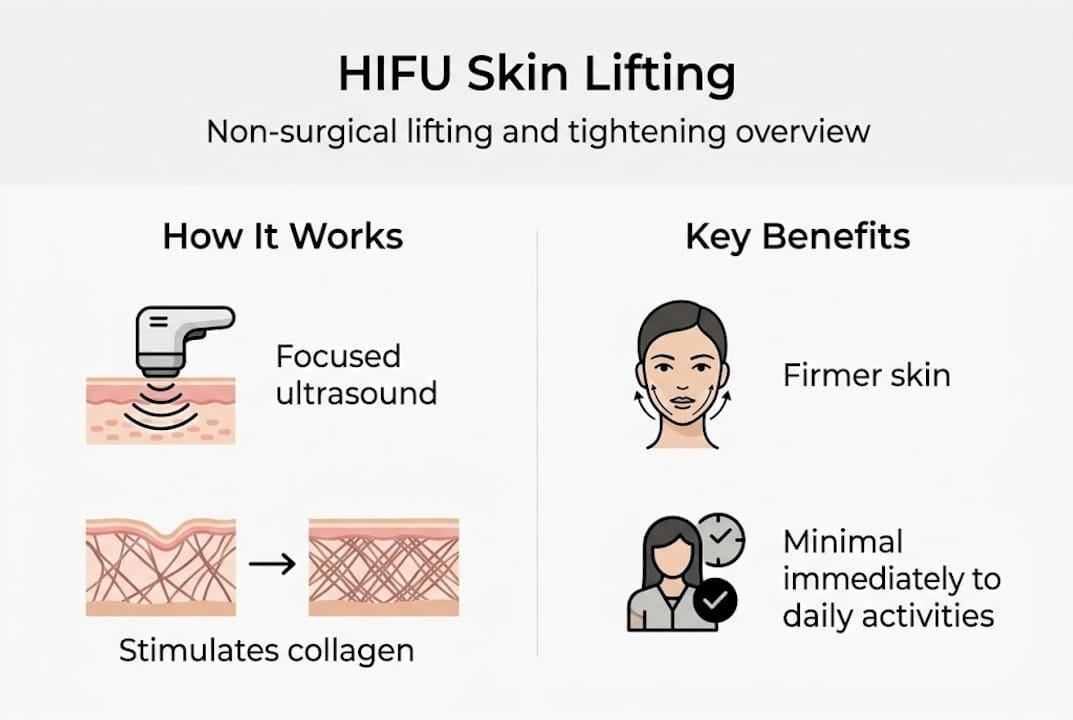
Clinical benchmarks for HIFU confirm that HIFU achieves significant lifting and tightening, with results measured in millimetres and visible wrinkle reduction. Treatment areas include the forehead, brow, jawline, neck, and décolletage, making it one of the most versatile non-surgical options available.
Typical HIFU treatment at a glance:
| Feature | Detail |
|---|---|
| Session duration | 30 to 90 minutes |
| Depth of treatment | 1.5mm, 3mm, 4.5mm |
| Downtime | None to minimal |
| Visible results | From 4 to 12 weeks |
| Treatment frequency | Once every 12 to 18 months |
The ideal candidate for HIFU is generally someone aged 30 to 55 with mild to moderate skin laxity. If you are unsure whether this treatment is right for your skin, reading about who should choose HIFU is a useful starting point.
Key benefits of HIFU for skin rejuvenation:
- Stimulates new collagen and elastin production deep within the skin
- Lifts brow, jawline, and neck without incisions or anaesthesia
- No downtime, making it compatible with an active lifestyle
- Results develop gradually for a natural, rested appearance
- Can be combined with other treatments for enhanced outcomes
Pro Tip: For best results, arrive at your appointment with clean, product-free skin and discuss your full skincare routine with your practitioner beforehand. Certain active ingredients can affect skin sensitivity on the day.
Now, let’s uncover what makes HIFU not just different, but uniquely effective compared to other approaches.
Expected results: What does HIFU deliver?
After understanding the process, it is vital to know what results to expect and whether HIFU truly delivers on its promises.
The honest answer is that HIFU produces real, measurable improvements, but they are gradual rather than dramatic. Most patients begin to notice visible tightening and lifting within 4 to 6 weeks, with the most significant changes typically appearing at the 3-month mark as collagen remodelling continues.
HIFU clinical satisfaction data shows that 70% of patients demonstrated significant tightening at 3 months, and 85% reported high satisfaction with their outcomes. These are compelling figures for a non-surgical treatment. Additionally, a bibliometric analysis of HIFU found that lower face and neck tightening averaged an 18 to 30% improvement, which is clinically meaningful for this category of treatment.
“The gradual nature of HIFU results is not a limitation — it is precisely what makes the outcome look natural. Skin that changes slowly is skin that looks like it simply aged in reverse.”
What you can realistically expect from HIFU:
- Visible lifting of the brow and midface within 6 to 12 weeks
- Improved jawline definition and reduced jowling
- Smoother, firmer neck and décolletage
- Subtle but consistent reduction in fine lines and skin laxity
- Results that typically last between 6 and 18 months
The longevity of results depends on several factors, including your age, baseline skin quality, sun exposure habits, and how well you support your skin with post-treatment care. Patients who invest in a targeted skincare routine and protect their skin from UV damage tend to maintain their results for longer. You can explore more about the benefits after HIFU to understand how to extend and support your outcomes.

It is also worth noting that HIFU is not a permanent solution. Think of it as a meaningful reset rather than a one-time fix. Most patients choose to repeat treatment once results begin to fade, which keeps the skin in a consistently improved state over time.
Safety, risks, and how to maximise positive outcomes
Knowing the results, the next step is understanding how to stay safe and how to maximise your satisfaction.
HIFU has an established safety profile when performed correctly. The majority of patients experience only mild, transient side effects that resolve within a few days. However, it is important to approach this treatment with clear eyes about both its benefits and its limitations.
Complications and risks of HIFU research confirms that common side effects are mild and temporary, but rare adverse events like fat atrophy can occur if the treatment is performed improperly. This is why provider selection matters enormously.
Common side effects (usually resolve within 2 to 7 days):
- Mild redness and flushing at the treatment site
- Temporary swelling or puffiness
- Tenderness or sensitivity to touch
- Occasional tingling or numbness
Rare but serious risks (associated with unapproved devices or inexperienced practitioners):
- Subcutaneous fat atrophy (localised fat loss)
- Nerve irritation causing temporary weakness
- Burns or blistering from incorrect energy settings
To protect yourself, always verify that the clinic uses FDA or HSA-approved equipment and that the practitioner has demonstrable experience with HIFU specifically. A thorough pre-treatment consultation is non-negotiable. It allows the practitioner to assess your skin depth, fat distribution, and suitability, all of which directly influence both safety and outcome.
Pro Tip: Ask your clinic to show you the device model and its regulatory approval status before booking. A reputable provider will share this information without hesitation. For a deeper understanding of what separates quality providers from the rest, read about the gold standard in HIFU safety.
Post-treatment, keep the skin hydrated, avoid direct sun exposure, and refrain from using strong actives such as retinoids or AHAs for at least 48 to 72 hours. These simple steps significantly reduce irritation and support the collagen-building process.
HIFU versus Ultherapy and other non-surgical skin treatments
With your safety and goals in mind, how does HIFU stack up against similar treatments?
The comparison between HIFU and Ultherapy is one of the most frequently asked questions we encounter. Both technologies use focused ultrasound energy to stimulate collagen production, but they are not identical.
Ultherapy vs generic HIFU analysis shows that Ultherapy offers visualisation-guided precision and is FDA approved, while HIFU offers a lower-cost option with variable efficacy depending on the device and operator. Ultherapy safety contrast research also notes that Ultherapy is often clinically preferred for its safety and evidence profile.
| Feature | Ultherapy | Generic HIFU |
|---|---|---|
| Regulatory approval | FDA approved | Varies by device |
| Real-time imaging | Yes | Usually no |
| Cost per session | Higher | Lower to moderate |
| Pain profile | Moderate to high | Mild to moderate |
| Outcome predictability | High | Variable |
| Downtime | Minimal | Minimal |
How to choose between HIFU and other treatments:
- Assess your budget honestly, but do not let cost be the primary driver of your decision.
- Check the specific device model and its regulatory status before committing.
- Consider combining HIFU with topical treatments such as the EYELIFT Peptides serum from Medik8 to support results around delicate areas.
- Ask your practitioner which technology they recommend for your specific skin concerns and why.
- Look at before-and-after images from that specific clinic, not generic promotional material.
Other non-surgical alternatives worth considering include radiofrequency (RF) treatments, microfocused ultrasound, and combination protocols. Each has its own depth of action, evidence base, and cost profile. The right choice depends on your skin condition, goals, and the expertise available to you.
Our perspective: What most HIFU advice overlooks
To round off, let us share a perspective built from experience that is rarely highlighted in standard HIFU guides.
Most articles about HIFU focus on the technology itself, and rightly so. But what they consistently underplay is the enormous variability in outcomes that stems not from the treatment, but from the device being used and the person operating it. Two patients receiving what is labelled the same treatment can have entirely different experiences based on these factors alone.
We also think the industry is too quick to present HIFU as a fully mature science. As a bibliometric analysis overview notes, prioritising provider experience and device approvals over cost is essential, and long-term data is still emerging, so regular follow-up is advised. There are still meaningful gaps in very long-term outcome data, particularly for patients who undergo repeated treatments over many years.
The practical implication? Realistic expectations are not just a courtesy, they are a clinical necessity. Patients who understand the gradual, natural nature of HIFU results are consistently more satisfied than those chasing dramatic, immediate change. We always encourage our clients to focus on choosing a safe provider above all else. Expertise is the variable that matters most.
Next steps: Enhance your results safely
Armed with knowledge, you are ready to take the next step towards firmer, more confident skin.
HIFU works best when supported by a targeted, clinically effective skincare routine. Post-treatment, your skin is actively remodelling, and the right products can meaningfully extend and enhance your results. We recommend exploring the PCA Clearskin serum for its calming, barrier-supportive properties in the days following treatment, and the Calecim Professional serum, which uses stem cell technology to accelerate skin renewal and support collagen production. Both are trusted by our clinicians and used within our own treatment protocols. To see what real patients have experienced, visit our treatment success stories and explore what is possible with the right care.
Frequently asked questions
How long do HIFU results last?
HIFU results typically last between 6 and 18 months, with longevity influenced by skin quality, age, and the consistency of your post-treatment skincare routine.
What are the most common side effects of HIFU?
The most common side effects are mild redness, swelling, and tenderness, with most HIFU side effects being transient and resolving within 2 to 7 days.
How do I choose a safe and effective HIFU provider?
Always select a clinic that uses FDA or HSA-approved devices and employs experienced practitioners, as provider experience directly impacts safety and the quality of your outcome.
Is HIFU or Ultherapy better for facial lifting?
Ultherapy offers advantages in precision and regulatory approval, but HIFU remains a cost-effective alternative with strong results when performed by a skilled, experienced practitioner using an approved device.
Can HIFU treatments be repeated?
Yes, HIFU can be repeated as results begin to fade, and HIFU can be repeated safely to maintain lifting and tightening effects, typically after 12 months or more.