


The role of peptides in skin repair explained
TL;DR:
- Peptides are signaling amino acid chains that promote skin repair, collagen synthesis, and inflammation control. Clinical evidence confirms their benefits, especially when combined with professional treatments like microneedling. Delivery methods, formulation stability, and consistent use are essential for maximizing their regenerative potential.
Peptides are short chains of amino acids that act as biological messengers in the skin, triggering repair processes including collagen synthesis, inflammation modulation, and tissue regeneration. The role of peptides in skin repair is now supported by a growing body of clinical evidence, with landmark studies examining compounds such as GHK-Cu (copper peptide) and Argireline demonstrating measurable improvements in wound healing, wrinkle depth, and skin density. A systematic review of 19 RCTs involving 1,341 participants confirmed that peptides significantly improve hydration, brightness, and wrinkle depth. That breadth of evidence positions peptides not as a passing trend but as a scientifically grounded pillar of modern skin repair.
How do different types of peptides repair skin?
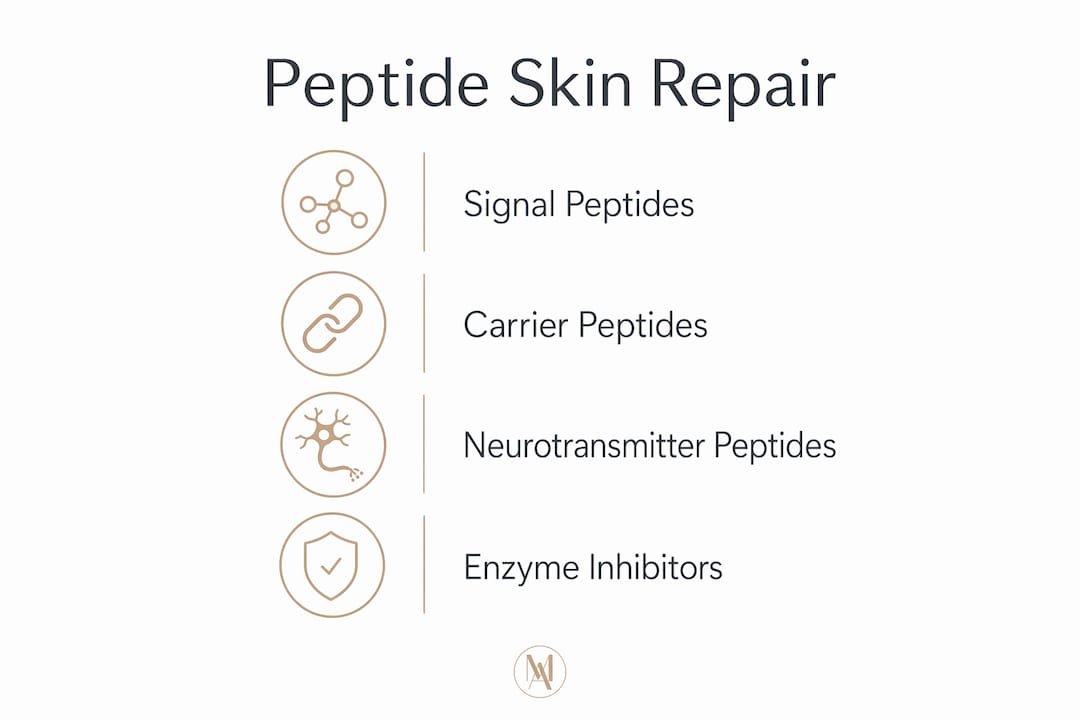
Peptides are classified into four functional categories, each targeting a distinct bottleneck in skin ageing or healing. Understanding these categories is the clearest way to appreciate why peptide formulations vary so widely in their claims and their results.
- Signal peptides stimulate fibroblasts to produce collagen, hyaluronic acid, and elastin through TGF-β and MAPK pathways. Matrixyl (palmitoyl pentapeptide-4) is the most widely studied signal peptide and remains a benchmark ingredient in anti-ageing formulations.
- Carrier peptides transport trace minerals to the skin. GHK-Cu delivers copper ions that support lysyl oxidase, the enzyme responsible for cross-linking collagen and elastin fibres. This makes GHK-Cu particularly relevant in post-procedure recovery and wound repair contexts.
- Neurotransmitter-inhibitory peptides reduce the depth of expression lines by moderating acetylcholine release at the neuromuscular junction. Argireline (acetyl hexapeptide-3) is the most recognised example in this class.
- Enzyme-inhibitory peptides protect the extracellular matrix (ECM) from degradation by inhibiting matrix metalloproteinases (MMPs), the enzymes that break down collagen under UV exposure and chronic inflammation.
GHK-Cu modulates inflammation by upregulating anti-inflammatory mediators while suppressing pro-inflammatory cytokines, which explains its dual role in both active wound repair and preventive anti-ageing care. This anti-inflammatory action is what separates GHK-Cu from purely cosmetic peptides. It does not simply mask the appearance of damage. It addresses the biological environment in which damage occurs.
Pro Tip: When reading a product label, look for the peptide class before the peptide name. A formulation combining a signal peptide with a carrier peptide addresses both collagen stimulation and mineral delivery simultaneously, which is a more complete approach than single-peptide products.
What does the clinical evidence say about peptide efficacy?
The clinical record on peptides is more nuanced than most marketing copy suggests, but it is genuinely encouraging when examined carefully.
Argireline at 10% concentration reduces wrinkle depth by 30% after 30 days of consistent application. That is a meaningful result for a topical ingredient, though it is worth noting that the mechanism (neuromuscular modulation) differs fundamentally from injectables such as botulinum toxin. Argireline works at the surface level and requires continuous use to maintain its effect.
GHK-Cu’s record in post-procedure recovery is particularly compelling. Applied after CO2 laser resurfacing, GHK-Cu accelerates healing by 33% compared to control, while also reducing erythema and improving skin density. That figure matters because it positions GHK-Cu as a clinically relevant post-procedure agent, not merely a cosmetic additive.
“Peptides act as signalling molecules mimicking natural skin processes and are best used synergistically with professional treatments rather than as standalone solutions.” — The PMFA Journal
The 2026 meta-analysis of 19 RCTs found statistically significant improvements in wrinkle depth (p=0.04), hydration, and skin brightness across both oral and topical peptide interventions. The effect sizes were modest rather than dramatic, which is an honest reflection of what topical skincare can achieve relative to procedural treatments. Oral collagen peptides showed stronger systemic effects on hydration and elasticity, while topical peptides excelled in localised repair and barrier support.
One important clarification: topical collagen peptides function primarily as humectants and do not meaningfully penetrate to stimulate new collagen production. This distinction matters when selecting products. Collagen peptides in a moisturiser hydrate the skin surface. Signal peptides such as Matrixyl and GHK-Cu work at a cellular level to trigger repair.
| Peptide | Primary mechanism | Key clinical finding |
|---|---|---|
| GHK-Cu | Carrier, anti-inflammatory | 33% faster healing post-CO2 laser |
| Argireline | Neurotransmitter-inhibitory | 30% wrinkle depth reduction in 30 days |
| Matrixyl | Signal peptide | Stimulates collagen via TGF-β pathway |
| Collagen peptides | Humectant (topical) | Hydration benefit; no active remodelling |
What limits topical peptide delivery and how can it be improved?
Peptides face a fundamental delivery challenge. Most are hydrophilic and relatively large in molecular terms, which prevents them from crossing the intact stratum corneum in therapeutically meaningful quantities. This is not a formulation failure. It is basic skin biology.
Microneedling dramatically changes this equation. Post-microneedling, 134 nanomoles of GHK-Cu penetrate the skin within nine hours, compared to essentially zero through intact skin. That difference is not incremental. It represents the shift from a cosmetic surface effect to genuine dermal delivery. This is why pairing peptide serums with professional microneedling treatments is one of the most evidence-supported strategies in modern skincare.
Formulation science also plays a significant role. Peptide-enriched hydrogels release 75 to 80% of active peptides within hours, providing rapid therapeutic action that unstable emulsions cannot match. Stability and release kinetics are therefore as important as the peptide concentration listed on the label.
To get the most from topical peptide products, consider the following:
- Choose formulations with proven stability. Hydrogel and serum formats generally outperform heavy creams for peptide delivery, as they minimise degradation before absorption.
- Apply peptides to freshly cleansed, slightly damp skin. This reduces transepidermal resistance and supports uptake of hydrophilic actives.
- Time peptide application after professional treatments. Microneedling and laser procedures create temporary channels in the stratum corneum, making the hours immediately post-treatment the most effective window for peptide absorption.
- Avoid mixing peptides with high-concentration acids in the same step. Acidic pH environments can degrade certain peptide bonds. Apply acids first, allow the skin to return to its natural pH, then apply peptides.
Pro Tip: If you are undergoing SkinPen microneedling, ask your clinician about applying a GHK-Cu serum immediately post-procedure. The evidence for enhanced peptide absorption post-microneedling is strong, and this is one of the most cost-effective ways to amplify a professional treatment.
How do peptides compare to other skin repair treatments?
Peptides are not a replacement for the established pillars of anti-ageing skincare. They are a complement to them. Retinoids remain the most evidence-backed topical ingredient for collagen remodelling and cell turnover. Broad-spectrum SPF is the single most effective intervention for preventing photoageing. Peptides sit alongside these, addressing specific repair mechanisms that retinoids and sunscreen do not directly target.
The comparison with polynucleotides is worth examining. Polynucleotides (PDRN) work by stimulating fibroblast proliferation and tissue regeneration at a deeper level, typically delivered via injection. Peptides, applied topically or used post-procedure, address surface-level signalling and barrier repair. The two are genuinely complementary rather than competitive. You can read more about polynucleotides in clinical rejuvenation to understand where each sits in a layered treatment plan.
Growth factors are another frequent comparison point. Growth factors are larger proteins that also stimulate ECM production, but their molecular size makes topical delivery even more challenging than peptides. Peptides, being smaller, have a practical delivery advantage in topical formats, even if that advantage is still limited by the intact skin barrier.
The most effective approach is to layer peptides with retinoids and antioxidants rather than choosing between them. A morning routine built around antioxidants and SPF, combined with an evening routine featuring a retinoid and a peptide serum, addresses collagen protection, stimulation, and repair across different biological pathways simultaneously.
Practical guidance for using peptides in your skincare routine
Incorporating peptides effectively requires consistency and realistic expectations. Observable improvements in skin texture, firmness, and hydration typically require eight to twelve weeks of daily use. This timeline reflects the natural turnover cycle of the extracellular matrix, not a product limitation.
- Start with GHK-Cu or Matrixyl. These are the most clinically studied peptides for skin repair and offer the strongest evidence base for new users. Medik8’s Liquid Peptides is a well-formulated option that combines multiple peptide classes in a stable serum format.
- Use peptides twice daily. Morning and evening application maintains consistent signalling to fibroblasts. Once-daily use is better than nothing, but twice daily produces more reliable results within the eight to twelve week window.
- Do not expect peptides to replace procedural treatments. For significant laxity, deep wrinkles, or post-acne scarring, peptides support but do not substitute for treatments such as microneedling, laser resurfacing, or injectables.
- Post-procedure use is where peptides deliver their strongest results. GHK-Cu applied after CO2 laser or SkinPen microneedling accelerates recovery and improves final outcomes, as the clinical evidence clearly supports.
Pro Tip: GHK-Cu is considered the gold standard anti-aging peptide, with the capacity to modulate expression of up to 30% of human genes. Delivery to the dermis remains the primary challenge, which is why professional treatments that disrupt the skin barrier are so valuable when paired with copper peptide serums.
Key takeaways
Peptides repair skin by acting as biological messengers that stimulate collagen synthesis, modulate inflammation, and support tissue regeneration, with clinical results that are meaningful but require consistent use and, ideally, professional delivery methods.
| Point | Details |
|---|---|
| Four peptide classes | Signal, carrier, neurotransmitter-inhibitory, and enzyme-inhibitory peptides each target distinct repair mechanisms. |
| Clinical evidence is solid | A 2026 meta-analysis of 1,341 participants confirmed significant improvements in hydration, brightness, and wrinkle depth. |
| Delivery is the limiting factor | Intact skin blocks most topical peptides; microneedling increases GHK-Cu absorption from zero to 134 nanomoles in nine hours. |
| Collagen peptides are not signal peptides | Topical collagen peptides hydrate the surface but do not stimulate new collagen production. |
| Consistency drives results | Eight to twelve weeks of twice-daily application is the minimum timeframe for observable skin repair benefits. |
Why I think peptides deserve more clinical rigour, not more hype
Having worked in premium skincare for years, I find peptides genuinely exciting and genuinely misrepresented in equal measure. The science is real. The mechanisms are well-characterised. The clinical data, particularly for GHK-Cu and Argireline, is more robust than most people realise. But the gap between what the research shows and what product marketing claims remains frustratingly wide.
What I observe most often is that peptides are sold as standalone solutions when their real power lies in combination. A GHK-Cu serum applied after SkinPen microneedling is a different proposition entirely from the same serum applied over an intact barrier. The delivery context changes the outcome. Most consumers never learn this distinction, and most brands have little incentive to explain it.
The next frontier for peptides is formulation science and delivery technology, not the discovery of new peptide sequences. Machine learning is already accelerating the identification of effective repair peptides, but without better delivery vehicles, those discoveries will remain largely theoretical. I expect the most meaningful advances in the next five years to come from peptide-loaded microneedle patches and biocompatible hydrogel systems rather than conventional serums.
My honest recommendation: treat peptides as a precision tool within a layered protocol. Pair them with professional treatments where possible, set a realistic twelve-week timeline, and choose products that specify peptide class and concentration rather than simply listing “peptide complex” on the label.
— Jess
Discover peptide-led skin repair at Them-ethod
At Them-ethod, we curate peptide formulations based on clinical evidence, not marketing claims. Our selection includes Medik8’s Liquid Peptides, which combines signal and carrier peptides in a stable serum format proven to support collagen synthesis and skin repair. For clients seeking to amplify results, our FDA-approved SkinPen microneedling treatments in London and Athens create the dermal access that topical peptides alone cannot achieve. Read what our clients say about their skin repair results on our reviews page, and speak with one of our expert clinicians to build a peptide protocol tailored to your skin.
FAQ
What are peptides and how do they repair skin?
Peptides are short chains of amino acids that act as signalling molecules in the skin, stimulating collagen production, reducing inflammation, and supporting tissue regeneration. Different peptide classes target specific repair mechanisms, from ECM synthesis to neuromuscular modulation.
How long does it take for peptides to show results?
Observable improvements in skin texture, firmness, and hydration typically require eight to twelve weeks of consistent twice-daily application. Post-procedure use with microneedling or laser resurfacing can accelerate visible results significantly.
Can peptides replace retinoids in a skincare routine?
Peptides and retinoids work through different biological pathways and are most effective when used together rather than as alternatives. Retinoids drive cell turnover and collagen remodelling; peptides signal repair and modulate inflammation.
Why does microneedling improve peptide absorption so significantly?
The intact stratum corneum blocks most hydrophilic peptides from reaching the dermis. Microneedling creates temporary microchannels that allow compounds such as GHK-Cu to penetrate in therapeutically meaningful quantities, with studies showing 134 nanomoles absorbed in nine hours post-treatment versus essentially zero through intact skin.
Are collagen peptides in skincare products effective for skin repair?
Topical collagen peptides function primarily as humectants, improving surface hydration but not stimulating new collagen production. Signal peptides such as Matrixyl and carrier peptides such as GHK-Cu are the classes with demonstrated collagen-stimulating activity.