





The role of growth factors in skincare explained
TL;DR:
- Growth factors are naturally occurring proteins that stimulate skin repair, collagen, and elastin production, improving firmness and texture over 8 to 12 weeks. They target specific processes, but effective delivery requires stabilization, penetration methods like microneedling, and consistent use to overcome biological half-life limitations. Clinical evidence supports their role in skin rejuvenation, especially when combined with professional treatments and advanced delivery systems.
Growth factors are naturally occurring signalling proteins that direct skin cells to repair, regenerate, and produce collagen and elastin, making them one of the most scientifically credible ingredients in advanced skincare today. The role of growth factors in skincare extends well beyond surface hydration. These proteins communicate directly with fibroblasts and keratinocytes, triggering the biological processes that restore firmness, improve texture, and address concerns like pigmentation, acne scarring, and visible ageing. Clinical effects such as firmer skin and reduced fine lines develop over roughly 8 to 12 weeks, which reflects the natural pace of collagen turnover rather than any shortcoming of the ingredient itself. Understanding how they work, and how to use them effectively, separates results-driven skincare from wishful thinking.
How growth factors biologically support skin repair and ageing
Growth factors are not a single ingredient but a family of proteins, each with a distinct biological role. Different growth factors target specific processes: Epidermal Growth Factor (EGF) supports epidermal renewal and barrier repair, while basic Fibroblast Growth Factor (bFGF) and Vascular Endothelial Growth Factor A (VEGFA) promote fibroblast activity, angiogenesis, and extracellular matrix deposition. This distinction matters enormously when selecting a product, because a formula targeting barrier repair requires a different growth factor profile than one aimed at deep dermal remodelling.

When skin ages or sustains environmental damage, the natural production of these signalling proteins declines. Fibroblasts become less responsive, collagen synthesis slows, and the skin’s ability to recover from daily stressors diminishes. Topically applied growth factors reintroduce these signals, prompting cells to behave more as they did in younger skin. The result is a gradual but measurable improvement in firmness, hydration, and elasticity rather than an overnight transformation.
One underappreciated factor is timing. bFGF and VEGFA have short biological half-lives of approximately 2 to 6 hours, which means a single application delivers only a brief window of activity. This is why consistent daily use and advanced delivery systems matter far more than the concentration listed on a label.
Key growth factors and their primary skin roles:
- EGF (Epidermal Growth Factor): stimulates keratinocyte proliferation and supports barrier function
- bFGF (basic Fibroblast Growth Factor): drives fibroblast activity and collagen synthesis in the dermis
- VEGFA: promotes new blood vessel formation and supports tissue oxygenation
- PDGF-BB (Platelet-Derived Growth Factor): accelerates wound healing and dermal remodelling
- TGF-beta: regulates collagen production and moderates inflammatory responses
Pro Tip: When reading a product ingredient list, look for terms like “sh-Oligopeptide-1” (EGF) or “sh-Polypeptide-1” (bFGF). These are the INCI names for recombinant growth factors and confirm the product contains the active protein rather than a peptide approximation.
What are the delivery challenges for growth factors in skincare?
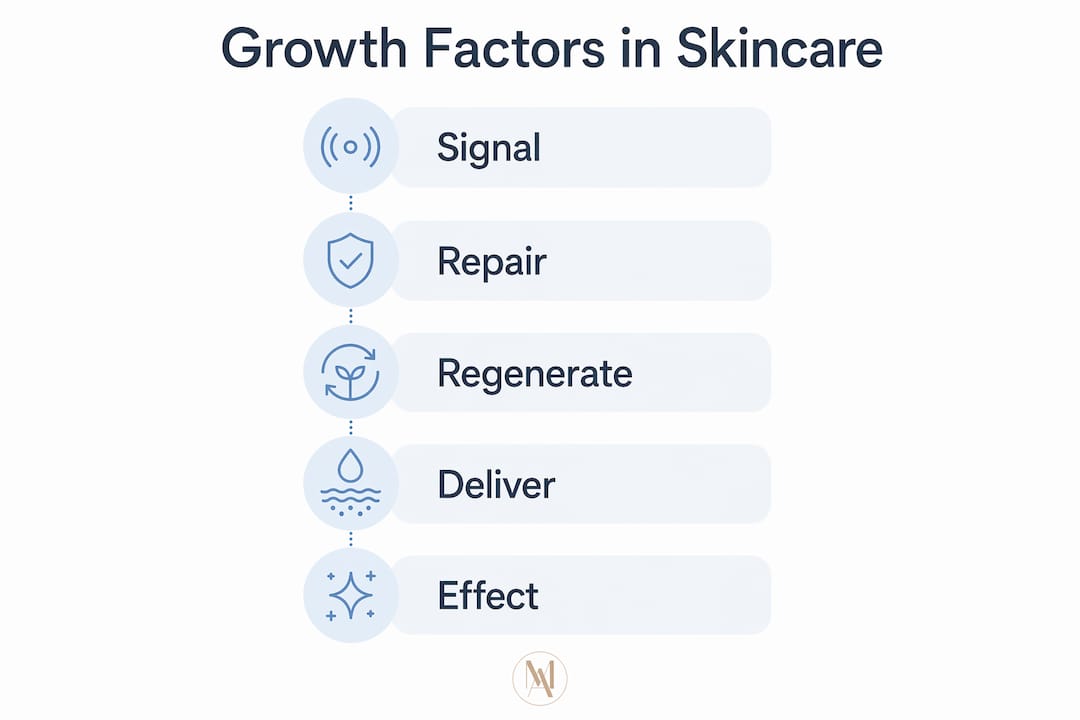
Formulating growth factors into a stable, effective topical product is one of the most technically demanding tasks in cosmetic science. These are large, fragile proteins that degrade rapidly when exposed to heat, light, or enzymatic activity in the skin. Without proper stabilisation, a growth factor serum can lose potency before it even reaches the stratum corneum.
The four primary delivery challenges are:
- Protein stability: Growth factors denature easily during manufacturing and storage, requiring cold-chain handling or encapsulation technologies to preserve bioactivity.
- Skin penetration: The stratum corneum is an effective barrier. Large protein molecules struggle to cross it without a delivery enhancer, which limits how much active ingredient reaches target fibroblasts in the dermis.
- Half-life limitations: Standard PRP loses over 80% of active components within 72 hours of application, illustrating how quickly growth factor activity diminishes without sustained-release technology.
- Burst-release patterns: A single concentrated dose may initiate repair but cannot sustain the proliferative and remodelling phases that produce lasting results.
| Delivery method | Mechanism | Key benefit |
|---|---|---|
| Topical serum (standard) | Passive diffusion through stratum corneum | Accessible and non-invasive |
| Microneedling + topical | Microchannels bypass the skin barrier | Significantly improved penetration |
| PRP injection | Direct intradermal delivery of autologous growth factors | Immediate bioavailability |
| Nanoparticle encapsulation | Protects protein and extends release window | Sustained activity over days |
Microneedling creates microchannels that allow topically applied growth factors to bypass the stratum corneum and reach viable epidermal and dermal cells. This is why combining a growth factor serum with a microneedling session consistently outperforms either approach used alone.
Pro Tip: Apply your growth factor serum immediately after a microneedling treatment, within the first 20 minutes, when microchannels are most open. This window offers the highest transdermal delivery of any topical application method.
What does clinical evidence show about growth factors for skin?
The clinical evidence supporting growth factors and skin health is growing steadily, with randomised controlled trials now providing objective measurements rather than subjective before-and-after assessments.
A four-week study comparing creams containing human EGF and Platelet-Rich Fibrin (PRF) demonstrated significant improvements in skin barrier function, including reduced transepidermal water loss (TEWL), increased hydration, and improved elasticity compared to control. EGF concentration in the stratum corneum reached equilibrium by week four, confirming that consistent use builds cumulative skin exposure rather than delivering a single-use benefit.
For procedural applications, a randomised trial of recombinant PDGF-BB applied after radiofrequency microneedling showed statistically significant improvement in aesthetic outcomes at 30 days with excellent tolerability and no serious adverse events. This positions PDGF-BB as a particularly promising growth factor for post-procedure recovery and skin remodelling.
Platelet-Rich Plasma (PRP), which delivers a concentrated cocktail of autologous growth factors, is the most extensively studied regenerative biologic in dermatology. Randomised trials consistently show superior outcomes for PRP combined with microneedling or fractional laser versus PRP alone, confirming that delivery method amplifies efficacy.
Measurable outcomes across clinical trials include:
- Reduced TEWL, indicating a stronger, more intact skin barrier
- Increased dermal thickness on ultrasound imaging
- Improved Cutometer elasticity scores
- Reduced melanin index in pigmentation studies
- Improved atrophic acne scar grading on standardised scales
Consumers and clinicians should prioritise products supported by these objective skin measurements rather than relying on testimonials or unverified before-and-after photography. The science exists. Demand it from your products.
How to integrate growth factors into your skincare routine
Using growth factors in skincare effectively requires understanding where they sit in a routine and how they interact with other actives. Growth factors are best applied to clean, slightly damp skin before heavier moisturisers or oils, as they need direct contact with the epidermis to initiate signalling. Layering them under occlusive products can actually improve their residence time on the skin.
Practical guidance for incorporating growth factors:
- Morning or evening use: Growth factors are not photosensitive, so they can be used at either time. Many clinicians recommend evening application to align with the skin’s natural nocturnal repair cycle.
- Avoid mixing with strong acids: Low-pH environments (AHAs, BHAs at high concentrations) can denature protein-based growth factors. Apply them separately or on alternating evenings.
- Pair with peptides: The role of peptides in skincare overlaps with growth factors at the signalling level. Peptides like Matrixyl (palmitoyl pentapeptide-4) support collagen synthesis through a different mechanism, making them complementary rather than redundant.
- Combine with professional treatments: Growth factors combined with microneedling or radiofrequency microneedling deliver the most clinically significant improvements, particularly for acne scarring and skin laxity.
- Consistency over intensity: Because collagen turnover takes 8 to 12 weeks, daily use over three months produces far better results than sporadic high-dose applications.
Over-the-counter products often contain peptides or growth factor derivatives with subtler effects than prescription-strength or clinic-applied formulations. This is not a reason to dismiss them. It is a reason to set realistic expectations and consider professional consultation when targeting specific concerns like deep scarring or significant photoageing. Exploring regenerative biologics like polynucleotides alongside growth factors can further support dermal rejuvenation, particularly for those managing volume loss or chronic skin laxity.
Key takeaways
Growth factors work by signalling skin cells to repair and regenerate, and their benefits are maximised through consistent use, advanced delivery methods, and combination with professional treatments.
| Point | Details |
|---|---|
| Growth factors are signalling proteins | EGF, bFGF, PDGF-BB, and VEGFA each target distinct repair processes in the skin. |
| Clinical results take 8 to 12 weeks | Collagen turnover dictates the timeline; consistent daily use is non-negotiable for results. |
| Delivery method determines efficacy | Microneedling and RF treatments dramatically improve growth factor penetration and outcomes. |
| Half-life limits single-dose impact | Sustained-release formulations and staged delivery outperform standard topical application. |
| Objective measures confirm efficacy | Look for products backed by TEWL, hydration, and elasticity data, not just testimonials. |
Why I think growth factors deserve more clinical rigour, not more hype
I have spent years watching ingredients cycle through the skincare industry with promises that outpace the evidence. Growth factors are different, and that is precisely why I find the current wave of marketing claims frustrating rather than encouraging.
The biology is genuinely compelling. The clinical data, particularly for EGF and PDGF-BB combined with microneedling, is among the most promising I have reviewed in regenerative dermatology. But the gap between what a well-formulated, clinician-applied growth factor protocol can achieve and what a mass-market serum delivers is significant. Most consumers never hear about that gap.
What I tell clients at Them-ethod is this: if you are using a growth factor product and not seeing results after 12 weeks of consistent use, the issue is almost certainly delivery, not the ingredient itself. Either the formulation is not protecting the protein adequately, or the product is not reaching deep enough to matter. That is when pairing with FDA-approved SkinPen microneedling becomes worth the conversation.
The future of growth factors in anti-ageing skincare lies in staged, sustained delivery systems and combination protocols. One-time PRP injections and single-use serums will always be limited by half-life biology. The clinics and brands investing in dual-phase delivery, encapsulation, and procedural integration are the ones producing results worth talking about. I am optimistic, but I want the evidence to lead.
— Jess
Explore growth factor skincare at Them-ethod
At Them-ethod, we curate scientifically formulated products and treatments selected for their clinical credibility, not their marketing budgets. For clients managing acne-prone skin, the PCA Skin Clearskin serum offers a targeted approach to active breakouts and post-inflammatory marks, formulated with ingredients that support skin repair and barrier integrity. Our virtual consultations with expert clinicians allow us to assess your specific concerns and recommend growth factor-based products or in-clinic treatments tailored to your skin type and goals. Whether you are addressing early signs of ageing, pigmentation, or acne scarring, we match the science to your skin.
FAQ
What are growth factors in skincare?
Growth factors are naturally occurring proteins that signal skin cells to repair, regenerate, and produce collagen and elastin. In skincare, they are used to address ageing, scarring, and barrier damage by reintroducing these biological signals to skin that has slowed its natural repair processes.
How long do growth factors take to work?
Clinical results from growth factor skincare typically develop over 8 to 12 weeks of consistent use, reflecting the natural pace of collagen turnover. Improvements in firmness, hydration, and elasticity are measurable at this point, though some users notice texture changes earlier.
Are growth factors the same as growth hormones in skincare?
Growth factors and growth hormones are distinct. Growth hormones are systemic endocrine signals produced by the pituitary gland, while growth factors are localised signalling proteins that act directly on skin cells. The term “growth hormones in skincare” is sometimes used loosely in marketing but does not accurately describe topical growth factor ingredients.
Do growth factors work better with microneedling?
Yes. Microneedling creates microchannels in the skin that significantly improve the penetration of topically applied growth factors, allowing them to reach fibroblasts in the dermis rather than sitting on the surface. Randomised trials confirm superior outcomes when growth factors are combined with microneedling or radiofrequency microneedling versus topical application alone.
Can growth factors help with acne scarring?
Growth factors combined with microneedling show promising improvements in atrophic acne scars, with studies reporting measurable improvements in scar grading and pigmentation reduction. PDGF-BB applied after radiofrequency microneedling has demonstrated statistically significant aesthetic improvement in clinical trials with no serious adverse events.


