



Artikel: Hormonal Acne Skincare: A Routine That Works
Hormonal Acne Skincare: A Routine That Works
The most effective hormonal acne skincare is a short, consistent routine built around one well-chosen active, introduced slowly and given two to three months to work. When breakouts along the jawline keep returning despite that, the next step is a prescription plan matched to your skin. At The M-ethod Skin we offer an online skin consultation with Dr Mandy, plus prescription-strength and dermatologist-recommended skincare shipped internationally. This guide explains what hormonal acne is, what to put on your skin, in what order, and when to step up.
TL;DR
- Hormonal acne tends to show up as deep, tender bumps on the lower face and often flares with your cycle.
- Use one active ingredient matched to your acne type (adapalene, azelaic acid, 2.5% benzoyl peroxide or salicylic acid) and give it 6 to 8 weeks before changing anything.
- Keep everything else simple: a mild cleanser, a non-comedogenic moisturiser and a daily sunscreen.
- Deep, painful, scarring or stubborn acne, or acne with irregular periods, calls for a clinician and possibly prescription options.
- If you are pregnant or trying to conceive, check every acne product with your doctor first.
Table of Contents
- What hormonal acne actually looks like
- The routine: four steps, one active
- Choosing your one active
- How to introduce an active without wrecking your skin barrier
- Why the routine gets personal
- When skincare alone is not enough
- If you are pregnant or trying to conceive
- Our perspective
- Where we can help
- FAQ
- Sources
What hormonal acne actually looks like
Hormonal acne is not a separate disease. Dermatologist Dr Joshua Zeichner of Mount Sinai says the name is a bit of a misnomer, because all acne is hormone-driven: testosterone stimulates the oil glands, which raises oil (sebum) production and inflammation. The label is useful because it describes a pattern: acne that is sensitive to hormone shifts, typically in adults.
Cleveland Clinic describes this adult acne as affecting people aged 20 to 50, caused by excess sebum clogging pores. It can appear as whiteheads, blackheads, papules (small raised bumps), pustules (pus-filled bumps) and deeper cysts, on the face, neck, back, shoulders and chest.
The typical giveaways:
- Location. WebMD’s dermatologist notes that hormonal acne usually causes reddish, painful nodules on the lower face: jaw, chin and neck. It is less likely to produce the many blackheads and whiteheads of teenage acne.
- Timing. Zeichner explains that hormone rises mid-cycle activate oil glands, so breakouts arrive a week or two later, around your period.
- Depth. Lesions are often deep and tender rather than surface-level.
Forehead bumps that itch can be something different, such as fungal acne, which is one reason a proper assessment is worth having if your routine is not working.
The routine: four steps, one active
The biggest mistake we see in acne routines is stacking products. Northwell Health’s Dr Ankuri Desai points out that more products can mean more irritation and clogged pores, so dermatology generally favours a simpler routine that you can tolerate and keep up.
The American Academy of Dermatology (AAD) recommends choosing one product with an active ingredient matched to your acne type and using it as directed for 6 to 8 weeks without adding anything else. The framework looks like this:
- Cleanse morning and night with a mild cleanser. Mayo Clinic advises avoiding scrubs, astringents and picking.
- Treat with one active (see below).
- Moisturise with a non-oily, non-comedogenic formula. Moisturiser makes actives easier to tolerate.
- Protect with a non-oily sunscreen every morning. Sun worsens the dark marks acne leaves behind, and some acne medications raise sunburn risk, according to Mayo Clinic.
In practice, Northwell’s example for mild acne is a salicylic acid cleanser plus sunscreen in the morning, and a gentle cleanser plus a retinoid and moisturiser at night.
Choosing your one active
The AAD lists four over-the-counter-style options to match against your acne type. Here is how they differ in practice.
| Active | Best suited to | What to expect |
|---|---|---|
| Adapalene (a retinoid) | Clogged pores, whiteheads, blackheads, recurring bumps | Dryness, flaking and redness early on; photosensitivity |
| Azelaic acid | Inflamed spots, dark marks, sensitive or redness-prone skin | Generally gentle; helps clear pores and reduce inflammation |
| Benzoyl peroxide (2.5%) | Inflamed pimples | Peeling, dryness; can bleach fabric |
| Salicylic acid | Mild, congested skin, oily areas | Mild exfoliation; works well as a cleanser |
The AAFP summary of the AAD guidelines notes that topical retinoid side effects include photosensitivity, burning, dryness, redness and peeling, and that benzoyl peroxide can cause peeling, irritation and fabric bleaching. It also says daily sunscreen should be considered.
Retinoids: adapalene and tretinoin
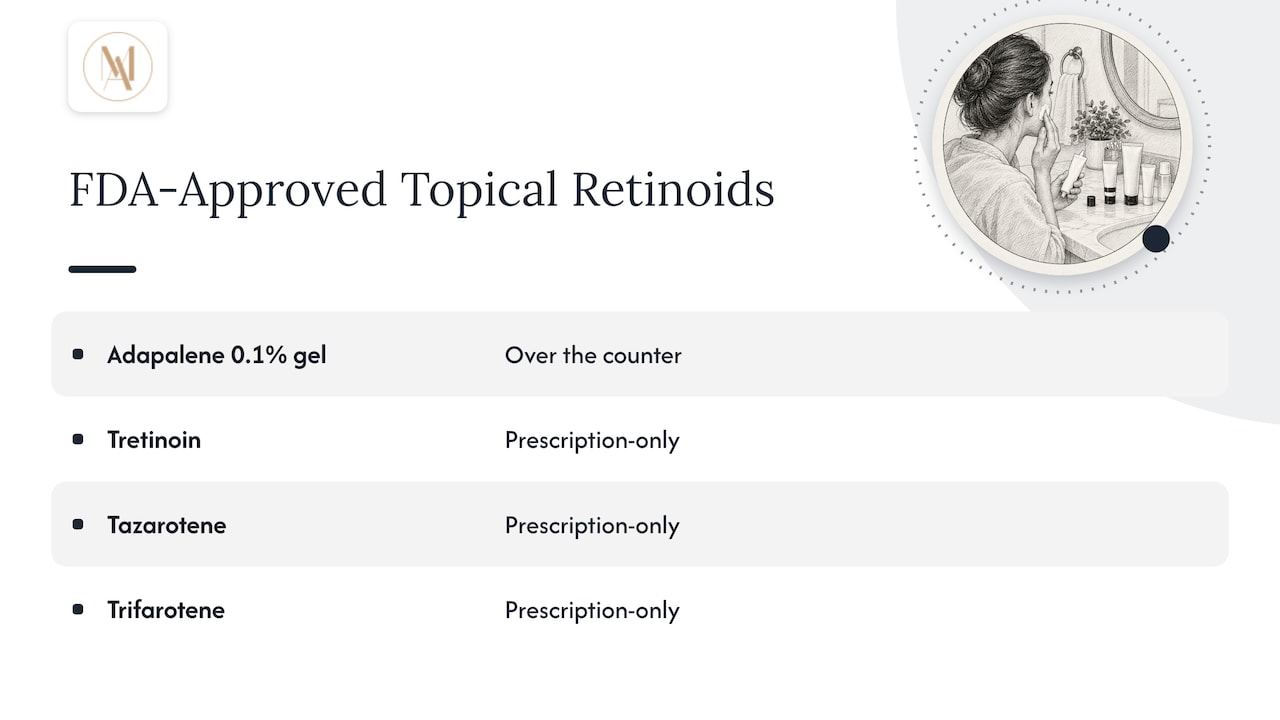
Retinoids are a cornerstone of acne care because they keep pores from clogging. The 2024 AAD guidelines published in JAAD state that four topical retinoids are FDA-approved for acne in the US: tretinoin, adapalene, tazarotene and trifarotene. Only adapalene 0.1% gel is available over the counter; the others are prescription-only. If you are weighing the two most common choices, our guide to tretinoin versus adapalene sets out the differences.
The same guidelines note that irritation, especially at higher strengths, can be eased by using the retinoid less often and with an emollient. Some tretinoin formulations should not be applied together with benzoyl peroxide, and the AAFP summary adds that tretinoin degrades when benzoyl peroxide is present. If you use both, use them at different times of day. For a practical walk-through of getting skin ready for a retinoid, see this piece on preparing skin for retinol.
Azelaic acid and benzoyl peroxide
Azelaic acid suits many people who find retinoids too drying, and it is also one of the options the AAD lists. Benzoyl peroxide works well on inflamed pimples; start low. Mayo Clinic recommends beginning with a lower strength, such as a 2.5% water-based formula, and increasing gradually over weeks, applying a thin layer after cleansing.
How to introduce an active without wrecking your skin barrier
Most routines fail not because the ingredient is wrong but because it is introduced too fast. A sensible pattern:
- Weeks 1 to 2: apply your active every second or third night. Dr Desai suggests slowing down or adding moisturiser if you see redness, flaking or tightness.
- Weeks 3 to 4: move to nightly use if your skin is comfortable.
- Weeks 6 to 8: assess. The AAD advises 6 to 8 weeks before changing anything.
- Weeks 8 to 12: judge results. Northwell recommends giving a treatment 8 to 12 weeks, and Mayo Clinic says to expect 2 to 3 months of daily use.
Two habits matter as much as the product. Do not pick: Zeichner warns that picking deep pimples can cause breaks in the skin, infection and scarring. And apply sunscreen daily, especially with a retinoid.
Why the routine gets personal
Two people with jawline acne can need very different plans. One has mild, cyclical bumps that respond to a retinoid and sunscreen. Another has deep cysts, dark marks that linger after each flare, and skin that reacts to everything. Dr Desai notes that lower-face and jawline acne can be more hormonally driven and may warrant a different treatment plan.
This is where individual guidance pays off. Skin tone, sensitivity, cycle patterns, pregnancy plans and current medication all change what you should use. Our guides on which skincare helps hormonal breakouts and managing hormonal acne skincare wisely go deeper into ingredient choices, and our acne management tips cover day-to-day habits.
When skincare alone is not enough
The AAD says to see a dermatologist if you have large, deep, painful pimples, acne that scars, dark spots that persist after the pimples heal, or no results after weeks of over-the-counter treatment. Persistent dark post-inflammatory marks, which are more common in darker skin tones, signal significant inflammation that over-the-counter products usually cannot resolve.
The 2024 AAD guidelines added topical clascoterone, which addresses hormonal causes of acne, and hormonal therapies such as combined oral contraceptives and spironolactone. In the JAAD guideline:
- Prescription topical retinoids (tretinoin, tazarotene, trifarotene) and fixed-dose combination topicals are standard options.
- Clascoterone is a topical that targets the hormonal side of acne.
- Combined oral contraceptives: four are FDA-approved for acne in the US, with improvement usually seen in 3 to 6 months.
- Spironolactone is not FDA-approved for acne, is avoided in pregnancy and is often paired with a contraceptive.
- Isotretinoin is reserved for severe or scarring acne. It requires enrolment in the iPLEDGE programme, which for people who can become pregnant means two forms of contraception or abstinence, plus liver, lipid and pregnancy monitoring.
These are decisions for a prescribing clinician, who will review your history. Dermatology Times notes that adult women whose acne has failed oral or topical therapy should be referred to a dermatology provider, where stronger systemic options may be appropriate.
Acne and PCOS
Acne together with irregular or absent periods, increased hair growth or hair thinning can be a reason to be evaluated for polycystic ovary syndrome (PCOS), a hormonal condition. Androgen excess can contribute to acne, but acne on its own does not mean you have PCOS, which needs a clinical and laboratory evaluation. If these signs sound familiar, book a visit with your doctor.
If you are pregnant or trying to conceive
Safety comes first here. Northwell advises that retinoids, including over-the-counter adapalene, should generally be avoided during pregnancy, and that you should check with your OB/GYN before using acne treatments when pregnant or trying to conceive. The AAD likewise advises consulting a dermatologist before self-treating. Spironolactone and isotretinoin are also not for use in pregnancy. We have gathered pregnancy-aware options in our guides to pregnancy-safe skincare and pregnancy-friendly skincare actives, to read alongside your doctor’s advice.
Our perspective
Hormonal acne is frustrating because it is both a skin problem and a timing problem. The products matter, but so does choosing them for your skin rather than for an average face.
At The M-ethod Skin we work with prescription-strength and dermatologist-recommended skincare, and our approach is built on one-on-one expert guidance. That is why we like to begin with the person: how long the acne has been there, where it sits, how the skin reacts, and what else is going on. A simple routine, introduced at the right pace and reviewed after a fair trial, usually beats a shelf of products.
Our online skin consultation with Dr Mandy brings that individual view to you wherever you live, and our international shipping is designed to make specialist skincare reachable from abroad. For those who want in-person care, our clinic offers treatments in London and Athens with a UK-trained doctor.
Jess
Where we can help
If you would like a routine built around your skin, start with an online skin consultation with Dr Mandy. You can also browse our cleansers, moisturisers, serums and sunscreens to put the four-step routine together. For marks and texture left behind by acne, our clinic in London and Athens offers microneedling with SkinPen, polynucleotides, Profhilo and HIFU, delivered by a UK-trained doctor, which suits international patients and Greek expats planning a visit.
FAQ
What is best for hormonal acne?
Start with one active matched to your acne type, such as adapalene, azelaic acid, 2.5% benzoyl peroxide or salicylic acid, alongside a mild cleanser, moisturiser and sunscreen. Use it for 6 to 8 weeks before adding anything. If acne is deep, painful or scarring, a prescription plan from a clinician is the next step.
How long before hormonal acne skincare works?
Expect at least 6 to 8 weeks, and give a treatment 8 to 12 weeks before judging it. Combined oral contraceptives, if prescribed, usually show improvement in 3 to 6 months. Changing products too early restarts the clock and adds irritation.
What does a PCOS pimple look like?
There is no single look. PCOS-related acne often sits along the lower face and jawline and can be deep and tender, like other hormonal acne. The clue is the company it keeps: irregular or absent periods, increased hair growth or hair thinning. These signs are worth raising with your doctor, because PCOS needs clinical and lab evaluation.
Can I use tretinoin and benzoyl peroxide together?
Some tretinoin formulations should not be applied with benzoyl peroxide, and tretinoin can degrade in its presence. The usual approach is to use them at different times of day, for example benzoyl peroxide in the morning and tretinoin at night. A clinician can confirm the right pairing for your prescription.
Sources
- Adult acne treatment dermatologists recommend, American Academy of Dermatology
- American Academy of Dermatology issues updated guidelines for acne management
- Guidelines of care for the management of acne vulgaris, JAAD 2024
- Acne management: guidelines from the AAD, American Family Physician
- Nonprescription acne treatment: which products work best? Mayo Clinic
- Hormonal acne: what is it, treatment, causes and prevention, Cleveland Clinic
- Expert tips and treatment options for hormonal acne, WebMD
- What to do about hormonal acne, Glamour
- Acne skin care routine: simple morning and night steps, Northwell Health
- Mastering the challenges of adult female acne in primary care, Dermatology Times