



Artikel: Clogged pores treatment: dermatologist-backed steps that work

Clogged pores treatment: dermatologist-backed steps that work
Gentle cleansing and a targeted salicylic acid product will clear most clogged pores within a few weeks; for lasting change, a retinoid prescribed or supervised by a clinician remains the most proven long-term fix. Start tonight with three moves: cleanse twice daily with a non-comedogenic formula, apply a leave-on BHA product to affected areas, and keep your hands off any blackhead or bump you’re tempted to squeeze.
For the deeper fix, a topical retinoid normalises how skin cells shed, which is what stops pores clogging in the first place. Expect gradual results over eight or more weeks, not overnight.
- Tonight: cleanse, apply BHA, resist picking
- This month: introduce a retinoid slowly, two to three nights a week
- See a clinician if: comedones persist beyond 12 weeks, look inflamed, or you notice early scarring
Key Takeaways
Clearing clogged pores long-term requires consistent gentle cleansing, a BHA or retinoid used correctly, and clinician supervision when home care plateaus.
| Point | Details |
|---|---|
| Start with the basics | Cleanse twice daily with a non-comedogenic formula and never squeeze or extract at home. |
| Use salicylic acid strategically | Apply a BHA three to five nights weekly to dissolve debris inside the pore lining. |
| Be patient with retinoids | Expect visible comedone reduction after eight or more weeks, not days. |
| Escalate when needed | See a clinician if congestion persists past 12 weeks or shows signs of scarring. |
| Consider clinician-led care | The M-ethod offers virtual consultations, prescription-strength options, and in-clinic procedures tailored to your skin. |
This article is general information, not a substitute for advice from a qualified doctor. Consult a qualified healthcare professional about your own circumstances before acting on anything here.
Table of Contents
- What causes clogged pores in the first place?
- The at-home routine that actually clears congestion
- Retinoids or over-the-counter actives: which do you need?
- What in-clinic treatments can do that home care can’t
- When should you book a dermatologist appointment?
- The daily routine that keeps pores clear long-term
- Why clinician-led treatment matters for stubborn cases
- Moisturising: the step people skip and shouldn’t
- Do diet, stress, and environment really affect clogged pores?
- Tailoring your routine to your skin type
- Get a clinician-supervised plan with The M-ethod
- Sources
What causes clogged pores in the first place?
Every pore contains a hair follicle and an oil (sebum) gland. Clogged pores form when sebum mixes with dead, keratinised skin cells and everyday debris, forming a plug that widens the follicle from the inside. That plug shows up in different guises depending on how it’s exposed to air and how deep it sits.
- Blackheads (open comedones): the plug reaches the surface and oxidises, turning dark.
- Whiteheads (closed comedones): the plug stays capped beneath the skin and stays pale.
- Sebaceous filaments: thin, greyish, hair-like structures lining oil glands. These are normal skin structures everyone has, not a blockage, and they’re often confused with blackheads because both appear on the nose and cheeks.
Skin type, heavy or occlusive makeup, hormonal shifts, and sleeping without cleansing all push the balance towards more visible congestion.
The at-home routine that actually clears congestion
Most people can meaningfully improve clogged pores without setting foot in a clinic, provided the routine is consistent and the actives are used correctly. Cleveland Clinic recommends gentle, twice-daily cleansing with non-comedogenic products as the baseline for managing congestion, and that baseline matters more than any single “miracle” ingredient.
- Cleanse morning and night with a gentle, non-comedogenic formula and lukewarm water. Hot water strips the skin barrier and can trigger more oil production to compensate. A gentle cleansing lotion works well as a first step for reactive or combination skin.
- Add a salicylic acid (BHA) product three to five nights a week. Salicylic acid is oil-soluble, so it can penetrate into the pore lining and help dissolve the debris sitting there, which is why dermatology guidance consistently names it alongside AHAs as a first-line exfoliant for congestion.
- Layer in AHAs or benzoyl peroxide sparingly, never on the same night as a retinoid, and always followed by a proper moisturiser.
- Use clay masks once or twice weekly at most to absorb excess surface oil, not as a daily habit.
Pro Tip: Introduce any new active gradually. Patch test on your jaw for three nights, then move to alternate nights before working up to daily use. Skin that goes from nothing to a nightly BHA and retinoid combination almost always reacts badly within a week.
What to avoid is just as important as what to add. Physical scrubs with jagged particles create microscopic tears that let bacteria in and worsen inflammation. Pore vacuums and suction devices can cause bruising and broken capillaries when used at home without proper training, and dermatologists rarely recommend them for routine care. DIY extraction with fingers or metal tools carries a real risk of pushing debris deeper, scarring, or introducing infection, which is exactly why Cleveland Clinic points people towards professional in-office extraction instead of home attempts.
Retinoids or over-the-counter actives: which do you need?
Adapalene, available over the counter at 0.1%, is a solid entry point for mild to moderate congestion and comedonal acne. Prescription-strength tretinoin and tazarotene work faster and more thoroughly for stubborn or widespread cases, but they demand more careful handling.
- Timeline: both OTC and prescription retinoids typically need eight or more weeks before you see meaningful comedone reduction. Anyone promising results in a week is overselling.
- Safety first: retinoids are contraindicated in pregnancy, so confirm your status before starting. Redness, flaking, and mild stinging in the first two to four weeks are normal; a moisturiser buffer and lower frequency solve most of it.
- Beyond topicals: when comedonal or mixed acne doesn’t respond to OTC and prescription topicals, Mayo Clinic notes that oral or hormonal therapies become part of the conversation, which is a decision for a clinician, not a self-directed trial.
What in-clinic treatments can do that home care can’t
When congestion persists despite a solid home routine, professional procedures reach areas and depths that over-the-counter products simply can’t. A licensed clinician performing extraction under sterile conditions clears comedones with far less risk of scarring than a DIY attempt at the bathroom mirror, according to Cleveland Clinic.
- Chemical peels (AHA/BHA): dissolve the bonds between dead skin cells across a controlled depth, usually delivered in a series of sessions spaced weeks apart.
- Microdermabrasion: physically buffs away the outer skin layer to reduce surface debris and refine texture.
- Microneedling and laser resurfacing: stimulate collagen production, which can visibly minimise the appearance of pores over several sessions, though pore size itself is largely genetic and won’t shrink permanently.
| Procedure | What it targets | Typical course |
|---|---|---|
| Professional extraction | Existing blackheads and whiteheads | Single session, repeated as needed |
| Chemical peel (AHA/BHA) | Surface congestion, dullness, texture | Series of 3 sessions |
| Microdermabrasion | Dead skin buildup, mild texture issues | Series of 4 sessions |
| Microneedling/laser | Collagen support, pore appearance | Series of 3 to 4 sessions, spaced weeks apart |
When should you book a dermatologist appointment?
Book a consultation if comedones persist beyond 12 weeks of consistent home care, if lesions become inflamed or painful, or if you notice early signs of scarring or dark marks that won’t fade. A first visit typically covers your skin history, a check for pregnancy or medication interactions, and a personalised plan.
- Persistent, inflamed, or scarring lesions warrant a referral, not more time waiting it out.
- Expect a review of current products, skin type, and any hormonal factors.
- Next steps usually include a prescription-topical plan, a discussion of in-clinic options like peels, and a monitoring timeline to track progress.
The daily routine that keeps pores clear long-term
Prevention beats treatment, and it’s a far simpler routine once your skin has settled. The same four-step structure, repeated consistently, does most of the work.
- Cleanse morning and night with a formula suited to your skin type, never anything that leaves skin feeling tight or squeaky.
- Apply a targeted active at night, alternating a BHA with a retinoid rather than layering both together.
- Moisturise with a non-comedogenic formula, even if your skin runs oily. A guide to choosing an acne-safe moisturiser helps if you’re unsure what “non-comedogenic” actually means on a label.
- Apply sunscreen every morning. Sun protection supports the collagen and elastin that keep pores looking finer over time, a point dermatology guidance makes clear.
Never sleep in makeup, and go easy on heavy, occlusive facial oils, which can sit in pores overnight and undo the day’s work. A monthly professional peel or polish treatment, layered on top of this routine, keeps congestion from building back up.
Why clinician-led treatment matters for stubborn cases
Home care solves most clogged pores, but stubborn or recurring congestion often needs prescription-grade tools that aren’t available over the counter. The M-ethod gives patients access to prescription-strength retinoids and in-clinic procedures like peels and microneedling, calibrated by a clinician rather than guessed at home.
- Clinicians adjust retinoid strength and peel depth to your specific skin, reducing irritation while maximising results.
- Professionally administered microneedling uses longer, properly sterilised needles than at-home devices, a meaningful difference in outcomes.
- A supervised plan catches contraindications, like pregnancy or medication interactions, before they become a problem.
Moisturising: the step people skip and shouldn’t
Skipping moisturiser because your skin is oily is one of the most common mistakes in a clogged-pores routine, and it usually backfires. When the skin barrier is stripped by cleansers or actives without adequate hydration, it often responds by producing more oil, which feeds the very problem you’re trying to solve.
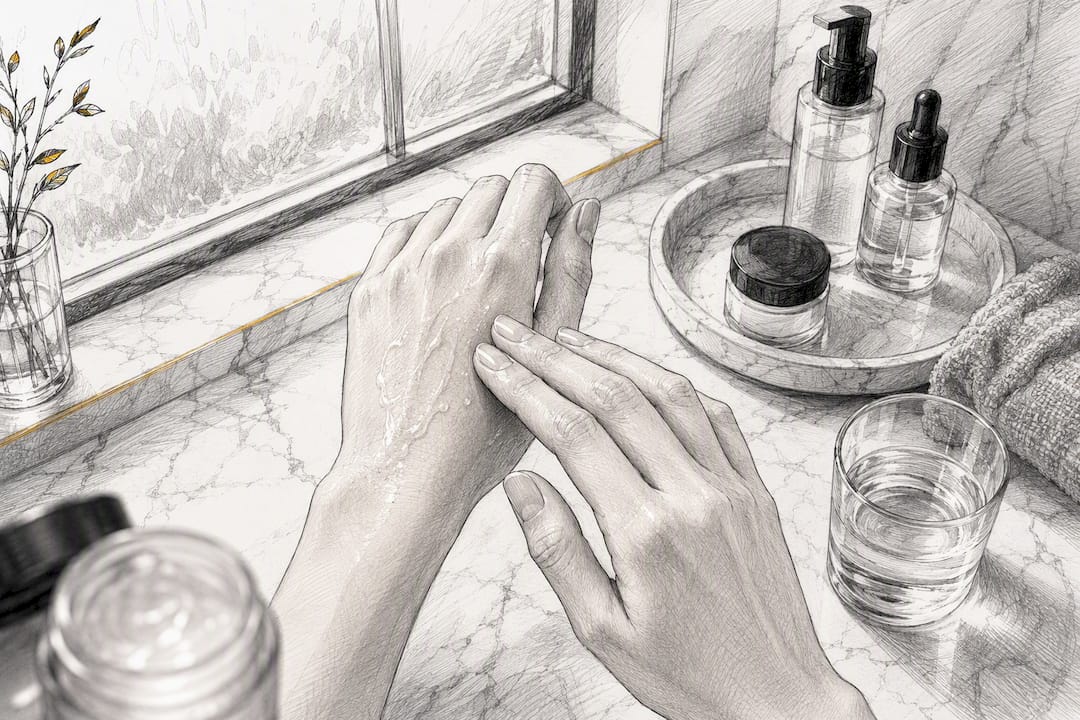
The fix isn’t heavier moisturiser. It’s the right formula. Look for lightweight, water-based, or gel-cream textures labelled non-comedogenic, meaning they’re formulated not to block pores. Ceramides and hyaluronic acid support the skin barrier without adding pore-clogging weight, while heavier occlusive balms and rich oils are better reserved for very dry patches, not the whole face.
Timing matters too. Apply moisturiser immediately after any BHA or retinoid to buffer irritation, and again after cleansing to prevent that tight, dehydrated feeling that often triggers overcompensating oil production. If you’re using a retinoid, some clinicians recommend a “sandwich” method: moisturiser, then retinoid, then moisturiser again, which softens the irritation curve without diluting the active’s effect.
For combination skin, it’s entirely reasonable to use a lighter gel formula on the T-zone and a slightly richer cream on the cheeks. There’s no single “correct” moisturiser for a whole face when oil production isn’t even across it. Consistency in application matters more than chasing a perfect formula.
Do diet, stress, and environment really affect clogged pores?
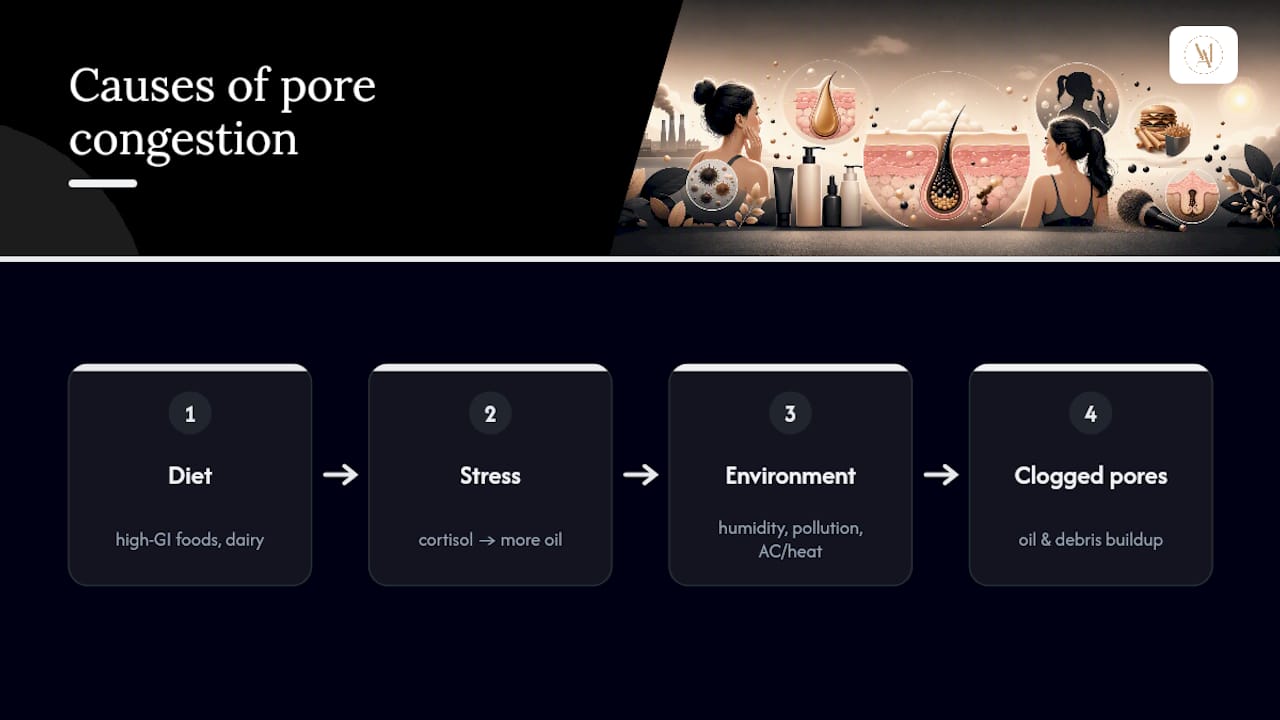
Yes, though not always in the ways people expect. Diet’s role in clogged pores isn’t fully settled, but high-glycaemic foods and dairy have been linked in some studies to increased oil production and inflammation in acne-prone skin. Cutting them out entirely isn’t necessary for most people, but if you notice a pattern between certain foods and breakouts, that’s worth tracking rather than dismissing.
Stress affects pores through a more direct route: cortisol, the hormone released under chronic stress, stimulates the sebaceous glands to produce more oil. That’s why breakouts often cluster around exam periods, work deadlines, or major life changes, quite apart from any change in skincare routine.
Environment plays its part too. Humid climates increase sweat and oil production, which can make pores appear more congested, while pollution particles settling on skin overnight add to the debris load that a cleanser needs to remove. Air conditioning and central heating both dry out the skin barrier, which paradoxically can trigger more oil production as skin tries to compensate.
None of these factors override a proper skincare routine, but they explain why the same routine can perform differently depending on the season, your stress levels that month, or wherever you happen to be living. Adjusting cleansing frequency and moisturiser weight to match your environment is often more useful than overhauling your entire regimen.
Tailoring your routine to your skin type
A single routine rarely suits everyone, because oily, dry, combination, and sensitive skin all clog differently and tolerate actives at different speeds.
Oily skin usually handles BHAs and retinoids well and benefits from a gel-based, oil-free moisturiser and clay masks used weekly rather than daily. Dry skin needs a gentler entry point, alternate nights rather than nightly actives, and a richer, non-comedogenic moisturiser to prevent the barrier disruption that can paradoxically trigger oil production.
Combination skin often does best zoning the routine: a stronger BHA concentration on the T-zone, a lighter touch and richer moisturiser on the cheeks. Sensitive skin should introduce any active at the lowest possible frequency, once a week to start, prioritising ceramide-rich moisturisers and skipping clay masks and physical exfoliants altogether until tolerance builds. A round-up of tips for acne and oily-prone skin covers product selection in more depth if you fall into that category. Whatever your starting point, the principle stays the same: match the active’s strength and frequency to what your skin can actually tolerate, not to what worked for someone else.
A note on patience and protecting your barrier
Retinoids reward patience, not intensity. Going in too fast damages the skin barrier before it can deliver results. If your routine isn’t working after a genuine trial, talk to a clinician rather than layering on more actives.
— Jess
Get a clinician-supervised plan with The M-ethod
The routes covered above work, but they all have a ceiling: over-the-counter products can only go so far, and guessing your way through retinoid strength or peel depth risks irritation without the payoff. The M-ethod offers a more direct route, where a virtual skin consultation with a clinician replaces trial and error with a plan built around your actual skin, not a generic routine.
Through The M-ethod, you get access to prescription-strength therapies alongside professional-grade products like PCA Clearskin, an acne treatment serum formulated for congestion-prone skin, plus in-clinic procedures such as peels and microneedling when your case calls for more than topicals alone. Clinician oversight means retinoid strength and peel depth get adjusted to you specifically, which matters most for stubborn or recurring congestion. Book a virtual consultation to get a personalised plan started.
Sources
- Clogged Pores: What They Are, Causes, Treatment & Prevention — Cleveland Clinic
- Retinoids and acne (PMC review)
- How to clear clogged pores: Treatments and techniques — Medical News Today
- Acne — Mayo Clinic
- How to shrink pores — Cleveland Clinic Health