



Skin assessment checklist for virtual and in-clinic consultations
A skin assessment checklist is a short, clinically aligned form you complete before a virtual or in-person consultation, giving your clinician the information needed to make safe, evidence-based product and treatment recommendations. It records your skin type, current products, medical history, photographs and treatment goals in one place, so nothing critical gets forgotten in the ten or fifteen minutes you actually have with a clinician.
Before any appointment, whether a video call or a chair at a clinic, gather these five things:
- Your current product list, including brand names and how often you use each one
- A medication list, flagging anything with isotretinoin or prescription retinoids and when you last took them
- Three photographs of your main areas of concern, taken in good light
- Records of any previous treatments, including approximate dates
- Your top three goals, ranked in order of priority
Clinicians assessing your skin will typically place you on the Fitzpatrick Scale (which grades how your skin reacts to sun exposure) and the Glogau Scale (which grades visible photoageing), and a proper skin analysis form is built around exactly these fields. At The M-ethod Skin, this documentation is what turns a consultation from a guessing game into a genuinely personalised plan.
Key Takeaways
A complete skin assessment checklist, covering medical history, current products, Fitzpatrick and Glogau classification, and consultation-ready photographs, is what allows a clinician to recommend medical-grade treatment safely.
| Point | Details |
|---|---|
| Gather medication history first | List every prescription, including isotretinoin timing, before your appointment to avoid contraindications. |
| Use standard clinical scales | Note your Fitzpatrick skin type and Glogau photoageing grade so device and peel settings are accurate. |
| Take structured photographs | Capture three angles in natural light with a neutral card for colour reference. |
| Know your red flags | Rapid lesion changes, spreading redness with fever, or severe allergic reactions need urgent dermatology care, not routine planning. |
| Book with documentation ready | The M-ethod Skin’s virtual consultations use your completed checklist and photos to build a personalised, medical-grade plan. |
Table of Contents
- What to include on your skin assessment form
- How to self-assess your skin type and condition at home
- How should you prepare for a skincare consultation?
- When should you see a dermatologist urgently?
- How clinicians use your checklist and what they look for
- Sample skin assessment template and next steps
- Book a consultation with The M-ethod Skin
- Sources
What to include on your skin assessment form
A thorough intake form is not bureaucracy for its own sake. Every field exists because it changes what a clinician can safely recommend.
Start with the basics: your contact details, the appointment date, and a short, ranked statement of your primary concerns. “I want fewer wrinkles” is far less useful than “fine lines around the eyes, then dullness, then occasional breakouts along the jawline.” Ranking matters because most treatment plans tackle one or two concerns first, not all of them at once.
Medical and medication history comes next, and it is the section clinicians read most carefully. Current prescriptions, isotretinoin timing, pregnancy or nursing status, and known allergies all directly affect what can be safely applied to your skin. Isotretinoin, for example, thins the skin and increases scarring risk, which is why many aesthetic procedures require a waiting period after you stop taking it.
Your current skincare routine needs the same precision, listing every product alongside its active ingredients and how often you use it. This lets a clinician sequence new actives safely rather than layering a fresh retinoid on top of one you are already using without realising it.
Lifestyle and sun exposure history round out the picture:
- Sunburn history, particularly in childhood
- Tanning bed or self-tanner use
- Smoking status
- Sleep quality and typical diet
- Any supplements you take regularly
Finally, the form needs clinical classification fields: your basic skin type (oily, dry or combination), a Fitzpatrick Scale entry, a Glogau photoageing grade, and a note of any sensitivity or past reactions to products or procedures. Add space for documentation too, including recent treatment dates, a signed consent and photo-consent checkbox, and room for clinician notes. Esthetician consultation forms that skip signed consent leave both you and the practice exposed if something goes wrong.
Pro Tip: Write your medication list from memory first, then check it against the actual packaging. People routinely forget occasional-use prescriptions, like a retinoid they only apply twice a week, and that gap can matter more than the products used daily.
How to self-assess your skin type and condition at home
You do not need clinical equipment to gather useful information before an appointment. Follow this sequence:
- Cleanse your face and wait 15 to 30 minutes without applying anything.
- Blot different areas with a blotting sheet to see where oil concentrates, typically the forehead, nose and chin.
- Gently pinch a small area of cheek skin and watch how quickly it springs back, a rough indicator of elasticity.
- Look closely for scaling, flaking, redness or visible comedones under good light.
- Note where pigmentation or redness sits, and whether it is patchy, uniform or follows a pattern like the cheeks and nose.
Describe what you find in plain terms rather than guessing at a diagnosis. “Redness across the cheeks that gets worse after coffee or exercise” tells a clinician far more than “I think I have rosacea,” and it still feeds directly into the Fitzpatrick and Glogau discussion during your consultation.
Photographs matter as much as the physical checks:
- Use natural daylight or a neutral ring light, never warm indoor bulbs that distort tone
- Take three angles: straight on, left profile, right profile
- Add close-ups of any specific concern area
- Include a plain white card in frame for colour reference
- Note the date and time each photograph was taken
Do not attempt to remove or biopsy anything yourself, and avoid picking at lesions between now and your appointment. Only stop actives like retinoids or exfoliants if a clinician has already told you to, since doing it prematurely can muddy how your skin actually presents.
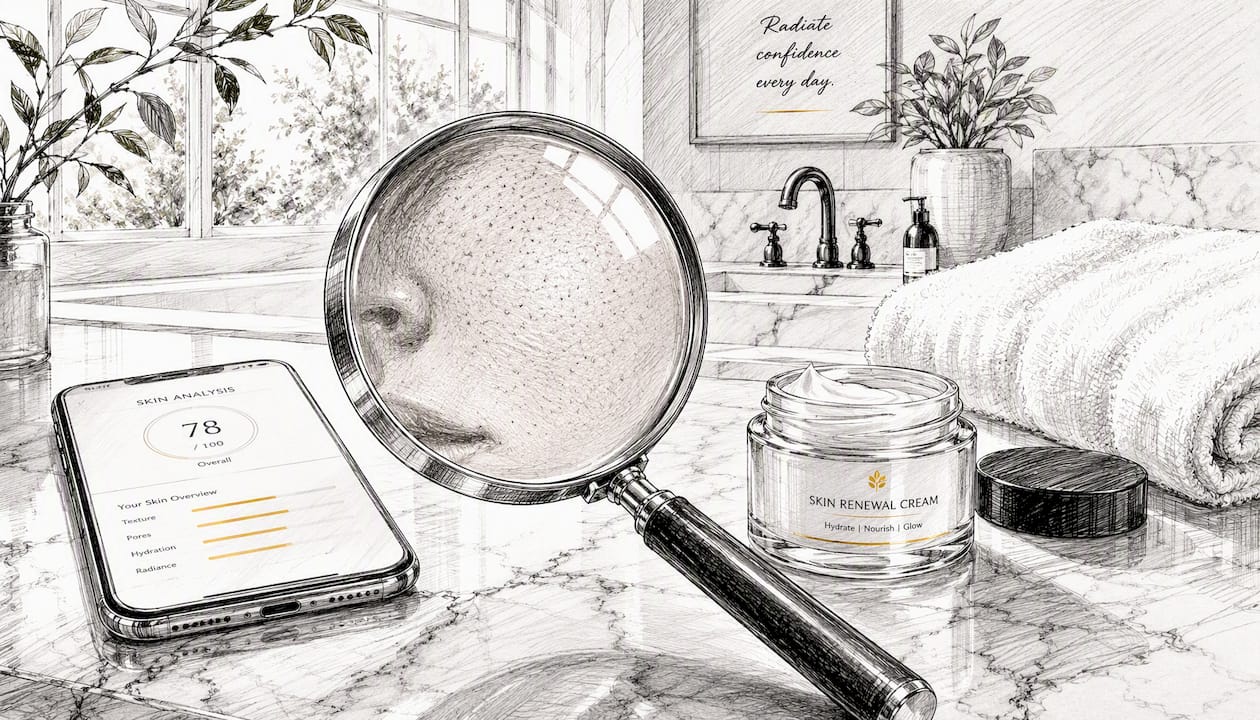
Consumer magnifying tools and phone-based “Wood’s lamp” filters can help you track changes over time, but they do not replace the imaging and dermatoscope inspection a clinician uses for genuine lesion or subsurface pigmentation assessment.
Pro Tip: Take your photographs at the same time of day and in the same spot each time you reassess. Lighting inconsistency is the single biggest reason before-and-after comparisons look misleading.
How should you prepare for a skincare consultation?
Good preparation starts two or three days out, not the morning of your appointment; following dermal hygiene best practices can help your skin present in its healthiest state for assessment.
48 to 72 hours before:
- Stop wearing heavy makeup over areas of concern so your skin’s true condition shows
- Finalise your product and medication lists
- Gather dates for any previous treatments or procedures
- Confirm your photograph set is complete and recent
On the day itself, arrive with bare, clean skin. For virtual calls, position yourself in natural light with the camera roughly at eye level, and be ready to hold the camera closer for detailed areas. A stable internet connection and a tested camera make a bigger difference to consultation quality than most people expect.
Bring or upload:
- Your completed skin assessment form
- Your photograph set
- Records of previous treatments
- Your medication and supplement list
- Signed consent to be photographed, where required
For virtual consultations specifically, log in five to ten minutes early, test your camera and microphone, and keep your close-up photographs ready to share in case the live lighting is not good enough for detailed viewing.
When should you see a dermatologist urgently?
Some findings need urgent professional attention rather than routine aesthetic planning.
- Any mole or lesion that grows rapidly, develops irregular borders, bleeds, crusts, or changes colour
- Spreading redness, fever, or rapidly worsening swelling or pain around a skin lesion, which can signal infection
- Hives combined with breathing difficulty, sudden widespread blistering, or severe swelling, all of which need emergency care
- Current isotretinoin use, which typically postpones cosmetic procedures like peels or resurfacing until your clinician confirms it is safe to proceed
If any of these apply to you, treat them as a priority over booking an aesthetic consultation.
How clinicians use your checklist and what they look for
Once your form lands on a clinician’s desk, it becomes a risk-screening tool before it becomes anything else. Medication entries, pregnancy status, isotretinoin timing and allergy history all get checked first, because they rule out contraindications before any product or procedure gets discussed.
Your Fitzpatrick and Glogau entries then shape the technical side of treatment planning. These scales inform laser, peel and energy-device settings and help predict your risk of post-inflammatory hyperpigmentation, which is higher in some skin types than others.
During examination, clinicians may reach for a dermatoscope to inspect individual lesions closely, or a Wood’s lamp to reveal pigmentation patterns that are not visible under normal light. Full-face imaging often supports longer-term treatment planning too, giving a baseline to measure progress against.
Your documentation shapes the sequence of a plan almost as much as the diagnosis does. It tells a clinician which active to introduce first, what timeline to expect results on, and whether anything warrants referral to medical dermatology or further testing rather than an aesthetic route.
Sample skin assessment template and next steps
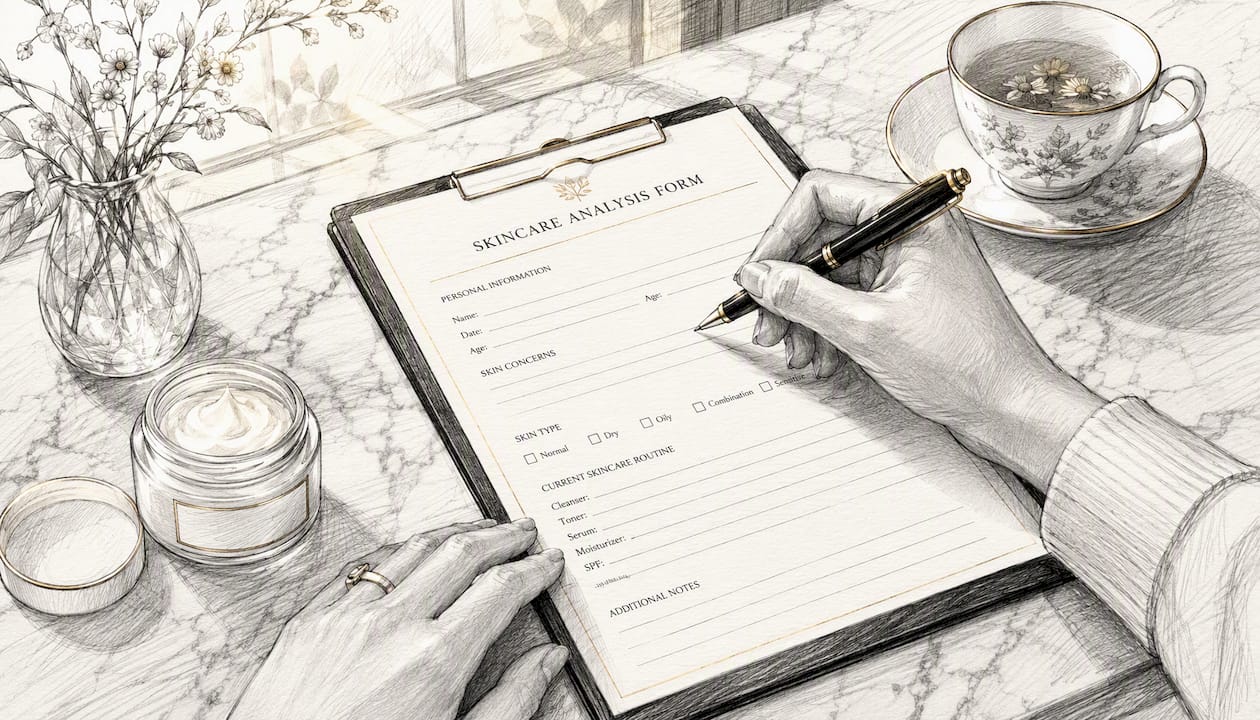
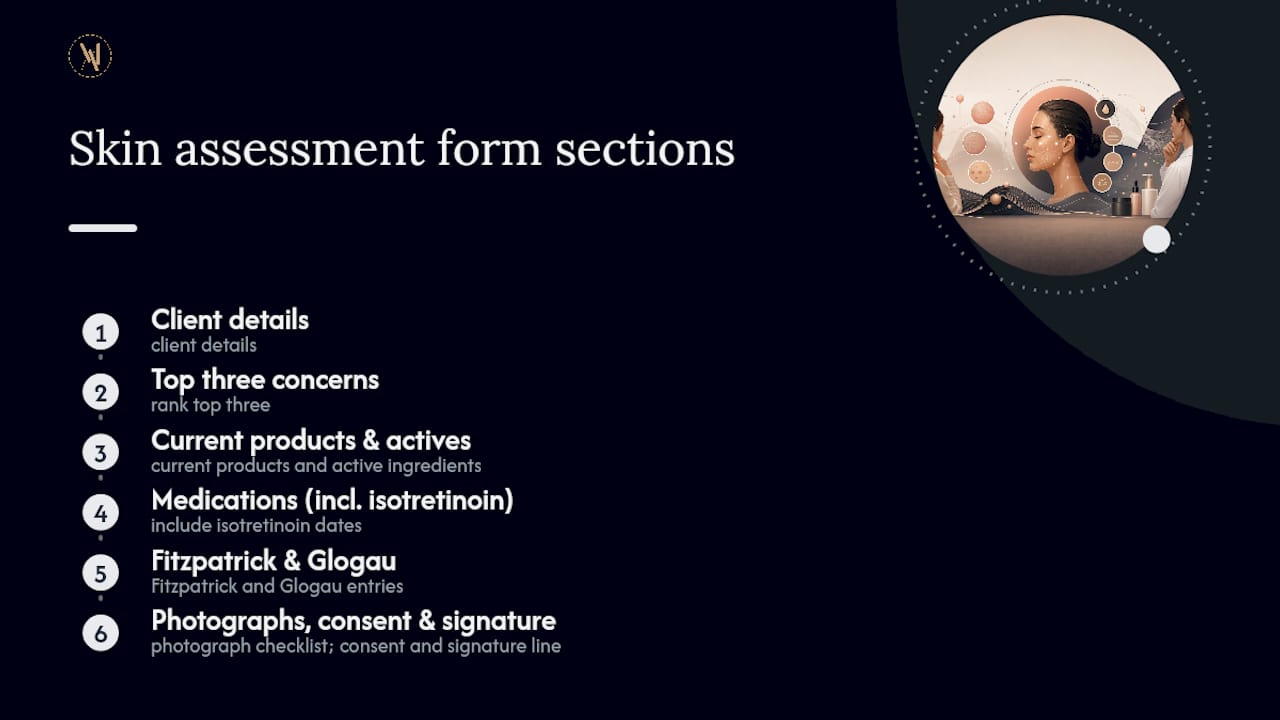
A usable template covers, in order: client details; your top three concerns; current products and their active ingredients; medications, including isotretinoin dates; Fitzpatrick and Glogau entries; your photograph checklist; and a consent and signature line.
To use it well in a virtual consultation, upload the completed form ahead of time rather than reading it aloud on the call. Flag anything urgent in a dedicated “clinician notes” box, and sum up what you want to achieve in a single sentence, since that focuses the conversation immediately.
Afterwards, expect your clinician to confirm their findings against what you submitted, propose a phased plan rather than everything at once, and set a rough timeline for introducing new products. A written plan naming product categories and application order is the mark of a consultation that has actually used your documentation properly, not just skimmed it. Book a follow-up or re-assessment date before you leave, so progress gets tracked rather than left to chance.
A note on getting this right before you book
Most of the friction in a first consultation comes down to incomplete information, not complicated skin. We have seen how a form filled in properly, with exact dates and honest answers, turns a fifteen-minute call into a genuinely useful plan rather than a list of generic suggestions. Be honest about the retinoid you only use occasionally or the peel you had eight months ago. Clinicians cannot work around information they were never given.
Book a consultation with The M-ethod Skin
If you have worked through this checklist, you already have what The M-ethod Skin needs to build a plan around your skin rather than a generic routine. Our virtual consultations are designed to take your completed form and photographs directly, so a clinician reviews your Fitzpatrick and Glogau classification, medical history and current products before recommending anything.
From there, product suggestions might include prescription-strength options like NEOSTRATA’s resurfacing range or a targeted formula such as PCA Clearskin for active breakouts, always matched against your intake rather than picked off a shelf. If your history includes retinoid use, that gets factored in before anything like PCA Retinol Night 0.5% is suggested, since timing and tolerance genuinely matter here.
Bring your completed checklist, and book a virtual consultation to get a plan built around your actual skin history, not a guess.
Sources
- Skin analysis form template and explanation
- Skin analysis methodology — proper steps and equipment for dermal assessment in the clinical practice and spa
- Telehealth aesthetic treatment planning: how to prepare for your first virtual consultation
- Skincare consultation: what to expect and how to prepare
Save or print the template and send it ahead of your appointment.
This article is general information, not a substitute for advice from a qualified doctor. Consult a qualified healthcare professional about your own circumstances before acting on anything here.