




Polynucleotide injection: science-backed skin rejuvenation
TL;DR:
- Polynucleotide injections stimulate skin regeneration at the cellular level without adding volume or contour changes.
- Clinical studies show significant improvements in skin hydration, elasticity, and texture over months.
- The treatment is safe, minimally invasive, and best suited for gradual, natural skin quality enhancement.
Not all injectables are created equal. While most people associate facial injections with adding volume or filling lines, polynucleotide injection takes an entirely different approach. Rather than replacing lost tissue, it works at a cellular level to trigger the skin’s own regenerative processes. Biopolymers derived from salmon DNA, injected intradermally, stimulate fibroblasts to produce fresh collagen, improve hydration, and reduce inflammation. The result is not an altered face, but a healthier, more resilient one. This guide covers the science, the clinical evidence, the practical process, and how it compares to other popular treatments you may already be considering.
Table of Contents
- What is polynucleotide injection and how does it work?
- Key benefits and clinical evidence for skin rejuvenation
- Treatment process, methodologies, and safety profile
- Comparing polynucleotide injections with HA, Profhilo, and other treatments
- Our take: where polynucleotide injections fit in modern skincare
- Explore advanced aesthetics with us
- Frequently asked questions
Key Takeaways
| Point | Details |
|---|---|
| Biological skin regeneration | Polynucleotide injections use salmon DNA to naturally repair and rejuvenate skin at a cellular level. |
| Proven clinical benefits | Clinical studies show visible improvements in hydration, elasticity, and overall skin quality with high patient satisfaction. |
| Safe for most, with mild side effects | Most people experience mild, short-lived side effects, but certain groups should avoid the treatment. |
| Works best with tailored protocols | Combining polynucleotide injections with other therapies and choosing the right regimen enhances results. |
| Not a quick fix | Expect gradual improvements over three to six months, with ongoing maintenance advised for best outcomes. |
What is polynucleotide injection and how does it work?
Polynucleotide injection, often abbreviated as PN or PDRN therapy, delivers long-chain DNA molecules into the dermis. These molecules are derived from salmon DNA, which shares a high degree of compatibility with human tissue, reducing the risk of rejection or adverse reaction. Once injected, the polynucleotides are absorbed by skin cells and used as raw material to drive tissue repair.
The mechanism is more sophisticated than simple hydration. Polynucleotides activate fibroblasts, the cells responsible for producing collagen and elastin. They also stimulate the A2A adenosine receptor pathway, which promotes anti-inflammatory activity and improves local microcirculation. The result is a cascade of regenerative effects that build progressively over weeks.
Here is a summary of the key biological actions:
| Biological action | Clinical impact |
|---|---|
| Fibroblast activation | Increased collagen and elastin synthesis |
| A2A receptor stimulation | Reduced inflammation and improved microcirculation |
| DNA repair support | Accelerated tissue regeneration |
| Antioxidant activity | Protection against free radical damage |
| Increased hydration | Improved skin plumpness and texture |
The treatment is also distinct in what it does not do. It does not volumise, lift, or restructure facial contours. This makes it particularly valuable for patients who want genuine biological improvement without changing their appearance. Our clinical rejuvenation guide explores this distinction in further detail.
Key effects observed across clinical studies include:
- Increased dermal collagen density
- Improved skin elasticity and firmness
- Enhanced epidermal hydration
- Reduction in fine lines and skin roughness
- Anti-inflammatory benefit in sensitised or reactive skin
“Polynucleotide injections are biopolymers that stimulate skin regeneration by activating fibroblasts and supporting extracellular matrix remodelling, making them a fundamentally different category of injectable treatment.”
This regenerative model is precisely why polynucleotide injection is attracting growing interest from both clinicians and patients seeking results that look natural because they actually are.
Key benefits and clinical evidence for skin rejuvenation
The clinical evidence behind polynucleotide injections is increasingly robust. Across multiple trials, patients have seen measurable improvements in hydration, elasticity, and surface texture. In one well-cited study combining hyaluronic acid with polynucleotides, results at 12 weeks showed +31% hydration, +22% elasticity, and a 19% reduction in skin roughness. Those are significant shifts in objective skin quality, not just subjective impressions.

Patient satisfaction figures are equally compelling. Across reviewed trials, satisfaction rates reached 97 to 100%, with 100% of participants showing visible facial improvement. In studies targeting the periorbital area, that is the skin around the eyes, significant improvements in fine lines were recorded at three months.
The benefits extend beyond simple anti-ageing. Polynucleotide injections have demonstrated real value in:
- Texture refinement: Smoothing rough or uneven skin tone without aggressive resurfacing
- Scar improvement: Supporting remodelling in atrophic acne scars
- Sensitive skin: Anti-inflammatory properties make it well tolerated in reactive skin types
- Under-eye rejuvenation: Improving the thin, delicate periorbital skin without risk of filler migration
- Natural results: No added volume or structural change, just biologically improved skin
- Gradual regeneration: Progressive improvement over three to six months mirrors natural skin renewal cycles
These benefits make the treatment especially appealing for those who have been hesitant about traditional fillers. The skin regeneration evidence points to a treatment that works with your biology rather than over it.
Pro Tip: To maximise results, consider scheduling sessions every two to four weeks initially, and plan a maintenance session every three to six months. Pairing polynucleotide injections with a well-formulated topical retinoid routine can further support collagen turnover between sessions.
What sets this treatment apart is the quality of outcome. Patients often describe their skin as looking “rested” or “refreshed” rather than treated, which is exactly the kind of result that sophisticated skincare clients want.
Treatment process, methodologies, and safety profile
Understanding what actually happens during a session removes uncertainty and helps you prepare. Polynucleotide injections are administered intradermally, meaning into the deeper layers of the skin, using very fine 30 to 32 gauge needles or cannulas. The injection techniques used include microinjection (nappage), serial puncture, linear threading, and blanching, each chosen based on the treatment area and clinical objective.
A typical treatment sequence looks like this:
- Consultation and skin assessment to confirm suitability and discuss expectations
- Topical anaesthetic cream applied 20 to 30 minutes before treatment for comfort
- Cleansing and preparation of the target area
- Injection of polynucleotide solution using the appropriate technique for the area
- Post-procedure cooling to minimise swelling and redness
- Aftercare instructions provided, covering skincare, sun exposure, and activity
Most protocols recommend three to four sessions spaced two to four weeks apart, followed by maintenance every three to six months. The volume injected varies by area and product concentration.
“In clinical trials, no serious adverse events were recorded, confirming polynucleotide injections as a well-tolerated and low-risk procedure when performed correctly by a trained clinician.”
Referred treatment protocols outline what appropriate aftercare looks like and what to communicate with your practitioner.
Common side effects are mild. Redness, swelling, and bruising are the most frequently reported and typically resolve within hours to a few days. Nodules and infection are rare, and serious allergic reactions are uncommon when contraindications are respected.
Contraindications include:
- Pregnancy or breastfeeding
- Active skin infection in the treatment area
- Known fish allergy (due to salmon-derived DNA)
- Autoimmune disorders
Pro Tip: Always disclose your full medical history, including any fish allergy or autoimmune condition, before treatment. Avoiding blood-thinning medications such as ibuprofen or aspirin for several days before your appointment can meaningfully reduce bruising.
Comparing polynucleotide injections with HA, Profhilo, and other treatments
Chooking the right injectable treatment means understanding what each one actually does. Polynucleotide injections occupy a distinct position in the landscape, and the differences matter when setting expectations.
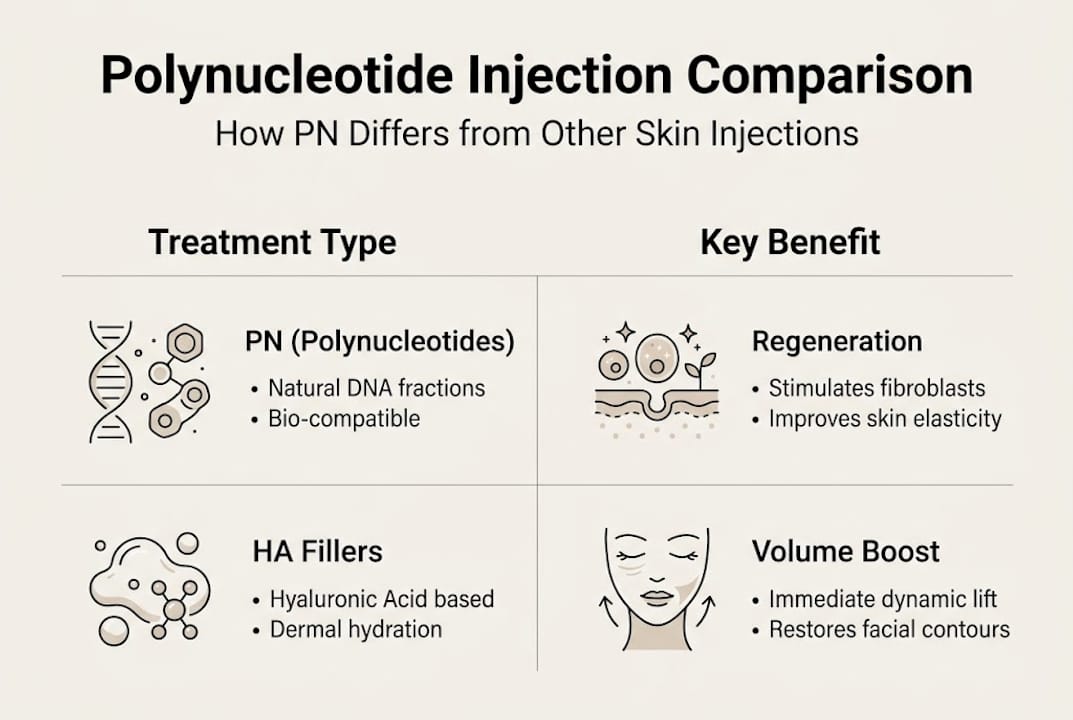
| Treatment | Primary mechanism | Key outcome | Best suited for |
|---|---|---|---|
| Polynucleotide (PN) | ECM remodelling, fibroblast activation | Regeneration, texture, scars | Gradual skin quality improvement |
| HA fillers | Volume replacement | Instant hydration and lift | Volume loss, deeper lines |
| Profhilo | Bio-remodelling via high-dose HA | Skin laxity, hydration | Overall skin firmness |
| PDRN | A2A receptor activation | Wound healing, anti-inflammation | Scarring, compromised skin |
| PRP | Autologous growth factors | Cell regeneration | Scars, hair loss, skin renewal |
PN differs from PDRN in a significant way: polynucleotides use longer DNA chains that support extracellular matrix remodelling and sustained hydration, whereas PDRN uses shorter chains focused on receptor-level signalling and the salvage pathway. Both are regenerative, but they work through distinct mechanisms.
Compared to Profhilo vs polynucleotides, Profhilo addresses bio-remodelling and laxity through a high concentration of hyaluronic acid, while polynucleotide injections focus on deeper repair at the cellular level. Many clinicians now use both in combination, and the data supports this approach.
HS fillers, including hyaluronic acid serums applied topically, offer surface-level hydration but cannot replicate the intradermal regenerative effect of polynucleotide injections.
Best-fit candidates:
- Polynucleotide injections: Patients seeking gradual, natural improvement in skin quality, texture, or scars
- HA fillers: Patients with noticeable volume loss or deep structural lines
- Profhilo: Patients with skin laxity and loss of overall firmness
- PRP: Patients focused on healing, hair thinning, or complex scarring
In practice, combining treatments often yields the best outcomes. Polynucleotides and HA, for instance, are frequently used together, with each addressing a different biological need.
Our take: where polynucleotide injections fit in modern skincare
We believe polynucleotide injections represent one of the most scientifically grounded developments in aesthetic medicine over the past decade. But we also think it is important to be honest about what the evidence currently shows and where gaps remain.
The results are cumulative over three to six months, and maintenance is required to sustain them. This is not a one-and-done treatment. Some clinics oversell the immediacy of results, and that sets patients up for disappointment. The real strength lies in progressive, natural improvement over time. It is particularly superior for texture and scarring when compared to HA’s rapid but surface-level hydration effect.
We also acknowledge the regulatory landscape is still catching up in some regions. Not all products on the market carry the same level of clinical validation. Patient selection matters enormously. Someone expecting dramatic volume or instant correction will not be satisfied. Someone seeking authentic, biology-driven improvement in skin quality, with realistic timelines and expert guidance, is exactly the right candidate. Our in-depth rejuvenation view reflects the approach we take with every client.
Explore advanced aesthetics with us
At The M-ethod Skin, we offer polynucleotide injections alongside a curated range of clinical treatments in London and Athens, designed for clients who expect results grounded in science. Whether you are exploring injectables for the first time or looking to optimise an existing routine, our clinicians are here to guide you. Browse targeted acne solutions and explore our full range underpinned by healthy skin science. Still deciding? Read our client testimonials to hear directly from those who have experienced our approach. Book a virtual consultation and let us build a bespoke plan tailored specifically to your skin.
Frequently asked questions
How soon will I see results from polynucleotide injections?
Most people notice visible improvement within three to four weeks, though results continue to build over three to six months as the skin regenerates. Maintenance sessions are recommended to sustain these cumulative improvements.
Are polynucleotide injections safe for everyone?
They are considered safe for most healthy adults, but are not suitable for those who are pregnant, have active skin infections, a fish allergy, or autoimmune disorders. Always disclose contraindications to your clinician before treatment.
Can polynucleotide injections be combined with other treatments?
Yes, they are frequently combined for synergy with hyaluronic acid, microneedling, or laser therapies for enhanced skin regeneration and more comprehensive results.
What are the typical side effects after treatment?
Mild redness, swelling, and bruising are common and typically resolve within hours or a few days. Serious reactions are rare when the procedure is performed by a trained clinician with contraindications properly assessed.
How do polynucleotide injections compare to HA fillers?
Polynucleotide injections focus on cellular regeneration and long-term texture improvement, while HA fillers provide instant hydration and volume. The two are complementary and are often used together for synergistic outcomes.