




2%–5% Niacinamide Proven in Trials, Clinician Recommended
The clinical evidence points to 2%–5% niacinamide as the effective, well-tolerated range, with most trials using 4–5% for pigmentation and ageing concerns. Concentrations above 10% have not demonstrated superior results in controlled trials and bring a meaningfully higher risk of stinging and flushing. Most people using a well-formulated 2%–5% product start seeing changes in skin tone and texture within four to twelve weeks.
TL;DR:
- Most clinical evidence supports using 2% to 5% niacinamide, with 5% showing significant benefits in reducing fine lines, pigmentation, and improving elasticity.
- Concentrations above 10% do not show extra results and raise the risk of irritation, such as stinging and flushing.
- Benefits tend to plateau around 5%, making higher percentages unnecessary and potentially irritating without added advantages.
- Proper formulation, skin sensitivity, and current active ingredients should guide the choice of concentration rather than chasing higher percentages.
- Introducing niacinamide gradually and patch-testing can minimize irritation, especially when combining with other actives like acids or retinoids.
Table of Contents
- Niacinamide percentage: what the clinical trials actually show
- Choosing the right percentage for your skin
- How to introduce niacinamide into your routine
- Layering niacinamide with vitamin C, retinoids, and acids
- Why niacinamide causes irritation, and what to do about it
- The clinician’s view on personalised dosing
- Getting a concentration and routine that actually suits your skin
- Sources
- FAQ
Niacinamide percentage: what the clinical trials actually show
A landmark split-face, double-blind randomised trial by Bissett et al. followed 50 subjects over 12 weeks, applying 5% niacinamide twice daily to one side of the face and a vehicle to the other. The niacinamide side showed statistically significant improvements (p<0.05) in fine lines, hyperpigmented spots, red blotchiness, and skin elasticity.
Separately, Hakozaki et al. found that 5% niacinamide inhibited melanosome transfer substantially in paired lab models, with a small human trial reporting visibly reduced hyperpigmentation after four weeks. That mechanism, blocking the transfer of pigment granules from melanocytes to surface skin cells, is the biological reason niacinamide helps with uneven tone rather than just masking it.

A review of cosmeceutical ingredient evidence backs this up from a different angle, summarising trials where niacinamide improved barrier function and reduced transepidermal water loss, mostly at concentrations commonly between 2% and 5%. Some of the effect holds at surprisingly low strengths: controlled trials using low-to-mid percentage formulations recorded measurable improvements in skin smoothness and roughness compared with vehicle, meaning you don’t necessarily need to reach for a stronger product to see a benefit.
What the evidence does not show is a case for going higher. Formulations at 10%–15% lack the same randomised, double-blind support, and clinical commentary and consumer-report data associate them with a higher incidence of stinging, flushing, and contact dermatitis. In practice, this looks like a dose-response plateau: benefits climb from low percentages up to roughly 5%, then flatten while irritation risk keeps climbing.
- Reduced fine lines and improved elasticity (5%, 12 weeks)
- Fading of hyperpigmented spots and reduced red blotchiness (5%, 12 weeks)
- Inhibited melanosome transfer, 35%–68% in lab models (5%)
- Improved skin smoothness and reduced roughness (2.5%–3.5%)
- Better barrier function and lower transepidermal water loss (2%–5%)
Choosing the right percentage for your skin
Matching the percentage to your skin, rather than chasing the highest number on the label, is where most people go wrong. Sensitivity, current actives, and what you’re formulation deliver matter more than the headline percentage.
This is where How Much Do We Really Know About Our Favorite Cosmeceutical Ingredients? places the lower boundary of consistent trial benefit, and it gives you room to judge tolerance before increasing. Anything beyond that should really only happen with clinician input, since dermatologists commonly advise increasing strength only under supervision.
Formulation matters as much as the number on the bottle. A serum with a stable vehicle and supporting humectants tends to perform better and irritate less than a poorly formulated product boasting a higher percentage.
- Identify your primary goal (pigmentation, oil control, barrier repair, fine lines).
- Rate your skin’s baseline sensitivity honestly, not aspirationally.
- Check what other actives you’re already using (retinoids, acids, vitamin C).
- Patch-test any new percentage for 48 hours before applying it to your whole face.
Pro Tip: If you’ve reacted to a niacinamide product before, the culprit is often the formulation, not the ingredient itself. Switching to a cleaner, better-purified 2% serum, such as one covering redness and sensitive skin, often resolves the issue without abandoning niacinamide altogether.
How to introduce niacinamide into your routine
Building tolerance gradually avoids the flushing and stinging that put people off niacinamide altogether.
- Patch-test first. Apply a small amount to your inner forearm or jawline for 48 hours before using it on your face.
- Start every other day. Use your chosen concentration, 2% or 4–5%, every second evening for the first week.
- Escalate to daily, then twice daily. If there’s no reaction after a week, move to nightly use, then add a morning application if your product and routine allow it.
- Place it correctly. Apply niacinamide after cleansing and any water-based serums, before your moisturiser. It works well in both morning and evening routines.
- Track progress at 4, 8, and 12 weeks. Photograph your skin in consistent lighting. Most visible change in tone and texture appears between four and twelve weeks, matching the timeframes used in the clinical trials.
Layering niacinamide with vitamin C, retinoids, and acids
Niacinamide has a reputation for “cancelling out” vitamin C that isn’t supported by the evidence readers usually assume it is. Both can generally be used together, and any perceived conflict tends to come from formulation pH mismatches rather than an inherent chemical clash, a myth worth debunking properly if you’ve been avoiding the pairing.
Retinoids and exfoliating acids are a different story, since stacking multiple actives raises irritation risk regardless of niacinamide’s percentage.
- Use niacinamide in the morning and retinoids at night if your skin is sensitive.
- Reduce retinoid or acid frequency to alternate nights when introducing niacinamide for the first time.
- Prioritise a barrier-supporting moisturiser underneath or over any exfoliating acid.
- If combining AHAs/BHAs with niacinamide in one routine, apply the acid first, wait 15 to 20 minutes, then follow with niacinamide.
Why niacinamide causes irritation, and what to do about it
Reactions to niacinamide are almost always a formulation issue rather than a sign the ingredient is “too strong” for you. Residual nicotinic acid, a manufacturing byproduct in poorly purified or highly concentrated formulations, triggers flushing and stinging through a prostaglandin-mediated vasodilation response. This is why two products at the same stated percentage can feel completely different on your skin.
If you react:
- Stop the product immediately and let your skin settle for a few days.
- Patch-test a lower percentage or a different formulation before reintroducing niacinamide.
- Switch to a cream-based vehicle if a serum caused stinging.
- Apply a barrier-repair moisturiser to calm redness while your skin recovers, following guidance on managing redness without further irritation.
- See a clinician if you develop persistent dermatitis, swelling, or a rash that doesn’t resolve within a few days.
The clinician’s view on personalised dosing
Where it gets more complicated is persistent pigmentation that doesn’t respond to topicals alone, mixed active regimens that keep causing flare-ups, or skin recovering from a procedural treatment. In those cases, a clinician can assess whether the concentration needs adjusting or whether a topical alone was never going to solve the problem.
This is where a virtual consultation earns its place. Reviewing your skin, history, and current products with a clinician catches issues a percentage-chasing approach misses, and it’s particularly useful before combining niacinamide with in-clinic procedures or higher-strength prescription actives.
— Jess
Getting a concentration and routine that actually suits your skin
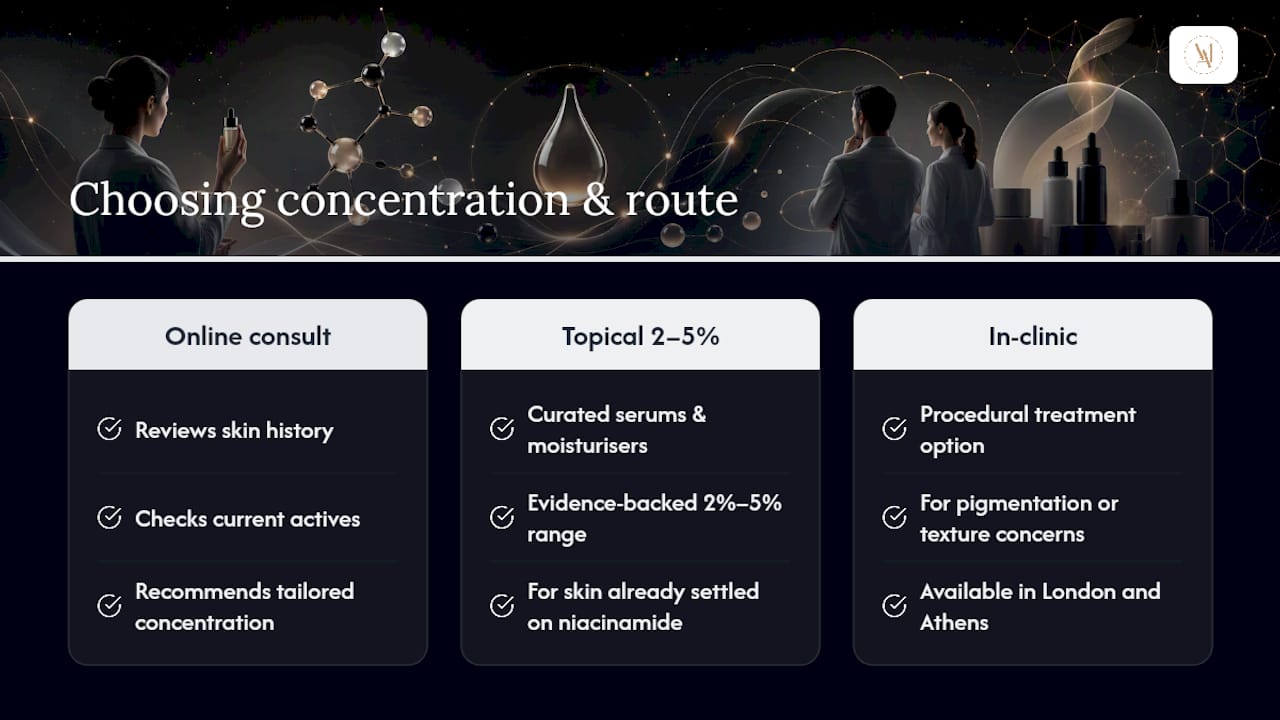
Rather than leaving you to interpret percentages off a label, an online skin consultation with one of our clinicians reviews your skin history, current actives, and goals before recommending a concentration and formulation suited to you, not a generic recommendation pulled from a bottle.
If your skin has settled on niacinamide and you’re ready to explore further, our curated range of serums and moisturisers features well-formulated options across the evidence-backed 2%–5% range. For pigmentation or texture concerns that need more than a topical alone, our in-clinic treatments in London and Athens offer a procedural route worth discussing with a clinician first. Book a consultation to get a plan built around your skin rather than a percentage on a label.
This article is general information, not a substitute for advice from a qualified doctor. Consult a qualified healthcare professional about your own circumstances before acting on anything here.
Sources
- Randomized, double-blind, split-face trial of 5% niacinamide (Bissett et al.)
- Hakozaki et al. 2002 — 5% niacinamide and hyperpigmentation
- How Much Do We Really Know About Our Favorite Cosmeceutical Ingredients? (PMC)
FAQ
Is 5% or 10% niacinamide better?
5% has the stronger evidence base, including the Bissett split-face RCT and Hakozaki’s pigmentation data.
Is 20% niacinamide too high?
Most dermatologists don’t recommend going that high without clinician supervision.
How long does niacinamide take to show results?
Most trial data and clinical guidance point to visible changes in tone and texture appearing between four and twelve weeks of consistent use, matching the 12-week timeframe used in the primary split-face trials.
Can I use niacinamide with vitamin C and retinoids?
Niacinamide and vitamin C can generally be used together despite the common myth that they cancel each other out. With retinoids or exfoliating acids, separate applications by time of day or alternate nights to reduce irritation risk.