





Skin cycling explained: Build a smarter, healthier routine
TL;DR:
- Skin cycling is a structured rotation of active skincare and recovery nights that supports barrier repair and reduces irritation. It involves a four-night cycle alternating exfoliation, retinoid application, and barrier-supporting recovery, improving long-term skin health. This approach aligns with skin biology, enhances tolerance, and yields sustainable results across diverse skin types.
There is a persistent belief in skincare that more is more. Use retinol every night, layer acids daily, and you will see faster results. In practice, the opposite is often true. Overloading skin with potent actives night after night disrupts the skin barrier, triggers chronic irritation, and ultimately slows progress. Skin cycling challenges this approach with a structured, evidence-informed method that alternates between active and recovery nights, giving your skin the treatment it needs and the breathing room it deserves. This article covers the core method, the science behind it, and how to apply it intelligently to your own routine.
Table of Contents
- What is skin cycling?
- How the skin cycling method works
- The science: Why skin cycling works
- Skin cycling vs cycle syncing: Avoiding confusion
- Practical tips and pitfalls: Applying skin cycling correctly
- Our perspective: What most routines get wrong about skin cycling
- Advanced solutions for your skin cycling journey
- Frequently asked questions
Key Takeaways
| Point | Details |
|---|---|
| Actives rotation improves skin health | Alternating actives with recovery nights prevents irritation and supports repair. |
| Four-night cycle structure | Skin cycling follows exfoliation, retinoid, then two recovery nights for optimal results. |
| Essential recovery phase | Recovery nights hydrate and strengthen the skin barrier, especially for sensitive types. |
| Avoid confusion with cycle syncing | Skin cycling refers to rotating actives; cycle syncing is hormone-based product selection. |
| Sunscreen remains crucial | Skin cycling is evening-focused and does not replace daily sun protection or basic care. |
What is skin cycling?
Skin cycling is a structured approach to your evening skincare routine that deliberately alternates between nights of active treatment and nights of recovery. Rather than applying retinoids or exfoliating acids every evening, the method builds in planned rest periods to allow the skin barrier to repair itself and remain resilient.
The concept gained widespread attention when dermatologist Dr Whitney Bowe popularised it on social media, but the underlying logic is grounded in well-established dermatology. Skin cycling alternates exfoliating actives, retinoids and recovery nights in a repeating sequence. The framework is straightforward: exfoliate on night one, apply retinoid on night two, then spend two nights focusing entirely on barrier support and hydration. That four-night structure then repeats.
This is not about using fewer actives out of timidity. It is about timing them intelligently. When skin is perpetually exposed to exfoliants and retinoids without recovery, it cannot keep pace with the cellular turnover those ingredients demand. The result is sensitised, compromised skin that is paradoxically less responsive to treatment. Skin cycling solves this by giving the skin a predictable rhythm.
Keeping an eye on healthy skin trends reveals that skin cycling represents one of the most clinically sensible shifts in routine skincare in recent years, precisely because it is rooted in how skin biology actually works.
Traditional nightly actives vs. skin cycling: A quick comparison
| Factor | Traditional nightly actives | Skin cycling |
|---|---|---|
| Barrier disruption | High risk with daily use | Minimised through planned recovery |
| Irritation likelihood | Elevated | Significantly reduced |
| Skin tolerance | Slow to build | Accelerated via structured rest |
| Long-term results | Inconsistent | More sustainable |
| Suitable for sensitive skin | Rarely | Yes, with adjusted recovery ratio |
The difference in outcomes is not subtle. Clients who switch from daily retinoid use to a structured cycling approach frequently report that their skin becomes less reactive and more responsive to active ingredients over time, not less.
“Skin cycling gives potent actives a chance to work without the barrier damage that continuous use often creates. Think of it as strategic rather than cautious.”
How the skin cycling method works
The structure of skin cycling is a repeating 4-night cycle, and each night has a specific purpose. Understanding the role of each phase is what separates effective cycling from simply skipping days at random.
The four-night cycle, step by step:
-
Night one: Exfoliation. After cleansing, apply a chemical exfoliant. Alpha hydroxy acids (AHAs) such as glycolic or lactic acid are most commonly used for surface renewal, while beta hydroxy acids (BHAs) like salicylic acid are preferred for those managing breakouts or congestion. Use gentle exfoliating cleansers to prepare the skin before your exfoliant, avoiding over-stripping the surface prior to treatment.
-
Night two: Retinoid. After a calming cleanse, apply your retinoid of choice. This is the most potent phase of the cycle. The retinoid works more effectively here because the exfoliation from the previous night has cleared away surface debris and improved penetration. Products such as R-Retinoate Day Night by Medik8 offer stabilised, well-tolerated retinoid activity suited to this step.
-
Night three: Recovery. No actives. Focus entirely on barrier-supporting ingredients such as ceramides, hyaluronic acid, niacinamide, and peptides. The skin is working hard to repair itself after two consecutive active nights, and this is when you support that process.
-
Night four: Recovery. Repeat the same recovery-focused approach. Two full nights of repair is what differentiates skin cycling from simply alternating actives and rest on alternate nights. This extended window allows the barrier to genuinely rebuild before active treatment begins again.
Example 4-night cycle mapped out:
| Night | Focus | Key ingredients |
|---|---|---|
| 1 | Exfoliation | AHA, BHA, gentle cleanser |
| 2 | Retinoid treatment | Retinol, retinaldehyde, retinoate |
| 3 | Recovery | Ceramides, hyaluronic acid, peptides |
| 4 | Recovery | Niacinamide, squalane, barrier lipids |
Pro Tip: If you are newer to retinoids or have reactive skin, you can extend recovery to three nights rather than two during the first month. The cycle is flexible, and getting the rhythm right matters more than strict adherence to a four-night count.
The science: Why skin cycling works
Having clarified the process, let us explore why this method produces results beyond conventional routines. The efficacy of skin cycling is not simply anecdotal. It maps directly onto what we know about skin physiology and barrier function.
When you apply an exfoliating acid or a retinoid, you are introducing a controlled stressor to the skin. Retinoids accelerate cell turnover, stimulate collagen production, and signal fibroblast activity. Exfoliants dissolve the bonds between dead skin cells, clearing the surface and improving both tone and absorption. These are genuinely transformative processes, but they require energy and recovery time.

Using these actives nightly means you are continuously disrupting the barrier before it can fully regenerate. Transepidermal water loss (TEWL) rises when the barrier is compromised, skin becomes sensitised, and inflammation follows. This chronic low-grade inflammation is precisely what drives accelerated ageing and worsens conditions like rosacea or post-inflammatory hyperpigmentation.
Skin cycling reduces irritation by spacing potent ingredients and supports barrier repair during recovery nights. This is the mechanism at the heart of the method.
Key benefits of cycling actives:
- Reduced transepidermal water loss between active nights
- Improved skin tolerance to retinoids over time, often enabling a step up in strength
- Lower risk of rebound sensitivity or reactive skin flares
- More consistent results due to a barrier that stays functional
- Enhanced penetration of actives when skin is not chronically inflamed
Recovery nights are not passive. When you apply ceramides, peptides, and hyaluronic acid to a post-active skin surface, you are actively replenishing what the treatments have temporarily depleted. Products such as the Recovery Night Complex by Calecim Professional are formulated specifically for this kind of targeted barrier restoration, using growth factors and stem cell-derived proteins to support overnight repair.
For sensitive skin, recovery nights are most important for barrier restoration. If your skin is prone to redness, flaking, or reactive flushing, the recovery phase is where the real progress happens. Consider reading more about the best approaches for skin barrier repair to build the most effective recovery toolkit possible.
Pro Tip: If your skin feels tight or looks dull the morning after an active night, that is a signal to extend recovery, not to push through with another active. A responsive routine is always more effective than a rigid one.
Skin cycling vs cycle syncing: Avoiding confusion
To prevent confusion, it is essential to understand how skin cycling compares with similarly named methods. The terms skin cycling and cycle syncing are frequently muddled online, and they refer to entirely different practices.
Skin cycling is about rotating your skincare actives in a structured sequence, completely independent of hormonal fluctuations. Cycle syncing, by contrast, aligns product choices and lifestyle habits with the four phases of the menstrual cycle, using hormone-phase-based logic to dictate what your skin might need at a given point in the month.
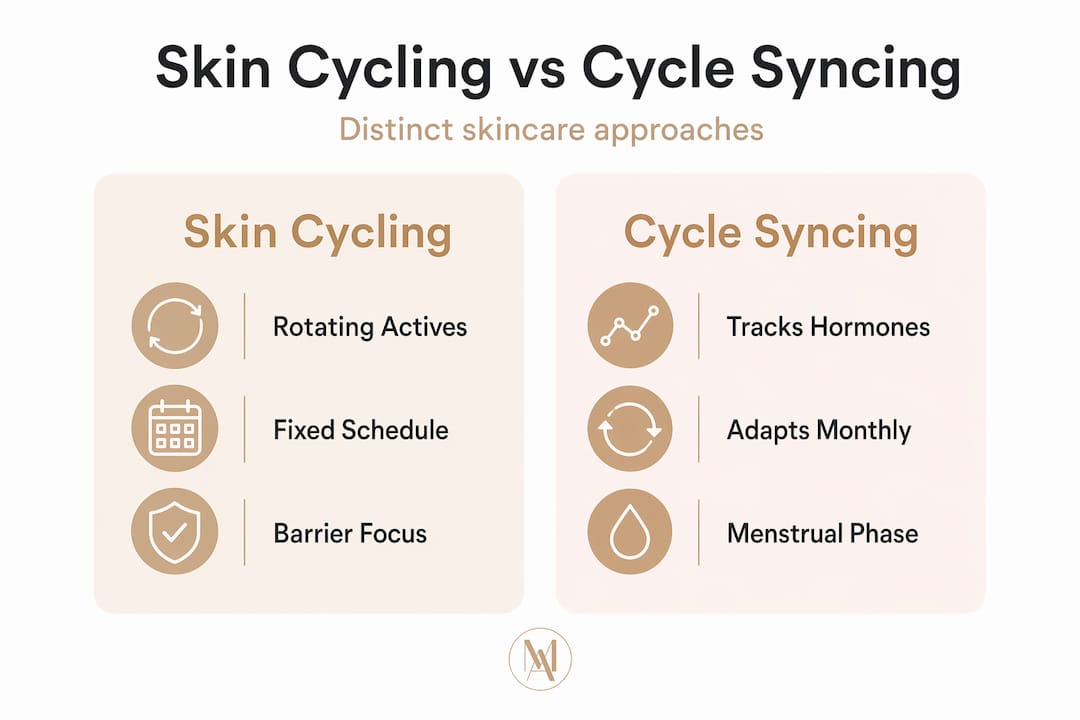
Skin cycling and cycle syncing are distinct methods, and treating them as interchangeable leads to genuine confusion about goals, implementation, and expected results.
Skin cycling vs cycle syncing: Key differences
| Feature | Skin cycling | Cycle syncing |
|---|---|---|
| Based on | Actives rotation schedule | Hormonal cycle phases |
| Applies to | All skin types, all genders | Primarily menstruating individuals |
| Duration of cycle | 4 nights | 28 days (approximate) |
| Main goal | Barrier health and tolerance | Hormonal skin harmony |
| Evidence base | Dermatologically supported | Emerging and more variable |
At a glance, the key differentiators:
- Skin cycling is universally applicable regardless of gender or hormonal status
- Cycle syncing is tailored to the biological changes across a menstrual cycle
- Skin cycling can be started immediately with any evening routine
- Cycle syncing requires tracking hormonal phases before personalising products
If you are exploring skincare adjustments during a specific life stage, such as pregnancy, reviewing guidance on pregnancy-friendly skincare actives is a sensible first step before choosing any rotation method.
Practical tips and pitfalls: Applying skin cycling correctly
With a clearer understanding, it is time for practical application. Knowing the method is one thing; implementing it without common errors is another entirely.
Common mistakes to avoid:
-
Layering actives on exfoliation night. Using both an exfoliant and a retinoid on the same evening overloads the skin and defeats the purpose of the cycle. Keep nights clearly defined.
-
Skipping SPF during the day. Skin cycling is not a substitute for sunscreen or foundational daily care. Retinoids increase photosensitivity, and if you are exfoliating regularly, broad-spectrum SPF is non-negotiable every morning.
-
Choosing too potent a retinoid too soon. Start with a lower concentration and increase strength after your skin has adapted. Products like the Intensive Age Refining Treatment 0.5% Pure Retinol Night by PCA Skin offer an effective but considered entry point.
-
Not adjusting the cycle for your skin concern. Acne-prone skin may benefit from a BHA on exfoliation night and a targeted acne treatment formula incorporated into the recovery phase. Hyperpigmentation cases may require a vitamin C serum introduced strategically during recovery nights.
-
Treating recovery nights as optional. This is possibly the most common error. Recovery nights are not rest days for your routine; they are active repair nights. Skipping them undermines the entire framework.
Tailoring skin cycling by concern:
- Ageing skin: Prioritise a quality retinoid on night two and use peptide-rich formulas during recovery
- Acne and congestion: Choose salicylic acid on exfoliation nights and a lightweight, non-comedogenic barrier repair for recovery
- Hyperpigmentation: Add a vitamin C or niacinamide serum during recovery nights alongside your barrier support
- Sensitive or rosacea-prone: Opt for a very gentle AHA at low concentration and extend recovery to three nights
Pro Tip: Track your skin’s response in the first two cycles. Note texture changes, dryness, or breakouts by night, as this data will help you personalise the rhythm and ingredient choices with precision.
Our perspective: What most routines get wrong about skin cycling
Here is what we observe consistently, across clients at every skin concern level: most people understand what skin cycling involves, but they fundamentally undervalue the recovery nights. They treat them as an inconvenient gap between the “real” active nights, rather than recognising them as the structural foundation that makes the active nights effective.
Nightly use of retinoids and acids is not ambitious skincare. It is, in most cases, counterproductive. Chronic barrier disruption creates a skin environment that is inflamed, reactive, and resistant to treatment. We regularly see clients who arrive convinced that their retinoid “has stopped working,” when in fact what has stopped working is their barrier. The ingredient is fine. The skin is exhausted.
Skin cycling’s contribution to routine skincare is not just structural convenience. It reframes recovery as a core therapeutic phase rather than an absence of action. When you commit to repairing your skin barrier with the same rigour you apply to active treatment, the results speak for themselves. Clients who follow a properly structured cycle consistently report that their skin tolerates stronger actives, responds more visibly to treatment, and looks measurably healthier within six to eight weeks.
The broader lesson is this: sustainable skincare is not about doing the most every night. It is about doing the right thing in the right sequence, consistently, and with enough patience to let the skin’s own repair mechanisms do their part.
Advanced solutions for your skin cycling journey
For those ready to take their skin cycling routine to the next level with clinically formulated products for each phase, we have curated options across every step of the cycle. On exfoliation nights, the ClearSkin serum by PCA Skin delivers targeted clearing activity suited to congestion-prone skin types. For retinoid nights, the Intensive Age Refining Treatment retinol night cream offers pure retinol in a well-tolerated, results-driven formula. And for those who want to explore a broader range of exfoliating and resurfacing options to anchor their active nights, the Neostrata collection features AHA-led formulations backed by decades of clinical research. Every product we recommend is chosen for efficacy, tolerability, and its ability to work within a structured cycling framework.

Frequently asked questions
How long does it take to see results from skin cycling?
Most users notice improvements in texture and tolerance within two to four weeks, particularly when the method is followed consistently without skipping recovery nights.
Is skin cycling suitable for all skin types, including sensitive skin?
Skin cycling benefits most skin types; sensitive and barrier-impaired skin in particular gains from the structured recovery nights that reduce cumulative irritation and support healing.
Can I use skin cycling if I am pregnant or breastfeeding?
Retinoids are contraindicated during pregnancy, so the retinoid night must be adapted using pregnancy-safe alternatives. Review cycle syncing and pregnancy-safe actives guidance and consult a dermatologist before starting any new routine during this period.
Should I change my daytime routine when starting skin cycling?
Daytime essentials, particularly broad-spectrum SPF and a gentle cleanser, remain essential throughout. Skin cycling does not replace sunscreen or morning skincare basics; it restructures only the evening routine.
What is the difference between skin cycling and cycle syncing?
Skin cycling is a structured rotation of actives and recovery nights applicable to anyone, while cycle syncing is hormone-phase-based and aligned to the menstrual cycle, making them entirely distinct practices with different goals.