



Sebaceous filaments vs blackheads: how to tell them apart
Those small dark or greyish dots across your nose and cheeks are, in most cases, sebaceous filaments, not blackheads. A filament is a normal channel that carries oil to the skin’s surface; a blackhead is a clogged pore where trapped, oxidised sebum has hardened into a plug. The quickest way to tell them apart:
- Colour and profile: filaments sit flush with the skin and look grey, tan, or yellowish; blackheads bulge slightly and turn dark brown or black.
- What not to do: don’t squeeze either one. Squeezing a filament empties it temporarily before it refills, and squeezing a blackhead can push bacteria deeper and cause scarring.
- First move: start a gentle, oil-targeting routine with salicylic acid, and book a dermatology consultation if anything looks inflamed or painful.
Key Takeaways
Sebaceous filaments are normal oil channels that respond to gentle, consistent care, while blackheads are oxidised plugs that sometimes need clinical escalation.
| Point | Details |
|---|---|
| Know the core difference | Filaments are flat, normal oil channels; blackheads are raised, oxidised, clogged pores. |
| Never squeeze either one | Squeezing refills filaments within about a month and risks scarring blackheads. |
| Start with salicylic acid | Use 1 to 2% BHA a few times weekly before introducing a retinoid. |
| Escalate when care stalls | Persistent, painful, or changing lesions warrant a dermatology consultation. |
| Consider clinician-led triage | Them-ethod’s virtual consultations and medical-grade actives support the step beyond over-the-counter care. |
Table of Contents
- Sebaceous filaments vs blackheads: what they actually are and why they form
- Spotting the visual and physical differences
- How to check your skin safely at home
- Building an at-home routine that actually reduces their appearance
- What professional treatments can and can’t do
- When it’s time to book a dermatologist
- Why clinician-led triage beats guesswork on this one
- Where to start if you want a clinician-backed routine
- Frequently asked questions
- Sources
Sebaceous filaments vs blackheads: what they actually are and why they form
A sebaceous filament is not a blemish. It’s a hairlike lining of dead skin cells and sebum that sits inside every pore, working constantly to shepherd oil from the sebaceous gland up to the surface. Everyone has them, though they’re most visible on the nose, chin, and centre of the cheeks, where oil glands cluster and pores run wider.
A blackhead, by contrast, is a genuine skin complaint. Dermatologists classify it as an open comedone: a pore that has become blocked with excess sebum and dead skin cells, then exposed to air. Oxidation darkens the trapped material, giving it that classic black tip.
Several factors push either condition into view:
- Naturally oily skin produces more sebum, so filaments appear more prominent and blackheads form more readily.
- Larger pore size, often genetic, gives both structures more room to become visible.
- Hormonal shifts, particularly during puberty or the menstrual cycle, increase oil output.
- Heavy, comedogenic skincare or makeup can thicken the material sitting inside the pore.
Spotting the visual and physical differences
Colour is the fastest tell. Filaments read as flat, uniform grey, tan, or pale yellow, almost like a fine dusting across the nose. Blackheads look darker and sit slightly raised, because the oxidised plug pushes outward rather than lying flush with the follicle.
- Filaments: flat, evenly spread, appear in clusters, most obvious on the nose and inner cheeks.
- Blackheads: raised, isolated, scattered rather than clustered, often accompanied by visibly enlarged pores.
- Extraction texture: a filament yields a thin, waxy, threadlike strand; a blackhead releases a firmer, darker plug.
Dermoscopic imaging backs this up at a microscopic level. Specialists describe sebaceous filaments as showing a consistent off-white or yellowish plug pattern under magnification, sometimes nicknamed the “lunar crater sign” for its uniform, punched-out look. Blackheads, being an inflammatory process, show far more variation from lesion to lesion.
How to check your skin safely at home
Wash your face first and check your skin in good, even lighting, ideally daylight rather than a bathroom spotlight that can exaggerate shadows and texture.
- Look for clustering versus isolation: filaments group together; blackheads tend to stand alone.
- Note whether it’s raised: run a fingertip gently over the area rather than pressing.
- Watch for colour change over days: a lesion that darkens or grows is more likely a blackhead or early breakout than a filament.
Resist squeezing during this check. Manual pressure on a filament empties it temporarily, but it refills within about a month since it’s simply doing its job again. On a blackhead, squeezing risks pushing bacteria deeper into the follicle, which can trigger inflammation or scarring.
Pro Tip: Take a photo under the same lighting once a month. It’s far more reliable than memory for tracking whether a routine is actually reducing visible pores.
Book a dermatology appointment if you notice pain, spreading redness, or any lesion that looks like it’s leaving a mark behind. Those signs point beyond simple filaments or blackheads.
Building an at-home routine that actually reduces their appearance
Neither sebaceous filaments nor blackheads disappear permanently. The realistic goal is control, not elimination, and that comes down to two ingredients working in tandem with sensible cleansing.
- Double cleanse if you wear makeup or sunscreen. An oil-based cleanser first lifts product and excess sebum, followed by a gentle gel cleanser that won’t strip the skin.
- Introduce salicylic acid. This oil-soluble BHA penetrates directly into the pore lining, dissolving the buildup that makes both filaments and blackheads more visible. Over-the-counter formulas typically sit at 1 to 2%, used a few times a week to start rather than daily.
- Layer in a retinoid. Retinoids increase cell turnover, which helps prevent dead skin cells from binding with oil inside the pore. Most people start two to three nights a week and build tolerance over four to eight weeks before seeing meaningful change; full results often take a few months.
- Use a clay mask once or twice weekly to draw out surface oil without the daily stripping that comes from over-exfoliating.
- Protect the barrier. Non-comedogenic moisturiser and daily sun protection matter just as much as the active ingredients, since sun damage and a compromised barrier can make pores look worse over time.
Clinical commentators are consistent on one point: aggressive exfoliation or stacking too many active ingredients does more harm than good. Strip the barrier and skin often responds by producing more oil, undoing the entire point of the routine.
Pro Tip: Introduce salicylic acid and retinoids on separate nights when you’re starting out. Combining two potent actives before your skin has adjusted is the most common cause of redness and flaking.

Pairing a salicylic acid with a retinol product designed for gradual introduction tends to outperform switching products every few weeks looking for a quick fix.
What professional treatments can and can’t do
When a consistent topical routine isn’t moving the needle, in-clinic options offer more targeted control. Chemical peels using salicylic or glycolic acid exfoliate more deeply than at-home strengths allow, softening the appearance of both filaments and blackhead-prone pores over a course of sessions.
- Microdermabrasion physically buffs away surface dead skin cells, temporarily reducing the debris that makes pores look larger.
- Professional extraction, performed with sterile tools under trained hands, carries far less risk of scarring than squeezing at home.
- Energy-based devices are the newest frontier. Research into selective photothermolysis at 1726nm suggests lasers tuned to this wavelength may target sebaceous glands directly. Broader phototherapy approaches are already used for general skin health applications, but controlled trials on isolated filaments specifically remain limited, so results should be treated as promising rather than proven.
None of these procedures offers a permanent fix. Sebum production continues, so maintenance sessions every few months are typically needed to sustain results.
When it’s time to book a dermatologist
Self-care has its limits, and a few signs mean it’s time to stop experimenting and get a professional opinion:
- Lesions stay inflamed, painful, or keep recurring despite several weeks of consistent salicylic acid and retinoid use.
- A spot changes shape, size, or colour rapidly, or you’re simply not sure what you’re looking at.
- You notice early scarring or dark marks left behind after a blemish clears.
A dermatology consultation can offer prescription-strength retinoids, in-clinic procedures suited to your skin type, and a plan built around your actual pore pattern rather than generic advice.
Why clinician-led triage beats guesswork on this one
Most people treat sebaceous filaments and blackheads with the same panicked energy, reaching for the strongest exfoliant on the shelf the moment their nose looks textured. That instinct is backwards. Filaments respond to patience and consistency; blackheads sometimes need a plan that escalates.
At The M-ethod, that escalation follows a deliberate order: topical oil control first, prescription-strength actives if over-the-counter strengths plateau, and in-clinic procedures reserved for cases where topicals alone won’t shift the texture. Virtual consultations with our clinicians exist precisely for the grey area between “just keep using salicylic acid” and “you need a peel.” If your own routine has stalled after a genuine trial, that’s the moment to ask a professional rather than escalate the product shelf yourself.
Where to start if you want a clinician-backed routine
Guessing your way through a skincare aisle for oily pores rarely beats a plan built around your actual skin. Them-ethod’s PCA Clearskin serum targets excess oil and visible pore congestion directly, giving you a medical-grade alternative to the trial-and-error routines most people default to. For anyone whose filaments or occasional blackheads have proven stubborn, our acne skincare collection pairs actives at appropriate strengths rather than leaving you to guess at percentages.
If you’d rather have a clinician map the plan before you buy anything, book a virtual skin consultation. You’ll get a tailored routine, an honest read on whether prescription retinoids or in-clinic care make sense, and a clear next step instead of another product gathering dust in a cabinet.
Frequently asked questions
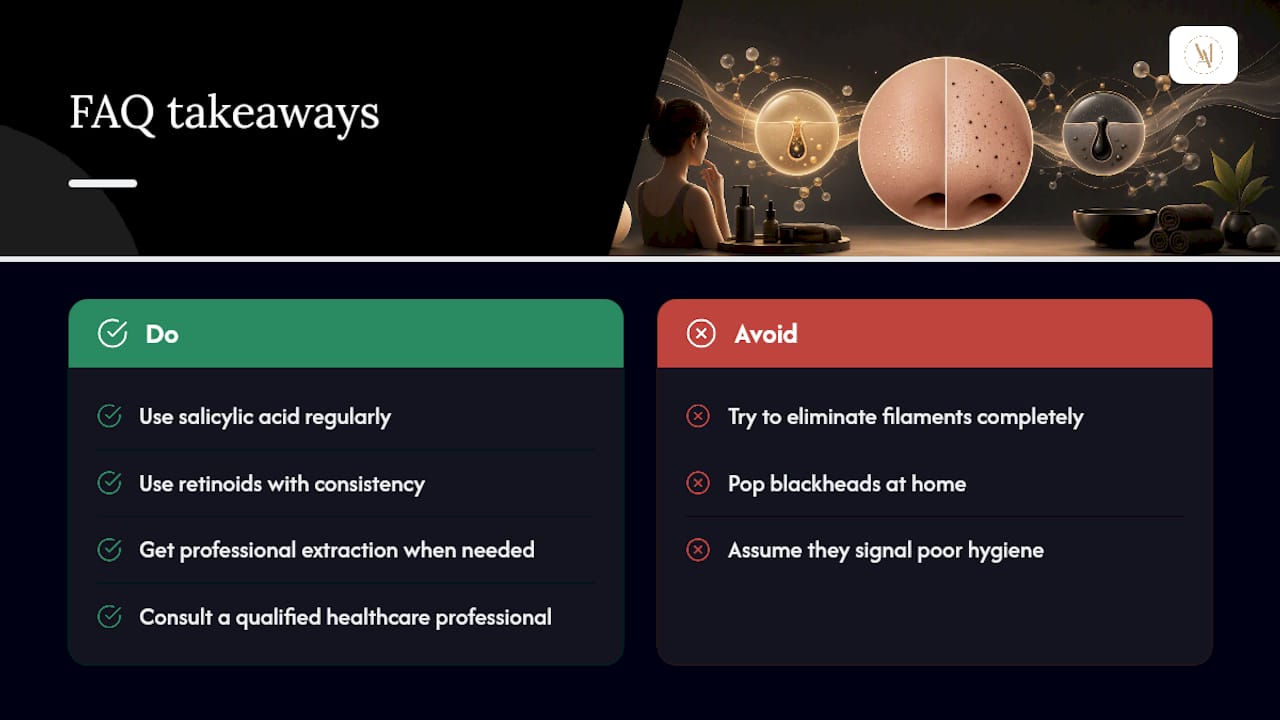
Are sebaceous filaments bad for your skin? No. They’re a normal, functional part of every pore, not a sign of poor skincare or hygiene. Trying to eliminate them completely isn’t realistic or necessary.
What’s the real difference between a blackhead and a clogged pore? A blackhead is one specific type of clogged pore, an open comedone where the trapped material has oxidised and darkened. Other clogged pores may stay closed beneath the surface, forming whiteheads instead.
Do BHAs work for sebaceous filaments? Yes, salicylic acid’s oil solubility lets it get inside the follicle and loosen the buildup that makes filaments look more prominent, though it won’t remove them permanently.
What’s the safest blackhead extraction technique? Professional extraction with sterile tools under trained hands carries far less risk than home popping, which can push bacteria deeper and leave marks.
How long does it take to see results from a new routine? Expect four to eight weeks before noticing a real change with consistent salicylic acid and retinoid use, with fuller results building over a few months.
This article is general information, not a substitute for advice from a qualified doctor. Consult a qualified healthcare professional about your own circumstances before acting on anything here.
Sources
- Sebaceous Filaments
- Sebaceous filaments
- PMC article on sebaceous-gland targeting and dermoscopy
- Sebaceous filaments vs blackheads