




Pigmentation solutions checklist: AM/PM routine + pro steps
Start reducing pigmentation today with four non-negotiable actions: apply a broad-spectrum SPF 50+ every morning, layer a vitamin C serum underneath it, use a targeted brightening active (retinoid, tranexamic acid, or azelaic acid) at night, and book a clinician review if your pigmentation is hormonal, deep, or treatment-resistant.
Start today — your immediate checklist:
- Apply broad-spectrum SPF 50+ (tinted with iron oxides if you have melasma or post-inflammatory hyperpigmentation)
- Use a stabilised vitamin C serum (10–20% L-ascorbic acid) every morning before sunscreen
- Introduce a nightly brightening active: retinoid, tranexamic acid, or azelaic acid (start two to three nights per week)
- Patch-test every new active on the inner arm for 24–48 hours before full application
- Check for contraindications: retinoids and hydroquinone are not safe in pregnancy; certain medications increase photosensitivity
- Consult a dermatologist if pigmentation is uncertain, rapidly changing, or unresponsive after several weeks of consistent topical treatment
The Medscape guideline summary and the global expert consensus both place photoprotection at the centre of every pigmentation treatment plan, before any topical or procedural intervention.
Key takeaways
Consistent photoprotection and a targeted topical routine are the foundation of every effective pigmentation treatment plan, and maintenance is required long-term for chronic conditions like melasma.
| Point | Details |
|---|---|
| SPF 50+ is non-negotiable | Apply broad-spectrum sunscreen every morning; use tinted with iron oxides for melasma or PIH. |
| Build routines slowly | Introduce one new active at a time, starting two to three nights per week before increasing frequency. |
| Topical-first approach | Combination topical therapy (vitamin C, retinoid, azelaic acid, tranexamic acid) is the clinical first-line for surface pigmentation. |
| Seek a clinician for complex cases | Hormonal, deep, uncertain, or treatment-resistant pigmentation needs professional assessment before procedural intervention. |
| Them-ethod for prescription support | Virtual consultations and prescription-grade products are available via Them-ethod for personalised pigmentation management. |
Table of Contents
- What type of pigmentation do you have, and what causes it?
- Evidence-backed active ingredients: what they do and how to use them
- Your practical AM and PM routine checklist
- How to layer, combine, and introduce actives safely
- When should you consider professional treatment options?
- Photoprotection and lifestyle habits that prevent pigmentation returning
- Safety notes, special populations, and important cautions
- What the clinical evidence says about managing hyperpigmentation
- Printable AM/PM checklist and quick-reference guide
- Sources
What type of pigmentation do you have, and what causes it?
Identifying your pigmentation type is the first step in choosing the right treatment path. The five main types behave differently, respond to different actives, and carry different risks if mismanaged.
- Melasma: Symmetrical brown or grey-brown patches, typically on the cheeks, upper lip, forehead, and chin. Strongly hormone-driven (pregnancy, oral contraceptives) and worsened by UV and visible light. Chronic and prone to relapse.
- Solar lentigines (sun/age spots): Flat, well-defined brown spots appearing on sun-exposed areas. Caused by cumulative UV damage; more common after 40. Generally surface-level and responsive to topical treatment and lasers.
- Post-inflammatory hyperpigmentation (PIH): Flat discolouration left after acne, eczema, a burn, or any skin trauma. More pronounced in deeper skin tones (Fitzpatrick types IV–VI). Fades with time and topical actives, but slowly.
- Periorbital hyperpigmentation: Darkening under and around the eyes. Can be vascular, structural (thin skin), or pigmentary in origin — the cause determines the treatment, and topical brighteners alone rarely resolve vascular or structural cases.
- Medication-induced or disorder-related pigmentation: Certain drugs (minocycline, antimalarials, amiodarone, some chemotherapy agents) deposit pigment in the skin or trigger melanocyte activity. Cleveland Clinic guidance is clear that treating the root cause must come before any cosmetic intervention.
When to seek a dermatology review promptly: a lesion that is changing in size, shape, or colour; any pigmented lesion with irregular borders or bleeding; uncertain diagnosis; suspected lentigo maligna; pigmentation appearing during pregnancy or alongside a new medication. A Wood’s lamp or dermoscopy can help distinguish epidermal from dermal pigment, which matters because dermal pigment responds poorly to most topical agents and requires procedural input.
Evidence-backed active ingredients: what they do and how to use them
Combination topical therapy is consistently described as the most effective approach for surface pigmentation, and the ingredient list below reflects what clinical evidence supports. No single active works in isolation as well as a well-chosen combination.

| Active | Mechanism | Typical concentration | Key cautions |
|---|---|---|---|
| Vitamin C (L-ascorbic acid) | Tyrosinase inhibition + antioxidant protection | 10–20% | Unstable in light/air; use stabilised formulations |
| Niacinamide | Reduces melanosome transfer to keratinocytes | 2–5% | Generally well tolerated; may cause flushing at high doses |
| Retinoids (retinol, tretinoin) | Accelerates cell turnover, disperses melanin | used at concentrations recommended by treating clinician | Avoid in pregnancy; start low, increase slowly |
| Azelaic acid | Tyrosinase inhibition + anti-inflammatory | 10–20% (15–20% Rx) | Safe in pregnancy (with clinician advice); mild irritation possible |
| Tranexamic acid | Disrupts UV-induced melanocyte activation | 2–5% topical | Well tolerated across skin types; oral use is clinician-managed |
| Hydroquinone | Tyrosinase inhibition (potent) | 2% OTC; 4% Rx | Short-term use only; avoid in pregnancy; can cause ochronosis with prolonged use |
| Kojic acid | Tyrosinase inhibition | used within tolerable concentration ranges | Sensitising at higher concentrations; patch-test carefully |
| Arbutin (alpha-arbutin) | Tyrosinase inhibition (gentler than HQ) | 1–2% | Generally well tolerated; avoid combining with strong acids |
| Thiamidol | Selective tyrosinase inhibition | As per formulation | Newer ingredient; emerging clinical evidence |
| AHAs (glycolic, lactic acid) | Exfoliation, accelerates pigment shedding | Glycolic 5–10% OTC; 2–6 sessions clinical peels | Increases photosensitivity; always pair with SPF |
| BHAs (salicylic acid) | Exfoliation, anti-inflammatory | 0.1–0.3% | Avoid in pregnancy at high concentrations |
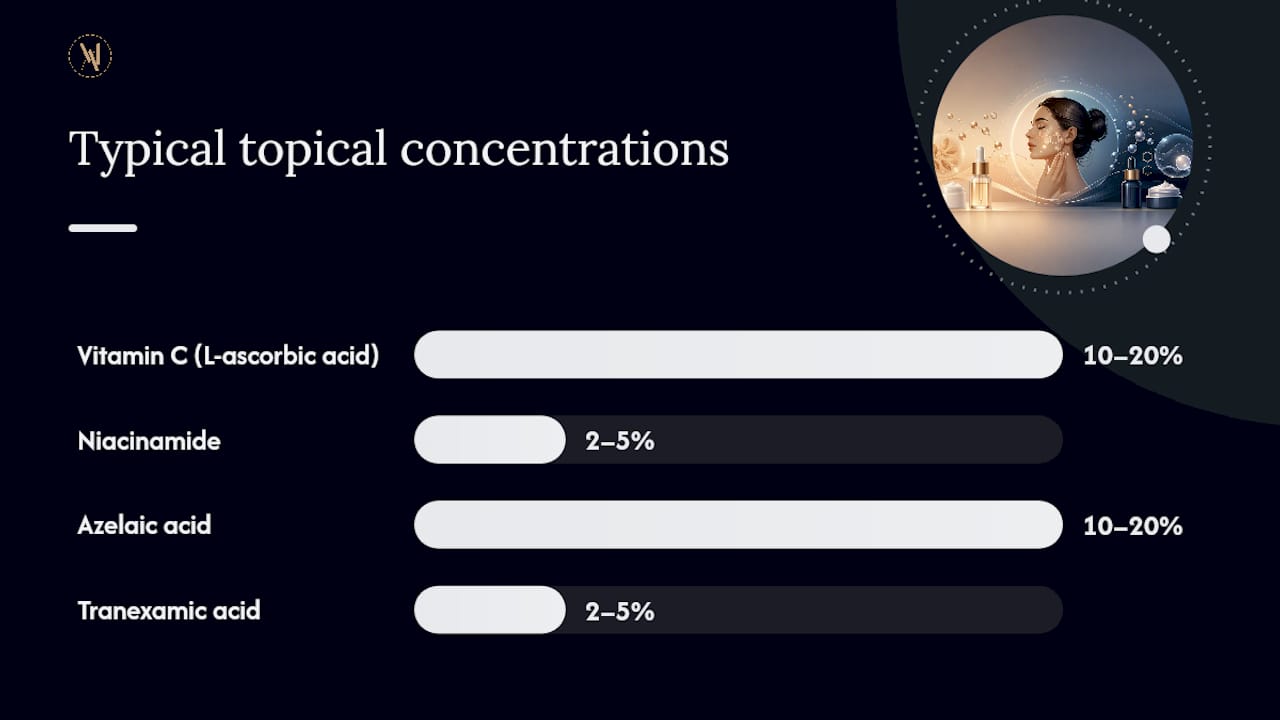
Topical tranexamic acid is increasingly favoured by practitioners for melasma and PIH because it targets a different pathway from tyrosinase inhibitors, making it a useful addition to combination routines rather than a substitute for them.
Pro Tip: Choose a vitamin C serum in an opaque, airtight bottle and check for a pH below 3.5 for L-ascorbic acid to remain active. Ascorbyl glucoside and sodium ascorbyl phosphate are more stable alternatives if you find pure L-ascorbic acid oxidises quickly in your climate.
Your practical AM and PM routine checklist
A consistent skincare routine for pigmentation does not need to be complicated. The sequence below follows the thin-to-thick layering principle and places actives where they work best.
Morning routine
- Cleanse with a gentle, pH-balanced cleanser. Avoid foaming cleansers with sulphates if your skin is reactive.
- Antioxidant serum — apply vitamin C (10–20% L-ascorbic acid or a stabilised derivative) to dry skin. Allow 60 seconds to absorb.
- Brightening booster — niacinamide (2–5%) or tranexamic acid serum if you are not using it at night. Apply over the vitamin C layer.
- Moisturiser — seal in actives and support the skin barrier. Choose a formula without fragrance if your skin is prone to PIH.
- Broad-spectrum SPF 50+ — the single most important step. For melasma or PIH, use a tinted sunscreen with iron oxides to block visible light as well as UV.
- Physical measures — wide-brimmed hat, UV-protective clothing, and shade between 10 AM and 4 PM.
Evening routine
- Double cleanse if you wore sunscreen or makeup. An oil-based cleanser first, then a gentle water-based cleanser.
- Targeted active — choose one: retinoid (start with retinol 0.1–0.3%, increase over weeks), azelaic acid (10–15%), or tranexamic acid. Do not layer all three on the same night.
- Exfoliant (two to three nights per week, not on retinoid nights) — glycolic acid 5–10% or lactic acid 5–10%. Never use a strong AHA on the same night as a retinoid.
- Moisturiser — apply over actives to buffer irritation. For retinoid nights, the “sandwich” method (moisturiser, retinoid, moisturiser) reduces sensitivity.
- Weekly treatment — a brightening mask or a higher-concentration AHA treatment (used once weekly, not alongside daily exfoliants).
Introducing new actives: add one new ingredient at a time, use it two to three nights per week for two weeks, then increase frequency only if your skin tolerates it without redness or peeling.
Pro Tip: If irritation appears, do not abandon the active entirely. Drop back to once or twice weekly and hold that frequency for a full month before increasing again. Slow and steady produces better long-term results than cycling through products.

How to layer, combine, and introduce actives safely
Layering multiple actives is where most people go wrong, either through incompatible combinations or by introducing too much too quickly. A well-structured pigmentation routine respects both chemistry and skin tolerance.
Core layering rules:
- Apply water-based serums before oil-based ones; thinner textures before thicker.
- Vitamin C belongs in the morning, where it doubles as an antioxidant against UV-induced free radicals.
- Retinoids belong at night; UV exposure degrades their efficacy and increases irritation risk.
- Hydroquinone, if prescribed, is typically used at night and for defined treatment cycles (eight to twelve weeks), not indefinitely.
Combinations to avoid or use cautiously:
- Strong AHAs (glycolic acid 10%+) and retinoids on the same night — both increase cell turnover and the combined irritation can trigger PIH, particularly in deeper skin tones.
- Vitamin C (low pH) layered directly over niacinamide at high concentrations — this combination can cause temporary flushing in some skin types; applying them in sequence with a short gap usually resolves this.
- Physical exfoliants (scrubs, brushes) alongside active chemical exfoliants — redundant and likely to compromise the skin barrier.
- Waxing, threading, or any trauma-inducing hair removal on actively pigmented areas while using retinoids or hydroquinone.
Patch-testing procedure: apply a small amount of the new product to the inner forearm or behind the ear. Leave it for 24–48 hours without washing. If no redness, itching, or swelling appears, proceed with facial use on a small area for a further 48 hours before full application.
Pregnancy and breastfeeding: retinoids (all forms), hydroquinone, and high-concentration salicylic acid are generally avoided. Azelaic acid and niacinamide are considered acceptable with clinician guidance. Always confirm with your prescriber before starting or continuing any active during pregnancy.
Priming before procedures: if you are planning a chemical peel, laser, or microneedling session, begin a topical lightening routine (vitamin C, azelaic acid, or a prescribed agent) four to six weeks beforehand. This primes the skin and reduces the risk of post-procedure PIH.
When should you consider professional treatment options?
Topical actives are first-line, but some pigmentation types need clinical intervention to shift. The key is knowing which procedure suits which depth of pigment, and ensuring the skin is properly prepared.
Common procedural options:
- Chemical peels (glycolic acid, TCA, Jessner’s): best for surface-level pigmentation and mild PIH. In-clinic acid peels use higher concentrations than OTC products and are spaced four to six weeks apart. Expect two to six sessions for visible improvement.
- Microneedling: creates controlled micro-injuries that stimulate collagen and can enhance penetration of topical brighteners. Microneedling is particularly useful for PIH in darker skin tones when performed carefully, as it carries lower thermal risk than lasers.
- Q-switched Nd:YAG and picosecond lasers: target melanin directly. Picosecond devices tend to produce less heat and carry a lower PIH risk than older Q-switched systems. Best suited to solar lentigines and superficial dermal pigment.
- IPL (intense pulsed light): effective for solar lentigines and diffuse redness on lighter skin tones (Fitzpatrick I–III). Less predictable on darker skin types and not recommended for melasma as a first-line option.
Priming is not optional. The Medscape guideline supports pre-treating with topical lightening agents before any procedural intervention to reduce post-procedure PIH risk and improve outcomes. Skipping this step is one of the most common reasons pigmentation worsens after a procedure.
When to refer to a dermatologist:
- Deep dermal pigment unresponsive to 12+ weeks of topical treatment
- Widespread or hormonally driven melasma
- Any lesion that is uncertain, changing, or suspicious
- Pigmentation appearing alongside a new medication or systemic condition
- Pregnancy-related pigmentation requiring safe prescription options
Questions to bring to your consultation:
- Is my pigmentation epidermal, dermal, or mixed?
- Do I need to prime before any procedure, and for how long?
- Which laser or peel is safest for my skin tone?
- What maintenance will I need after treatment?
- Are any of my current medications contributing to my pigmentation?
For a fuller overview of pigmentation treatment options, including procedural comparisons, the Them-ethod journal covers the clinical landscape in detail.
Photoprotection and lifestyle habits that prevent pigmentation returning
Pigmentation is one of the most relapse-prone skin concerns. Melasma, in particular, can return within weeks of sun exposure even after successful treatment. Prevention is not a passive step — it is an active, daily commitment.
Sunscreen specifics:
- Use a broad-spectrum sunscreen covering UVB, long-wave UVA, and high-energy visible light (HEVL). The Medscape consensus recommends SPF 50+ for anyone managing a pigmentary disorder.
- Apply an adequate amount of sunscreen to cover the face evenly. Most people apply less than recommended, which reduces effective SPF significantly.
- Reapply every two hours when outdoors, or immediately after swimming or heavy sweating.
- For melasma and PIH, the AAD recommends tinted sunscreens with iron oxides because standard chemical sunscreens do not reliably block visible light, which is sufficient to reactivate melanocytes in sensitive skin. If a colour-matched tinted sunscreen is unavailable, apply a non-tinted broad-spectrum SPF followed by iron-oxide-containing makeup.
The global expert consensus on hyperpigmentation management places tinted sunscreens with iron oxides as the clinical standard for melasma and PIH, and emphasises that maintenance photoprotection is the single most important factor in preventing relapse — not just during treatment, but indefinitely. Source: Beiersdorf global consensus
Photoprotection behaviours:
- Seek shade between 10 AM and 4 PM, particularly in summer months.
- Wear wide-brimmed hats and UV-protective clothing (UPF 50+ rated) on high-exposure days.
- Apply sunscreen indoors near windows: UVA penetrates glass, and UV exposure is the dominant cause of photodamage and pigmented lesions.
- Use sun-protective window film in cars and offices if you spend extended time near glass.
Diet and lifestyle factors:
- Antioxidant-rich foods (vitamins A, C, and E from leafy greens, citrus, nuts, and oily fish) support the skin’s defence against UV-induced oxidative stress.
- Stay well hydrated; a compromised skin barrier is more susceptible to inflammation and subsequent PIH.
- Review oral contraceptives or hormone replacement therapy with your GP if melasma is hormonally driven — switching formulations sometimes reduces the trigger.
- Manage stress: elevated cortisol can worsen inflammatory skin conditions that lead to PIH.
- Avoid trauma to pigmented areas: waxing, aggressive tweezing, and picking at blemishes all increase PIH risk.
Safety notes, special populations, and important cautions
Some actives that are effective for pigmentation carry real risks in specific populations. Knowing these before you start protects both your skin and your health.
Pregnancy and breastfeeding:
- Avoid: retinoids (all forms, including retinol), hydroquinone, high-dose salicylic acid, and kojic acid.
- Generally considered acceptable with clinician guidance: azelaic acid, niacinamide, vitamin C, and gentle lactic acid exfoliants.
- Always confirm your full product list with your midwife or dermatologist before continuing any active during pregnancy.
Medication interactions:
- Certain medicines, including some antibiotics (tetracyclines), diuretics, antifungals, and NSAIDs, increase photosensitivity and can worsen pigmentation with UV exposure. The FDA’s guidance on sun and medicines is a useful reference to check your current prescriptions.
- If you suspect a medication is causing or worsening your pigmentation, speak to your prescribing doctor before stopping it.
Hydroquinone and topical steroid safety:
- Hydroquinone is effective but should be used in defined cycles (typically eight to twelve weeks) under clinician supervision. Prolonged unsupervised use can cause ochronosis (paradoxical darkening) and skin thinning.
- Topical steroids are sometimes included in combination pigmentation formulations (e.g., Kligman’s formula). These should only be used under medical supervision and for the shortest effective duration.
Stop treatment and seek care if you notice:
- Severe redness, blistering, or burning that does not resolve within 48 hours of stopping the active
- A pigmented lesion that is growing rapidly, bleeding, or developing irregular borders
- Signs of allergic contact dermatitis (widespread itching, swelling, or hives)
- Paradoxical darkening after starting a new active
What the clinical evidence says about managing hyperpigmentation
The evidence base for hyperpigmentation management has become considerably clearer over the past few years, with two major consensus documents shaping current clinical practice.
The Medscape guideline summary places photoprotection at the top of every treatment algorithm, specifying SPF 50+ with UVA and HEVL coverage as the foundation before any topical or procedural therapy is added. Topical agents are first-line for PIH, and priming the skin before procedures is described as a clinical priority to reduce post-procedure PIH risk.
The Beiersdorf global consensus reinforces this, adding that a personalised approach across skin types and resource settings is necessary, and that maintenance therapy for melasma is not optional — it is the difference between sustained improvement and rapid relapse.
Harvard Health’s review confirms that combination topical therapy — retinoids, azelaic acid, vitamin C, niacinamide, and acids used together thoughtfully — outperforms any single active. The Cleveland Clinic adds the critical caveat that underlying causes (medication, active inflammation, hormonal drivers) must be addressed before cosmetic treatment can succeed.
Pro Tip: When translating guidelines into a home routine, prioritise the two non-negotiables first: SPF 50+ every morning and one targeted brightening active at night. Add further actives only once those two habits are consistent. Complexity without consistency produces no results.
Printable AM/PM checklist and quick-reference guide
AM checklist
- Gentle cleanse
- Vitamin C serum (10–20% or stabilised derivative)
- Niacinamide or tranexamic acid serum (optional, if not used at night)
- Moisturiser
- SPF 50+ broad-spectrum (tinted with iron oxides for melasma/PIH)
- Hat and shade if outdoors
PM checklist
- Double cleanse (oil cleanser + water-based cleanser)
- Targeted brightening active: retinoid, azelaic acid, or tranexamic acid (choose one per night)
- AHA exfoliant (glycolic or lactic acid, two to three nights per week, not on retinoid nights)
- Moisturiser (sandwich method on retinoid nights)
- Weekly brightening mask or higher-concentration AHA (once per week only)
When to see a clinician
- Pigmentation unresponsive after 12 weeks of consistent topical treatment
- Hormonal or widespread melasma
- Any lesion that is changing, bleeding, or uncertain
- Pregnancy or breastfeeding (to confirm safe actives)
- Medication-induced pigmentation (speak to your prescriber)
- Planning a procedure (book a priming consultation first)
| Active | Typical OTC range | Key caution |
|---|---|---|
| Vitamin C (L-ascorbic acid) | 10–20% | Use stabilised formulation; store away from light |
| Niacinamide | 2–5% | Well tolerated; avoid very high concentrations |
| Tranexamic acid | 2–5% | Oral use is clinician-managed only |
| Azelaic acid | 10–15% OTC | Safe in pregnancy with clinician guidance |
| Retinol | 0.1–1% | Avoid in pregnancy; start low and increase slowly |
| Glycolic acid | 5–10% OTC | Always pair with SPF; avoid on retinoid nights |
| Alpha-arbutin | 1–2% | Gentler than hydroquinone; patch-test first |
What we know about realistic timelines
Pigmentation responds slowly, and that is not a failure of the routine — it is the biology. Melanin dispersal through the epidermis takes a full skin cycle (roughly four to six weeks), and deeper or more established pigment takes longer. Most people see a meaningful shift at the eight-to-twelve-week mark with consistent daily use, but melasma in particular is a chronic condition. Maintenance is not a phase you complete; it is the ongoing practice that keeps results in place. We see this consistently: the readers who achieve the clearest, most sustained improvement are those who treat photoprotection as permanent and actives as long-term tools, not a short course. For complex or hormonal cases, a clinician’s input shortens the trial-and-error period considerably and reduces the risk of worsening pigmentation through poorly timed procedures.
Personalised prescription-grade support from Them-ethod
For readers who want to move beyond OTC actives, Them-ethod offers virtual skin consultations with expert clinicians who can assess your pigmentation type, recommend prescription-strength formulations, and design a routine that accounts for your skin tone, medical history, and lifestyle. Whether you are managing melasma, treatment-resistant PIH, or preparing your skin before a procedure, a personalised consultation removes the guesswork and reduces the risk of worsening your skin with the wrong combination. Them-ethod also stocks clinic-grade brightening products, including the Calecim Professional Pigment Solution, with international shipping available. Book your virtual consultation or browse prescription-grade options directly at Them-ethod.
Sources
The following resources were used to build this checklist and are recommended for further reading:
- Management of melanin hyperpigmentation disorders — Medscape guideline summary
- Hyperpigmentation | Cleveland Clinic
- Demystifying hyperpigmentation: Causes, types, and effective treatments – Harvard Health
- Fade dark spots — American Academy of Dermatology (AAD)
This article is general information, not a substitute for advice from a qualified doctor. Consult a qualified healthcare professional about your own circumstances before acting on anything here.