

Άρθρο: Why prescription skincare needs monitoring: a UK guide

Why prescription skincare needs monitoring: a UK guide
TL;DR:
- Prescription skincare contains potent active ingredients that require clinical monitoring to ensure safety, proper dosing, and effectiveness. Regular oversight helps manage risks such as skin irritation, systemic effects, photosensitivity, and drug interactions, especially with treatments like tretinoin, tazarotene, or isotretinoin. Structured review schedules and self-monitoring practices are essential to achieve safe, optimal results and avoid potential harm.
Prescription skincare is clinically potent and requires professional monitoring to manage safety, optimise dosing, and confirm it is actually working. Unlike over-the-counter products, prescription actives penetrate deeper skin layers, carry a higher risk of adverse effects, and in some cases produce systemic changes that need formal clinical review. Monitoring is not optional paperwork; it is the mechanism that keeps treatment safe and effective.
The principal reasons monitoring is non-negotiable:
- Potency: Prescription formulations contain higher concentrations of active ingredients than OTC equivalents, producing faster but more reactive effects on the skin barrier.
- Systemic effects: Oral agents such as isotretinoin affect the liver, lipid levels, and foetal development, requiring blood tests and pregnancy-prevention checks throughout treatment.
- Drug interactions: Certain prescription actives interact with other topical or systemic medicines, and only a prescriber can assess that risk.
- Photosensitivity: Retinoids and other prescription actives significantly increase UV sensitivity, making sun-safety guidance and monitoring of sun exposure clinically important.
- Pregnancy risk: Several prescription actives are teratogenic or contraindicated during breastfeeding; formal safety checks are mandatory before and during treatment.
Without monitoring, the risks include severe irritation, skin barrier damage, allergic contact dermatitis, misdiagnosis, and wasted expense on a treatment that is not suited to your skin.
Pro Tip: Keep a brief daily note of any redness, stinging, or peeling from day one. If a reaction feels severe or is worsening after 48 hours, pause application and contact your prescriber before resuming.
Table of Contents
- What counts as prescription skincare, and why does it matter?
- Why clinical oversight prevents real harm
- How clinicians in the UK monitor prescription skincare in practice
- Who can prescribe and supervise prescription skincare in the UK?
- Special rules for high-risk groups
- What you should do at home between appointments
- Timelines, costs, and how to access prescription skincare in the UK
- Common misconceptions worth correcting
- Key takeaways
- A clinician’s perspective on balancing efficacy and safety
- Them-ethod: clinician-led prescription skincare, wherever you are
- Useful sources for further reading
What counts as prescription skincare, and why does it matter?
Prescription skincare contains active ingredients at concentrations that require a licensed prescriber’s authorisation. OTC products are formulated for general consumer use and regulated as cosmetics; prescription products are regulated as medicines, subject to clinical trials and prescriber oversight.
Key prescription actives you should know:
- Tretinoin: A vitamin A derivative (retinoid) used for acne and photoageing. Prescription concentrations are significantly higher than those found in any OTC retinol equivalent. Serious skin reactions including burning, peeling, and photosensitivity are well-documented, and improvement may take 12 weeks or longer.
- Tazarotene: A more potent prescription retinoid used for acne and psoriasis. Common local adverse events include pruritus, burning, and desquamation; dosing frequency is adjusted by monitoring if severe reactions occur.
- Azelaic acid (higher-strength): Available OTC at lower concentrations in the UK; prescription formulations at higher strengths are used for rosacea, acne, and pigmentation. The stronger concentrations increase the likelihood of stinging and irritation.
- Hydroquinone (prescription-strength): Used for hyperpigmentation. Clinical guidelines recommend cycling use over extended periods to minimise the risk of ochronosis, a paradoxical skin darkening that can occur with prolonged, unsupervised use.
- Isotretinoin (oral): Reserved for severe or treatment-resistant acne. It is a systemic drug with significant potential for teratogenicity, hepatotoxicity, and dyslipidaemia. Monitoring is mandatory under UK clinical guidelines and includes blood tests and a formal pregnancy-prevention programme.
The formulation vehicle matters too. Gels penetrate differently from creams; microencapsulated preparations release actives more slowly. These differences alter both efficacy and the side-effect profile, which is why a prescriber assesses your skin type and history before selecting a formulation.

Why clinical oversight prevents real harm
Prescription-strength products produce faster, more reactive effects than OTC alternatives, and that potency is precisely what makes unsupervised use risky. The harms monitoring is designed to detect fall into two broad categories: local and systemic.
Local side effects and their typical timing:
- Irritation, peeling, and dryness: Common in the first two to four weeks of retinoid use; usually manageable with moisturiser and frequency adjustment.
- Photosensitivity: Begins immediately with retinoids and tazarotene; sunscreen and sun-avoidance guidance must accompany every prescription.
- Stinging and contact dermatitis: Can indicate an allergic reaction rather than simple irritation; a clinician distinguishes between the two and adjusts treatment accordingly.
- Skin barrier disruption: Overuse or incorrect combination of actives can compromise the barrier, leading to chronic sensitivity and increased infection risk.
Systemic risks for oral agents:
Isotretinoin can elevate liver enzymes and triglycerides, and it is teratogenic at any dose. Blood monitoring at baseline and at regular intervals throughout treatment is standard UK practice. Drug interactions with tetracycline antibiotics (risk of raised intracranial pressure) and vitamin A supplements are clinically significant.
Monitoring is what separates a prescription from a gamble. Using prescription-strength products without dermatological supervision raises the risk of severe irritation, incorrect use, drug interactions, and wasted expense — harms that structured clinical review is specifically designed to prevent.
Early detection matters because skin barrier damage and allergic sensitisation can become self-perpetuating problems. A prescriber who catches excessive peeling at week three can adjust the regimen before the barrier is significantly compromised.
How clinicians in the UK monitor prescription skincare in practice
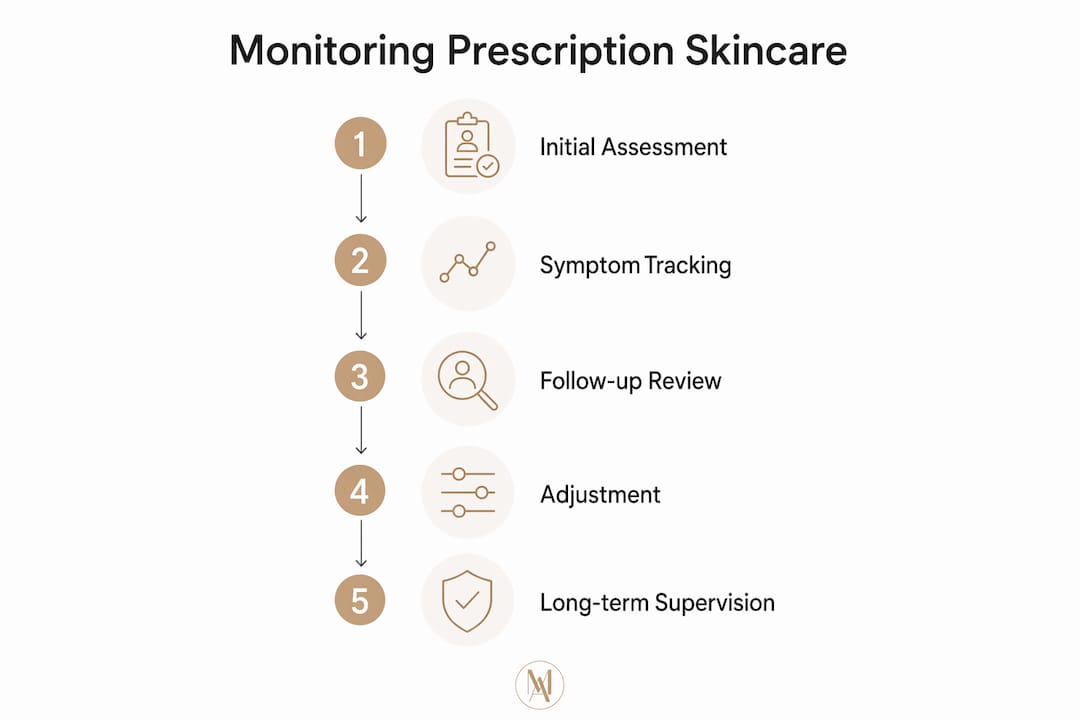
Monitoring is structured, not ad hoc. A well-run prescription skincare pathway follows a clear sequence from baseline to maintenance.
What a baseline assessment covers
- Full skin and medical history, including current medications and supplements
- Skin examination and phototype assessment
- Baseline photographs (standardised lighting and angles)
- Pregnancy status and contraception review where relevant
- Written treatment plan and application instructions
- Consent discussion covering expected effects and adverse-event reporting
Typical review schedule
| Treatment type | First review | Subsequent reviews | Key checks at each visit |
|---|---|---|---|
| Topical retinoids (tretinoin, tazarotene) | Initial review within weeks | Follow-up at regular intervals | Tolerance, peeling, photosensitivity, progress photos |
| Topical azelaic acid / hydroquinone | Initial review after several weeks | Follow-up every few months | Pigmentation response, irritation, ochronosis risk |
| Oral isotretinoin | Early review after weeks of initiation | Regular monthly monitoring | Blood tests, pregnancy test, mood assessment |

At each follow-up, the clinician assesses tolerance and treatment response, compares progress photographs, considers dose adjustment or temporary cessation if irritation is significant, and reviews sun-safety adherence. Practical instructions given at the outset typically cover application amount (a pea-sized quantity for retinoids), frequency, SPF 30+ daily use, and which OTC actives to avoid (AHAs, BHAs, and vitamin C can compound irritation when used alongside prescription retinoids).
Pro Tip: Prescribers often introduce retinoids on alternate nights for the first two to four weeks before moving to nightly application. If your skin is reactive or darker in phototype, your clinician may start at a lower concentration and titrate upward more slowly. Never self-escalate the frequency.
Who can prescribe and supervise prescription skincare in the UK?
Not every skincare professional has prescribing authority. In the UK, the following practitioners are legally authorised to prescribe:
- Consultant dermatologists and dermatology registrars: The gold standard for complex or severe presentations; NHS referral or private appointment.
- GPs with dermatology experience: Can prescribe common topical prescription treatments and initiate isotretinoin referrals; appropriate for straightforward cases.
- Nurse independent prescribers: Registered nurses who have completed a prescribing qualification; increasingly common in private aesthetic and dermatology clinics.
- Pharmacist independent prescribers: Qualified pharmacists with prescribing authority; can prescribe across a wide range of conditions, including dermatological.
When you see a prescriber, they should provide documented evidence of a safe prescribing pathway. The trust signals a legitimate prescription skincare service provides include: a written treatment plan, clear application instructions, baseline photographs, a record of your consent discussion, and guidance on how to report adverse events.
A prescription issued without a documented treatment plan, baseline photographs, or a follow-up appointment is a clinical governance concern. If a service cannot demonstrate these elements, seek care elsewhere.
Virtual consultations are a legitimate and increasingly common route to prescription skincare in the UK, particularly for straightforward presentations such as mild-to-moderate acne or early photoageing. In-person review remains preferable when a lesion needs physical examination, when the patient has a complex skin of colour presentation, or when a severe adverse reaction requires direct clinical assessment. A prescription skincare consultation should always begin with a thorough history, regardless of whether it takes place online or in clinic.
Special rules for high-risk groups
Some patients need additional safeguards beyond the standard monitoring pathway.
Pregnancy and breastfeeding:
Tretinoin, tazarotene, and oral isotretinoin are all contraindicated in pregnancy. Isotretinoin carries a mandatory UK pregnancy-prevention programme: two forms of contraception are required, pregnancy tests are performed at baseline and monthly throughout treatment, and prescribers must register patients on the approved monitoring scheme. Even topical retinoids are avoided during breastfeeding as a precaution.
Children and adolescents:
Paediatric prescribing requires specialist involvement. Dosing for isotretinoin in adolescents is weight-based, and psychological monitoring (mood, depression risk) is part of the standard review.
Skin of colour:
- Higher-strength hydroquinone and prescription azelaic acid require specialist assessment in darker phototypes due to the risk of paradoxical hyperpigmentation and post-inflammatory hyperpigmentation.
- Retinoids can trigger post-inflammatory hyperpigmentation if irritation is not managed carefully; lower starting concentrations and slower titration are standard practice.
- A clinician experienced in skin of colour is better placed to assess baseline pigmentation and set realistic treatment expectations.
Patients with Fitzpatrick skin types IV–VI benefit most from a prescriber who routinely treats skin of colour. The risk of worsening pigmentation with poorly monitored prescription actives is real and can be distressing; specialist oversight is not a luxury in these cases.
Patients on multiple systemic medicines or with liver disease:
Oral isotretinoin is hepatotoxic and lipid-altering; baseline and ongoing liver function tests and fasting lipid panels are mandatory. Patients on hepatotoxic drugs, lipid-lowering agents, or tetracycline antibiotics require careful prescriber review before isotretinoin is initiated.
What you should do at home between appointments
Structured self-monitoring between appointments is one of the most underused tools in prescription skincare. Behavioural science research shows that daily logging reduces attribution errors caused by the one-to-three-day delay between a trigger and a visible skin response, and that two to four weeks of consistent data begins to reveal meaningful patterns.
Daily self-monitoring checklist
- Symptom severity: Rate redness, peeling, dryness, and breakouts on a simple 1–5 scale.
- Application adherence: Note whether you applied the prescription product as directed, and if not, why.
- New products used: Record any new OTC products, cleansers, or supplements introduced that day.
- Sun exposure: Log approximate duration and whether you applied SPF.
- Lifestyle factors: Note significant sleep disruption, stress events, or dietary changes.
- Photographs: Take a consistent photo (same lighting, same distance, same angles) at least twice weekly.
Simple log template
| Date | Symptom score (1–5) | Applied as directed? | New products? | SPF applied? | Notes |
|---|---|---|---|---|---|
| Day 1 | 2 | Yes | No | Yes | Mild stinging at application |
| — | 3 | Yes | No | Yes | Increased peeling, moisturiser added |
| — | 2 | Yes | No | Yes | Peeling settling |
Copy this into a phone note or a simple spreadsheet. You do not need a dedicated app, though AI-assisted tools can help standardise image capture and surface trends for your clinician to review.
For photographs: use natural daylight or consistent artificial lighting, keep the same distance from the camera (arm’s length works), and photograph front-on, left profile, and right profile at each session. Avoid filters.
Pro Tip: The variables that matter most in the first two to four weeks are symptom severity and application adherence. Bring your log and photographs to your first review appointment. Patients who arrive with tracked data shift the clinical conversation from “I think it might be getting worse” to a concrete timeline that allows faster, more confident adjustments.
Timelines, costs, and how to access prescription skincare in the UK
Typical treatment timelines
- Topical retinoids: Initial irritation often appears within weeks; visible improvement in acne or texture generally takes several weeks; full benefits develop over several months.
- Topical azelaic acid / hydroquinone: Pigmentation improvement usually occurs after several weeks; hydroquinone treatment is cycled over months.
- Oral isotretinoin: A standard course runs several months; some patients require a second course after a treatment break.
Monitoring does not end when the skin looks better. Prescribers step down supervision gradually, moving from monthly reviews to quarterly check-ins as the skin stabilises. Maintenance prescriptions for topical retinoids are common and still require periodic review.
NHS versus private access
| Route | Access | Approximate cost | Notes |
|---|---|---|---|
| NHS GP referral | Via GP appointment | Standard NHS prescription charge (varies by region) | Waiting times for dermatology referrals vary by region |
| NHS dermatology | GP referral required | Prescription charges as above | Isotretinoin typically initiated in secondary care |
| Private consultation | Direct booking | — | Faster access; prescriber issues private prescription |
| Private prescription | Via private prescriber | — | No NHS subsidy; costs vary by pharmacy |
| Virtual consultation | Online booking | — | Suitable for straightforward cases; follow-ups often lower cost |
Online prescription skincare services can reduce the cost of follow-up appointments, particularly for stable patients on maintenance regimens. Some private insurers cover dermatology consultations; check your policy before booking. Repeat prescriptions for topical agents are usually issued after a review, not automatically.
Common misconceptions worth correcting
- “Prescription means fast results.” Tretinoin can take 12 weeks before acne improvement is visible, and an initial purging phase is common. Graded improvement is the norm, not rapid transformation.
- “Natural ingredients are safe to combine with prescription actives.” Potency and interaction risk are what matter, not origin. Essential oils, citrus extracts, and certain plant-based actives can compound irritation or photosensitivity when used alongside retinoids or azelaic acid.
- “Using more will speed things up.” Overuse of prescription actives increases harm and can trigger treatment pauses that set progress back further than the overuse gained. Application amount and frequency are clinical decisions.
- “If it seems fine, I can skip follow-ups.” Some adverse effects, including lipid changes with isotretinoin and early ochronosis with hydroquinone, are not visible or symptomatic until they are formally assessed. A review appointment is not just for problems you can already see.
Key takeaways
Prescription skincare requires clinical monitoring because its potency, systemic effects, and interaction risks cannot be safely managed without a prescriber’s structured oversight and regular review.
| Point | Details |
|---|---|
| Potency demands oversight | Prescription actives penetrate deeper and react faster than OTC products; side effects need clinical management. |
| Monitoring has a clear structure | Baseline photos, written plans, and scheduled reviews are standard practice, not optional extras. |
| Self-monitoring improves outcomes | Daily logging and consistent photographs give clinicians the concrete data needed for confident, timely adjustments. |
| Special populations need extra safeguards | Pregnancy, skin of colour, and systemic medication use all require additional checks beyond the standard pathway. |
| Them-ethod offers clinician-led care | Them-ethod provides virtual prescription consultations and clinician follow-ups with a documented, safety-first approach. |
A clinician’s perspective on balancing efficacy and safety
The tension I see most often in practice is between a patient’s understandable desire for rapid results and the clinical reality that prescription actives need time and careful titration to work safely. Patients who start tretinoin and push through significant irritation without telling their prescriber are not being resilient; they are accumulating skin barrier damage that can take months to resolve. The most effective approach is almost always the slower one.
What I find genuinely useful in practice is the combination of baseline photographs and a simple symptom log. When a patient arrives at their six-week review with a photo series and a daily record, the conversation changes entirely. We can see exactly when peeling peaked, whether it correlated with a new product or a missed moisturiser application, and whether the trajectory is heading in the right direction. Without that data, we are both guessing.
The other judgement call that comes up regularly is when to refer to secondary care. If a patient on topical prescription treatment is not responding after three months of consistent use, or if there is diagnostic uncertainty about the underlying condition, a dermatology referral is the right next step, not an escalation of the same prescription. Prescribers who work within their competence and refer appropriately are the ones whose patients get the best long-term outcomes.
Them-ethod: clinician-led prescription skincare, wherever you are
Prescription skincare works best when it is prescribed, monitored, and adjusted by a clinician who knows your skin. At Them-ethod, virtual skin consultations are led by expert clinicians who provide a documented treatment plan, baseline photographs, and structured follow-up appointments as standard. Whether you are starting a retinoid for the first time or looking for a more responsive approach to pigmentation or acne, the process begins with a thorough assessment, not a product recommendation.
Bring your self-monitoring log and your photographs to your first appointment. The more data you arrive with, the more targeted the clinical conversation can be. For readers ready to take the next step, explore our acne treatment options or book a virtual consultation directly through Them-ethod to begin a prescription skincare pathway with full clinical oversight.
Useful sources for further reading
- NHS: Prescription charges — Official NHS guidance on current prescription charges across England, Scotland, Wales, and Northern Ireland.
- Mayo Clinic: Tretinoin (topical route) — Detailed patient-facing summary of tretinoin’s side effects, dosing guidance, and monitoring requirements.
- DailyMed: Tazarotene (TAZORAC) prescribing information — Full prescribing label for tazarotene, including adverse event data and dose-adjustment guidance.
- Cleveland Clinic: Prescription skin care — Clear clinical overview of prescription skincare categories, timelines, and monitoring expectations.
- Them-ethod: What is a prescription skincare consultation? — Explains what to expect at an initial consultation, including the baseline assessment and documentation process.
- Them-ethod: Skincare routine checklist for prescription results — Practical step-by-step checklist for patients using prescription actives, covering routine sequencing and observation guidance.