





Άρθρο: Why choose results-driven skincare for visible changes

Why choose results-driven skincare for visible changes
TL;DR:
- Results-driven skincare uses high-concentration actives and clinical evidence to target root skin concerns.
- Personalisation through expert advice or AI assessments enhances the effectiveness of clinical formulations.
- It offers measurable improvements over time, making it a smarter investment for specific skin issues.
You invest in cleanser after serum after moisturiser, yet your skin looks largely the same. Sound familiar? Most people cycle through product after product without ever addressing the root cause of their concern, whether that is persistent pigmentation, stubborn acne, or accelerating signs of ageing. Results-driven skincare breaks this cycle by using clinical-grade actives, evidence-backed formulations, and measurable outcomes rather than vague promises. This guide explains exactly what sets these solutions apart, how the science works, and whether the investment is genuinely worth it for your skin.
Table of Contents
- What does results-driven skincare mean?
- The science: Active ingredients and proven results
- Personalisation: Why tailored skincare matters
- Is results-driven skincare worth the investment?
- Our perspective: What truly sets results-driven skincare apart
- Discover your personalised results-driven skincare solution
- Frequently asked questions
Key Takeaways
| Point | Details |
|---|---|
| Clinical actives work | Higher concentrations of proven ingredients deliver results where standard skincare often fails. |
| Personalisation accelerates change | Consultations and diagnostics ensure your routine targets your specific concerns effectively. |
| Visible results take time | Real improvement usually takes 8-12 weeks of consistent application and adherence. |
| Investment is worth it | Though costlier, the benefits of a results-driven approach outweigh standard products for many users. |
What does results-driven skincare mean?
The term “results-driven” is used frequently in the beauty industry, but its meaning is often diluted. In a clinical context, it refers to skincare formulated with the specific intent of producing measurable, documented improvements in the skin’s condition. This is fundamentally different from the majority of cosmetic products on the market, which are designed primarily to improve appearance temporarily, hydrate the surface, or deliver a pleasant sensory experience.
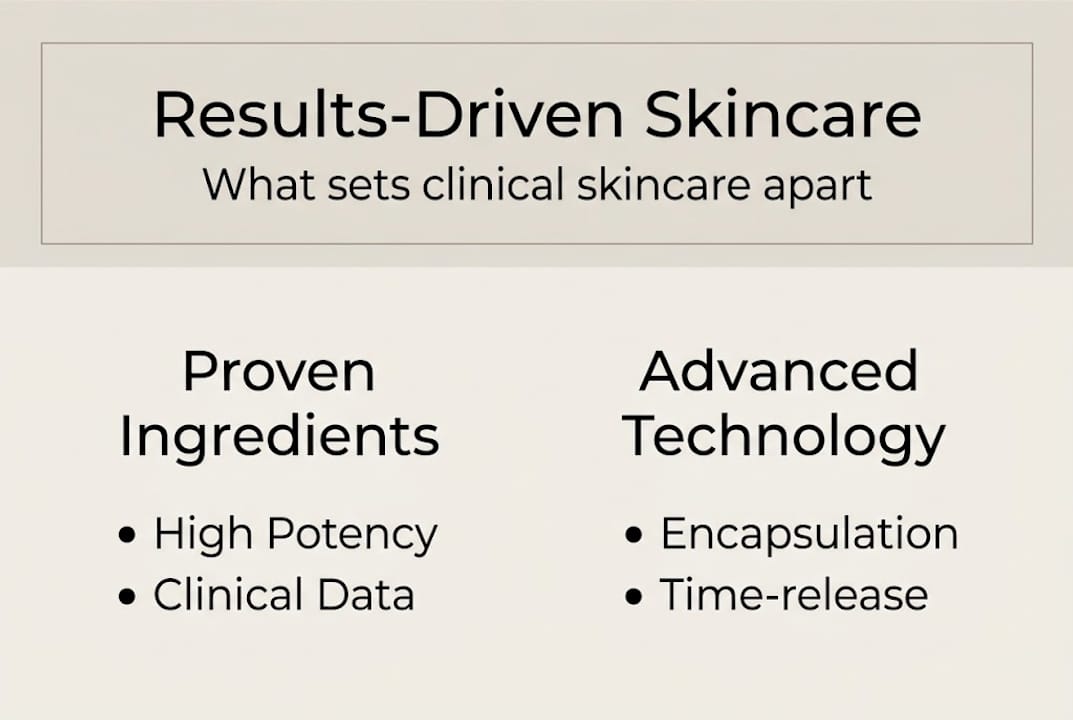
The distinction lies in three areas: ingredient concentration, delivery technology, and clinical evidence. Results-driven skincare uses higher concentrations of active ingredients like retinoids, vitamin C, peptides, and niacinamide, with advanced delivery systems for deeper penetration to target root causes of ageing, pigmentation, and acne. A standard high-street vitamin C serum might contain 5% ascorbic acid in a basic water base. A clinical-grade equivalent may contain 15-20% in a stabilised, encapsulated form that actually reaches the dermis where collagen synthesis occurs.
| Feature | Regular cosmetic skincare | Results-driven skincare |
|---|---|---|
| Active concentration | Low to moderate | Clinical to prescription strength |
| Delivery system | Surface-level | Encapsulated or liposomal |
| Evidence base | Marketing claims | Clinical trials |
| Target | Cosmetic appearance | Root cause correction |
| Supervision | None required | Often benefits from expert guidance |
Who benefits most from this approach? Those dealing with:
- Hyperpigmentation and melasma, where surface brighteners simply do not penetrate deeply enough
- Active or cystic acne, requiring anti-inflammatory and sebum-regulating actives at therapeutic concentrations
- Visible ageing, including fine lines, loss of firmness, and uneven texture
- Redness and barrier dysfunction, needing targeted repair rather than temporary soothing
The role of advanced skincare technology in this space cannot be overstated. Innovations in encapsulation, time-release delivery, and microbiome-aware formulation have made it possible to achieve outcomes that were once only accessible through in-clinic procedures. This is not simply premium packaging. It is a fundamentally different category of product.
The science: Active ingredients and proven results
Understanding the science behind results-driven skincare removes the guesswork and replaces it with confidence. The four most clinically studied actives are retinoids, vitamin C, peptides, and niacinamide, and each has a distinct mechanism of action.

Retinoids accelerate cell turnover and stimulate collagen production by binding to nuclear receptors in the skin. This makes them effective for acne, pigmentation, and ageing simultaneously. Vitamin C (ascorbic acid) inhibits melanin synthesis via tyrosinase suppression while also providing antioxidant protection against UV-induced damage. Peptides signal the skin to produce more collagen and elastin, working at a structural level rather than a cosmetic one. Niacinamide (vitamin B3) reduces melanin transfer to keratinocytes, strengthens the skin barrier, and regulates sebum production.
The clinical data behind these actives is substantial. Measurable improvements include a 36-47% reduction in hyperpigmentation and 42-50% gains in skin firmness in rigorously conducted trials on full formulations. These are not anecdotal reports. They are standardised outcomes measured using validated tools such as the Melanin Area and Severity Index (MASI).
| Active ingredient | Primary target | Documented outcome |
|---|---|---|
| Retinoids | Ageing, acne, pigmentation | Increased collagen, reduced wrinkle depth |
| Vitamin C | Pigmentation, oxidative stress | Tyrosinase inhibition, brightening |
| Peptides | Firmness, structural ageing | 42-50% firmness improvement |
| Niacinamide | Pigmentation, barrier | Reduced melanin transfer |
| Thiamidol | Hyperpigmentation | 36% MASI reduction at 12 weeks |
For pigmentation specifically, the results are particularly compelling. Thiamidol achieves a 36% MASI reduction at 12 weeks, while a multimodal serum combining several actives can deliver up to 47% MASI improvement. For someone who has spent years masking pigmentation with coverage, these numbers represent a genuine shift in skin health.
Pro Tip: When assessing any results-driven product, look for clinical trial data on the complete formulation, not just individual ingredients. The interaction between actives matters as much as their individual potency.
Personalisation: Why tailored skincare matters
Even the most potent clinical formulation will underperform if it is not matched to your specific skin type, concern, and lifestyle. This is where personalisation becomes the decisive factor in achieving lasting results.
Personalisation in results-driven skincare takes several forms:
- Expert clinical consultation: A dermatologist or trained aesthetician assesses your skin in detail, considers your medical history, and recommends a regimen built around your primary concerns. This is the gold standard.
- Virtual skin consultation: Remote assessments with qualified clinicians have made expert guidance far more accessible. A virtual skincare consultation allows a clinician to review your skin, discuss your concerns, and prescribe or recommend a tailored protocol without the need for an in-person visit.
- AI-powered skin diagnostics: Digital tools analyse photographs of your skin to identify concerns such as uneven tone, pore size, and fine lines, then map these to appropriate actives. While not a replacement for clinical expertise, these tools significantly outperform self-diagnosis.
- Skin typing and barrier assessment: Understanding whether your skin is oily, dry, combination, or sensitised determines which actives you can tolerate and at what concentration.
Personalisation via expert consultations or AI assessments tailors actives to individual concerns for measurably better efficacy. This is not a marketing claim. It is the reason why two people using the same retinoid can have entirely different outcomes.
Realistic timelines are also important to understand. For most concerns, you should expect:
- Acne: Visible improvement in 6-8 weeks with consistent use
- Pigmentation: Meaningful reduction in 10-16 weeks depending on depth
- Ageing and firmness: Structural changes become visible at 12-24 weeks
The skincare consultation benefits extend beyond ingredient selection. A good clinician will also manage your expectations, adjust your regimen as your skin responds, and identify any reactions early. This ongoing relationship is what separates a truly personalised skincare approach from simply buying a more expensive product.
Pro Tip: Always introduce new actives one at a time, with at least two weeks between additions. This allows you to identify what is working and what may be causing irritation, making your regimen far easier to refine.
Is results-driven skincare worth the investment?
Premium clinical skincare carries a higher price point than high-street alternatives. The honest question is whether that premium translates into proportionally better outcomes.
The answer depends on your concern and your commitment. For surface-level hydration or a basic cleansing routine, the difference between a £10 and a £100 product may be marginal. For active concerns like melasma, cystic acne, or significant photodamage, the gap in efficacy between clinical-grade and cosmetic-grade products is substantial and well-documented.
Consider the cost in context:
- A targeted clinical serum used twice daily typically lasts 2-3 months. The cost per day is often less than a cup of coffee.
- The alternative, repeated purchases of ineffective products, frequently costs more over a year than a single well-chosen clinical regimen.
- In-clinic procedures for the same concerns (laser, chemical peels, microneedling) carry significantly higher costs and downtime.
“Results-driven skincare is not about spending more. It is about spending smarter, on fewer products that actually work.”
Prescription brands show results in 8-12 weeks, which is a meaningful timeframe for anyone who has spent years without visible progress. That said, common pitfalls can undermine even the best regimen:
- Inconsistency: Skipping applications breaks the cumulative effect that clinical actives rely on
- Overloading: Using too many actives simultaneously causes irritation and compromises the barrier
- Unrealistic expectations: Clinical skincare improves skin health, it does not reverse decades of damage in weeks
- Ignoring professional guidance: Self-prescribing strong actives without assessment increases the risk of adverse reactions
Results-driven skincare may not be the right fit if you have no specific active concern, if your skin is currently in a compromised or reactive state, or if you are unwilling to commit to a consistent routine. Honest self-assessment here saves both time and money.
Our perspective: What truly sets results-driven skincare apart
We have worked with thousands of clients across a wide range of skin concerns, and the most consistent observation is this: the ingredient list matters far less than the relationship between the person and their regimen.
The clinical science is robust. The actives work. But what we see time and again is that the clients who achieve the most significant transformations are not necessarily those using the most potent formulations. They are the ones who commit fully, adjust intelligently, and maintain an ongoing dialogue with their clinician. Consistency, in our experience, outperforms any single miracle ingredient.
There is also an underappreciated psychological dimension. When you understand why each product in your routine works, and you have a clinician confirming your progress, your adherence improves dramatically. Belief and discipline are as powerful as the actives themselves. The role of technology in skincare routines is to support this relationship, not replace it. Results-driven skincare is, at its core, a partnership.
Discover your personalised results-driven skincare solution
At The M-ethod, we combine clinically tested formulations with expert guidance to create skincare programmes that deliver measurable, visible change. Whether your concern is pigmentation, acne, or ageing, our team of top clinicians is here to help you build a regimen that works for your skin specifically. Explore customer successes from clients who have seen real transformations, or browse targeted solutions such as our ClearSkin by PCA Skin for acne-prone skin. The next step toward visible results starts with the right guidance.
Frequently asked questions
How quickly can I expect visible results with results-driven skincare?
Visible improvements typically appear within 8-12 weeks of consistent use, with pigmentation and breakout reduction often the first changes you will notice.
Are results-driven skincare products suitable for sensitive skin?
Many results-driven formulas can be adapted for sensitive skin, but expert consultation is recommended to personalise your routine and ensure both safety and comfort.
What is the main difference between results-driven and regular skincare?
Results-driven skincare uses higher-potency clinical actives with measurably backed outcomes, whereas regular skincare focuses on cosmetic improvement with considerably less clinical evidence.
How personalised are results-driven routines?
These routines use expert recommendations or AI-powered diagnostics to match ingredients to your unique skin type and concerns, making them significantly more targeted than off-the-shelf alternatives.


