



Άρθρο: Professional skincare workflow for clinical results in 8 steps
Professional skincare workflow for clinical results in 8 steps
Most advanced skincare routines fail before they even begin. Not because the products are wrong, but because the order, timing, and ingredient combinations are off. If you are dealing with persistent pigmentation, early signs of ageing, or adult acne that simply will not respond, the problem is rarely the individual product. It is the workflow around it. A clinical approach to skincare is not about owning more products. It is about using the right ones, in the right sequence, with the right expectations. This guide gives you a structured, evidence-based framework that mirrors what dermatologists and skin clinicians actually recommend.
Table of Contents
- What makes a professional skincare workflow?
- Key ingredients for common concerns
- Prepping for best results: tools and environment
- Step-by-step: professional workflow in action
- Measuring progress and troubleshooting
- Take your workflow further with professional-grade solutions
- Frequently asked questions
Key Takeaways
| Point | Details |
|---|---|
| Order products correctly | Applying skincare from thinnest to thickest ensures actives work efficiently. |
| Personalise for your needs | Customise ingredients and steps for ageing, pigmentation or acne for best results. |
| Stay consistent | Stick with your workflow daily to see visible improvements, usually within 8-12 weeks. |
| Monitor and adjust | Track progress and tweak your routine if you notice side effects or lack of improvement. |
What makes a professional skincare workflow?
A professional skincare workflow is not a ten-step routine copied from a beauty blog. It is a structured, science-backed sequence designed to maximise ingredient absorption, protect the skin barrier, and deliver measurable results over time. Every step has a purpose, and every product earns its place based on your specific concern.
The most common mistake is treating skincare as a collection of individual products rather than a system. When actives are applied in the wrong order, they can neutralise each other, cause unnecessary irritation, or simply sit on the surface without penetrating effectively. A well-designed skincare checklist removes that guesswork entirely.
Personalisation is where clinical workflows truly separate themselves from generic routines. Evidence consistently shows that tailoring a routine to your specific concern, whether that is collagen loss, uneven tone, or congestion, produces far superior outcomes compared to a one-size-fits-all approach. As professional vs. generic routines research highlights, a simple three-step routine of cleanse, treat, moisturise, and SPF often outperforms elaborate ten-step programmes in terms of adherence and reduced irritation. Korean skincare popularised layering and hydration, but dermatologists consistently prioritise evidence-based actives over sheer volume of steps.
| Approach | Steps | Best for | Adherence risk |
|---|---|---|---|
| Minimalist (3-step) | Cleanse, treat, SPF | Sensitive or reactive skin | Low |
| Clinical targeted | 4 to 6 steps | Specific concerns (ageing, acne) | Moderate |
| Multi-step (10+) | Multiple layers | Hydration focus | High |
Key principles of a professional workflow include:
- Sequencing actives correctly to avoid ingredient conflict
- Adjusting for skin type rather than following a universal template
- Prioritising barrier health alongside active treatment
- Reviewing and rotating products as your skin responds and evolves
For broader healthy skin tips that complement any clinical routine, consistency and simplicity remain the most powerful tools.
Key ingredients for common concerns
With the importance of workflow clear, it is vital to choose ingredients that address your specific needs and work together safely. The right actives, used correctly, are what separate a routine that transforms skin from one that merely maintains it.
For ageing, the evidence is well established. Retinoids and bakuchiol used in the evening support collagen production, while vitamin C applied in the morning provides antioxidant protection against environmental damage. Peptides and hyaluronic acid reinforce hydration and structural support. Visible improvement in skin texture and firmness typically appears within 8 to 12 weeks of consistent use.
For pigmentation, vitamin C, azelaic acid, and niacinamide are the workhorses. Niacinamide is particularly versatile because it calms inflammation, regulates sebum, and inhibits melanin transfer simultaneously. It pairs well with most actives, making it a reliable addition to almost any routine.
For adult acne, which becomes increasingly common from the thirties onwards, the approach requires more nuance. Low-irritation salicylic acid, glycolic acid, and targeted retinoids address congestion and cell turnover, but barrier support is non-negotiable. Stripping the skin in pursuit of clarity almost always backfires. If breakouts are hormonal or persistent, a professional evaluation is the most efficient next step rather than escalating product use.
Our guide for ageing and acne routines covers ingredient combinations in greater depth for each concern.
Key actives by concern:
- Ageing: Retinol or bakuchiol (PM), vitamin C (AM), peptides, SPF 50
- Pigmentation: Vitamin C, niacinamide, azelaic acid, SPF 50
- Acne: Salicylic acid, benzoyl peroxide (targeted), retinoid, barrier repair moisturiser
Pro Tip: Introduce one new active at a time and allow two weeks before adding another. This makes it far easier to identify what is working and what is causing a reaction.
Prepping for best results: tools and environment
With ingredients selected, setting up the right environment and workflow tools is the next critical foundation for success. Preparation is not glamorous, but it is what separates a routine that delivers from one that disappoints.
Cleansing properly is the starting point for everything that follows. A gentle, pH-balanced cleanser removes surface debris, excess sebum, and residual SPF without disrupting the skin’s acid mantle. Avoid anything that leaves skin feeling tight or squeaky. That sensation signals barrier disruption, not cleanliness.
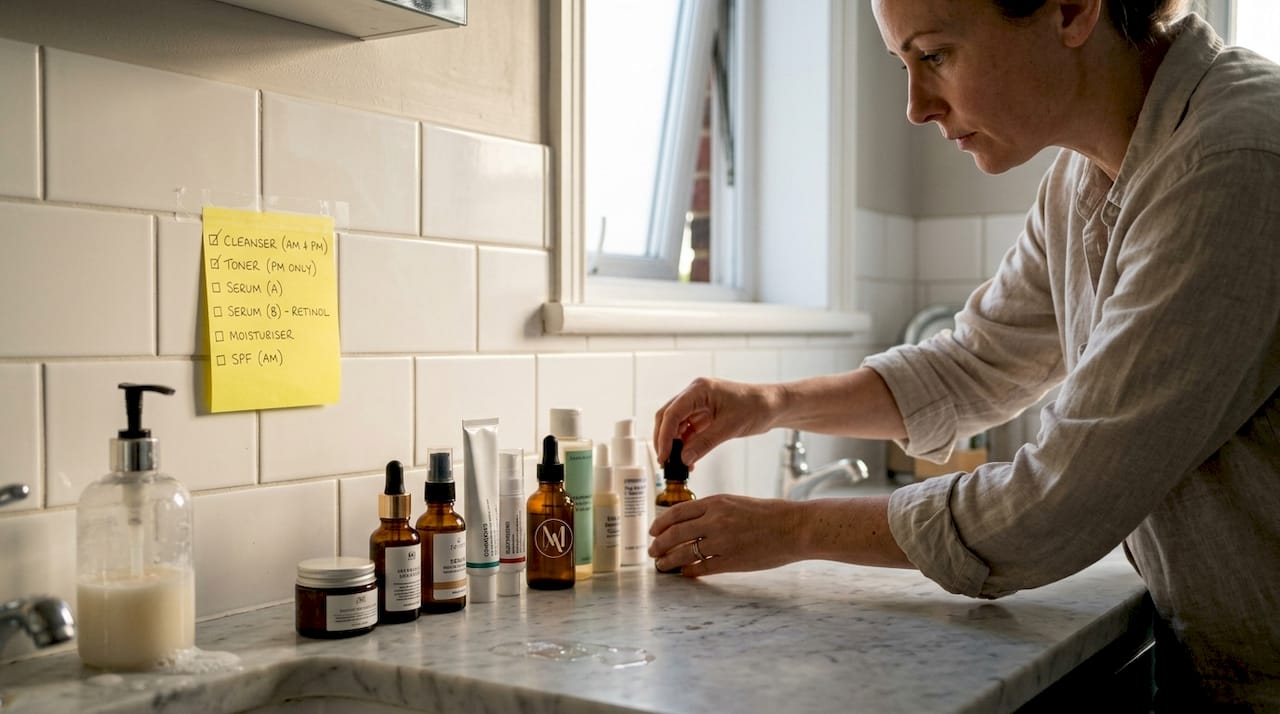
Organising your products in the correct order before you begin saves time and prevents mistakes. Layering from thin to thick textures ensures each product can absorb without being blocked by a heavier formula applied too early. Water-based serums go before oils. Actives are applied to clean, dry skin for maximum penetration.
| Step | Product type | Wait time |
|---|---|---|
| 1 | Cleanser | None |
| 2 | Toner or essence (optional) | 30 seconds |
| 3 | Active serum | 60 to 90 seconds |
| 4 | Moisturiser | 30 seconds |
| 5 | SPF (AM only) | Apply last |
Environmental factors matter more than most people realise. Clean hands, good lighting, and a consistent time of day all reinforce the habit. Habit-stacking, attaching your skincare routine to an existing daily behaviour such as brushing your teeth, dramatically improves long-term adherence. Use our product checklist to organise your shelf before you start.
Pro Tip: Keep your retinoid and acid products on separate shelves or label them clearly as AM or PM. Visual cues reduce the risk of accidentally combining strong actives on the same application.
Step-by-step: professional workflow in action
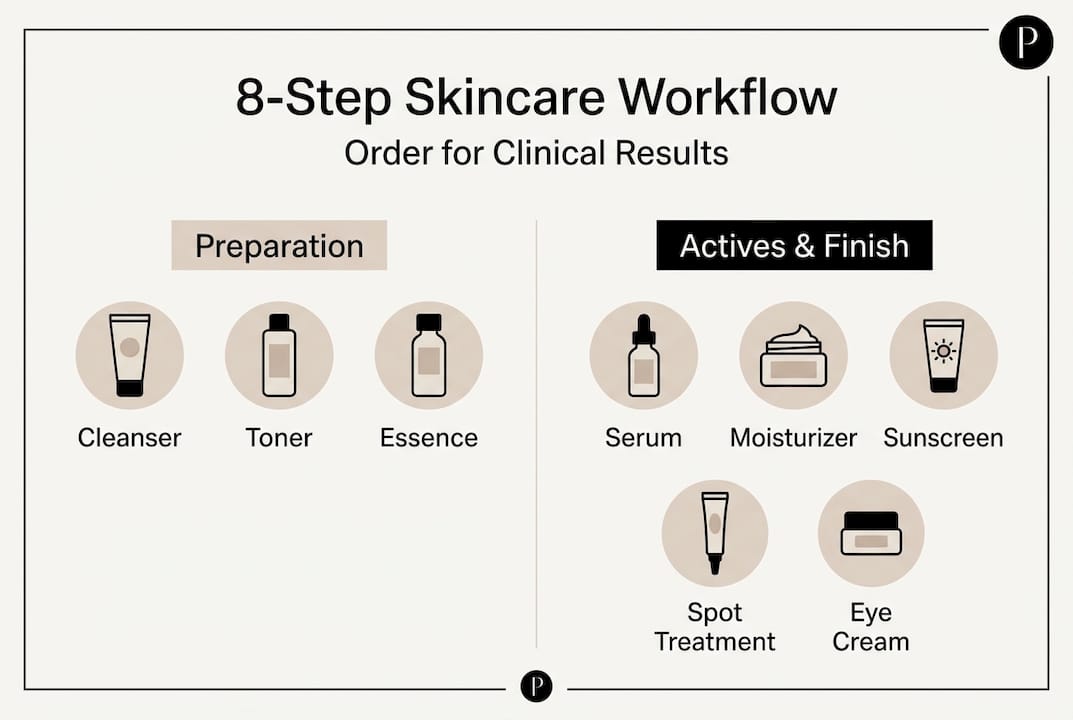
With everything in place, you can now execute a consistent, professional workflow each day with confidence. Here is how a clinical morning and evening routine looks in practice.
Morning routine:
- Cleanse with a gentle, pH-balanced cleanser
- Apply vitamin C serum to clean, dry skin and allow 60 seconds to absorb
- Follow with a hydrating serum containing hyaluronic acid or niacinamide
- Apply moisturiser suited to your skin type
- Finish with a broad-spectrum SPF 50, applied generously
Evening routine:
- Double cleanse if wearing SPF or makeup (oil cleanser first, then gentle foam or gel)
- Apply any exfoliating acid (glycolic, salicylic, or lactic) on nights you are not using retinoid
- On retinoid nights, apply retinol or prescription retinoid to clean, dry skin
- Wait 10 to 15 minutes before applying moisturiser to reduce potential irritation
- Seal with a barrier-supportive moisturiser containing ceramides or peptides
Separate strong actives by time of day or alternate nights. Retinoids and acids used together on the same evening significantly increase the risk of irritation, redness, and barrier compromise.
For a deeper look at the skincare layering steps behind this sequence, we have a dedicated guide that covers timing and product compatibility in detail.
Pro Tip: If you are new to retinoids, begin with two nights per week for the first month. Increase frequency only when your skin tolerates it without redness or flaking.
Measuring progress and troubleshooting
Following the workflow will deliver results, but effective monitoring and troubleshooting ensure you reach your goals sustainably. Knowing what to expect at each stage prevents unnecessary product switching and keeps you on track.
Realistic timelines by concern:
- Week 1 to 4: Skin may purge slightly with new actives. Texture can feel temporarily uneven. This is normal with retinoids and acids.
- Week 4 to 8: Hydration improves, early tone evenness becomes visible, and congestion begins to clear.
- Week 8 to 12: Collagen-supporting actives such as retinoids and peptides produce visible firmness and fine line reduction at this stage.
- Beyond 12 weeks: Pigmentation fades progressively. Consistent SPF use is essential to protect gains.
The most common roadblocks and how to address them:
- Purging vs. breakouts: Purging is clustered in areas where you normally congestion and clears within four to six weeks. New breakouts in unusual areas suggest a product is not suited to your skin.
- Persistent irritation: Reduce active frequency immediately. Prioritise barrier repair with ceramide-rich moisturisers and avoid all exfoliants until skin stabilises.
- Stagnation: If results plateau after 12 weeks, it is time to reassess your actives or seek a professional consultation rather than simply adding more products.
For skincare troubleshooting specific to hormonal acne or persistent pigmentation, professional evaluation is often the most efficient route. A clinician can identify whether a prescription-strength formula or an in-clinic treatment would accelerate your progress.
Pro Tip: Take a photograph in consistent lighting every four weeks. Skin changes are gradual and easy to miss day-to-day. A visual record keeps you objective and motivated.
Take your workflow further with professional-grade solutions
Mastering your at-home workflow is a powerful foundation, but clinical-grade formulations and expert guidance can meaningfully accelerate your results. At The M-ethod Skin, we work with prescription-strength and dermatologist-recommended products designed to address the concerns that over-the-counter routines often cannot fully resolve. Whether you are targeting stubborn pigmentation, persistent adult acne, or visible signs of ageing, our curated range offers targeted solutions. Explore our acne treatment serum for congestion-prone skin, or browse NEOSTRATA for even skin tone and texture refinement. For a fully personalised approach, visit our professional skincare solutions hub and book a virtual consultation with one of our expert clinicians.
Frequently asked questions
What is the ideal order to layer skincare products?
Always apply from thinnest to thickest texture, with actives on clean, dry skin for optimum absorption. Following dermatologist layering guidance ensures each ingredient can penetrate without interference from heavier formulas applied too early.
How long before I see results with a professional skincare workflow?
Most active routines produce noticeable results within 8 to 12 weeks, depending on your concern and how consistently you follow the routine. Pigmentation typically takes longer than acne or hydration improvements.
Can I combine retinol and acids like glycolic or salicylic in one routine?
It is best to use these strong actives on alternate nights or separate them by time of day. Using retinoids and acids together on the same evening significantly increases the risk of irritation and barrier disruption.
What if my skin gets more irritated after starting a new workflow?
Reduce the frequency of your active products immediately and focus on barrier repair with ceramide-rich moisturisers. If irritation persists beyond two weeks, consult a professional, particularly if you are using prescription-strength actives for acne or pigmentation.