





Retinaldehyde vs retinol: which one should you actually use?
Retinal (retinaldehyde) is the faster, stronger over-the-counter retinoid; retinol is the gentler, more gradual starter option. Prescription tretinoin sits above both in raw potency but demands medical oversight. For most readers weighing retinaldehyde vs retinol, the choice comes down to skin tolerance, how quickly you want results, and whether you are also managing breakouts.
- Choose retinol if you’re new to vitamin A actives, have reactive or very dry skin, or want a widely available, budget-friendly entry point.
- Choose retinal if you’ve built some tolerance already, want quicker visible change, or are dealing with adult acne alongside early ageing signs.
- Consider prescription tretinoin only via a dermatologist or clinician, and never during pregnancy or breastfeeding, whichever retinoid you choose. Daily SPF 30+ is non-negotiable with any of them.
Key Takeaways
Retinal converts to retinoic acid in one step and acts faster, while retinol needs two steps and suits beginners; consistency in either determines the real-world result.
| Point | Details |
|---|---|
| Match ingredient to tolerance | Choose retinol if you’re new to actives or reactive; choose retinal once you’ve built some tolerance. |
| Trust the trial data | 0.1% retinal produced a 13.7% texture improvement and 6.5% melanin reduction in a controlled trial. |
| Ramp slowly, always | Start low, buffer with moisturiser, and increase frequency only as tolerated over several weeks. |
| Protect and avoid conflicts | Use SPF 30+ daily, skip strong exfoliants when starting, and never use any retinoid during pregnancy or breastfeeding. |
| Get a personalised plan | Them-ethod’s virtual consultations match strength and ramping pace to your specific skin history. |
Table of Contents
- Retinaldehyde vs retinol: what retinal actually is and how it works
- Retinaldehyde vs retinol: how retinol differs and why beginners start here
- Is retinal stronger than retinol? What the potency numbers actually mean
- What side effects should you expect, and when should you worry?
- How do you introduce retinol or retinal without wrecking your skin barrier?
- Can you mix retinal or retinol with other actives?
- When should you see a clinician about retinol, retinal, or tretinoin?
- Why the “which is stronger” debate misses the real point
- Getting personalised guidance from Them-ethod
- Frequently asked questions
- Sources
Retinaldehyde vs retinol: what retinal actually is and how it works
Retinal is the common name for retinaldehyde, the vitamin A derivative that sits one biochemical step closer to retinoic acid than retinol does. The skin’s own enzymes convert retinol to retinal first, then retinal to retinoic acid, which is the active form that binds retinoic acid receptors and drives the changes you actually see. Applying retinal directly means you’ve skipped that first conversion, which is largely why it tends to act faster.
That single-step conversion pathway explains most of retinal’s reputation. Mechanistically, it accelerates keratinocyte turnover, stimulates fibroblasts to produce more collagen, and interrupts the pigment-transfer process that causes uneven tone. It also does something retinol doesn’t: retinaldehyde shows direct antibacterial activity against Cutibacterium acnes, the bacterium implicated in inflammatory acne. That gives it a genuine niche for adults juggling breakouts and fine lines at once, rather than one or the other.
Statistic callout: In a six-week prospective study, a 0.1% anhydrous retinal concentrate delivered a 12% reduction in pigmentation, a 14% reduction in fine lines, and a 12% improvement in texture, with 81% of participants reporting visibly improved skin by the end of the study.
Retinal is chemically unstable, though, which is why formulation matters more here than with almost any other active:
- It oxidises quickly on exposure to light, air, and moisture, so stability depends heavily on how it’s packaged.
- Look for anhydrous (water-free) formulas, opaque tubes or airless pump dispensers, and avoid jars you dip fingers into repeatedly.
- A retinal product sold in a clear jar has likely lost potency before it ever reaches your skin.
Retinaldehyde vs retinol: how retinol differs and why beginners start here
Retinol is the alcohol form of vitamin A, and it needs two conversion steps to become active: retinol to retinal, then retinal to retinoic acid. Each step is a chance for the process to slow down, which is the core reason retinol takes longer to show results but tends to be gentler on the skin barrier while it does.
That gentler action is precisely why most dermatology guidance still points beginners toward retinol first. Consistent use matters more than nominal potency, and a milder retinoid you’ll actually stick with for months beats a stronger one you abandon after a fortnight of flaking. Retinol is also cheaper and more widely stocked, which lowers the barrier to simply starting.
Our PCA Retinol Night 0.5% sits at that more established strength for skin that’s already adjusted.
- Visible smoothing and improved tone often begin around 6 to 8 weeks of consistent nightly or alternate-night use.
- More meaningful changes to fine lines and pigmentation typically need 12 weeks or longer.
- Results plateau eventually at any given concentration, which is when people consider stepping up strength or switching ingredient.
Is retinal stronger than retinol? What the potency numbers actually mean
Retinal needs only one conversion step to become retinoic acid; retinol needs two. That single fact underpins most “retinal is ten times stronger than retinol” claims you’ll see in marketing copy, but the real relationship is more nuanced than a flat multiplier.
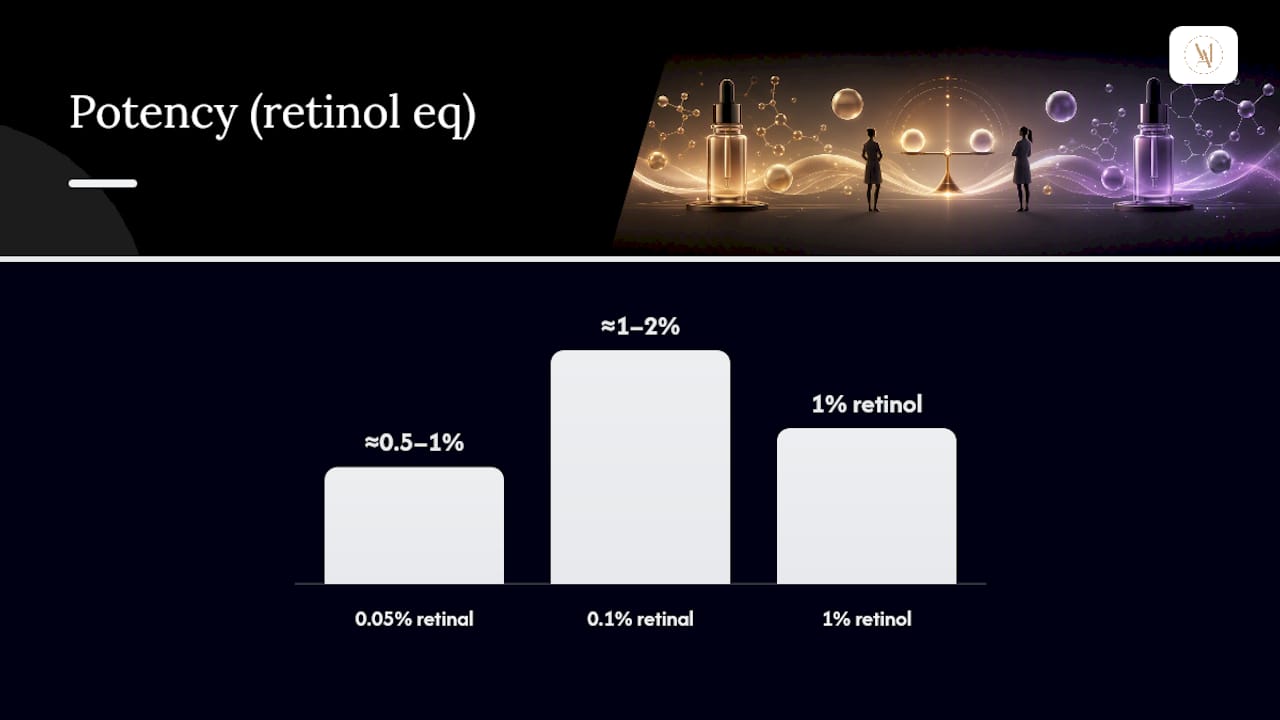
A useful working approximation, drawn from formulation and equivalence research, puts 0.05% retinal at roughly the biological activity of 0.5% to 1% retinol, and 0.1% retinal in the range of 1% to 2% retinol equivalence. That’s a meaningful jump, but it isn’t the clean tenfold rule often quoted, and vehicle, pH, and stability all shift where a given product actually lands within that range.
The clinical evidence for retinal specifically is more substantial than most people assume. A randomised, double-blind controlled trial testing 0.05% and 0.1% retinal creams over three months found both concentrations produced significant improvement in photoaged skin, with most participants showing measurable benefit.
Statistic callout: The 0.1% retinal group achieved a 13.7% improvement in skin texture and a 6.5% reduction in melanin index, while the 0.05% group still managed a 12.6% texture improvement, a strong result for the lower dose.
Separately, clinical reviews report that retinaldehyde’s conversion is more tightly controlled by keratinocyte differentiation than tretinoin’s, which helps explain why it achieves meaningful anti-ageing results with a lower irritation burden than the prescription form.
What’s genuinely missing from the literature is a clean, large-scale, head-to-head trial pitting retinol against retinal at matched concentrations in the same population. Most of what circulates as “retinal is faster” comes from comparing separate studies rather than a single controlled comparison, and some critical commentary on the marketing claims argues the size of the speed advantage gets overstated. In practice, three variables decide your outcome far more than the ingredient label:
- The actual concentration in the product, not just the ingredient name on the box.
- Whether the formulation is stabilised well enough to deliver its stated strength.
- How consistently you use it, week after week, without giving up during the adjustment phase.
What side effects should you expect, and when should you worry?
Redness, dryness, peeling, and mild stinging are the expected side effects of both retinaldehyde and retinol, and severity tracks closely with concentration and how often you apply the product. This adjustment phase, sometimes called retinisation, is a normal part of building tolerance rather than a sign something’s gone wrong, unless it becomes severe.

Retinal generally causes less irritation than prescription tretinoin for a specific biochemical reason: its conversion into retinoic acid happens progressively, regulated by the skin’s own keratinocyte differentiation process, rather than arriving as an already-active molecule the way tretinoin does. That doesn’t make retinal risk-free. It’s still stronger than most retinol formulations and can still cause a flare of irritation in someone who jumps in at too high a frequency.
A few safety rules apply regardless of which retinoid you land on:
- Never use retinal, retinol, or tretinoin while pregnant or breastfeeding; all three carry contraindications here.
- Apply at night only, and wear SPF 30 or higher every morning without exception, since retinoids increase sun sensitivity.
- Pause strong physical scrubs, high-percentage AHA/BHA exfoliants, and other harsh actives for the first few weeks of starting a new retinoid.
- See a clinician if redness, swelling, or peeling becomes severe, spreads beyond the treated area, or doesn’t settle within a few days of stopping use.
Pro Tip: If your skin stings within seconds of application and stays uncomfortable for more than 20 minutes, you’ve likely gone in too strong or too often. Drop back a step in frequency before you drop the product altogether.
How do you introduce retinol or retinal without wrecking your skin barrier?
Ramping speed matters more than the ingredient you choose. Whichever retinoid you pick, going in too hard too fast is the single most common reason people quit before they see results.
- True beginners should start with a low-strength retinol, around 0.01% to 0.03%, applied twice a week for the first two weeks. Increase to every other night by week four, then nightly by week six or seven if skin tolerates it well.
- Sensitive skin benefits from buffering: apply moisturiser first, wait ten minutes, then apply a thin layer of retinol over the top. Alternatively, mix a pea-sized amount of retinol directly into your moisturiser before application, which dilutes contact without reducing consistency of use.
- Acne-plus-ageing skin often does well starting on retinol for two to three weeks to establish baseline tolerance, then transitioning to a 0.05% retinal to gain the antibacterial benefit against C. acnes alongside the anti-ageing effect.
- Plateaued retinol users who’ve used a mid-strength retinol consistently for several months without further improvement can consider switching to retinal. Clinicians typically recommend reducing frequency during the first two to six weeks of the switch, applying retinal once or twice weekly while maintaining moisturiser buffering, then building up as tolerated.
The short-contact method suits anyone prone to irritation at any stage: apply the retinoid, leave it on for 20 to 30 minutes, then rinse with lukewarm water. It reduces total contact time with the active while still delivering benefit, and it’s a useful bridge for people who react badly to overnight leave-on formulas. Our guide on how to layer retinol safely covers buffering techniques in more depth, and our beginners’ starting guide walks through week-by-week expectations.
Pro Tip: Keep a simple skin diary for the first month, noting redness, flaking, and how your skin feels 24 hours after each application. It makes the difference between guessing and actually knowing when you’re ready to step up.
Can you mix retinal or retinol with other actives?
Layering rules matter as much as the ramping schedule, because the wrong combination can undo weeks of careful tolerance-building in a single night.

Avoid combining retinaldehyde or retinol with strong physical exfoliants, high-percentage chemical exfoliants like glycolic or salicylic acid, or benzoyl peroxide when you’re first starting out. Retinaldehyde in particular shouldn’t be layered with strong exfoliants during the introduction phase, since the combined irritation can overwhelm the skin barrier before it’s had a chance to adjust.
A dependable sequencing rule: retinoids belong in your evening routine, and antioxidants plus sunscreen belong in the morning. Vitamin C, particularly at higher concentrations, is better used in the morning rather than layered directly with a retinoid at night. Azelaic acid is one of the few actives that plays well alongside a retinoid routine and can be used during the day without the same conflict.
Quick rules for anyone juggling multiple actives:
- Night: retinoid only, applied to fully dry skin, moisturiser afterwards if needed.
- Morning: antioxidant serum, then moisturiser, then SPF 30 or higher, no exceptions.
- Alternate exfoliating acids and your retinoid across different nights rather than stacking them.
- Introduce one new active at a time so you can actually identify what’s causing any reaction.
When should you see a clinician about retinol, retinal, or tretinoin?
Deciding between over-the-counter options and a prescription is where a genuine clinical opinion earns its keep, rather than another algorithm-generated skincare quiz.
Our general threshold: we recommend retinol for first-time users, anyone with a compromised or reactive barrier, and those easing back into actives after a break. Retinal suits people who’ve already built tolerance, want faster visible change, or are managing acne alongside early signs of ageing. We refer to prescription tretinoin when photoaging is more advanced, when over-the-counter strengths have plateaued for months despite consistent use, or when a patient needs closer medical monitoring for a coexisting skin condition.
A virtual consultation with The M-ethod Skin lets a clinician assess your skin history, current routine, and goals before recommending a specific strength and ramping pace, rather than leaving you to guess from a product label.
Retinoid choice isn’t really an ingredient decision. It’s a tolerance and consistency decision, and getting that assessment right the first time saves months of trial and error.
- Book a consult if you’ve plateaued on retinol for 12 weeks or more with no further change.
- Book a consult if you’re managing acne and ageing together and aren’t sure which strength to start at.
- Book a consult before combining a retinoid with other prescription actives, including anything already prescribed for acne.
Why the “which is stronger” debate misses the real point
Jess’s take: the retinaldehyde vs retinol argument gets framed as a potency contest, and that framing does readers a disservice. The trial data on 0.1% retinal is genuinely strong, and the antibacterial action against C. acnes is a real point of difference worth knowing. But the research also shows something the marketing rarely admits: a well-formulated retinol used every night for three months will usually outperform a retinal used sporadically because someone found it too irritating to stick with.
The conventional advice tells people to pick the “stronger” ingredient and push through the irritation. That’s backwards. Adherence beats potency almost every time, which is precisely why we build ramping schedules around tolerance rather than around getting to the highest strength fastest. If there’s one thing worth prioritising from everything the evidence shows, it’s this: pick the concentration you can use consistently for 12 weeks without quitting, then reassess. Ingredient names matter far less than that discipline.
Getting personalised guidance from Them-ethod
Choosing between retinaldehyde and retinol, and finding the right concentration to actually stick with, gets far easier with a clinician looking at your skin rather than a product description. Them-ethod gives you that route directly: a virtual skin consultation with an expert clinician who can assess your history, current tolerance, and goals, then recommend a specific strength and ramping schedule instead of leaving you to guess between dozens of over-the-counter options.
For readers managing acne alongside early ageing, our PCA Clearskin acne treatment serum is a practical starting point we recommend in clinic. Those ready for medical-grade actives more broadly can explore the NEOSTRATA collection, formulated for visibly healthier, more even skin. Support your results further with guidance from this anti-ageing nutrition resource, which pairs well with any topical routine.
Book a virtual consultation with Them-ethod today to get a strength and schedule built around your actual skin, not a guess from a shelf label.
Frequently asked questions
Is retinal stronger than retinol? Retinal converts to retinoic acid in a single step versus retinol’s two, and clinical trials show meaningful improvement at 0.05% to 0.1% concentrations. It’s generally more potent, though not by the flat “ten times” figure often quoted in marketing.
Is retinaldehyde good for sensitive skin? It can work for sensitive skin once some retinoid tolerance is established, particularly because its conversion is more controlled than tretinoin’s. True beginners with reactive skin usually do better starting on retinol first.
Can you use retinol and retinal together? Using both at once isn’t necessary and raises irritation risk without added benefit. Most people either stay on one or transition between them, reducing frequency during the switch rather than combining them nightly.
How long does retinal take to show results? Full results generally build over three months or longer, similar to most retinoids.
What should you avoid mixing with retinol or retinaldehyde? Avoid strong AHA/BHA exfoliants, physical scrubs, and benzoyl peroxide in the same routine when first starting either ingredient. Vitamin C is better used in the morning, with the retinoid reserved for night.
This article is general information, not a substitute for advice from a qualified doctor. Consult a qualified healthcare professional about your own circumstances before acting on anything here.
Sources
- Review article on retinaldehyde and its use in photoaging (PMC2699641)
- Efficacy and Safety of a Novel Anhydrous 0.1% Retinal-Based Concentrate with Hydrophilic Actives for Photoaged Skin: A Six-Week Prospective Study
- Retinaldehyde: Retinal benefits and side effects explained — Everyday Health

%20is%20the%20faster,%20stronger%20over-the-counter%20retinoid;%20retinol%20is%20the%20gentler,%20more%20gradual%20starter%20option.%20Prescription%20tretinoin%20sits%20above%20both%20in%20raw%20potency%20but%20demands%20m...)