




The real impact of supplements on skin health
TL;DR:
- Only a select few supplements, like hydrolysed collagen and polyphenols, have strong scientific backing for improving skin health and aging. Most marketed products lack rigorous clinical evidence and can pose risks if used improperly, emphasizing the importance of consulting professionals. A balanced diet rich in nutrient-dense whole foods remains the most effective foundation for healthy skin, with supplements serving as targeted gap-fillers.
The supplement aisle can feel overwhelming when every product claims to transform your skin. Not all of them will. A growing body of clinical research is separating the genuinely effective ingredients from the marketing noise, and the findings are more specific than most brands would have you believe. Whether your concern is fine lines, persistent acne, or uneven pigmentation, the evidence points to a short but powerful list of ingredients that genuinely move the needle. Here is what the science actually supports.
Table of Contents
- What does the science say about supplements and skin health?
- Supplements for ageing skin: What really works?
- Supplements for acne, pigmentation and the gut-skin axis
- Supplements that lack proof or carry risks
- Why diet remains king for healthy skin
- Explore advanced solutions for your skin health
- Frequently asked questions
Key Takeaways
| Point | Details |
|---|---|
| Collagen and polyphenols lead | Scientific evidence shows collagen and polyphenols significantly improve ageing skin’s elasticity and hydration. |
| Gut-skin axis matters | Probiotics and prebiotics offer real benefits for acne by supporting the gut-skin connection. |
| Beware ineffective supplements | Biotin, hyaluronic acid, and some antioxidants lack proof unless you have a deficiency. |
| Diet versus supplements | A balanced diet remains the foundation for skin health, while supplements bridge gaps for specific needs. |
| Consult and verify | Always consult with a professional and choose certified supplement brands to ensure safety and effectiveness. |
What does the science say about supplements and skin health?
Having set the context, let’s explore which supplements stand up to scientific scrutiny.
The honest answer is that only a handful of ingredients have been rigorously tested in well-designed randomised controlled trials (RCTs). Most supplements on the market have limited or no clinical backing. The ones that do stand out are worth understanding in detail, because the mechanisms behind them explain both their benefits and their limitations.
Collagen supplements improve skin elasticity, hydration, and reduce wrinkles in ageing skin, based on meta-analyses of multiple RCTs showing significant benefits over placebo. These are not small, industry-funded studies. The data is consistent across multiple populations and product types. Hydrolysed collagen peptides, in particular, are absorbed efficiently and stimulate fibroblast activity in the dermis, which is the deeper skin layer responsible for structure and firmness.
Polyphenols and flavanols are another category with solid evidence. Flavanols and polyphenols alleviate skin photoaging, increasing minimal erythema dose (MED) and elasticity. MED refers to the minimum amount of UV exposure needed to cause redness; a higher MED means better natural photoprotection. These plant-derived compounds work by neutralising free radicals and reducing oxidative stress in skin tissue.
Here is a summary of how the most studied supplement categories compare:
| Supplement | Primary benefit | Evidence level |
|---|---|---|
| Hydrolysed collagen | Elasticity, hydration, wrinkle reduction | High (multiple RCTs) |
| Flavanols and polyphenols | Photoprotection, elasticity | Moderate to high |
| Omega-3 fatty acids | Barrier function, inflammation | Moderate |
| Probiotics and synbiotics | Acne, gut-skin axis | Moderate (growing) |
| Biotin | Only effective if deficient | Low for healthy skin |
Key findings from the broader research base include:
- Hydrolysed collagen peptides consistently outperform placebo in improving skin hydration and reducing the appearance of fine lines
- Polyphenols from sources such as cocoa, green tea, and grape seed extract show measurable UV-protective effects
- Omega-3 fatty acids reduce inflammatory markers that contribute to both acne and barrier compromise
- Results typically require consistent supplementation over eight to twelve weeks before visible changes occur
For a curated overview of clinically proven supplement options that align with this evidence base, we have pulled together our recommendations based on published research and clinical experience.
Supplements for ageing skin: What really works?
Now that we know which supplements help generally, let’s focus on their impact for ageing skin.
Ageing skin is where the supplement evidence is strongest. Two mechanisms are particularly well documented. First, oral collagen peptides stimulate the extracellular matrix (ECM), the scaffold of proteins that gives skin its structural integrity. As collagen synthesis naturally declines from the mid-twenties onwards, supplementing with hydrolysed peptides provides the amino acid building blocks that fibroblasts need to rebuild it.
Second, polyphenols work through a different but complementary route. They reduce the activity of matrix metalloproteinases (MMPs), enzymes that degrade collagen and elastin. By inhibiting these enzymes while simultaneously reducing oxidative stress, polyphenols protect existing skin architecture rather than simply adding to it.
Supplements like collagen and omega-3 target ageing and acne via antioxidant and anti-inflammatory mechanisms, improving ECM integrity and the skin barrier, though benefits for pigmentation remain more limited.
The evidence is stronger for ageing concerns such as collagen loss and photoaging than for acne or pigmentation, with certain edge cases such as PCOS-related skin issues potentially benefiting from chromium and berberine.
Here is a ranked overview of anti-ageing supplements by evidence quality:
- Hydrolysed collagen peptides at 2.5 to 10 grams daily, consistently the most studied with the broadest evidence base
- Flavanol-rich polyphenols from sources including cocoa extract and green tea, showing photoprotective and elasticity benefits
- Omega-3 fatty acids (EPA and DHA), supporting the lipid barrier and reducing systemic inflammation that accelerates skin ageing
- Vitamin C in combination with collagen, which is required for proline hydroxylation, a critical step in collagen synthesis
- Coenzyme Q10 (CoQ10), which shows some evidence for reducing oxidative stress in skin cells, though data is less robust
“Consistent supplementation over a minimum of eight weeks is necessary to evaluate the true impact of collagen and polyphenol products on skin ageing. Short-term use is unlikely to produce measurable outcomes.”
Pro Tip: Pair your collagen supplement with a topical product that supports the same mechanisms. The PCA Collagen Hydrator works well alongside an oral collagen routine, addressing surface hydration while the supplement works at the deeper dermal level.
For more context on which supplements are generating the most clinical interest, our guide to the top supplements for glowing skin offers a practical breakdown.
Supplements for acne, pigmentation and the gut-skin axis
Ageing is not the only skin concern: let’s look at acne and pigment issues, plus the gut’s influence.
The gut-skin axis is one of the most exciting areas of dermatological research right now. The concept is straightforward: the composition of your gut microbiome (the community of bacteria, fungi, and other microorganisms in your digestive tract) directly influences skin inflammation, barrier function, and immune responses. Disruptions to the microbiome, caused by antibiotics, stress, or poor diet, have been linked to acne flares, rosacea, and compromised skin repair.

Probiotics, prebiotics, and synbiotics improve skin health, delay ageing, and treat acne via the gut-skin axis, with RCT evidence supporting their use in multiple skin conditions. Synbiotics combine probiotics (live beneficial bacteria) with prebiotics (the fibres that feed them), creating a more robust effect than either alone.
This has significant implications for acne management. Systemic inflammation driven by gut dysbiosis (microbial imbalance) contributes to the inflammatory cascade that triggers acne lesions. Targeted probiotic supplementation can reduce serum levels of inflammatory cytokines, which are signalling proteins that drive this process.
For pigmentation specifically, the evidence is thinner. Most pigmentation concerns such as melasma, post-inflammatory hyperpigmentation, and sun spots are driven by UV exposure and hormonal factors that supplements cannot fully address. Topical treatments remain the gold standard here.
Key considerations for acne and pigmentation supplementation:
- Probiotics containing Lactobacillus and Bifidobacterium strains show the most consistent acne-related benefits in RCTs
- Zinc is one of the better-studied supplements for acne, with anti-inflammatory and sebum-regulating properties, though doses need careful management to avoid toxicity
- Chromium and berberine show specific benefit in PCOS-related acne where insulin resistance plays a role, though they are not appropriate for all acne presentations
- Vitamin D deficiency has been linked to inflammatory acne, and correcting a deficiency can improve outcomes
Pro Tip: If acne is a primary concern, explore the acne skincare collection alongside any probiotic supplementation. Topical actives such as niacinamide, salicylic acid, and azelaic acid work synergistically with internal gut-skin support.
Supplements that lack proof or carry risks
After highlighting what works, it’s critical to recognise what doesn’t, and why expert caution matters.
This is the part of the conversation that rarely makes it into marketing copy. Several popular supplements either lack meaningful evidence for skin health or carry real risks when used inappropriately.
Biotin is arguably the most overhyped skin supplement on the market. Biotin is ineffective for skin health in individuals who are not deficient. Most people eating a reasonably varied diet have adequate biotin levels. Supplementing beyond what you need does not improve skin quality and can actually interfere with thyroid and cardiac laboratory tests, leading to misleading results.
Several other popular supplements have also been scrutinised more carefully in recent research. Hyaluronic acid, lycopene, carotenoids, and astaxanthin show no significant benefits for photoaging when tested in controlled studies, despite their widespread use and marketing prominence.
Supplements to approach cautiously include:
- Biotin in high doses: No benefit for non-deficient individuals, and interferes with common lab tests
- Antioxidant megadoses: Excessive vitamin A or E supplementation can become toxic with long-term use and may paradoxically promote oxidative stress
- Unlicensed herbal blends: Regulation of supplements in many markets is far looser than for pharmaceutical products, meaning label accuracy and ingredient purity are not guaranteed
- Collagen drinks with undisclosed peptide weights: Molecular weight affects absorption, and some products do not disclose this, making efficacy comparison impossible
Dermatologists recommend prioritising dietary sources over supplements unless a deficiency is confirmed, and they flag that supplements remain largely unregulated in most markets. This means that without third-party certification, there is no guarantee that what is on the label matches what is in the product.
Pro Tip: Always choose supplements with third-party testing certification and, where possible, seek advice from a dermatologist-informed source before adding new products to your regimen. A virtual consultation can help you identify genuine deficiencies rather than guessing.
Why diet remains king for healthy skin
Here is the perspective most supplement discussions miss: even the strongest clinical evidence for oral supplements does not come close to the consistent, long-term skin benefits associated with a nutrient-dense, varied diet.
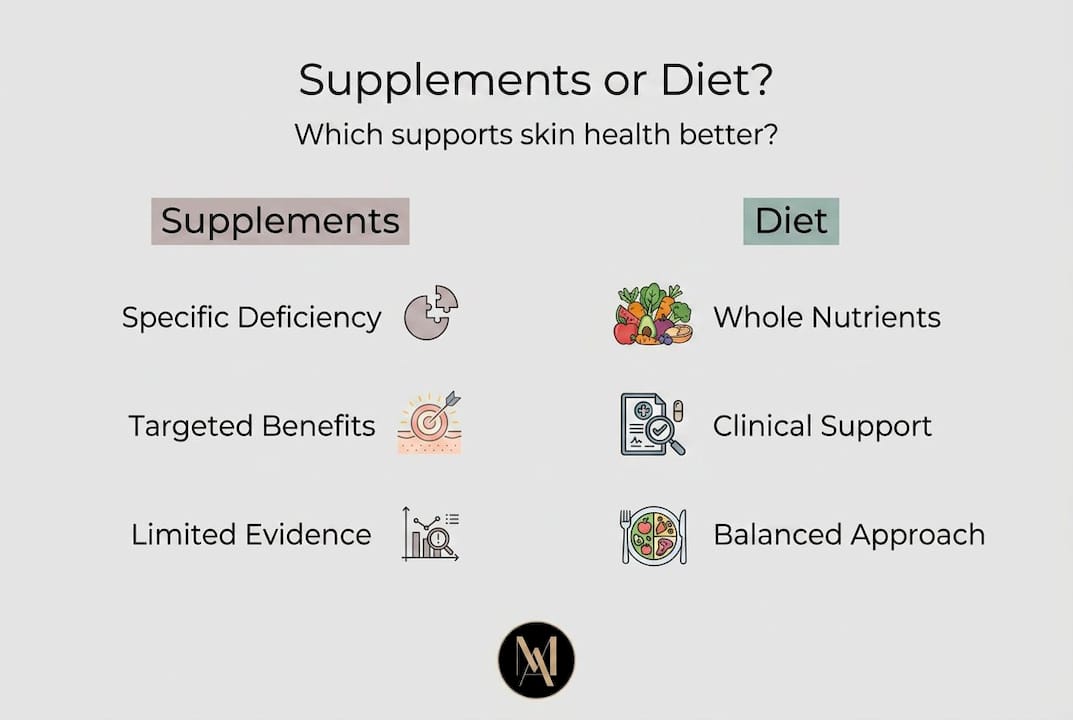
Whole foods deliver vitamins, minerals, phytonutrients, and fibre in combinations and concentrations that supplements cannot replicate. A diet rich in oily fish provides EPA and DHA alongside co-factors that improve absorption. Colourful vegetables deliver a spectrum of carotenoids, polyphenols, and antioxidants in bioavailable forms. Fermented foods like yoghurt and kimchi naturally seed the gut microbiome with diverse bacterial strains that single-strain probiotic capsules simply cannot match.
We have seen time and again, through both clinical research and consultations, that clients who address their diet first experience more consistent, lasting skin improvements than those who reach for supplements as a substitute for dietary quality. Supplements are best understood as gap-fillers, not foundations.
The evidence supports this view. Dermatologists consistently advise relying on food sources first and using supplements only to address confirmed deficiencies. The unregulated nature of the supplement industry adds another layer of reason to be selective.
Our recommendation is practical rather than restrictive. If your diet is broadly balanced, focus supplementation on areas where clinical evidence is strongest, specifically hydrolysed collagen if skin ageing is your primary concern, or targeted probiotics if acne and gut health are the priority. Cross-reference your choices against a clinically proven supplement framework and, where possible, confirm any suspected deficiencies with a healthcare professional before spending on products that may not serve your specific needs.
Supplements can absolutely play a meaningful role in a well-designed skin health strategy. They just should not be the whole strategy.
Explore advanced solutions for your skin health
For those ready to take action, curated products can complement the science-backed guidance above. At The M-ethod Skin, we bring together dermatologist-recommended supplements, prescription-strength topicals, and personalised consultations so that your routine is built on evidence rather than expectation. Whether you are addressing skin ageing with collagen peptides, managing acne through the gut-skin axis with probiotic support, or looking for advanced topical treatments to complement internal nutrition, our team can guide you to the right combination. Explore our premium skincare range and book a virtual skin consultation to receive truly bespoke advice tailored to your skin’s unique needs.
Frequently asked questions
Which supplements are proven to improve skin elasticity?
Collagen peptides and polyphenols have the strongest clinical evidence, with collagen supplements demonstrating measurable improvements in elasticity and hydration across multiple meta-analyses of RCTs.
Can probiotics help reduce acne?
Yes, in specific contexts. Probiotics and synbiotics show RCT-backed evidence for improving acne by modulating the gut-skin axis and reducing systemic inflammation.
Is biotin useful if I want clearer skin?
Only if you have a confirmed deficiency. Biotin is ineffective for skin health in those with sufficient levels, and high-dose supplementation can distort laboratory test results.
Are supplements better than diet for skin health?
No. Dermatologists advise prioritising a nutrient-dense diet, using supplements only to address confirmed deficiencies rather than as replacements for dietary quality.
How safe are supplements for skin health?
Short-term use of evidence-backed supplements is generally well tolerated, but regulation of supplements varies widely across markets, so selecting certified, third-party tested products and seeking professional guidance is essential.