


Why treat adult acne differently: a clear guide
TL;DR:
- Adult acne persists after age 25 due to hormonal, biological, and environmental factors, requiring different treatment than adolescent acne. Treatments must support skin barrier health, use rotation of gentle actives, and be patient, with professional guidance when necessary. Aggressive teen skincare protocols worsen adult skin, so a calm, consistent, and customized approach is essential for effective management.
Adult acne is defined as acne vulgaris that persists or first appears after the age of 25, and it requires a fundamentally different treatment approach from adolescent acne. The biological, hormonal, and lifestyle factors driving breakouts in adults are distinct from those in teenagers. Applying the same harsh, oil-stripping protocols designed for teenage skin to adult skin routinely worsens the condition. Understanding why treat adult acne differently is the first step towards choosing treatments that actually work for your skin.
Why adult acne requires different treatment from teen acne
Adult acne is a complex intersection of biology, hormones, environment, and stress. It is not caused by poor hygiene or a lack of discipline. That distinction matters because it changes the entire treatment logic.
Teenage acne is primarily driven by a surge in androgens during puberty, which triggers excess sebum production across the T-zone (forehead, nose, and chin). Adult acne behaves differently. It primarily affects the lower face, jawline, and chin, and it tends to be more inflammatory and deeper in the skin. These are not surface-level blocked pores. They are often painful, nodular lesions rooted in hormonal fluctuations tied to the menstrual cycle, perimenopause, chronic stress, and cortisol spikes.
Adult skin also has slower cell turnover than teenage skin. Blemishes linger longer, post-inflammatory hyperpigmentation is more pronounced, and the risk of scarring is significantly higher. This slower biology means treatments need more time to show results, and aggressive protocols cause more damage than they resolve.
“Adult acne is not a personal failure. It is a biological and environmental response that requires patient-centred care, not a stronger cleanser.” — Dermatology consensus, British Journal of Nursing
How does adult skin physiology change acne behaviour?
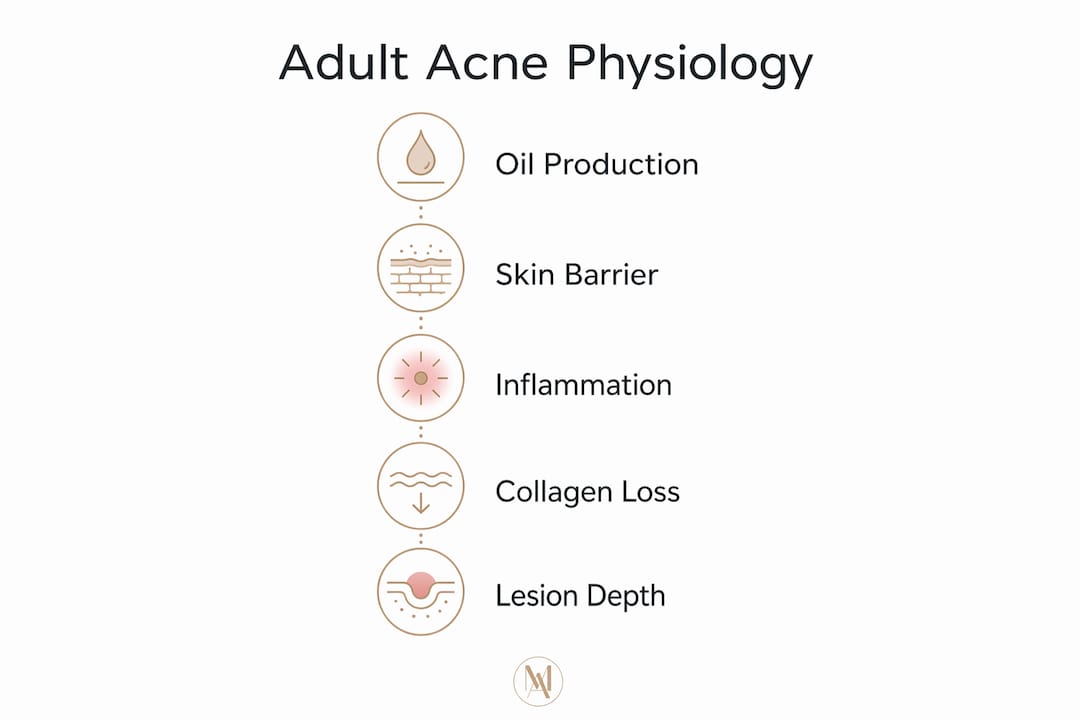
Adult skin produces less natural oil than teenage skin overall, yet it still breaks out. This apparent contradiction is explained by hormonal volatility rather than consistent sebum overproduction. Cortisol, the stress hormone, triggers irregular oil surges. Oestrogen fluctuations across the menstrual cycle or during perimenopause alter sebaceous gland activity in ways that are unpredictable and cyclical.
The skin barrier in adults is also more fragile. Collagen production slows from the mid-twenties onwards, and the lipid layer that holds moisture in becomes thinner. This means adult skin is simultaneously more prone to dryness and more reactive to irritants. Breakouts in this context are not just an oil problem. They are an inflammation problem compounded by a compromised barrier.
Adult acne lesions tend to be deeper and more inflamed than the surface-level comedones common in teenage skin. They carry a higher risk of leaving behind dark marks and textural scarring. This is why the difference in acne treatment between adults and teenagers is not merely cosmetic preference. It is a clinical necessity.
Why do teen acne treatments often fail adults?
The most common mistake adults make is reaching for the same products they used at 16. Benzoyl peroxide washes, high-strength salicylic acid toners, and alcohol-based astringents are formulated for oilier, more resilient teenage skin. On adult skin, aggressive anti-oil protocols disrupt the skin barrier, triggering more inflammation and, paradoxically, more oil production.
Here is what happens at a microscopic level. Harsh treatments strip the skin’s protective lipid layer, creating microscopic cracks in the barrier. The skin responds by producing more sebum to compensate. Inflammation increases. New breakouts form. The adult then uses more product to fight the new breakouts, and the cycle continues.
Layering several actives without professional guidance compounds this problem. Using a vitamin C serum, a retinol, a niacinamide, and a salicylic acid toner in the same routine without understanding how they interact can cause what clinicians refer to as “skincare acne.” This is a distinct category of breakout caused entirely by product overload rather than underlying skin pathology.
The steps below illustrate what typically goes wrong with teen-focused protocols on adult skin:
- Harsh cleanser strips natural oils from the skin surface.
- Toner with high alcohol content removes residual moisture.
- Spot treatment with high-concentration benzoyl peroxide damages the surrounding healthy skin.
- Skin barrier breaks down, triggering compensatory sebum production.
- New breakouts appear, and the cycle repeats.
Pro Tip: If your skin feels tight, dry, or stings after cleansing, your cleanser is too aggressive for adult acne-prone skin. Switch to a gentle cleansing lotion formulated for sensitive or barrier-compromised skin.
What are the best treatment methods for adult acne?
Effective adult acne care is built on three principles: barrier support, consistent actives, and patience. A steady, gentle routine is more effective than intense or frequently changing regimens. Switching products every few weeks prevents any single treatment from completing its mechanism of action.
Building a barrier-first routine
The foundation of any adult acne care routine is a cleanser that does not strip the skin, followed by a moisturiser that reinforces the lipid barrier. Ingredients like ceramides, niacinamide, and hyaluronic acid support barrier function while reducing redness and sensitivity. These are not optional extras. They are the base on which actives can work safely.

Rotating actives intelligently
Treatment rotation is the clinical standard for adult acne management. Use acids such as azelaic acid or low-concentration salicylic acid in the morning to manage congestion. Use retinoids at night to accelerate cell turnover and prevent new comedones. Apply niacinamide as a soothing agent between actives to reduce the risk of irritation. This approach delivers results without overwhelming the skin.
Prescription vs over-the-counter treatments
| Treatment Type | Best For | Key Consideration |
|---|---|---|
| OTC salicylic acid (0.5–2%) | Mild, surface-level congestion | Gentle enough for daily use on adult skin |
| OTC retinol (0.025–0.1%) | Early signs of ageing alongside acne | Start low, increase slowly over weeks |
| Prescription tretinoin | Persistent moderate acne | Requires professional supervision |
| Topical antibiotics (clindamycin) | Inflammatory lesions | Use with benzoyl peroxide to limit resistance |
| Oral antibiotics | Moderate to severe acne | Limit to 3 months per AAD guidelines |
Adults should commit to stable regimens for at least 8–12 weeks before judging effectiveness. Slower cell turnover means results take longer to appear than they would in a teenager using the same product.
Pro Tip: Keep a simple skin diary for the first 8 weeks of a new routine. Note breakout location, timing in your cycle, and stress levels. Patterns in this data are often more useful than any single product change.
For adults dealing with post-acne scarring or persistent texture, professional treatments such as laser therapy and microneedling complement topical medications for more thorough management. These energy-based procedures address what topicals cannot reach.
When should adults see a dermatologist instead of self-treating?
Self-treatment is appropriate for mild, occasional breakouts. It becomes insufficient, and potentially harmful, when certain signs appear. Delayed professional intervention increases both the physical risk of scarring and the psychological impact of prolonged acne.
Seek professional guidance when you notice any of the following:
- Painful, cystic, or nodular lesions that do not respond to OTC products within 8 weeks
- Visible scarring or persistent dark marks (post-inflammatory hyperpigmentation)
- Acne that flares cyclically and correlates with hormonal events
- Emotional distress, reduced confidence, or social withdrawal linked to skin condition
- Skin that is simultaneously breaking out and feeling dry, tight, or reactive
A dermatologist or specialist clinician will assess the acne grade, identify hormonal or lifestyle triggers, and build a multi-modal plan. This typically combines a topical prescription, a systemic treatment where needed, and a dermocosmetic routine. Systemic antibiotics should be limited to three months to avoid resistance, per AAD and European dermatology guidelines. Longer courses are reserved for exceptional clinical cases.
The value of professional care extends beyond the prescription pad. A clinician can identify whether hormonal therapy, such as combined oral contraceptives or spironolactone, is appropriate. They can also recommend advanced procedures for residual scarring. SkinPen microneedling, for example, stimulates collagen remodelling in acne-scarred tissue and is FDA-approved for this indication. Realistic expectations and a long-term maintenance mindset are central to any successful plan.
Key takeaways
Adult acne requires a fundamentally different treatment approach because adult skin has a slower cell turnover, a more fragile barrier, and hormonally driven breakouts that aggressive teen-focused protocols actively worsen.
| Point | Details |
|---|---|
| Adult acne location differs | Breakouts concentrate on the jawline and lower face, not the T-zone as in teenagers. |
| Barrier health comes first | Stripping adult skin triggers compensatory oil production and worsens inflammation. |
| Actives need rotation | Use acids in the morning and retinoids at night, with niacinamide to buffer irritation. |
| Patience is clinical, not optional | Commit to any new regimen for 8–12 weeks before assessing results. |
| Professional care prevents scarring | Cystic lesions, cyclical flares, and emotional distress all warrant dermatologist input. |
Adult acne is not a teenage problem you failed to outgrow
I have worked with hundreds of adults who arrive frustrated, having spent years cycling through products designed for teenagers. The most consistent pattern I see is not a lack of effort. It is a mismatch between the treatment logic and the skin in front of them.
The biggest clinical mistake is the assumption that stronger equals better. A 10% benzoyl peroxide wash does not outperform a 2.5% formulation on adult skin. It simply causes more irritation, more barrier damage, and ultimately more breakouts. The skin does not reward aggression. It rewards consistency and respect for its physiology.
What I advocate for is a smarter approach, not a harder one. That means understanding your hormonal patterns, managing chronic stress as a genuine skin intervention, and choosing products that work with your barrier rather than against it. Adult acne is a complex biological response, and long-term, patient-centred maintenance leads to better outcomes than any quick fix.
Clear, healthy skin at 35 or 45 is entirely achievable. It simply requires a different map than the one you used at 16.
— Jess
Treat your adult acne with clinically backed solutions
At Them-ethod, we work with adults who are done guessing and ready for a plan that reflects how their skin actually behaves. Our step-by-step acne treatment guide walks you through medical-grade solutions matched to adult skin physiology. For targeted daily treatment, the PCA ClearSkin acne serum is formulated to address adult breakouts while supporting barrier integrity, making it a strong foundation for any adult acne care routine. For those dealing with post-acne scarring or persistent texture, our London and Athens clinics offer FDA-approved SkinPen microneedling as part of a bespoke treatment plan. Book a virtual consultation with our clinicians to receive a personalised protocol built around your skin.
FAQ
What makes adult acne different from teenage acne?
Adult acne primarily affects the jawline and lower face, is driven by hormonal fluctuations and stress rather than puberty, and occurs on skin with slower cell turnover and a more fragile barrier. These differences make it more prone to scarring and less responsive to teen-focused treatments.
Can i use the same acne products i used as a teenager?
Products formulated for teenage skin, such as high-strength benzoyl peroxide washes and alcohol-based toners, are too aggressive for adult skin. They strip the barrier, trigger compensatory oil production, and worsen inflammation rather than resolving it.
How long should i try a new adult acne treatment before switching?
Adults should commit to a consistent regimen for at least 8–12 weeks before assessing results, due to slower skin cell turnover. Switching products too frequently prevents any treatment from completing its mechanism of action.
When does adult acne require a prescription?
Escalate to prescription-strength treatment when acne is cystic or nodular, causes visible scarring, correlates with hormonal cycles, or does not respond to OTC products after 8 weeks of consistent use.
Does stress genuinely cause adult acne?
Yes. Cortisol, the primary stress hormone, triggers irregular sebum surges in adult skin. Managing chronic stress through sleep, exercise, and lifestyle adjustments is a clinically recognised component of adult acne management, not a secondary concern.