


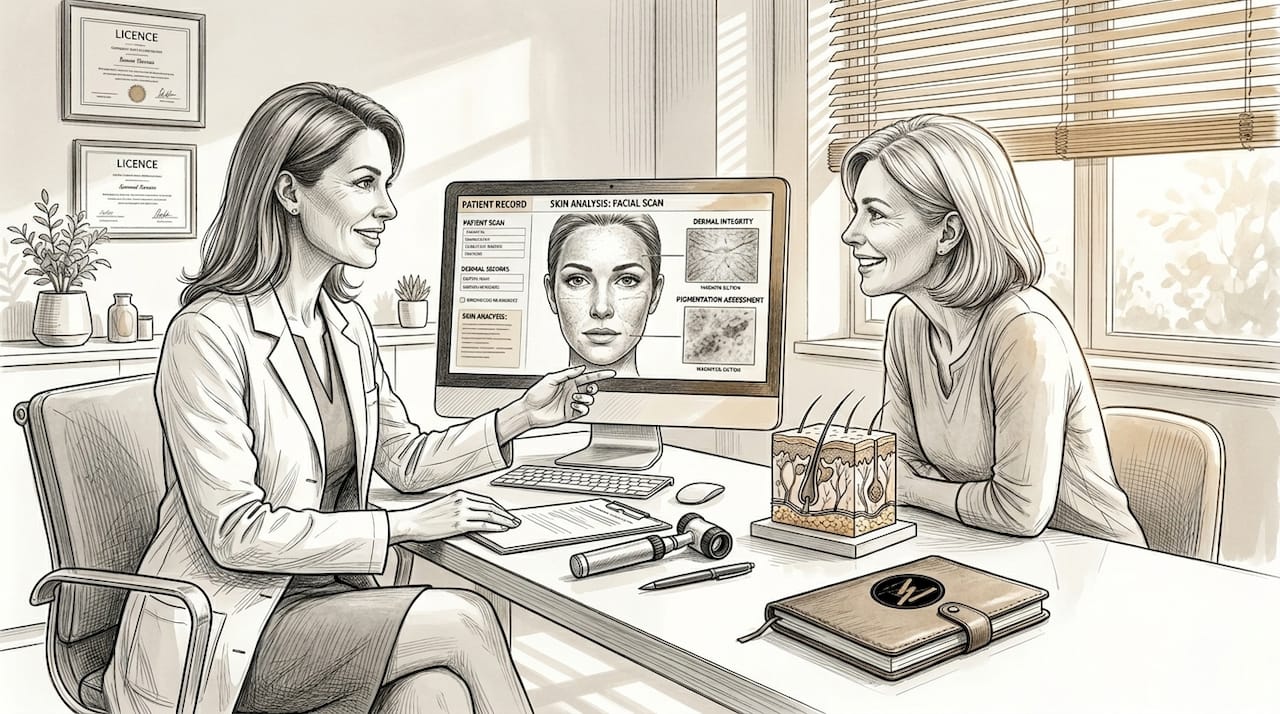
Why professional skin analysis matters for real results
TL;DR:
- Professional skin analysis uses advanced imaging technology to provide an objective, comprehensive assessment of your skin. It enables precise diagnosis, personalized treatment plans, and effective progress tracking by revealing sub-surface concerns invisible to the naked eye. Relying on standardized imaging over subjective judgment improves treatment safety, efficacy, and long-term skin health outcomes.
Professional skin analysis is the scientific evaluation of your skin using advanced imaging technology and clinical expertise, providing an objective, multi-dimensional picture of your skin health that no mirror or smartphone app can replicate. For anyone dealing with persistent acne, uneven pigmentation, premature ageing, or sensitivity that refuses to respond to over-the-counter products, understanding why professional skin analysis matters is the difference between guessing and genuinely knowing what your skin needs. Systems like VISIA-CR use multispectral imaging to detect concerns invisible to the naked eye, from sub-surface inflammation to early pigmentation, in a single session. That data, interpreted by a trained clinician, becomes the foundation for a treatment plan that actually works.
Why professional skin analysis matters more than ever
Professional skin analysis replaces subjective impression with standardised, reproducible data. Where a DIY assessment might identify “oily skin” or “a few blemishes,” a clinical evaluation using multimodal optical imaging detects inflammatory and non-inflammatory acne lesions, quantifies erythema and hyperpigmentation, all in under five minutes with minimal operator bias. That speed and precision matter because skin concerns rarely exist in isolation. Acne, for instance, often coexists with post-inflammatory erythema, dehydration, and a compromised barrier, each requiring a different treatment approach.
The role of professional skin analysis extends beyond diagnosis. It creates a shared visual language between clinician and client. When you can see your own sub-surface pigmentation or active inflammation on a screen, the treatment recommendations stop feeling abstract and start feeling urgent and logical. This is why skin analysis devices in clinics increase client confidence and adherence, leading to higher uptake of appropriate treatments and products.
The importance of skin analysis also lies in what it prevents. Without it, clients frequently invest in products that address the wrong concern, or worse, aggravate an underlying condition they did not know existed. A professional evaluation removes that risk from the outset.
How do professional skin analysis technologies work?
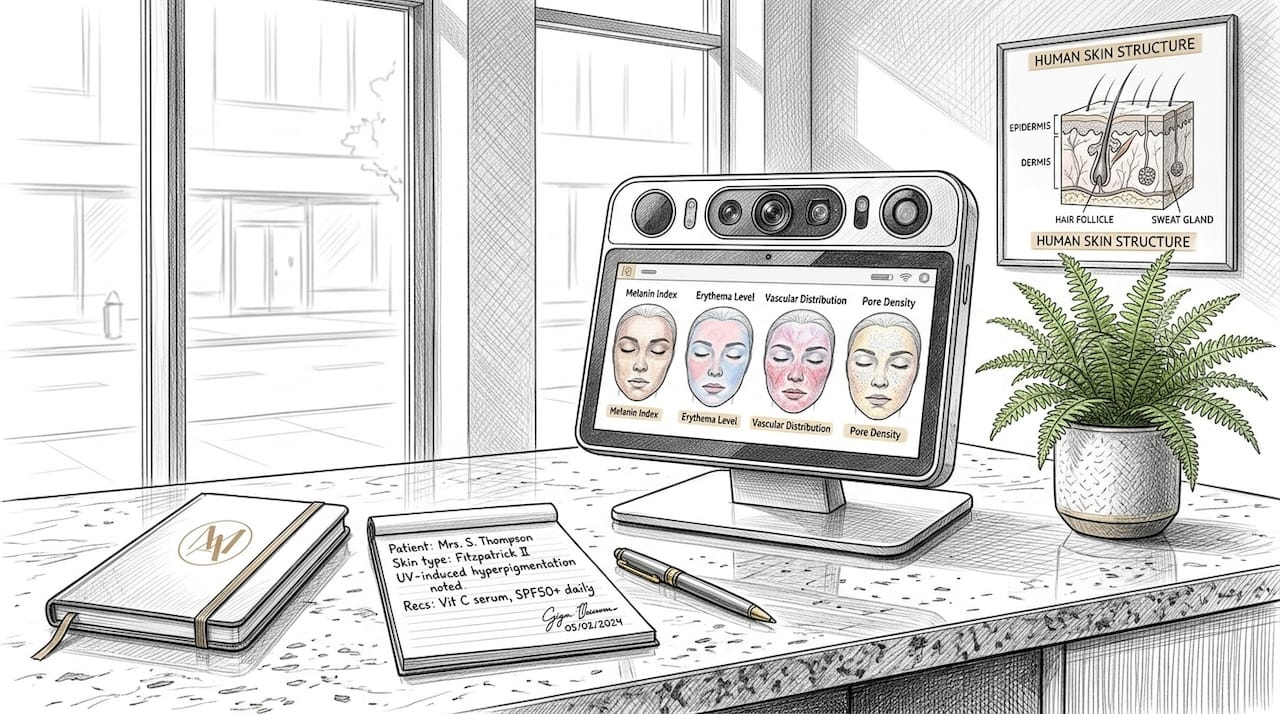
The most clinically reliable systems use multispectral imaging, capturing your skin under different light conditions simultaneously. UV fluorescence reveals porphyrins produced by acne-causing bacteria. Polarised light separates surface texture from deeper vascular and pigmentation structures. Cross-polarised light removes surface glare to expose sub-dermal features. Together, these modalities create a layered picture of your skin biology that a single photograph simply cannot provide.
VISIA-CR, one of the most widely used systems in professional clinics, uses full-face acquisition with automated analysis to reduce variability and operator burden. This standardisation is critical. When lighting angles, equipment settings, and capture protocols are consistent, the data collected at your first appointment is directly comparable to data collected six months later. That consistency is what makes objective progress tracking possible.
Advanced optical imaging can also integrate complementary modalities co-registered in a single session, such as reflectance confocal microscopy combined with laser speckle contrast imaging, to distinguish active inflammation from residual erythema. This level of detail matters clinically because treating active inflammation and treating post-inflammatory redness require entirely different protocols.
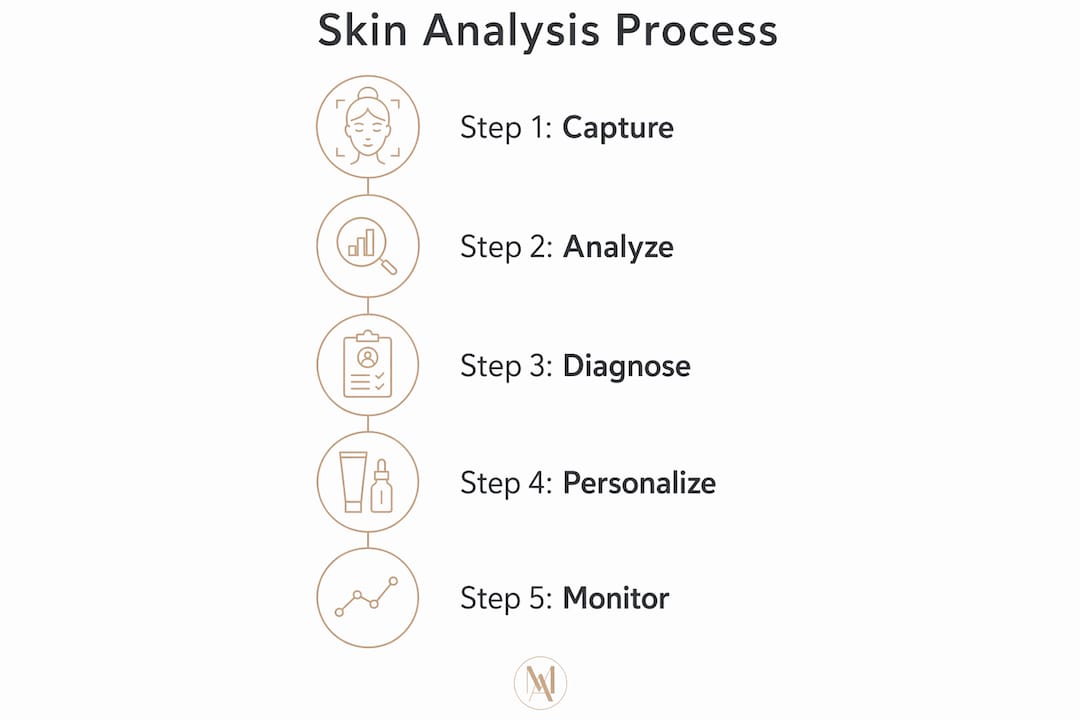
- Multispectral imaging captures UV, polarised, and cross-polarised light to reveal bacterial activity, pigmentation depth, and vascular changes
- Standardised capture protocols eliminate variability from lighting or angle differences, making before-and-after comparisons scientifically valid
- Automated analysis reduces operator-dependent error and produces quantified scores for features like texture, pores, and pigmentation
- Clinical interpretation translates raw imaging data into a diagnosis and a prioritised treatment plan tailored to your specific skin biology
Pro Tip: Ask your clinician to show you your imaging results on screen during the consultation. Seeing your own sub-surface pigmentation or bacterial activity makes the treatment rationale immediately clear and significantly improves your motivation to follow through.
What does research say about diagnostic accuracy?
The evidence base for professional skin analysis is grounded in teledermatology research, which evaluates how accurately remote or imaging-based assessments align with in-person clinical diagnosis. A systematic review finds that teledermatology achieves ~76% diagnostic concordance with in-person consultations, with accuracy improving further when dermoscopy is incorporated. That figure represents moderate-to-good reliability, comparable to many in-person specialist referrals, and comes with cost savings of approximately US$81.31 per patient. For clients, this means professional imaging-based assessment delivers clinical-grade insight at a fraction of the cost of repeated specialist visits.
“Standardised imaging protocols ensure consistency in data quality and interpretation, substantially improving clinical decision-making compared to subjective visual assessment alone.”
A European expert Delphi study on teledermatological assessment of skin tumours identifies image quality and lesion characteristics as the most robust essential variables, requiring at least 67% expert agreement across geographic subgroups. This consensus reinforces a critical point: the reliability of any professional skin analysis depends not just on the technology used, but on the standardisation of how images are captured and interpreted. Repeatability in lighting, angles, and equipment is not a technical detail. It is the foundation of trustworthy results.
| Assessment method | Diagnostic concordance | Key limitation |
|---|---|---|
| Professional imaging with dermoscopy | High (~76%+) | Requires trained operator and standardised protocol |
| Standard teledermatology | Moderate (~76%) | Image quality variability affects accuracy |
| AI or selfie-based analysis | Unvalidated clinically | Misinterprets normal features; no medical context |
| Unaided visual self-assessment | Low | Subjective; misses sub-surface concerns entirely |
AI-based skin analysis tools present a specific risk that the research community has flagged clearly. Experts warn that AI algorithms pathologise normal skin variations, causing unnecessary anxiety and potentially delaying appropriate medical care. A smartphone camera analyses a 2D image under uncontrolled lighting. It has no access to your medical history, no ability to palpate a lesion, and no clinical training to differentiate a benign sebaceous filament from a comedone. The result is often a list of “concerns” that generates confusion rather than clarity.
What are the practical benefits for personalised treatment?
The benefits of professional skin care grounded in clinical analysis become most apparent when you consider treatment monitoring. Skin improvement is gradual and often imperceptible day-to-day. Without a standardised baseline, clients frequently abandon effective treatments because they cannot perceive progress. Professional imaging solves this by providing objective, quantified comparisons over time.
Here is how a structured professional analysis workflow delivers practical value:
- Baseline assessment captures your skin’s current state across multiple parameters, including pigmentation distribution, pore size, texture irregularity, and vascular activity, before any treatment begins
- Concern prioritisation allows your clinician to identify which issues are primary drivers and which are secondary, preventing the common mistake of treating symptoms rather than causes
- Product and treatment matching uses your specific skin profile to select formulations and procedures with the highest probability of efficacy for your biology, not a generic skin type
- Progress reviews at standardised intervals use the same imaging conditions to produce directly comparable data, making it immediately clear whether a treatment is working or needs adjustment
- Long-term skin health monitoring detects new concerns early, often before they become visible, allowing preventive intervention rather than reactive treatment
Pro Tip: Request a copy of your baseline imaging report. Keeping a record of your starting point gives you a personal reference that makes progress reviews far more meaningful and helps you stay consistent with your regimen.
Skin analysis for personalised treatment also improves the quality of your skincare choices. When you know your barrier is compromised and your pigmentation is sub-surface rather than post-inflammatory, you select actives accordingly. Retinoids, vitamin C, niacinamide, and AHAs each serve different functions, and applying them without accurate skin data is genuinely counterproductive.
How does skin analysis shape product and treatment selection?
Accurate skin typing is more complex than the classic oily, dry, combination, and sensitive categories suggest. Professional analysis reveals the biological reality beneath those labels. A client presenting with oily, acne-prone skin may have a dehydrated barrier driving excess sebum production as a compensatory response. Treating that client with stripping, oil-controlling products will worsen the underlying condition. Professional analysis identifies the true driver and redirects the treatment accordingly.
The importance of skin analysis in product selection extends to safety. Certain active ingredients, including high-concentration retinoids, chemical exfoliants, and prescription-strength hydroquinone, carry real risks when applied to the wrong skin condition. A compromised barrier, active rosacea, or undiagnosed perioral dermatitis can all be aggravated by products that would be appropriate for a different skin profile. Professional analysis removes the guesswork from these decisions.
- Oily or acne-prone skin may require sebum-regulating actives like niacinamide or salicylic acid, but only after barrier integrity is confirmed
- Hyperpigmentation requires differentiation between post-inflammatory, melasma, and solar lentigines before selecting between vitamin C, kojic acid, or prescription azelaic acid
- Sensitive or reactive skin needs barrier assessment before any active treatment is introduced, to avoid triggering further inflammation
- Ageing concerns benefit from collagen-stimulating treatments like SkinPen micro-needling or Profhilo, but only when underlying inflammation or pigmentation is addressed first
| Skin concern | Without professional analysis | With professional analysis |
|---|---|---|
| Acne | Generic salicylic acid wash | Targeted protocol addressing bacterial load, barrier, and inflammation |
| Pigmentation | Broad-spectrum vitamin C | Specific actives matched to pigmentation type and depth |
| Sensitivity | Fragrance-free moisturiser | Barrier repair protocol with inflammation monitoring |
| Ageing | Retinol without context | Collagen-stimulating treatment sequenced after barrier assessment |
Skin analysis for personalised treatment is not a luxury reserved for complex cases. It is the logical starting point for anyone who wants their skincare investment to produce measurable results rather than marginal, unpredictable improvement.
Key takeaways
Professional skin analysis is the most reliable foundation for personalised skincare because it replaces subjective impression with standardised, clinically interpreted imaging data that guides accurate diagnosis and effective treatment selection.
| Point | Details |
|---|---|
| Imaging technology reveals hidden concerns | Multispectral systems like VISIA-CR detect sub-surface pigmentation, inflammation, and bacterial activity invisible to the naked eye. |
| Diagnostic reliability is evidence-backed | Teledermatology achieves approximately 76% concordance with in-person diagnosis, improving further with dermoscopy. |
| AI tools carry documented risks | Experts confirm AI algorithms misinterpret normal skin features, causing anxiety and misdirected treatment without clinical context. |
| Standardisation enables progress tracking | Consistent imaging protocols produce directly comparable baseline and follow-up data, making treatment monitoring objective. |
| Analysis drives safer product selection | Accurate skin typing prevents the use of actives that aggravate underlying conditions misidentified by self-assessment. |
Why I believe professional analysis is non-negotiable
I have worked with enough clients to know that the most common reason a skincare regimen fails is not the products. It is the starting point. People come to us having spent months, sometimes years, on routines built around a self-diagnosis or an AI app recommendation, and the results are either stagnant or actively counterproductive.
What strikes me most is the psychological dimension of AI-based analysis. Dermatologists are right to warn that AI-driven perfection standards cause real harm. I have seen clients arrive convinced they have severe cystic acne because an app flagged their pores, or that their skin is “severely aged” because an algorithm compared them to a filtered baseline. That is not diagnosis. That is anxiety generation dressed up as technology.
The reproducible, objective data from a proper clinical assessment does something that no app can: it gives you a truthful, contextualised picture of your skin. Not a comparison to an algorithm’s idea of perfection, but an accurate map of your biology. From that map, we can build a clinical protocol that addresses what is actually happening, in the right sequence, with the right tools.
My honest advice is this: before you invest another penny in skincare products, invest in understanding what your skin actually needs. The analysis is not the cost. The guesswork is.
— Jess
Start with a professional skin analysis at Them-ethod
At Them-ethod, we use standardised imaging technology and expert clinical review to build a complete picture of your skin before recommending a single product or treatment. Our virtual skin consultations connect you with top clinicians who assess your skin with the same rigour applied in our London and Athens clinics. Clients who begin with a professional analysis consistently report better results, and our client reviews reflect that. For those managing active acne or post-inflammatory concerns, targeted formulations like PCA Clearskin are selected only after your skin profile confirms they are the right fit. Explore what a genuinely personalised approach feels like.
FAQ
What is professional skin analysis?
Professional skin analysis is a clinical evaluation of your skin using advanced imaging technology, such as multispectral or UV fluorescence systems, interpreted by a trained clinician. It identifies both visible and sub-surface concerns to inform a personalised treatment plan.
How accurate is professional skin analysis compared to AI tools?
Professional imaging-based assessment achieves approximately 76% diagnostic concordance with in-person consultations, while AI tools have no validated clinical accuracy. Experts warn that AI algorithms frequently misidentify normal skin features as pathological concerns.
How does skin analysis help with personalised skincare?
Skin analysis reveals your skin’s specific biology, including pigmentation type, barrier integrity, and inflammatory activity, allowing your clinician to match products and treatments to your actual condition rather than a generic skin type.
How often should you have a professional skin analysis?
A baseline analysis before starting any new regimen is the minimum. Follow-up assessments every three to six months allow objective monitoring of progress and timely adjustment of your treatment plan based on measurable changes.
Can professional skin analysis detect concerns not visible to the naked eye?
Yes. Multispectral imaging detects sub-surface pigmentation, bacterial porphyrins, early vascular changes, and dehydration that are entirely invisible during a standard visual examination, enabling earlier and more targeted intervention.