


The role of niacinamide in skin care explained
TL;DR:
- Niacinamide is a highly validated dermatological ingredient that supports skin barrier repair, reduces sebum, and improves pigmentation safely across skin types. It enhances hydration by stimulating lipid synthesis and decreases inflammation, helping manage acne and sensitive skin. Its anti-ageing benefits include boosting collagen through NAD+ support, with visible improvements typically after eight to twelve weeks of consistent use.
Niacinamide is defined as the amide form of vitamin B3, and it is one of the most clinically validated ingredients in modern dermatology. Its role in skin care spans barrier repair, sebum regulation, pigmentation reduction, and collagen support, making it genuinely multi-functional in a way that few single ingredients can claim. Brands such as The Ordinary, Paula’s Choice, and Medik8 have built bestselling formulations around it, and dermatologists consistently recommend it across skin types. Whether you are managing acne, melasma, or early signs of ageing, understanding how niacinamide works gives you a clear advantage in building a routine that actually delivers results.
How does niacinamide support skin barrier repair and hydration?
Niacinamide strengthens the skin barrier by directly stimulating the synthesis of ceramides, cholesterol, and fatty acids, the three components that form the lipid matrix holding skin cells together. Think of this matrix as a brick-and-mortar wall: the cells are the bricks, and the lipids are the mortar. Without adequate mortar, moisture escapes and irritants enter freely. Niacinamide upregulates the enzymes responsible for restoring this lipid structure, making it particularly effective for sensitive and rosacea-prone skin.
The clinical data here is compelling. Consistent twice-daily application of 2 to 5% niacinamide reduces transepidermal water loss by up to 30% within four to twelve weeks. That figure means your skin retains significantly more moisture throughout the day, which translates to reduced tightness, fewer flare-ups, and a more resilient complexion overall. For anyone with a compromised barrier, whether from over-exfoliation, environmental stress, or a chronic skin condition, this is a foundational benefit.
| Barrier benefit | Clinical outcome |
|---|---|
| Ceramide synthesis increase | Reinforces lipid matrix, reduces moisture loss |
| TEWL reduction up to 30% | Improved hydration and reduced skin sensitivity |
| Cholesterol and fatty acid boost | Supports skin resilience against irritants |
| Rosacea and sensitive skin support | Reduces redness and reactivity with regular use |
Pro Tip: If you are introducing niacinamide to a compromised or reactive skin barrier, start with a 2% concentration in a moisturiser format rather than a serum. This delivers the ingredient within an already-soothing vehicle, lowering the chance of any initial sensitivity.
What impact does niacinamide have on oiliness, acne, and inflammation?
Niacinamide reduces sebum production by interfering with the signalling pathways that trigger excess oil secretion from sebaceous glands. This is not a surface-level mattifying effect. It is a genuine reduction in oil output at the cellular level. The result is measurable: sebum production decreases by 25 to 30% with consistent twice-daily use of 2 to 5% niacinamide over four weeks. For oily and acne-prone skin types, that reduction alone can meaningfully change how skin looks and behaves throughout the day.

The anti-inflammatory properties of niacinamide go further still. It downregulates pro-inflammatory cytokines, the signalling molecules that drive redness, swelling, and the formation of inflammatory papules. This is why it performs so well against acne. A 5% concentration applied for eight to twelve weeks reduces inflammatory acne lesions by 40 to 50%, a result comparable to clindamycin phosphate gel. That comparison matters because it positions niacinamide as a genuine therapeutic option, not simply a cosmetic one.
Key benefits for acne-prone and oily skin include:
- Sebum regulation: Reduces oil production at the gland level, not just on the surface
- Anti-inflammatory action: Calms active breakouts by suppressing cytokine activity
- Post-acne redness: Reduces the erythema that lingers after spots resolve
- Antibiotic-comparable efficacy: Clinically equivalent to clindamycin for mild to moderate acne without antibiotic resistance risk
- Barrier support during acne treatment: Counteracts the drying effects of benzoyl peroxide and retinoids
Pro Tip: If you are using niacinamide alongside benzoyl peroxide or a topical retinoid, apply niacinamide first after cleansing. It buffers the skin and reduces the irritation that these stronger actives can cause, particularly during the first four weeks of use.
How does niacinamide reduce pigmentation and even skin tone?
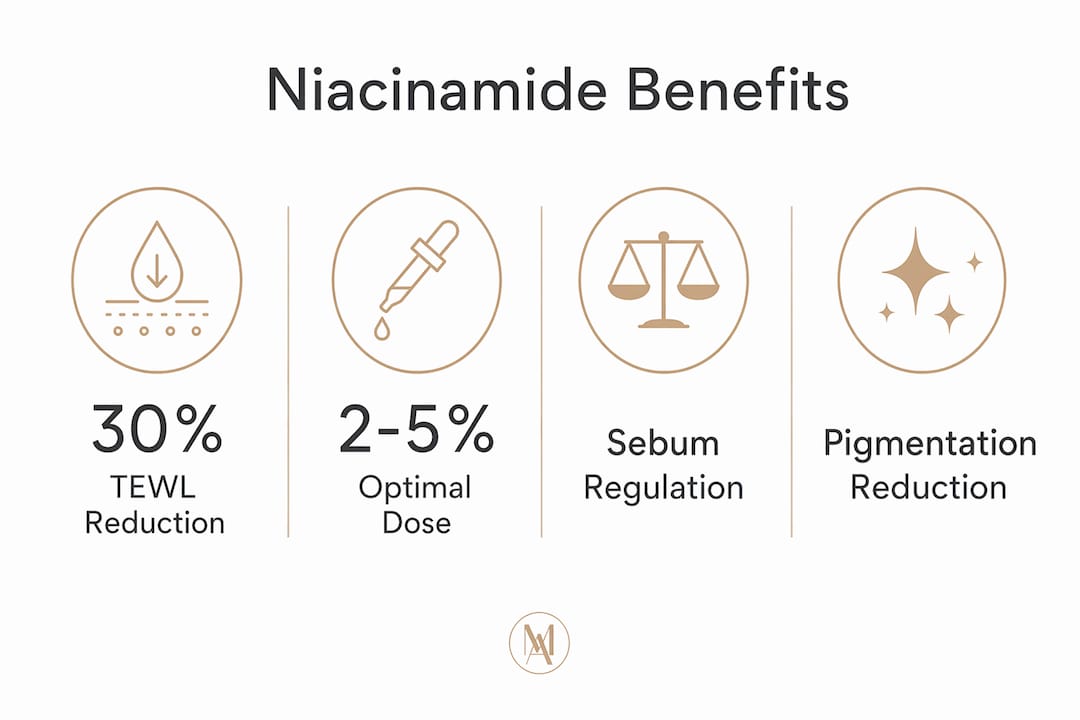
Niacinamide addresses pigmentation through a mechanism that is distinct from most brightening ingredients. Rather than blocking tyrosinase, the enzyme that produces melanin, it works downstream by inhibiting melanosome transfer from melanocytes to keratinocytes by 35 to 40%. Melanosomes are the packets that carry melanin from the cells that produce it to the skin cells that display it. By interrupting that transfer, niacinamide prevents pigmentation from appearing at the surface, even when melanin production itself continues.
This mechanism makes it safer and more stable for long-term use than many alternatives. Hydroquinone, for instance, directly inhibits tyrosinase but carries risks of ochronosis with prolonged use and is not suitable for all skin tones. Niacinamide carries none of those risks, which is why it is recommended for melasma, post-inflammatory hyperpigmentation, and sun-induced dark spots across all Fitzpatrick skin types.
Here is how to use niacinamide effectively for pigmentation:
- Use a concentration of 4 to 5% consistently, twice daily, for a minimum of eight weeks before assessing results.
- Combine with a broad-spectrum SPF 30 or higher every morning. Without sun protection, pigmentation will continue to worsen regardless of what you apply.
- Layer niacinamide with an azelaic acid or alpha arbutin product for additive brightening. These work on complementary pathways and do not compete.
- For stubborn melasma, explore a pigmentation skincare routine that incorporates niacinamide as a daily staple alongside prescription-strength actives.
| Ingredient | Mechanism | Skin type suitability | Irritation risk |
|---|---|---|---|
| Niacinamide | Inhibits melanosome transfer | All skin types | Very low |
| Hydroquinone | Tyrosinase inhibition | Limited (not for darker tones long-term) | Moderate to high |
| Alpha arbutin | Tyrosinase inhibition | Most skin types | Low |
| Azelaic acid | Multiple pathways | Most skin types, good for rosacea | Low to moderate |
What are the anti-ageing benefits of niacinamide?
Niacinamide functions as a precursor to NAD+, a coenzyme that powers cellular energy production and DNA repair. This is where its anti-ageing role becomes genuinely interesting. NAD+ levels decline with age, and that decline is directly linked to reduced cellular resilience, slower repair, and the accumulation of damage that manifests as fine lines, uneven texture, and loss of firmness. By supporting NAD+ synthesis, topical niacinamide helps restore some of that cellular capacity at the skin level.
The downstream effects are clinically measurable. Fibroblasts, the cells responsible for producing collagen and elastin, become more active in the presence of adequate NAD+. Studies using 5% niacinamide over eight to twelve weeks show significant improvements in fine lines and skin texture, alongside the pigmentation benefits already discussed. Elasticity improves, and the overall quality of the skin surface becomes noticeably smoother.
Key anti-ageing actions of niacinamide include:
- NAD+ precursor activity: Supports cellular energy and DNA repair at the mitochondrial level
- Fibroblast stimulation: Increases collagen and elastin synthesis in the dermis
- Fine line reduction: Visible improvement in surface texture within eight to twelve weeks at 5%
- Sirtuin activation: Activates longevity-associated proteins that regulate cellular stress responses
- Complementary to retinoids: Works alongside retinol to support barrier function while retinol drives cell turnover
For those using retinol products such as Medik8 Intelligent Retinol or Revision Skincare Retinol Complete, pairing with niacinamide is a particularly well-evidenced strategy. Niacinamide supports the barrier while retinol accelerates cell renewal, and the two do not interfere with each other’s mechanisms.
How to incorporate niacinamide into your skincare routine
Niacinamide is best applied after cleansing and toning, before your moisturiser and sunscreen. This positioning allows it to absorb into skin that is clean and slightly damp without being diluted by heavier occlusives applied first. It works in both serum and moisturiser formats, so the choice depends on your skin type and the concentration you need.
Practical guidance for building niacinamide into your routine:
- Concentration for beginners: Start at 2 to 4% if your skin is sensitive or reactive. Move to 5% once tolerance is established.
- Concentrations above 5% carry an increased risk of irritation and flushing, particularly in rosacea-prone skin, without delivering greater efficacy. Stay within the 2 to 5% range.
- Compatibility with vitamin C: Niacinamide and vitamin C can be used in the same routine. Apply vitamin C in the morning and niacinamide in the evening, or use them in separate steps if your skin tolerates both well.
- Compatibility with retinol: Apply niacinamide before your retinol product to buffer the skin and reduce the likelihood of irritation.
- Frequency: Twice daily use delivers the best outcomes. Once daily is appropriate for very sensitive skin during the first two to four weeks.
Pro Tip: Do not judge niacinamide by results at two weeks. Clinical studies consistently show that meaningful improvements in hydration, sebum control, and pigmentation require a minimum of four weeks, with the most significant changes appearing between eight and twelve weeks. Commit to the timeline.
Key takeaways
Niacinamide is the most clinically versatile single ingredient in skin care, delivering barrier repair, sebum regulation, pigmentation reduction, and collagen support from one well-tolerated molecule.
| Point | Details |
|---|---|
| Barrier repair and hydration | 2 to 5% niacinamide reduces TEWL by up to 30%, restoring the lipid matrix effectively. |
| Acne and sebum control | Reduces sebum by 25 to 30% and inflammatory lesions by 40 to 50% at 5% concentration. |
| Pigmentation reduction | Inhibits melanosome transfer by 35 to 40%, safely fading dark spots across all skin tones. |
| Anti-ageing via NAD+ | Supports collagen synthesis and DNA repair; visible fine line improvement within 8 to 12 weeks. |
| Routine integration | Apply after cleansing, before moisturiser; stay within 2 to 5% for optimal results without irritation. |
Why niacinamide has earned its place in every serious routine
I have worked with hundreds of clients across a range of skin concerns, and niacinamide is the ingredient I return to most consistently. Not because it is fashionable, but because it genuinely performs across skin types and concerns without the drama that accompanies stronger actives. Retinoids cause purging. Acids cause sensitivity. Niacinamide, used correctly, causes neither.
What I find most underappreciated is its role as a buffer ingredient. When clients are transitioning onto retinol or introducing prescription-strength actives, niacinamide is what keeps the barrier stable during that adjustment period. It is not passive support. It is active barrier maintenance running in parallel with the more aggressive work happening elsewhere in the routine.
The 2026 consumer trend toward ingredient minimalism has actually worked in niacinamide’s favour. As people move away from ten-step routines, they are selecting ingredients that do more with less. Niacinamide fits that model perfectly. One well-formulated 5% serum addresses oiliness, pigmentation, redness, and early ageing simultaneously. That is genuinely rare. For anyone building a results-driven routine, I would place niacinamide alongside SPF as a non-negotiable daily step, not an optional add-on.
— Jess
Discover niacinamide-led skincare at Them-ethod
At Them-ethod, we curate clinically effective formulations chosen for their evidence base, not their marketing. Our range includes dermatologist-recommended products that pair niacinamide with complementary actives for targeted results across acne, pigmentation, and ageing concerns. If you are unsure which formulation suits your skin, our virtual consultations with expert clinicians take the guesswork out of the process entirely. Read what our clients say about their results on our client reviews page and see how a well-structured, niacinamide-led routine can transform your skin with consistency and the right professional guidance behind you.
FAQ
What concentration of niacinamide is most effective?
A concentration of 4 to 5% is optimal for most skin concerns, including acne, pigmentation, and fine lines. Concentrations above 5% increase irritation risk without delivering greater clinical benefit.
Can niacinamide be used with retinol and vitamin C?
Yes. Niacinamide is compatible with both retinol and vitamin C. Apply it after cleansing and before your moisturiser, and use vitamin C in the morning and retinol in the evening to keep each active working at its best.
How long does niacinamide take to show results?
Initial improvements in hydration and redness can appear within four weeks. Meaningful changes in pigmentation, fine lines, and sebum control typically require eight to twelve weeks of consistent twice-daily use.
Is niacinamide suitable for sensitive and rosacea-prone skin?
Niacinamide is one of the best-tolerated actives for sensitive and rosacea-prone skin. Start at 2% and build gradually. Its barrier-repairing and anti-inflammatory properties make it particularly well-suited to reactive skin types.
Does topical niacinamide work the same as oral supplements?
No. Topical niacinamide addresses cosmetic concerns such as redness, pigmentation, and ageing directly at the skin surface. Oral supplements serve separate systemic functions, including potential roles in skin cancer prevention, and should not be treated as interchangeable.