




How to choose skincare for personalised, expert results
TL;DR:
- Effective skincare relies on personalized routines tailored to your skin type and concerns.
- Using targeted, evidence-backed actives and layering correctly enhances results while minimizing irritation.
- Consulting with a dermatologist ensures precise treatment plans and safe, effective skin health management.
Following the latest skincare trends can feel empowering, until your skin tells a different story. Breakouts from a viral serum, irritation triggered by a heavily promoted routine, or simply no visible change after months of effort: these are frustratingly common outcomes when skincare is chosen by popularity rather than clinical relevance. The truth is, skin responds to precision, not popularity. This guide walks you through every step of building a dermatologist-informed skincare routine, from accurately reading your skin type to selecting targeted active ingredients, layering correctly, and troubleshooting when things go wrong.
Table of Contents
- Understand your skin type and major concerns
- Essentials of an effective skincare routine
- How to select targeted treatments for specific concerns
- Common mistakes and how to troubleshoot your skincare
- Why expert-led, personalised skincare always wins
- Personalise your skincare with expert support
- Frequently asked questions
Key Takeaways
| Point | Details |
|---|---|
| Know your skin type | Identifying your skin’s baseline and main concerns is the first step to choosing effective products. |
| Build your core routine | Every skincare regimen needs a gentle cleanser, targeted treatment, moisturiser, and daily SPF. |
| Start actives carefully | Introduce strong ingredients gradually, buffer with moisturiser, and patch test to prevent irritation. |
| Troubleshoot and adjust | Monitor your skin’s reaction and be ready to modify your approach if issues arise. |
| Expert guidance matters | For prescription actives or persistent issues, dermatologist or specialist support personalises and boosts results. |
Understand your skin type and major concerns
With your goals in mind, the next step is understanding your unique skin profile. This is not about a quick quiz on a beauty website. It is about honest, consistent observation over time and, ideally, a conversation with a qualified clinician.
The five main skin types each behave differently and require distinct approaches:
- Dry skin feels tight, may appear flaky, and lacks sufficient lipid production. It benefits most from occlusive and emollient-rich formulas.
- Oily skin produces excess sebum, appears shiny, and is prone to enlarged pores and congestion. Lightweight, non-comedogenic (pore-blocking) formulas work best.
- Combination skin presents with oiliness in the T-zone (forehead, nose, chin) and dryness or normal texture on the cheeks. It often requires a zone-specific approach.
- Sensitive skin reacts easily to fragrance, alcohol, and active ingredients. Redness, stinging, and flushing are common responses that signal a compromised skin barrier.
- Acne-prone skin may overlap with oily or sensitive types but requires specific antibacterial and comedolytic (pore-clearing) treatments.
Beyond skin type, identifying your primary skin concern is equally important. The four major concern categories are acne, pigmentation, fine lines and loss of firmness, and barrier sensitivity. Each requires a different suite of actives, and layering the wrong combination can worsen the very problem you are trying to solve.
For those dealing with adult acne in their 30s and 40s, the approach must be more measured. Adult acne at this life stage calls for barrier repair first using ceramides, a hormonal check where relevant, and a slower, more cautious introduction of retinoids. Sensitive skin combined with acne requires even lower concentrations of actives, introduced one at a time. For those with skincare for darker skin tones, special care is needed because aggressive peels and certain laser treatments significantly raise the risk of post-inflammatory hyperpigmentation (PIH), a darkening of the skin that can be more persistent than the original concern.
Environmental and lifestyle triggers also shape how your skin behaves. Stress hormones, dietary patterns, sleep quality, and urban pollution all influence sebum production, barrier integrity, and inflammatory responses. Identifying these factors makes the difference between managing symptoms and addressing root causes.
Pro Tip: Photograph your skin weekly under consistent lighting for one month before buying any new products. This gives you an honest baseline and helps you spot genuine changes when you do introduce a new routine.
If you have sensitive skin, exploring best practices for sensitive skin with expert guidance will help you avoid common trigger ingredients and find formulas your skin can genuinely tolerate.
Essentials of an effective skincare routine
Now that you have identified your skin’s needs, it is time to build the framework of your ideal routine. An evidence-based routine does not need to be complicated. In fact, simplicity usually performs better than complexity.
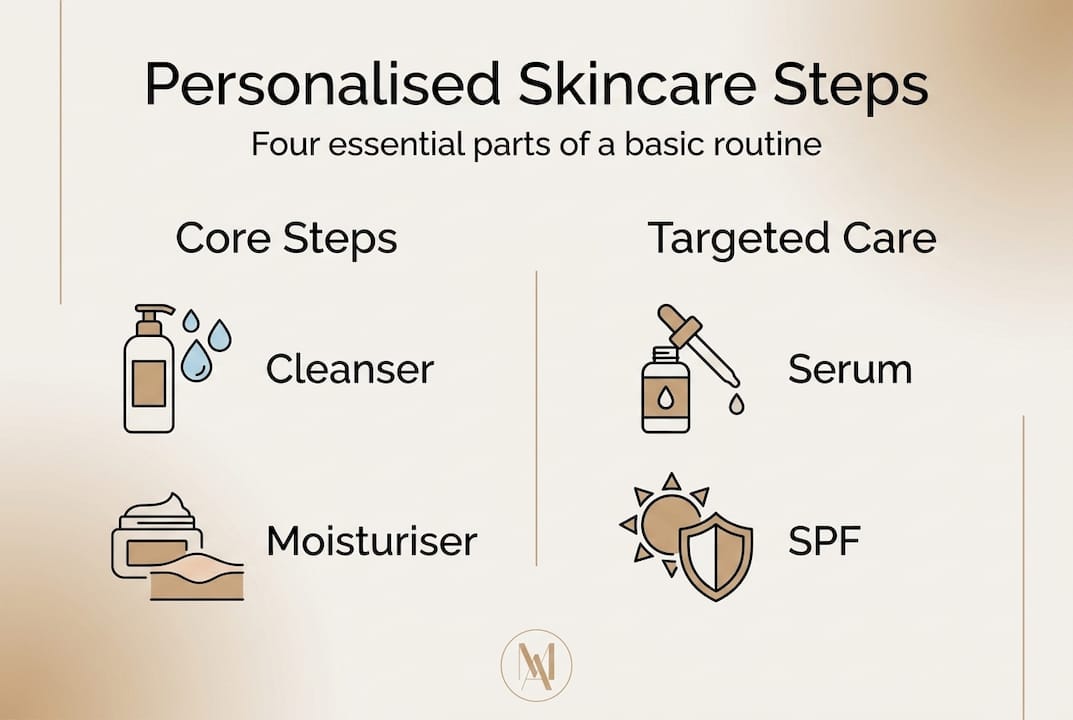
The four foundational steps are: cleansing, treatment (serum), moisturising, and sun protection. Every effective routine, regardless of skin concern or budget, follows this sequence. Deviating from it, or skipping steps, undermines the efficacy of even the most expensive actives.
The skincare layering process matters significantly. Products should be applied from the thinnest to thickest consistency, and active ingredients should be given time to absorb before the next layer is applied. Applying a thick moisturiser before a water-based serum, for example, blocks the serum from penetrating properly.
| Routine step | Purpose | Product type |
|---|---|---|
| Cleanser | Remove impurities without stripping barrier | Gentle, pH-balanced or mild foaming |
| Treatment serum | Deliver active ingredients to the skin | Targeted to specific concern |
| Moisturiser | Restore hydration and seal the barrier | Cream, gel-cream, or lotion based on skin type |
| SPF | Prevent UV-induced damage and pigmentation | Broad-spectrum SPF 30+ daily |
A few common mistakes undermine even well-chosen routines:
- Overusing actives: More is rarely better. Using a retinoid, an exfoliating acid, and a vitamin C serum all at once overwhelms the skin’s tolerance threshold.
- Skipping SPF: This is non-negotiable. Broad-spectrum SPF 30+ is a core daily step, and for acne-prone skin, mineral or oil-free formulas are recommended.
- Applying too much product: A pea-sized amount of most serums is sufficient. Using excess product does not accelerate results; it increases the risk of irritation and waste.
- Neglecting patch testing: Apply a small amount of any new product to the inner forearm or behind the ear for 24 to 48 hours before full facial use.
Pro Tip: If you are new to actives, start your routine with just a cleanser, moisturiser, and SPF for two weeks. Establish a calm baseline before adding any treatment step. This makes it much easier to identify which product is responsible if a reaction occurs later.
Patch testing is not just for sensitive skin. Even tolerant skin types can react unexpectedly to specific formulations, fragrances, or preservatives. Making it a habit from the start saves time and prevents setbacks.
How to select targeted treatments for specific concerns
With the foundation of your routine solid, choosing the right treatments is the next crucial step. This is where most people make their costliest mistakes, whether by choosing the wrong actives for their concern or by using clinical-grade ingredients without the right protocol.
Here is a guide to the most evidence-backed actives for the most common concerns:
- Retinoids (retinol, tretinoin): The gold standard for anti-ageing, acne, and pigmentation. Tretinoin is prescription-only and significantly more potent than over-the-counter retinol. Introduce slowly, beginning two nights per week, and always follow with moisturiser.
- Benzoyl peroxide: Highly effective for acne. AAD acne treatment guidelines recommend topical retinoids and benzoyl peroxide as first-line treatments, with oral antibiotics like doxycycline added for moderate to severe cases.
- Azelaic acid: Anti-inflammatory, antibacterial, and pigmentation-reducing. It is one of the safest actives for sensitive skin and a strong option for those managing rosacea or mild hyperpigmentation.
- Niacinamide: Regulates sebum, reduces the appearance of pores, and supports barrier function. It is highly tolerated and suitable for most skin types, including sensitive and acne-prone.
- Vitamin C (L-ascorbic acid): A potent antioxidant that brightens skin, reduces pigmentation, and supports collagen production. It is best used in the morning before SPF and kept away from direct combinations with retinoids.
| Active ingredient | Primary concern | Prescription needed? | Suitable for sensitive skin? |
|---|---|---|---|
| Tretinoin (retinoid) | Ageing, acne, pigmentation | Yes | With caution |
| Benzoyl peroxide | Acne | No | Low concentrations only |
| Azelaic acid | Acne, rosacea, pigmentation | No (up to 10%) | Yes |
| Niacinamide | Sebum, barrier, mild pigmentation | No | Yes |
| Vitamin C | Brightening, antioxidant protection | No | With caution |
The distinction between prescription and over-the-counter treatments is clinically significant. If you have persistent acne, visible scarring, or deep pigmentation, a consultation with a dermatologist or qualified clinician is not optional but rather essential. Prescription actives operate at concentrations that genuinely shift skin biology, whereas many over-the-counter products work more gently and gradually.
Combining actives correctly is an art as much as a science. Aggressive combinations such as retinoids with acids and benzoyl peroxide can be effective, but they carry a real risk of irritation and barrier disruption. The smarter path, particularly for sensitive skin guidance, is to buffer with moisturisers and alternate application days. As consistent evidence confirms, gentler actives like azelaic acid and niacinamide offer excellent tolerance profiles for those who cannot manage high-intensity formulas.
Pro Tip: Never combine a retinoid with a high-concentration vitamin C serum in the same evening application. Use vitamin C in the morning and your retinoid at night. This protects both the efficacy of vitamin C (which degrades with light and oxidation) and the stability of your retinoid.
Common mistakes and how to troubleshoot your skincare
Even with the best advice, mistakes happen. Knowing how to diagnose and adjust is just as important as the initial product selection.
Signs that a product is not working for you include:
- Persistent redness or stinging that does not subside after the first two weeks of use
- New breakouts in areas not typically prone to spots, which may indicate comedogenic (pore-blocking) ingredients
- Flaking or tightness that worsens rather than improves with continued use
- No visible or tactile change after eight to twelve weeks of consistent application
The golden rule of troubleshooting is to introduce products one at a time. Patch test each new addition, then wait at least two weeks before adding another. This systematic approach is the only reliable way to identify which product is causing a reaction or delivering results.
Overusing exfoliants is one of the most frequent errors we see. Daily use of AHAs (alpha-hydroxy acids) or BHAs (beta-hydroxy acids) can compromise the skin barrier, leading to what is known as barrier disruption: increased sensitivity, redness, and paradoxically more breakouts. Healthy exfoliation frequency is two to three times per week at most for most skin types.
“When skin becomes irritated during a new routine, the instinct is to add more products to fix the damage. In reality, stripping the routine back to just a gentle cleanser and a ceramide-based moisturiser is almost always the most effective first response. Let the barrier heal before reintroducing anything active.”
For sensitive skin troubleshooting, the barrier-first philosophy is especially important. Ceramides, hyaluronic acid, and gentle occlusive moisturisers are your reset tools. Only once the skin is calm and tolerant should you attempt to reintroduce any active ingredient.
For those with tips for darker skin tones, the same principle applies at an even higher level of caution. Post-inflammatory hyperpigmentation in darker skin is a documented risk when aggressive treatments are used without adequate skin preparation. Avoid lasers and high-concentration peels unless under direct clinical supervision, and opt for depigmenting actives like azelaic acid, tranexamic acid, and low-dose niacinamide as safer first-line options.
If your skin condition changes suddenly without a clear cause, such as a new texture, widespread sensitivity, or unexplained breakouts, do not simply swap products. This is the moment to seek a professional consultation. Hormonal shifts, dietary changes, and environmental stressors can all alter how your skin functions at a physiological level.
Why expert-led, personalised skincare always wins
Stepping back reveals something mainstream advice rarely addresses: the fundamental flaw in most popular skincare content is that it treats efficacy as universal. What works for one person’s skin biology, microbiome, hormonal profile, and lifestyle will not automatically work for yours. This is not a nuance. It is the central reason so many people cycle through products, spend significant money, and still feel stuck.
Generic routines fail not because the products are poor quality but because they are applied without clinical context. A retinoid serum that transforms skin for one person can severely disrupt the barrier of another person if their skin is already sensitised or if they are using an incompatible combination of actives. The intensity-first mentality, loading up on the strongest available concentrations, produces short-term disruption more often than long-term improvement.
The real value of a virtual dermatology consultation is not just product selection. It is the ongoing calibration of your routine based on how your skin actually responds. Prescription actives, when appropriately matched to your concern and guided by a qualified clinician, produce results that no over-the-counter product can match in the same timeframe. This is not about exclusivity. It is about precision.
We firmly believe that the most effective routines are often the most boring-looking ones. A well-formulated gentle cleanser, a clinically matched treatment serum, a good moisturiser, and a broad-spectrum SPF beats a ten-step routine built around trends every time. Consistent, correctly layered routines over three to six months outperform high-intensity regimes abandoned after three weeks because the skin could not tolerate them.
Patience and precision are not passive virtues in skincare. They are the active ingredients.
Personalise your skincare with expert support
Making the shift from guesswork to genuinely effective skincare is simpler when you have the right support. At The M-ethod, we combine expert clinical knowledge with a curated selection of prescription-strength and dermatologist-recommended products, making it straightforward to find what your skin actually needs. Whether you are managing persistent acne or refining an anti-ageing protocol, our virtual skin consultations connect you directly with top clinicians who assess your concerns and recommend targeted solutions. The PCA Clearskin Serum is an excellent example of a clinically formulated treatment for acne-prone skin, while our NEOSTRATA collection offers proven resurfacing and regenerating options for ageing and pigmentation concerns. Every recommendation we make is grounded in clinical evidence, not trends.
Frequently asked questions
How do I know which skincare ingredients are right for me?
Identify your primary skin concerns first, then look for evidence-backed actives matched to those needs. For instance, retinoids and benzoyl peroxide are established first-line treatments for acne, while retinoids and vitamin C are well-supported for signs of ageing.
Why do I need to patch test new skincare products?
Patch testing identifies potential allergic reactions or irritation before you apply a product to your full face. As part of any sound routine, you should patch test new products on the inner arm for 24 to 48 hours before facial use.
Is it safe to use multiple actives in my routine?
Some actives can be combined safely, but they must be introduced gradually and never all at once. Aggressive active combinations can be effective when buffered with moisturisers and alternated across days, but gentler options like azelaic acid suit those with lower tolerance.
What should I do if my skin becomes irritated after starting a new routine?
Stop all new products immediately and return to a simple routine of gentle cleanser and a ceramide-based barrier repair moisturiser. Reintroduce actives slowly, one at a time, only once the skin has settled.
How can people with darker skin tones avoid pigmentation issues when choosing skincare?
Choose gentle, proven actives such as azelaic acid and niacinamide, and avoid procedures that carry a higher PIH risk. Darker skin tones face increased PIH risk from aggressive lasers and high-concentration chemical peels, so clinical supervision is strongly advisable.