


Hydroquinone explained: UK guide to safe skin treatment
Hydroquinone is a topical depigmenting agent that reduces melanin production in the skin by inhibiting tyrosinase, the key enzyme in melanin synthesis. The 4% formulation, which contains 40 mg of hydroquinone per gram, is the most commonly prescribed strength. In the UK, hydroquinone is classified as a prescription-only medicine (POM), meaning you cannot legally purchase it over the counter. You must obtain it through a clinician who can diagnose your condition, assess your suitability, and monitor your response.
Key facts at a glance:
- Hydroquinone is a metabolic inhibitor, not a bleach. It suppresses melanin synthesis rather than destroying existing pigment.
- Prescription strengths in the UK: typically 2% or 4%.
- UK legal status: prescription-only medicine (POM). Obtain via a qualified clinician only.
- Depigmentation is reversible. Without consistent sun protection, pigment returns.
Key takeaways
Hydroquinone is the most clinically validated topical depigmenting agent available in the UK, but its safety and efficacy depend entirely on correct diagnosis, appropriate concentration, combination therapy, and consistent photoprotection.
| Point | Details |
|---|---|
| UK prescription status | Hydroquinone is a prescription-only medicine (POM) in the UK; obtain it only via a qualified clinician. |
| Mechanism and reversibility | It inhibits tyrosinase to reduce melanin synthesis; depigmentation is reversible without strict SPF 30+ photoprotection. |
| Best-suited conditions | Most effective for epidermal pigmentation: melasma, post-inflammatory hyperpigmentation, and solar lentigines. |
| Combination therapy | Pairing hydroquinone with a retinoid and mild steroid is the standard clinical approach for better results and reduced irritation. |
| Them-ethod consultation | Book a virtual or in-clinic consultation at Them-ethod for a clinician-prescribed, regulated hydroquinone regimen and Obagi Nu-Derm access. |
Table of Contents
- How does hydroquinone work in the skin?
- Which pigmentation conditions does hydroquinone treat?
- What should a clinician assess before prescribing?
- How do you apply hydroquinone correctly?
- What are the side effects and risks of hydroquinone?
- When should you avoid hydroquinone?
- How does combination therapy improve results?
- What are the alternatives to hydroquinone?
- How is hydroquinone regulated in the UK?
- When will you see results, and how do you maintain them?
- Practical safety tips and red flags to watch for
- What does a responsible clinic consultation involve?
- A clinician’s perspective on realistic outcomes
- Prescription-led pigmentation care at Them-ethod
- Sources
How does hydroquinone work in the skin?
Hydroquinone’s chemical identity is 1,4-dihydroxybenzene (C6H6O2), a small phenolic compound that penetrates the epidermis and acts directly on melanocytes, the pigment-producing cells. Its primary mechanism is inhibition of tyrosinase, the enzyme that converts tyrosine into DOPA and then into melanin. By blocking this conversion, hydroquinone reduces the rate of new melanin synthesis. It also interferes with other melanocyte metabolic processes, including the degradation of melanosomes, the organelles that store and transfer pigment.
The depigmentation this produces is reversible. Melanocytes are not destroyed; their activity is suppressed. Once treatment stops, or once UV radiation stimulates the skin, melanin production resumes. This is why photoprotection is not optional during treatment. It is the mechanism that determines whether results last.
Key points on the mechanism:
- Tyrosinase inhibition is the primary action, reducing melanin synthesis at source.
- Secondary effects include disruption of melanosome formation and transfer.
- Depigmentation is reversible; UV exposure triggers repigmentation.
- Hydroquinone is a metabolic inhibitor. Treating the underlying inflammatory trigger is equally important to prevent recurrence.
Which pigmentation conditions does hydroquinone treat?
Hydroquinone is the standard topical treatment for acquired hyperpigmentation. Its primary clinical indications are:
- Melasma (chloasma): Hormonally driven facial pigmentation, common in pregnancy and with oral contraceptive use.
- Post-inflammatory hyperpigmentation (PIH): Pigment left after acne, eczema, injury, or other inflammatory skin conditions.
- Solar lentigines: Sun-induced flat brown spots, sometimes called age spots or liver spots.
- Freckles (ephelides): Genetically determined pigment spots that darken with UV exposure.
A clinically important distinction governs how well hydroquinone works for any individual: epidermal pigment responds well; dermal pigment generally does not. Melanin deposited in the upper layers of the skin is accessible to topical agents. Pigment that has migrated deeper into the dermis, as sometimes occurs in long-standing melasma, is largely beyond the reach of topical hydroquinone. A clinician uses Wood’s lamp examination or dermoscopy to assess pigment depth before prescribing.
Hydroquinone is not indicated for general skin lightening of otherwise healthy, uniformly pigmented skin. Using it for that purpose increases the risk of adverse effects, including paradoxical darkening, without a meaningful clinical benefit.
What should a clinician assess before prescribing?
Hydroquinone should only be prescribed after a clinician has diagnosed the type and cause of your pigmentation. Self-diagnosis and self-prescribing carry real risks, including treating the wrong condition, missing a contraindication, and using the agent without appropriate monitoring.
A responsible clinical assessment covers:
- Full medical history, including current medications, allergies, and prior skin reactions.
- Skin examination to determine pigment depth (epidermal vs dermal) and rule out conditions that mimic hyperpigmentation.
- Pregnancy and breastfeeding status (hydroquinone is contraindicated in pregnancy).
- Fitzpatrick skin type assessment, since darker skin types carry a higher risk of paradoxical hyperpigmentation and ochronosis.
- Identification of the underlying cause (hormonal, UV-driven, post-inflammatory) to address triggers alongside treatment.
Bring to your consultation:
- A list of all current skincare products, including SPF.
- Photographs showing the pigmentation over time, if available.
- Details of any previous treatments and their outcomes.
- Information about any hormonal changes (pregnancy, contraception, HRT).
Pro Tip: Ask your clinician specifically about treatment cycling (how long you will use hydroquinone before a break), the follow-up schedule, and which sunscreen formulation they recommend. These three questions separate a thorough consultation from a rushed one.
How do you apply hydroquinone correctly?
Step-by-step application:
- Patch test first. Apply a small amount to the inner forearm and wait 24 hours. If you experience redness, itching, or swelling, do not proceed without clinician guidance.
- Cleanse the skin with a gentle, non-irritating cleanser and pat dry.
- Apply a thin layer to the affected areas only. Avoid applying to surrounding healthy skin.
- Use as directed by your clinician, typically once or twice daily. Evening application is common when combined with a retinoid.
- Apply broad-spectrum SPF 30+ sunscreen every morning, regardless of weather. This is non-negotiable for maintaining results.
- Avoid contact with eyes, nostrils, and mouth.
Typical course duration and cycling:
- Standard courses run for 8–12 weeks.
- If there is no visible improvement after approximately 3 months, discontinue and review with your clinician.
- Cycling strategies (for example, 3 months on, then a break) are commonly recommended to reduce the risk of long-term adverse effects such as ochronosis.
- Maintenance may involve intermittent use alongside consistent photoprotection.
What are the side effects and risks of hydroquinone?
Most people using prescription hydroquinone under clinical supervision tolerate it well. The most common side effects are mild and localised:
- Skin irritation, redness, and dryness at the application site.
- Contact dermatitis (allergic or irritant), presenting as itching, scaling, or a rash.
- Temporary stinging or burning on application, particularly in the first few weeks.
These effects usually resolve when treatment stops or the dose is reduced. They are more likely with higher concentrations and more frequent application.
Two rarer but more serious risks deserve particular attention:
Paradoxical hyperpigmentation occurs when hydroquinone causes darkening rather than lightening, particularly in darker skin tones. This can result from inflammatory irritation triggered by the product itself.

Exogenous ochronosis is a blue-black discolouration of the skin associated with prolonged, unsupervised use, particularly at high concentrations. It is documented in peer-reviewed clinical literature and is considered largely irreversible. The risk is substantially higher with continuous long-term use and with unregulated products of unknown concentration.
Systemic toxicity from topical use at prescription concentrations is rare. The concern rises sharply with unregulated, high-concentration products purchased online without medical oversight.
When should you avoid hydroquinone?
Some situations call for avoiding hydroquinone entirely; others require extra caution. Your clinician will screen for these, but you should be aware of them before your consultation.
Absolute contraindications:
- Pregnancy and breastfeeding (unless a clinician has explicitly assessed and advised otherwise).
- Known hypersensitivity or allergy to hydroquinone or any component of the formulation.
- Application to open wounds, broken, or actively infected skin.
- Active contact dermatitis or eczema in the treatment area.
Use with particular caution:
- Children: hydroquinone is not routinely recommended for paediatric use.
- Darker Fitzpatrick skin types (IV–VI): higher risk of paradoxical darkening and ochronosis.
- Concurrent use of other potentially irritating topical agents (strong exfoliants, high-concentration vitamin C, or other depigmenting agents) without clinician guidance.
If you develop severe irritation, blistering, or any rapid darkening of the treated area, stop treatment immediately and contact your clinician.
How does combination therapy improve results?
Hydroquinone alone is effective, but combination therapy is the standard clinical approach for moderate to severe melasma and persistent hyperpigmentation. The classic triple combination pairs hydroquinone with a topical retinoid and a mild topical corticosteroid.
Each component serves a distinct purpose:
- Hydroquinone (2%–4%): Inhibits tyrosinase and reduces new melanin synthesis.
- Topical retinoid (e.g., tretinoin): Accelerates epidermal cell turnover, enhancing hydroquinone penetration and dispersing existing pigment. It also independently inhibits melanin transfer.
- Mild topical corticosteroid: Reduces the irritation that hydroquinone and retinoids can cause, lowering the risk of paradoxical hyperpigmentation from inflammation.
Sequencing matters. Clinicians typically prescribe the combination as a single formulation or with clear instructions on application order and timing. Applying a strong exfoliant (such as a high-strength glycolic acid product) at the same time as this regimen increases irritation risk significantly and should be avoided unless specifically directed.
Pro Tip: If you are using a retinoid as part of your regimen, ask your clinician whether a PCA Retinol Night 0.5% or similar formulation is appropriate for your skin type and tolerance before adding it to your routine.
Clinical protocols typically cycle the full combination regimen, with periods of treatment followed by maintenance phases, to reduce cumulative irritation and the risk of ochronosis.
What are the alternatives to hydroquinone?
Several evidence-based alternatives exist for those who cannot use hydroquinone, prefer to avoid prescription bleaching agents, or have dermal pigment that hydroquinone is unlikely to address. A thorough pigmentation treatment guide can help you compare these options in detail.
When to consider alternatives:
- Pregnancy or breastfeeding.
- Intolerance or allergy to hydroquinone.
- Dermal or mixed pigmentation where topical agents have limited reach.
- Preference for non-prescription options.
Key alternatives:
- Azelaic acid (10%–20%): Available on prescription in the UK; anti-inflammatory and tyrosinase-inhibiting properties. Well tolerated in pregnancy.
- Kojic acid: A fungal-derived tyrosinase inhibitor; available in some cosmetic formulations, though less potent than prescription hydroquinone.
- Tranexamic acid (topical or oral): Increasingly used for melasma; reduces melanin synthesis via a different pathway and is generally well tolerated.
- Chemical peels (glycolic, salicylic, TCA): Accelerate epidermal turnover and can improve superficial pigmentation; best combined with topical agents.
- Laser and light therapies (Q-switched Nd:YAG, IPL, picosecond lasers): Useful for lentigines and some cases of PIH; require careful patient selection, particularly in darker skin tones.
| Treatment category | Typical advantage | Key limitation |
|---|---|---|
| Topical tyrosinase inhibitors (azelaic acid, kojic acid, tranexamic acid) | Non-prescription options available; suitable in pregnancy (azelaic acid) | Generally slower or less potent than 4% hydroquinone |
| Chemical peels | Addresses superficial pigmentation; can be combined with topicals | Risk of PIH in darker skin; requires professional application |
| Laser and light therapies | Effective for discrete lesions (lentigines); long-lasting results possible | Higher cost; not suitable for all skin types; risk of worsening in darker tones |
How is hydroquinone regulated in the UK?
In the UK, hydroquinone is a prescription-only medicine. You cannot legally buy it over the counter in a pharmacy, and any product sold without a prescription in the UK is either mislabelled or operating outside the law. The Medicines and Healthcare products Regulatory Agency (MHRA) oversees the regulation of medicines in the UK, and hydroquinone-containing products intended for therapeutic use fall within its remit.
Risks of unregulated online purchases:
- Unknown concentration (products may contain far higher than 4%, increasing ochronosis risk).
- Unlisted or harmful additional ingredients.
- No clinical oversight, patch testing, or monitoring.
- Counterfeit or contaminated products.
How to obtain hydroquinone safely in the UK:
- Consult a qualified clinician (dermatologist, GP with a special interest in dermatology, or a regulated aesthetic clinic).
- Request the Summary of Product Characteristics (SPC) or Patient Information Leaflet (PIL) for any prescribed product.
- Check that the product is dispensed by a registered pharmacy.
- Avoid purchasing from unverified online retailers, regardless of price.
When will you see results, and how do you maintain them?
Many patients notice visible improvement within 6–12 weeks of consistent use, though individual response varies considerably. Epidermal pigmentation tends to respond faster than mixed pigmentation. Dermal pigment, as noted earlier, responds poorly to topical hydroquinone regardless of duration.
Repigmentation after stopping treatment is common, particularly without rigorous photoprotection. UV exposure is the single most powerful trigger for melanin resynthesis, which is why SPF 30+ broad-spectrum sunscreen applied every morning is as much a part of the treatment as the hydroquinone itself.
Typical follow-up and maintenance:
- Review with your clinician at 6–8 weeks to assess response and check for adverse effects.
- If improvement is satisfactory at 12 weeks, discuss a maintenance strategy: intermittent use, a lower concentration, or transition to an alternative agent.
- Address underlying triggers: hormonal changes, UV exposure, and ongoing inflammation all drive recurrence.
- For melasma in particular, long-term photoprotection and trigger management are the foundation of sustained results.
Practical safety tips and red flags to watch for
Daily safety habits:
- Apply SPF 30+ broad-spectrum sunscreen every morning, reapplying if outdoors for extended periods.
- Apply hydroquinone only to the affected area; avoid healthy surrounding skin.
- Complete a patch test before starting any new formulation.
- Keep products out of reach of children.
- Do not use on broken, sunburnt, or irritated skin.
Red flags that require you to stop and seek clinician review:
- Severe burning, blistering, or swelling at the application site.
- Rapid darkening of the treated area (paradoxical hyperpigmentation).
- Persistent blue-black discolouration developing in treated skin (possible ochronosis — seek urgent review).
- Signs of an allergic reaction: widespread rash, hives, or facial swelling.
Safe sourcing reminder: Always obtain hydroquinone through a clinician and a registered pharmacy. Unlabelled creams purchased online carry serious risks that no price saving justifies.
What does a responsible clinic consultation involve?
A responsible clinic consultation for hydroquinone treatment is not simply a prescription transaction. It is a diagnostic and planning process that protects you and improves your outcomes.
A well-structured consultation typically includes:
- Medical history review: Medications, allergies, hormonal status, prior skin treatments.
- Photographic assessment: Baseline photographs to track progress objectively.
- Pigment depth assessment: Wood’s lamp or dermoscopy to distinguish epidermal from dermal pigment.
- Treatment plan: Concentration, formulation, combination agents (retinoid, mild steroid), application schedule, and cycling strategy.
- Aftercare and monitoring: Scheduled follow-up, red-flag guidance, and sunscreen prescription or recommendation.
At Them-ethod, we offer virtual skin consultations with experienced clinicians who assess your pigmentation, discuss the full range of treatment options, and prescribe appropriately within UK regulatory requirements. As a UK-based Obagi Ambassador Clinic, we provide access to the Obagi Nu-Derm system, a clinician-prescribed regimen that incorporates hydroquinone alongside retinoids and other active agents in a structured, monitored programme. Our consultations cover combination therapy, safe sourcing, and realistic outcome planning, so you begin treatment with a clear picture of what to expect.
A clinician’s perspective on realistic outcomes
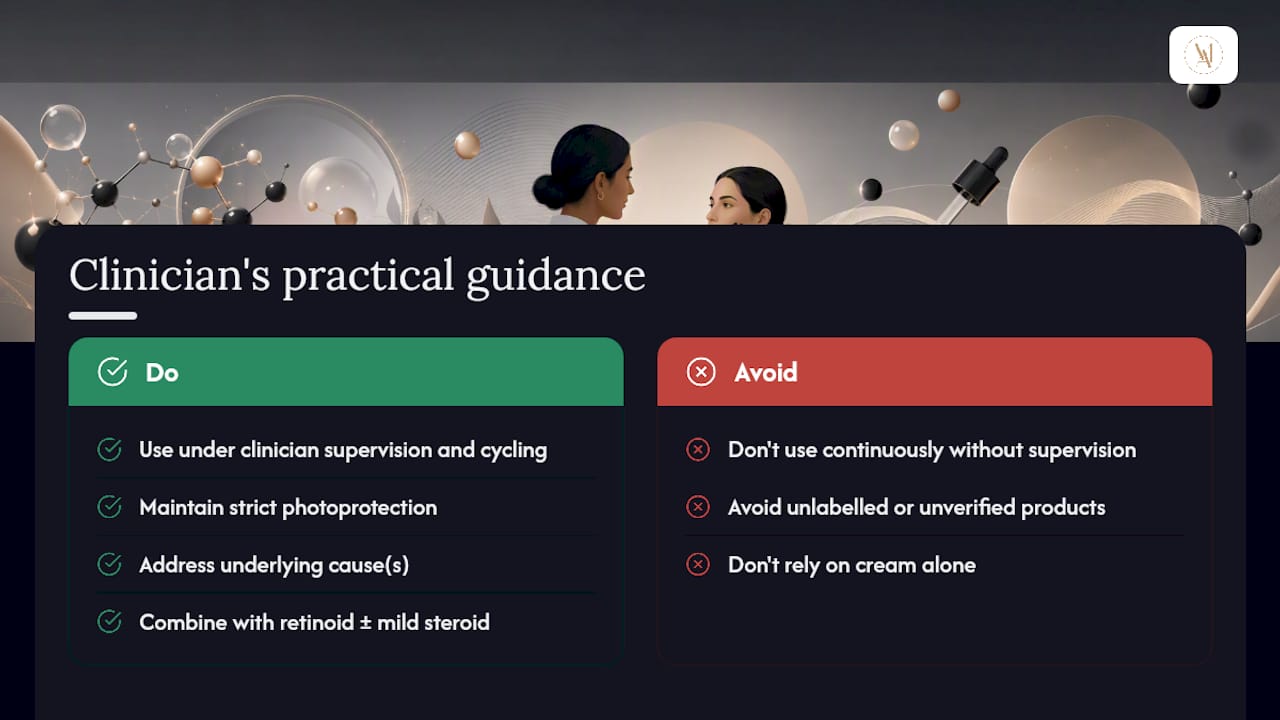
Hydroquinone works. Used correctly, under supervision, with consistent photoprotection and a structured cycling protocol, it remains the most clinically validated topical depigmenting agent available. The problem is not the molecule. The problem is misuse: continuous unsupervised application, unregulated products of unknown concentration, and the expectation that a cream alone will resolve pigmentation driven by ongoing hormonal or UV triggers.
The patients who see the best results are those who treat hydroquinone as one component of a broader strategy. Photoprotection is the foundation. Addressing the underlying cause, whether that is hormonal, inflammatory, or UV-driven, is what prevents recurrence. Combination therapy with a retinoid and, where appropriate, a mild steroid, is what accelerates and sustains the response. Hydroquinone without these elements is a partial solution at best.
There is also a meaningful conversation to have about skin tone. Darker skin types can benefit significantly from hydroquinone, but they carry a higher risk of paradoxical hyperpigmentation and ochronosis. That does not mean avoiding treatment. It means choosing a clinician who understands those risks, starts at an appropriate concentration, and monitors closely. The long-term safety considerations are manageable with the right oversight. They are not manageable with an unlabelled cream from an unverified online retailer.
Prescription-led pigmentation care at Them-ethod
For those ready to address hyperpigmentation with clinician-led precision, Them-ethod offers a clear, medically supervised pathway. Book a virtual or in-clinic consultation with our expert clinicians, who will assess your pigmentation type, confirm suitability for hydroquinone, and build a personalised treatment plan within UK regulatory requirements.
Our pigmentation services include virtual consultations, prescription hydroquinone regimens, combination therapy protocols, and access to the Obagi Nu-Derm system as an authorised UK Ambassador Clinic. For skin renewal support alongside your depigmenting regimen, our Calecim Professional Serum is used in clinic protocols to support skin recovery and radiance. We also stock medical-grade adjunctive care through our NeoStrata collection for readers who want to build a complete, evidence-based pigmentation routine.
Every product and prescription we provide comes through verified, regulated channels. No unlabelled imports, no guesswork. Book your consultation at Them-ethod and start treatment the right way.
Sources
The following authoritative resources provide additional clinical and regulatory detail for readers who want to go deeper:
- Hydroquinone - StatPearls - NCBI Bookshelf
- Hydroquinone (bleaching cream)
- HYDROQUINONE USP, 4% (DailyMed)
- PubMed record (31802394)
When you receive a prescription for hydroquinone, ask your clinician or pharmacist for the Summary of Product Characteristics (SPC) or Patient Information Leaflet (PIL). These documents contain the full prescribing information specific to the formulation you have been given.
This article is general information, not a substitute for advice from a qualified doctor. Consult a qualified healthcare professional about your own circumstances before acting on anything here.