

Acne scarring: causes, types and treatment explained
Acne scarring is a permanent structural change to the skin caused by the inflammatory repair process that follows acne lesions. When a deeply inflamed blemish damages the dermis, the skin attempts to heal itself through collagen remodelling. The result is either a loss of tissue, producing an indentation, or an excess of collagen, producing a raised band. This is distinct from post-inflammatory pigmentation, the flat red or brown marks that often follow spots and typically fade over weeks to months without any structural change to the skin. True scarring, by contrast, is a fibrous repair response to full-thickness inflammatory injury and does not resolve on its own, though it can often be significantly improved with the right treatment plan.
Your immediate next steps:
- Apply a broad-spectrum SPF 30+ sunscreen daily to protect healing skin and prevent pigmentation from deepening.
- Stop picking or squeezing active lesions. Early, effective treatment of inflammatory acne and avoiding manipulation are the most reliable ways to reduce permanent scarring.
- If scarring is new, widespread, or causing psychological distress, speak to your GP about a referral to dermatology. Most NHS treatment is limited, but a GP assessment is the right starting point.
- For existing scars, realistic improvement rather than complete removal is the usual outcome. A clinician-led plan tailored to your scar type and skin tone gives the best results.
Key takeaways
Acne scarring is a permanent structural change to the dermis that can be significantly improved with the right combination of treatments, but realistic expectations and a scar-type-specific plan are essential for good outcomes.
| Point | Details |
|---|---|
| Scars are structural, not pigment | True acne scars alter skin texture permanently; flat pigmented marks often fade without treatment. |
| Classification drives treatment | Ice pick, boxcar, rolling, and hypertrophic scars each require different procedures for effective improvement. |
| Combination approaches work best | No single treatment suits all scar types; staged, multi-modality plans tailored to skin type produce the best results. |
| Prevention is the highest-leverage step | Treating active acne early and avoiding picking are the most reliable ways to prevent permanent scarring. |
| Them-ethod for personalised planning | Virtual consultations and prescription-strength products at Them-ethod support both prevention and staged scar treatment. |
This article is general information, not a substitute for advice from a qualified doctor. Consult a qualified healthcare professional about your own circumstances before acting on anything here.
Table of Contents
- What is acne scarring, and how does it differ from a temporary mark?
- How does acne cause permanent scarring?
- How can you tell if a mark is an acne scar?
- What are the evidence-based treatment options for acne scars?
- How do you choose the right treatment and clinician in the UK?
- Practical steps to prevent scarring and support skin healing
- Do acne scars go away on their own?
- How does skin tone affect treatment safety and suitability?
- How is acne scarring treated on the NHS versus privately in the UK?
- How a specialist clinic approaches acne scar assessment and treatment planning
- A clinician’s perspective on realistic outcomes
- Personalised acne scar support from Them-ethod
- Sources
What is acne scarring, and how does it differ from a temporary mark?
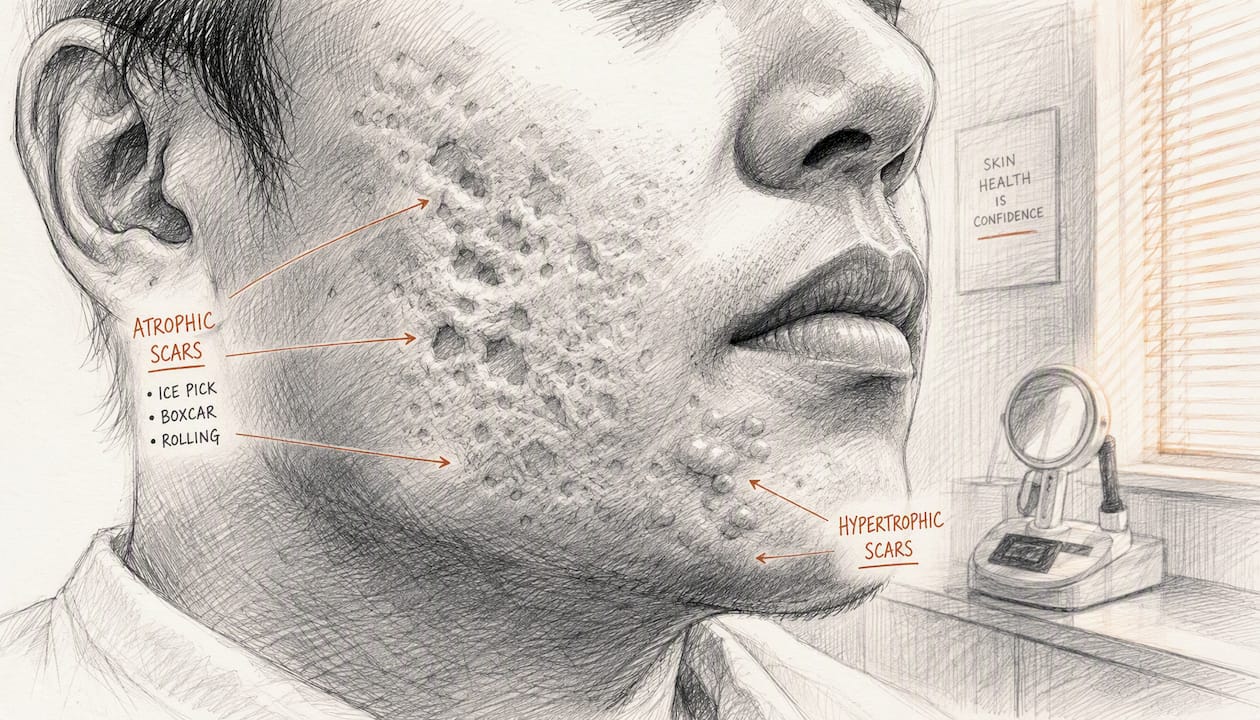
Acne scars are classified into two broad structural categories: atrophic scars, caused by a net loss of collagen during healing, and hypertrophic or keloid scars, caused by an overproduction of collagen. Atrophic scars are by far the more common type and are further divided into three clinically recognised subtypes.
Atrophic scar types:
- Ice pick scars are deep, narrow channels that extend into the dermis. They look like small puncture marks and are among the most difficult to treat because of their depth.
- Boxcar scars are broader, round or oval depressions with sharply defined, near-vertical edges. They tend to be shallower than ice pick scars and respond well to resurfacing techniques.
- Rolling scars are shallow but wide, with gently sloping edges that create an undulating, wave-like texture. They are caused by fibrous tethering beneath the skin surface.
Hypertrophic and keloid scars:
- Hypertrophic scars are raised, firm bands of scar tissue that remain within the original wound boundary. They are more common on the chest, back, and shoulders.
- Keloid scars grow beyond the original wound margins and can continue to enlarge over time. They carry a genetic component and are more prevalent in people with darker skin tones.
Why does classification matter? Because scar morphology directly drives treatment selection. A clinical review linking specific procedures to scar subtypes established that subcision is the technique of choice for rolling scars, punch excision or TCA CROSS for ice pick scars, and laser resurfacing or dermabrasion for boxcar scars. Treating a rolling scar with a punch technique, or an ice pick scar with a superficial peel, produces poor results. Getting the classification right first is not a formality; it is the foundation of an effective plan.
How does acne cause permanent scarring?
Scarring follows deep inflammation, not surface-level spots. When a pore becomes severely inflamed, it can rupture and spill its contents into the surrounding dermis. The body responds by sending collagen to repair the damage. If collagen production falls short of what was lost, the result is an atrophic scar. If the repair process overshoots, a raised hypertrophic or keloid scar forms instead.
Cleveland Clinic’s patient resource describes this clearly: a swollen pore breaks down, spills into surrounding tissue, and triggers a collagen-based repair response. The type of scar that results depends on the depth of the original injury and the individual’s healing biology.
Key risk factors that increase scarring likelihood:
- Severe or cystic acne. Nodular and cystic lesions reach deeper into the dermis and cause more tissue destruction than superficial comedones.
- Delayed treatment. The longer inflammatory acne goes untreated, the greater the cumulative dermal damage.
- Picking and squeezing. Manipulating lesions forces bacteria and debris deeper into the tissue, worsens inflammation, and dramatically increases the risk of permanent scarring.
- Genetics. Some people are predisposed to produce excess collagen (keloid tendency) or to mount a more intense inflammatory response.
- Skin type. Certain phototypes carry a higher risk of both post-inflammatory pigmentation and keloid formation alongside structural scarring.
The link between lesion type and scar morphology is fairly consistent. Cystic and nodular lesions tend to produce rolling and boxcar scars because of the wide tissue destruction they cause. Smaller but deeply infected papules more often produce ice pick scars. Hypertrophic and keloid scars are most common on the trunk, where skin tension is higher and sebaceous gland density differs from the face.
How can you tell if a mark is an acne scar?
The most reliable indicator of structural scarring is a change in skin texture that persists beyond three to six months. Pigmented marks, whether pink, red, or brown, that lie flat and do not alter the skin’s surface are almost always post-inflammatory changes rather than true scars. They can take time to fade, particularly in darker skin tones, but they do not represent permanent structural damage. DermNetNZ describes scarring as a fibrous repair process following full-thickness inflammatory injury, which is precisely why it differs from reversible pigment changes.
Visual cues that suggest structural scarring:
- A persistent indentation or depression that does not change when the skin is stretched gently.
- A raised, firm band or nodule that remains after the active spot has resolved.
- Tethering beneath the skin surface, visible as a pulling or dimpling effect when the surrounding skin is moved.
- Texture irregularity, such as pitting or roughness, that remains consistent regardless of lighting.
A practical timeline to guide you:
- 0–6 weeks: redness or darkening after a spot is almost always post-inflammatory erythema or pigmentation.
- 6 weeks to 6 months: pigmentation should be fading. If a mark is still present but flat and changing colour, it is likely still pigmentation.
- Beyond 6 months: a mark that has not changed in texture or depth is likely structural scarring.
When a clinician assesses scarring, they consider scar type, depth, distribution, skin phototype, and the history of prior treatments. Yale Medicine notes that assessing severity and contributing factors is central to planning the right intervention. Bringing dated photographs to a consultation, ideally taken in natural side-lighting to show texture, gives the clinician a baseline to work from.
Pro Tip: Take photographs in raking light, with a lamp positioned at a 45-degree angle to the side of your face. This reveals textural changes that flat, frontal lighting conceals, and it makes scar depth far easier to assess during a virtual consultation.
What are the evidence-based treatment options for acne scars?
No single treatment removes all scar types. Mayo Clinic is explicit on this point: combination approaches tailored to scar morphology, skin type, and severity produce the best outcomes, and most options require repeat sessions. The table below maps the main modalities to what they treat most effectively.
| Treatment | Best suited to | Typical sessions | Downtime | Key risks |
|---|---|---|---|---|
| Laser resurfacing (ablative) | Boxcar, rolling, texture | 1–3 | 7 days | PIH, infection, prolonged redness |
| Laser resurfacing (non-ablative/fractional) | Mild–moderate atrophic | 3–6 | 2–5 days | PIH in darker skin |
| Microneedling (SkinPen) | Rolling, boxcar, texture | 3–6 | 1–3 days | Infection, PIH |
| Subcision | Rolling (tethered) | 2–4 | 3–5 days | Bruising, uneven elevation |
| Punch excision | Deep ice pick | 1–2 | 5 days | Linear scar, colour mismatch |
| TCA CROSS | Ice pick | 3–6 | 5 days | PIH, over-treatment |
| Chemical peels | Superficial boxcar, pigment | 4–6 | 1–5 days | PIH, irritation |
| Dermabrasion | Shallow boxcar, rolling | 1–2 | 7 days | PIH, infection |
| Soft tissue fillers | Volume loss, rolling | 1–2 (maintenance) | Minimal | Bruising, migration |
| Steroid injections | Hypertrophic, keloid | 3–6 | None | Atrophy, depigmentation |
| Topical agents | Pigmentation, mild texture | Ongoing | None | Irritation (retinoids) |
How clinicians typically apply these options:
- Rolling scars respond well to subcision, which mechanically severs the fibrous strands tethering the scar base to the dermis. Fillers are often added in the same session to maintain the elevation achieved.
- Ice pick scars are too deep and narrow for resurfacing alone. Punch excision removes the scar core surgically; TCA CROSS uses a focal application of high-concentration trichloroacetic acid to stimulate collagen within the channel.
- Boxcar scars respond to ablative or fractional laser resurfacing, dermabrasion, or deeper chemical peels that remodel the scar edges.
- Hypertrophic and keloid scars are treated with intralesional steroid injections to suppress collagen overproduction, sometimes combined with silicone sheeting.
UPMC HealthBeat reinforces that treatments aim to improve texture and appearance rather than fully erase scar tissue. Managing expectations around this is central to patient satisfaction. Staged treatment plans, with baseline photographs and defined improvement endpoints such as texture, contour, and shadow reduction, are the standard approach in experienced clinics.
For a deeper look at how these procedures are applied in practice, the Them-ethod guide to treating acne scarring covers clinic protocols and cosmetic approaches in detail.
How do you choose the right treatment and clinician in the UK?
Selecting the right clinician matters as much as selecting the right treatment. The UK has no single statutory register for aesthetic practitioners, which means the burden of due diligence sits with the patient. Yale Medicine’s clinical guidance underlines that assessing severity and contributing factors is a clinical skill, not a checklist exercise.
What to look for in a clinician:
- GMC registration (for doctors) or NMC registration (for nurses); for aesthetic practitioners, check membership of a recognised professional body such as the British College of Aesthetic Medicine (BCAM) or the Cosmetic Practice Standards Authority (CPSA).
- Demonstrable experience with your specific scar type and skin tone, including before-and-after documentation.
- A clear protocol for managing complications, including post-inflammatory pigmentation and infection.
- Willingness to stage treatment and reassess rather than promising dramatic results in a single session.
Questions to ask at your consultation:
- Which scar types do I have, and how would you classify them?
- Which treatments do you recommend for my specific morphology and skin tone, and why?
- What is the realistic improvement I can expect, and over how many sessions?
- What are the risks for my skin type, and how would you manage them?
- What is the total estimated cost, and what does each session include?
- What aftercare will I need, and are there any activities or products to avoid?
NHS versus private routes:
The NHS classifies most acne scarring as cosmetic and does not routinely fund treatment. Exceptions can be made where scarring causes severe, documented psychological distress, but referrals to NHS dermatology for cosmetic scarring are uncommon and waiting times are long. The more typical pathway is: GP assessment, possible referral to dermatology for severe or functionally impactful cases, then a discussion about private options if NHS treatment is not available.
Private dermatologists and aesthetic clinics offer the full range of procedural options. Costs vary considerably by modality, clinic, and location, but multi-session treatment plans represent a meaningful financial commitment. Getting a second opinion before committing to an expensive plan is always reasonable.
Practical steps to prevent scarring and support skin healing
Prevention is the most cost-effective strategy available. Cleveland Clinic’s guidance is clear: treating inflammatory acne early and avoiding lesion manipulation are the most reliable ways to prevent permanent scarring. Once a scar has formed, the window for prevention has closed, so acting on active acne promptly is the single highest-leverage step.
Core preventive measures:
- Treat active acne early. Prescription-strength topicals such as tretinoin, adapalene, or azelaic acid reduce inflammatory lesion burden and lower the risk of dermal damage. Speak to a GP or dermatologist if over-the-counter options are not controlling breakouts.
- Do not pick, squeeze, or pop lesions. This is the most direct way to convert a superficial spot into a permanent scar.
- Apply SPF 30+ daily. UV exposure darkens post-inflammatory pigmentation and slows healing. Sunscreen is non-negotiable, both during active acne and after any procedure.
- Use gentle, non-comedogenic cleansers and moisturisers. Stripping the skin barrier with harsh products worsens inflammation and delays healing.
Topical agents that support skin quality:
- Retinoids (tretinoin, adapalene) promote cell turnover, support collagen production, and reduce post-inflammatory pigmentation over time. Start low and slow to minimise irritation.
- Azelaic acid reduces pigmentation and has anti-inflammatory properties, making it useful both for active acne and for fading marks after lesions resolve.
- Niacinamide supports barrier function and reduces redness; well tolerated across skin types.
- Vitamin C (ascorbic acid) can help fade pigmentation and supports collagen synthesis, though it requires careful formulation to remain stable.
For a structured approach to managing pigmentation alongside scarring, a pigmentation skincare routine that incorporates these actives can make a measurable difference to overall skin clarity.
Peri-procedure care:
Skin preparation before procedures typically involves a course of topical retinoids or hydroquinone to reduce pigmentation risk, particularly in darker skin tones. After procedures, the priority is barrier support, strict sun avoidance, and following the clinician’s specific aftercare instructions. Introducing new actives too soon after a procedure is one of the most common causes of post-inflammatory pigmentation.
Pro Tip: Apply sunscreen as the final step of your morning routine, every day, even in winter and even when working indoors near windows. UV exposure through glass is sufficient to deepen post-inflammatory marks and compromise healing after any resurfacing procedure.
Do acne scars go away on their own?
Structural acne scars do not resolve without intervention. DermNetNZ describes scarring as a fibrous repair response to full-thickness inflammatory injury, which means the altered collagen architecture is a permanent feature of the dermis. This is the fundamental difference between a true scar and post-inflammatory pigmentation, which can and often does fade naturally.
What you can realistically expect from treatment:
- Significant improvement in texture, contour, and shadow is achievable for most scar types with the right combination of treatments.
- Complete removal is rarely the outcome. The goal is meaningful reduction in visibility, not a return to pre-acne skin.
- Timelines are measured in months to years. Most procedural treatments require multiple sessions spaced weeks apart, and the skin continues to remodel for three to six months after each session.
Factors that influence how well scars respond:
- Scar age. Newer scars tend to respond better than older, more established ones, though older scars can still improve.
- Scar type. Rolling and boxcar scars generally respond better to treatment than deep ice pick scars.
- Skin type and phototype. Darker skin tones require more conservative approaches to avoid post-inflammatory pigmentation, which can slow progress.
- Prior treatments. Skin that has been well prepared with topicals before procedures tends to respond more predictably.
Documenting baseline photographs and setting measurable endpoints, such as a reduction in pitting depth or shadow, helps both clinician and patient assess progress objectively. Maintenance sessions are often needed to sustain results, particularly for rolling scars treated with fillers.
How does skin tone affect treatment safety and suitability?
Skin tone is one of the most clinically significant variables in acne scar treatment. Mayo Clinic’s guidance notes that many options carry pigment or scarring risks, particularly in darker skin, and that experienced clinicians use test patches and conservative settings to manage this. This is not a minor caveat; in Fitzpatrick phototypes IV–VI, certain ablative lasers can trigger post-inflammatory hyperpigmentation that is more visible and more persistent than the original scar.
Key risk factors to discuss with your clinician:
- A personal or family history of keloid scarring, which increases the risk of hypertrophic response to any procedure.
- Recent use of isotretinoin (Roaccutane). Most clinicians advise waiting six to twelve months after completing a course before undertaking ablative or resurfacing procedures, as the skin’s healing response is altered.
- Pregnancy or breastfeeding, which restricts the use of many topical actives and rules out most procedural treatments.
- Active inflammatory acne at the treatment site, which should be controlled before any resurfacing is attempted.
- Immune conditions or medications that affect wound healing.
For higher-risk skin, staged and conservative approaches are standard:
- Test patching a small area before committing to a full treatment session allows the clinician to assess pigmentation response and healing.
- Non-ablative fractional lasers and microneedling carry a lower pigmentation risk than fully ablative devices and are often the first procedural choice for darker phototypes.
- Skin preparation with azelaic acid or low-strength retinoids for four to six weeks before a procedure reduces post-inflammatory pigmentation risk.
A note on test patching and clinician experience: If you have a darker skin tone or a history of keloids, always ask your clinician whether they routinely test patch before treating and how many patients with your phototype they have treated. A clinician who cannot answer this question confidently is not the right choice for your skin. Seeking out practitioners with documented experience across diverse skin tones is not overcautious; it is the appropriate standard of care.
How is acne scarring treated on the NHS versus privately in the UK?
The NHS classifies most acne scarring as cosmetic and does not routinely fund treatment. This is the default position across NHS England, and it applies even when scarring is extensive. The exception is where a patient can demonstrate severe psychological distress caused by the scarring, in which case a GP may support a referral to NHS dermatology. Even then, the cosmetic procedural options available through the NHS are limited compared to what private clinics offer.
The typical NHS pathway:
- Book a GP appointment and describe both the physical extent of the scarring and any psychological impact, such as anxiety, social withdrawal, or impact on daily functioning.
- The GP may refer to NHS dermatology for assessment. This is more likely if active acne also needs management or if the scarring is severe.
- NHS dermatology can prescribe topical and oral treatments for active acne and may offer limited procedural options, but waiting times are long and cosmetic resurfacing is rarely available.
Private routes:
Private dermatologists and aesthetic clinics offer the full range of treatments described in this article. Many patients with acne scarring choose private care because it provides faster access, a wider procedural menu, and clinicians who specialise in scar management. Costs depend on the treatment type, number of sessions, and clinic location, but a realistic multi-session plan represents a significant financial commitment. For UK readers exploring private options, resources covering private cosmetic treatment access can help frame what to expect.
What to bring to your GP to support a referral:
- Dated photographs showing the extent and progression of scarring.
- A written note describing the psychological impact, including any effect on work, relationships, or mental health.
- A record of any acne treatments already tried, including prescription medications and their outcomes.
How a specialist clinic approaches acne scar assessment and treatment planning
An evidence-informed clinic does not begin with a procedure. It begins with a thorough assessment. The first step is scar mapping: identifying which scar types are present, their distribution, depth, and the patient’s skin phototype. This assessment shapes everything that follows, from the choice of topical preparation to the sequencing of procedures.
A typical staged pathway at a specialist clinic:
- Skin preparation phase (4–8 weeks): Topical retinoids, azelaic acid, or hydroquinone are used to optimise skin quality, reduce active inflammation, and lower post-procedure pigmentation risk.
- Scar-type-specific procedural plan: Treatments are sequenced to address the most structurally significant scars first. For a mixed presentation of rolling and boxcar scars, subcision might be performed first to release tethering, followed by fractional laser resurfacing to address contour and texture. For a predominantly ice pick presentation, TCA CROSS or punch excision would take priority, with resurfacing added in a later phase.
- Review and maintenance: Progress is assessed against baseline photographs at defined intervals. Maintenance sessions are planned for treatments such as fillers, which are not permanent.
What to bring to your consultation:
- Dated photographs taken in raking side-light, covering multiple angles.
- A full history of acne treatments, including any courses of isotretinoin and when they ended.
- Your current skincare routine and any known allergies or sensitivities.
- A note of any medications that affect healing or pigmentation.
Combination protocols are standard practice because most patients present with mixed scar morphology. Single-modality treatment rarely addresses every component of a complex scar pattern.
Pro Tip: For a virtual consultation, take three sets of photographs: one in natural daylight facing forward, one in raking light from the left, and one from the right. Use the same neutral expression in each set. This gives the clinician enough information to classify scar types and suggest a realistic treatment pathway before you meet in person.
A clinician’s perspective on realistic outcomes
What I see most often in practice is not a lack of options. It is a mismatch between what patients have been told to expect and what treatment can actually deliver. Acne scarring is a structural change to the dermis, and no procedure reverses that entirely. What skilled, staged treatment does achieve is a meaningful and often substantial reduction in visibility, texture irregularity, and the psychological weight that scarring can carry.
The patients who do best are those who come in with a clear understanding of their scar types, realistic expectations about timelines, and a willingness to commit to a multi-step plan. Safety comes first, always. That means skin preparation before procedures, conservative settings for higher-risk phototypes, and honest conversations about what a given treatment can and cannot do for a specific scar morphology.
If you are considering treatment, the most productive first step is a thorough consultation with a clinician who will classify your scars, explain the rationale for each recommended modality, and give you a staged plan with defined endpoints. Bespoke planning, grounded in clinical evidence, is what separates a good outcome from a disappointing one.
Personalised acne scar support from Them-ethod
Them-ethod brings together prescription-strength skincare, medical-grade devices, and virtual consultations with expert clinicians, giving you a direct route to a personalised scar management plan without the wait. Whether you are at the skin-preparation stage or ready to discuss procedural options, a Them-ethod virtual consultation covers scar classification, treatment sequencing, and product selection tailored to your skin type and history.
For those managing active acne alongside scarring, the PCA Clearskin Acne Treatment Serum is a clinician-recommended option for reducing inflammatory lesion burden as part of a broader prevention strategy. The NeoStrata clinical-grade topical range supports skin resurfacing and pigmentation control as an adjunct to procedural treatment.
Book a virtual skin consultation at Them-ethod to receive a clinician-reviewed plan built around your specific scar types, skin tone, and treatment goals.
Sources
- Acne - Complications
- Acne Scars: Causes, Diagnosis, Types & Treatment
- Acne scars: What’s the best treatment? - Mayo Clinic
- Acne scarring: a classification system and review of treatment options
- How to Treat Acne Scars | UPMC HealthBeat
- Acne scarring
- Acne Scar | Clinical Keywords | Yale Medicine