

Polynucleotides in skincare: clinical rejuvenation guide
Many skincare professionals believe polynucleotides work purely as hydrators or simple collagen boosters. Recent molecular research reveals they activate multiple signalling pathways simultaneously, modulating senescent macrophages, restoring proteostasis in fibroblasts, and balancing immune responses in photoaged skin. This guide examines the advanced clinical mechanisms behind polynucleotide therapies, their applications in periocular rejuvenation and acne scar treatment, and evidence-based protocols for integrating them into premium anti-ageing programmes in 2026.
Table of Contents
- How Polynucleotides Influence Collagen Synthesis And Skin Repair
- Multi-Pathway Modulatory Effects Of PDRN In Fibroblast And Immune Regulation
- Clinical Outcomes And Advanced Protocols Using Polynucleotide Therapies
- Specialised Polynucleotide Applications For Eye Area Rejuvenation
- Explore Polynucleotide-Based Skincare Solutions
- Frequently Asked Questions About Polynucleotides In Skincare
Key takeaways
| Point | Details |
|---|---|
| Macrophage modulation | Polynucleotides enhance collagen by regulating Phosphoenolpyruvate Carboxykinase 1 in ageing macrophages, directly improving extracellular matrix quality. |
| Multi-pathway activation | PDRN activates PI3K-Akt and TGF-β signalling whilst enhancing autophagy-lysosome activity to restore fibroblast proteostasis in photoaged skin. |
| Clinical scar improvement | Combined polynucleotide and hyaluronic acid treatments show significant ASAS score improvements at three and six months for atrophic facial acne scars. |
| Periocular specialisation | PDRN acts as a potent macromolecular ingredient for eye area rejuvenation through integrated ECM repair and immune modulation in delicate skin. |
| Synergistic protocols | Combining polynucleotides with peptides, phototherapy, and hyaluronic acid maximises rejuvenation efficacy across multiple skin ageing pathways. |
How polynucleotides influence collagen synthesis and skin repair
Polynucleotides are chains of nucleotide monomers that interact directly with cellular machinery in skin tissue to promote regeneration. At the molecular level, they influence gene expression and metabolic pathways in key skin cells, particularly macrophages and fibroblasts. Understanding these mechanisms is essential for clinicians designing targeted rejuvenation protocols.
Recent research demonstrates that polynucleotides modulate Phosphoenolpyruvate Carboxykinase 1 in senescent macrophages, a metabolic enzyme critical for cellular energy production. This modulation reverses age-related metabolic dysfunction in macrophages, cells that orchestrate tissue repair and inflammation. When macrophage function improves, they signal fibroblasts more effectively to synthesise collagen and other extracellular matrix components.
The impact on fibroblasts themselves is equally significant. Polynucleotides enhance fibroblast proliferation and migration whilst protecting them from oxidative stress and inflammatory damage. In ageing skin environments where fibroblast activity naturally declines, this intervention restores the cellular capacity to rebuild structural proteins. The result is measurable improvement in dermal thickness, elasticity, and overall tissue architecture.
Key cellular effects include:
- Enhanced expression of collagen types I and III in dermal fibroblasts
- Increased elastin production supporting skin resilience and recoil
- Improved fibroblast migration to wound sites and areas of tissue damage
- Protection against UV-induced cellular senescence and apoptosis
Pro Tip: Assess baseline skin quality and patient age before treatment, as younger skin with mild photoageing may respond faster to polynucleotide therapy than severely sun-damaged tissue requiring longer protocols.
Multi-pathway modulatory effects of PDRN in fibroblast and immune regulation
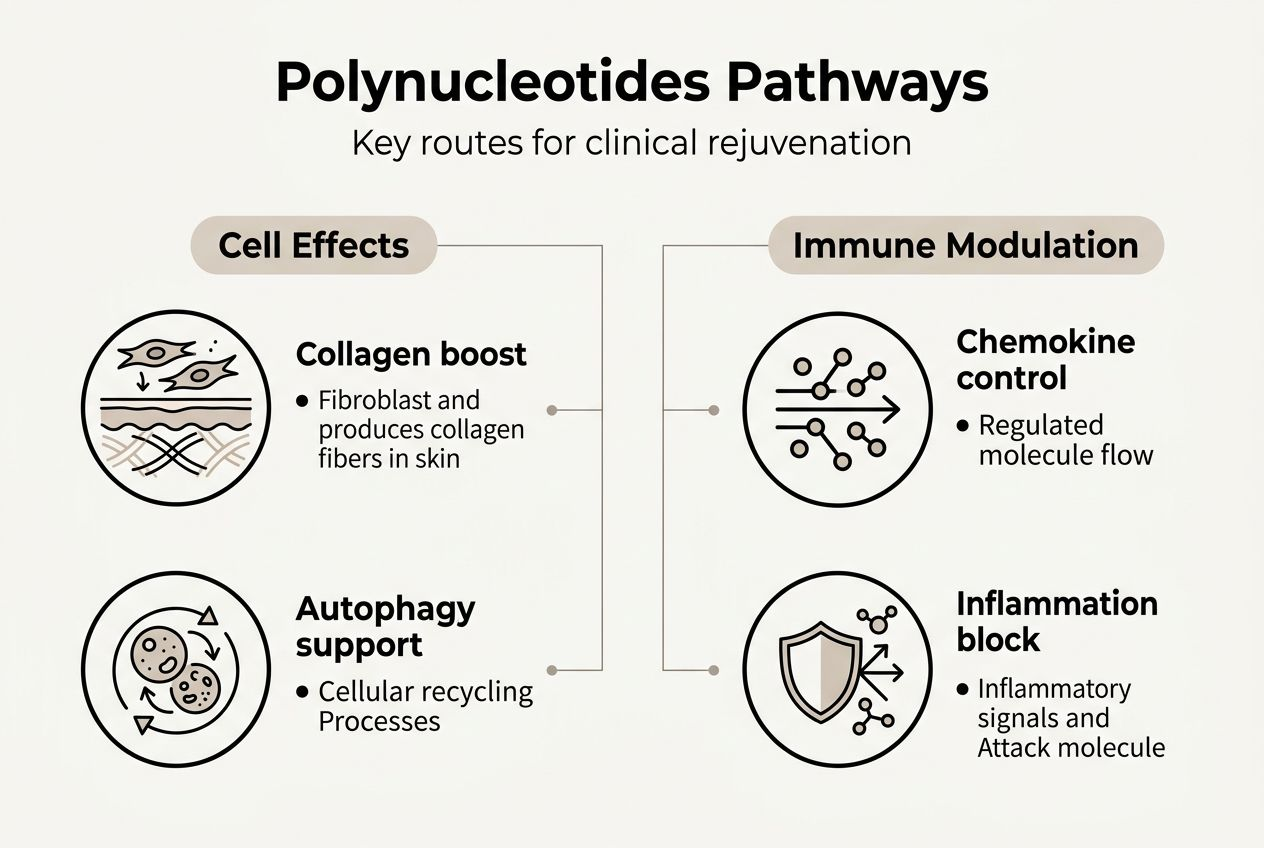
Polydeoxyribonucleotide (PDRN), a specific polynucleotide fraction derived from salmon DNA, demonstrates particularly robust effects on multiple cellular pathways. Its molecular weight and nucleotide composition allow it to bind adenosine A2A receptors whilst directly influencing intracellular signalling cascades. This dual action makes PDRN uniquely effective for comprehensive skin rejuvenation.
PDRN restores collagen and elastin expression in UVB-damaged fibroblasts through activation of the PI3K-Akt pathway, a central signalling route controlling cell survival and protein synthesis. Simultaneously, it enhances TGF-β signalling, which drives fibroblasts to produce extracellular matrix proteins. These pathways work synergistically to rebuild dermal architecture compromised by chronic sun exposure.
Beyond structural protein synthesis, PDRN enhances autophagy-lysosome activity and spliceosome function within fibroblasts. Autophagy clears damaged proteins and organelles that accumulate with age, whilst spliceosomes ensure accurate gene expression. Together, these mechanisms restore proteostasis, the cellular protein balance essential for healthy tissue function. This is particularly valuable in photoaged skin where protein quality control systems are impaired.
PDRN also modulates immune cell behaviour by suppressing excessive chemokine signalling. In chronically inflamed or photoaged skin, aberrant chemokine activity attracts immune cells that perpetuate tissue damage. By rebalancing these signals, PDRN creates a microenvironment favouring repair over inflammation, allowing fibroblasts to function optimally.
| Factor | PDRN Effect | Typical Collagen Stimulator |
|---|---|---|
| Collagen I/III expression | Significant restoration in UV-damaged cells | Moderate increase in healthy cells |
| Elastin production | Enhanced through TGF-β activation | Variable, often minimal |
| Autophagy enhancement | Marked improvement in proteostasis | Not typically addressed |
| Immune modulation | Suppresses excessive chemokine signalling | Limited to no effect |
| Cellular senescence | Delays through metabolic support | May not address senescence |
Pro Tip: Combine PDRN treatments with LED phototherapy to amplify fibroblast activation, as specific wavelengths enhance cellular ATP production and complement polynucleotide metabolic effects.
Clinical outcomes and advanced protocols using polynucleotide therapies
Clinical trials provide compelling evidence for polynucleotide efficacy in treating atrophic acne scars and photoaged skin. A 2026 study examining Polynucleotide High-Purification Technology combined with hyaluronic acid demonstrated significant improvements in both objective clinical assessments and patient-reported outcomes. Understanding these results helps clinicians set realistic expectations and design effective treatment protocols.
The trial enrolled patients with moderate to severe atrophic facial acne scars, treating them with intradermal injections of polynucleotide HPT™ plus hyaluronic acid. Researchers measured outcomes using the Atrophic Acne Scar Assessment Scale (ASAS) and Global Aesthetic Improvement Scale (GAIS). Results showed progressive improvement over six months, with the most dramatic changes occurring between baseline and three months.
| Timepoint | Mean ASAS Score | Patient GAIS (% Improved/Much Improved) |
|---|---|---|
| Baseline | 3.2 | 0% |
| 3 months | 2.1 | 78% |
| 6 months | 1.8 | 89% |
Standard protocol steps for polynucleotide scar treatment:
- Cleanse treatment area thoroughly and apply topical anaesthetic for 20 to 30 minutes
- Inject polynucleotide solution intradermally using multiple puncture technique, distributing 2ml across affected areas
- Massage gently to ensure even distribution without applying excessive pressure
- Apply cold compress for 10 minutes to minimise swelling and enhance patient comfort
- Schedule follow-up sessions at three to four week intervals for optimal collagen remodelling
- Assess progress at three months using standardised photography and clinical scoring
Advanced combination approaches enhance outcomes beyond polynucleotides alone. Integrating PN HPT™ with hyaluronic acid boosting serums provides immediate volumising effects whilst polynucleotides stimulate long-term collagen synthesis. Adding growth factor peptides creates synergistic signalling that accelerates tissue remodelling. Some practitioners layer polynucleotide treatments with microneedling or laser resurfacing, though timing must be carefully managed to avoid excessive inflammation.
Pro Tip: Adjust treatment intervals based on individual scar depth and patient healing response, extending to five or six weeks for patients showing robust improvement or shortening to three weeks for minimal responders.
Specialised polynucleotide applications for eye area rejuvenation
The periocular region presents unique challenges for rejuvenation due to thin skin, minimal subcutaneous fat, and constant muscle movement. Traditional volumisers and stimulators often prove too aggressive for this delicate area. PDRN’s integrated approach to ECM repair, proteostasis restoration, and immune modulation makes it particularly suitable for periocular applications.
Periocular skin ages distinctly from other facial areas. It shows earlier signs of collagen loss, develops fine lines from repetitive expressions, and suffers pronounced photodamage due to sun exposure. The thin dermis means any inflammation or poor healing becomes immediately visible. Polynucleotides address these concerns through gentle, progressive tissue remodelling rather than dramatic volumising that can appear unnatural around eyes.
The immunomodulatory effects of PDRN are especially valuable periocularly. This area is prone to inflammatory conditions like allergic dermatitis and irritation from cosmetics. By rebalancing immune signalling, PDRN creates a stable environment for collagen synthesis whilst reducing the chronic low-grade inflammation that accelerates periocular ageing. This dual action improves both structural integrity and skin barrier function.
Leading formulations for periocular use include pure PDRN solutions at concentrations between 5mg/ml and 20mg/ml, often combined with peptides or low-molecular-weight hyaluronic acid. Some products incorporate antioxidants like vitamin C or niacinamide to enhance photoprotection. The key differentiator is molecular weight distribution, with lower weights penetrating more effectively but higher weights providing longer-lasting effects.
Best practices for periocular polynucleotide application:
- Use fine gauge needles (30G or 32G) to minimise trauma and bruising risk
- Inject superficially into the dermis, avoiding deeper planes near orbital structures
- Distribute small volumes (0.1ml to 0.2ml per injection point) across multiple sites
- Avoid injecting directly over bony prominences where product may migrate
- Schedule treatments every four weeks initially, then extend to maintenance intervals
Combining peptide-based eye treatments with polynucleotide injections creates comprehensive periocular rejuvenation. Topical peptides enhance dermal-epidermal communication and support barrier function, whilst injected polynucleotides rebuild deeper structural tissue. For patients with significant volume loss, consider alternating polynucleotide sessions with targeted eye contour products containing retinoids and growth factors to address multiple ageing pathways.
Explore polynucleotide-based skincare solutions
Integrating polynucleotide treatments with premium topical formulations maximises clinical outcomes for your clients. The M-ethod offers scientifically validated products that complement injectable therapies, supporting skin barrier function and enhancing treatment results. For acne-prone skin benefiting from polynucleotide scar therapy, PCA Clearskin delivers targeted active ingredients that maintain clarity between sessions. Periocular rejuvenation protocols pair effectively with Intensive Eye Therapy containing peptides and antioxidants that support the delicate eye area. Proper exfoliation using professional-grade cleansers prepares skin for optimal polynucleotide absorption whilst maintaining healthy cell turnover. Explore these clinically backed formulations to create comprehensive treatment programmes.
Frequently asked questions about polynucleotides in skincare
What are polynucleotides and how do they differ from PDRN?
Polynucleotides are chains of nucleotide monomers of varying lengths and molecular weights derived from biological sources. PDRN is a specific polynucleotide fraction with molecular weight between 50kDa and 1500kDa, typically extracted from salmon DNA. PDRN represents a purified, standardised subset of polynucleotides with consistent adenosine receptor binding activity, whilst broader polynucleotide preparations may contain mixed molecular weights and nucleotide compositions.
How soon can clinicians expect visible skin improvements?
Initial improvements in skin texture and hydration typically appear within two to three weeks as fibroblast activity increases. Measurable collagen synthesis and structural remodelling become evident at six to eight weeks, with optimal results visible at three to four months. For acne scars, progressive improvement continues through six months as new collagen matures and remodels. Patient age, baseline skin condition, and treatment frequency significantly influence timeline.
Are polynucleotides safe for sensitive or periocular skin?
Polynucleotides demonstrate excellent safety profiles in sensitive areas due to their biocompatibility and anti-inflammatory properties. Clinical studies show minimal adverse reactions beyond transient injection site erythema and mild swelling. For periocular applications, use appropriate injection techniques with fine gauge needles and avoid excessive volumes. Patients with known allergies to fish proteins should undergo patch testing, though purified PDRN preparations rarely trigger allergic responses.
Can polynucleotides be combined with other anti-ageing treatments?
Polynucleotides synergise effectively with multiple modalities including hyaluronic acid fillers, peptide serums, LED phototherapy, and microneedling. Allow two to three weeks between aggressive treatments like laser resurfacing and polynucleotide injections to avoid excessive inflammation. Topical retinoids, antioxidants, and growth factors complement polynucleotide therapy without interference. The multi-pathway mechanisms of polynucleotides make them ideal foundation treatments in comprehensive rejuvenation protocols.
What patient factors influence treatment success with polynucleotides?
Age significantly impacts response, with patients under 50 typically showing faster, more dramatic improvements than older individuals with advanced photoageing. Smoking impairs microcirculation and collagen synthesis, reducing treatment efficacy. Baseline skin quality matters, as moderately photoaged skin responds better than severely sun-damaged tissue. Realistic expectations and commitment to multiple sessions predict satisfaction, since polynucleotides work progressively rather than providing immediate dramatic changes. Concurrent use of quality skincare supporting barrier function enhances outcomes.