

Perioral Dermatitis Treatment: What Works and What to Avoid
Perioral dermatitis clears for most people, but not with the usual instincts. The treatment starts with taking things away: stopping topical steroids, cutting back your products, and letting the skin settle. If that is not enough, a clinician can add a prescription cream or a course of oral antibiotics. Below, we explain each step in the order it is usually used, what a safe routine looks like, and when to stop managing it alone.
TL;DR
- The first step is “zero therapy”: stop all topical steroids, including hydrocortisone, and pare back facial products. Cleveland Clinic and the American Academy of Dermatology both start here.
- Expect the rash to look worse for days or even weeks after stopping a steroid. That rebound flare is not a reason to restart it.
- Mild to moderate cases are often treated with a prescription non-steroid cream such as pimecrolimus 1%. Moderate to severe cases usually need oral doxycycline or minocycline for 4 to 8 weeks.
- Keep the routine minimal: lukewarm water, a bland cleanser if needed, and only light products once the inflamed phase calms.
- A rash around the mouth can mimic acne, rosacea or contact dermatitis, so a proper diagnosis comes before any treatment plan.
Table of Contents
- What perioral dermatitis looks like, and why the diagnosis matters
- What triggers it
- Step one: zero therapy
- Step two: prescription treatment
- Treating perioral dermatitis at home
- A safe skincare routine during treatment
- Our view: why we treat it as a process, not a product
- Getting personal advice
- When to see someone urgently
- Preventing a recurrence
- FAQ
- Sources
What perioral dermatitis looks like, and why the diagnosis matters
Perioral dermatitis is a red rash of small bumps, sometimes with pustules and flaking, that circles the mouth. It can also spread around the nose and eyes, which is why dermatologists increasingly call it periorificial dermatitis. DermNet describes it as a benign, self-limiting condition, but one that can distress people because of how visible it is. Many people also report itching or burning.
The trouble is that it looks like several other things. Acne, rosacea, seborrhoeic dermatitis and contact dermatitis can all appear around the mouth. Their treatments differ, and some of the usual remedies for those (a hydrocortisone cream, a rich moisturiser, a strong exfoliating acid) can make perioral dermatitis worse. This is the main reason people find it so hard to shift: the things they reach for to calm the rash often feed it.
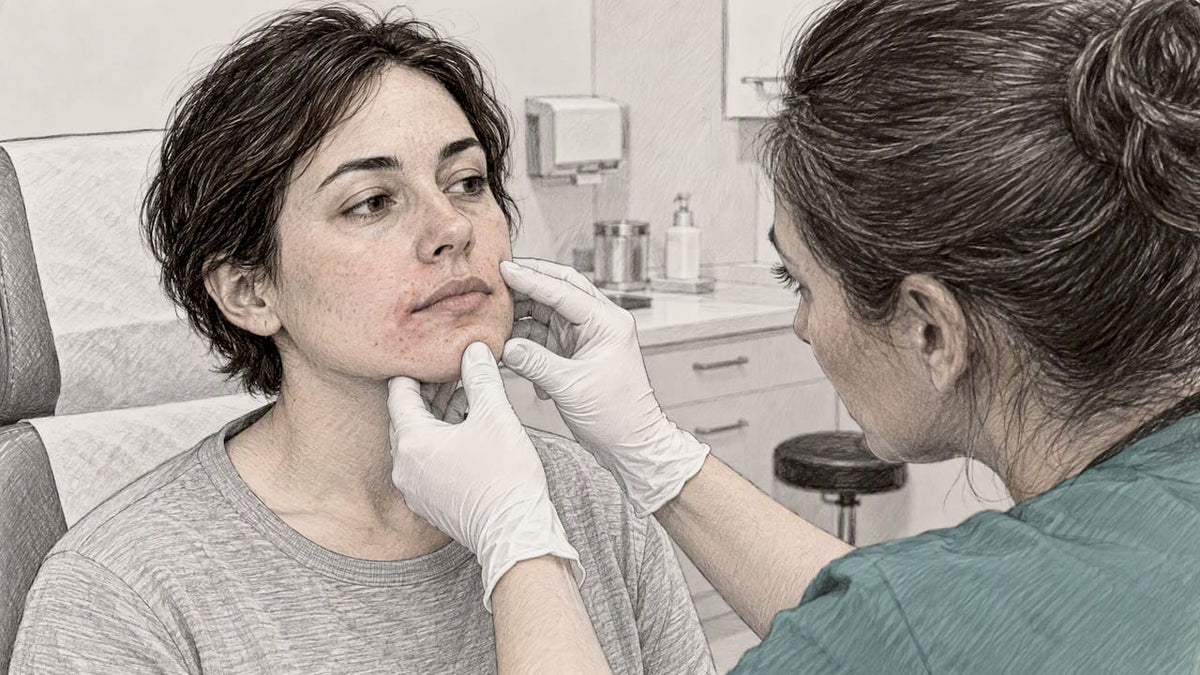
If this is your first episode, if the rash is spreading, or if it has not improved after a couple of weeks of simplifying your routine, have it looked at. An in-person dermatologist is the gold standard. If you cannot get an appointment quickly, an online skin consultation with Dr Mandy can confirm what you are dealing with and set out a plan.
What triggers it
The cause is not fully pinned down, but several triggers come up repeatedly.
- Topical steroids. StatPearls notes that steroid use on the face can trigger perioral dermatitis. Cleveland Clinic lists inhaled steroids too, which is worth knowing if you use a steroid inhaler or nasal spray.
- Accidental transfer. The AAD advises washing your hands with soap after applying any topical medication to your body, so steroid cream from an elbow or hand does not reach your face.
- Everyday facial products. A 2026 review in JAAD Reviews reports that where steroids were not the main cause, products such as mineral sunscreen, whitening toothpaste, moisturisers and foundation were linked to up to 63% of cases.
- Heavy creams and cosmetics. The Primary Care Dermatology Society lists emollient creams and cosmetic creams among topical products that can make it worse.
- Fluoridated dental products. The Merck Manual includes avoiding fluorinated dental products in its treatment outline.
None of these is a certain cause in any one person. The practical point is that your trigger may be something you use daily and consider harmless.
Step one: zero therapy
The most consistent advice across the sources is to stop. In practice, zero therapy means:
- Stop every topical steroid on the face, including over-the-counter hydrocortisone. The AAD is explicit that clearing the rash requires this.
- Stop the products you are unsure about: moisturisers, foundation, heavy sunscreens, exfoliants, actives, and anything that stings.
- Wash with lukewarm water, or a very mild, fragrance-free cleanser if you truly need one. Cleveland Clinic-aligned advice is that many people find plain warm water safest during early healing.
- Review your toothpaste with your clinician if the rash sits tightly around the lips.
The 2026 JAAD Reviews scoping review describes this approach as first-line, with withdrawal of corticosteroids under medical supervision to avoid severe rebound flares. If you have been using a steroid cream on your face for a long time, do not assume you should quit abruptly without a plan. StatPearls points out that abrupt cessation can cause rebound, and a clinician may taper you off, for example by moving to a weaker steroid first.
The rebound flare
When you stop a steroid, the rash will very likely get worse before it gets better. The AAD says this flare can last several days or even weeks. It is expected. It does not mean zero therapy has failed.
The temptation is to put the steroid back, because it works within hours. That relief is temporary, and it keeps the cycle going. If the flare is painful, widespread or frightening, contact your clinician for a non-steroid treatment rather than restarting the cream yourself.
Step two: prescription treatment
Zero therapy alone clears many mild cases, though it can take weeks. When the rash is more inflamed, or you need to speed things up, a clinician can add medication. Your doctor chooses based on severity, your age and whether you are pregnant.
| Option | Typical use | What to know |
|---|---|---|
| Pimecrolimus 1% cream (topical calcineurin inhibitor) | Mild to moderate cases | Does not trigger or worsen perioral dermatitis the way steroids can, according to the 2026 JAAD Reviews paper |
| Topical metronidazole or erythromycin | Mild cases | Antibiotic applied to the skin, often enough for mild disease per WebMD |
| Oral doxycycline (50 to 100 mg daily) or minocycline | Moderate to severe cases | Usually 4 to 8 weeks |
| Oral erythromycin | Pregnancy, children under 8 | Preferred systemic antibiotic in these groups |
Topical options
Pimecrolimus is favoured because it calms inflammation without the steroid risk. Topical metronidazole and erythromycin are also widely used. The Merck Manual lists topical calcineurin inhibitors and topical or sometimes oral antibiotics alongside avoidance of steroids and fluorinated dental products. All of these are prescription products in the United States, so they need a clinician. Prescription topicals can sting at first, so ask what to expect.
Oral antibiotics
For moderate to severe disease, oral tetracyclines are often the first systemic choice. The JAAD Reviews paper gives doxycycline at 50 to 100 mg daily, or minocycline, for 4 to 8 weeks, and notes that the American Academy of Dermatology recommends keeping systemic antibiotic courses to a maximum of 3 to 4 months because of resistance. Doxycycline here is used for its anti-inflammatory effect, not only to kill bacteria.
Two cautions belong right where you act on this:
- Tell your prescriber about every medication you take. Tetracyclines and isotretinoin should not usually be combined, because both carry a risk of raised pressure around the brain (intracranial hypertension). Your prescriber needs the full list.
- Pregnancy and children. Tetracyclines are not the choice for pregnant women or children under 8. Erythromycin is the preferred systemic option instead.
How long it takes
DermNet says treatment is usually 4 to 8 weeks and may need extending, and that recurrence can happen if treatment is too short. So when the rash looks clear after two weeks, do not stop early unless your clinician says so. Equally, do not expect the pace of an acne spot treatment.
Treating perioral dermatitis at home
You can do a lot at home, but “at home” should mean less, not more. A safe at-home plan looks like this:
- Stop steroids and unnecessary products, as above.
- Wash hands after touching any body medication.
- Use lukewarm water on the face. Pat dry with a clean, soft towel.
- Avoid scrubs, toners, fragranced products, heavy balms and anything occlusive.
- Do not pick or squeeze.
- Switch toothpaste only if your clinician suggests it.
- Keep a short diary of products and flares so you can see patterns.
Over-the-counter treatments rarely work on their own, and the common home remedies (tea tree oil, apple cider vinegar, toothpaste dabbed on bumps, essential oils) are more likely to irritate. If the rash has not started to ease within a few weeks, you need a prescription, not a stronger home remedy.
A safe skincare routine during treatment
A routine for perioral dermatitis has two phases, and the order matters.
Phase 1: the inflamed stage
This is the stage where zero therapy is running and the skin is red, bumpy or flaky. Use warm water only. If dryness is severe, practitioners generally advise against heavy moisturisers or occlusive creams, which can worsen the rash. If you have to use something, choose a very light, oil-free moisturiser and only once the most inflamed stage has begun to resolve. Ask your clinician first.
Phase 2: rebuilding
Once the skin has been calm for a while, reintroduce products one at a time, about a week or two apart, so that if the rash returns you know the culprit. A sensible order is:
- A gentle, fragrance-free cleanser.
- A light barrier-supporting moisturiser.
- Sunscreen, introduced carefully.
- Only later, if at all, active ingredients such as retinoids, acids or vitamin C.
Sunscreen needs thought, since the JAAD Reviews data named mineral sunscreen as a possible trigger. We cover how to choose one for reactive skin in our guide to rosacea-friendly sunscreen, and the same principles of short ingredient lists and non-irritating formulas apply here.
For the rebuilding phase, calming barrier-repair creams such as C.R. Recovery by pHformula, designed for redness-prone, sensitive skin, or P.O.S.T. Recovery Cream are products our clients ask about. Introduce any new product on a small area first, and only after the active rash has settled and your clinician agrees. Rich creams are not for the first weeks.
Our view: why we treat it as a process, not a product
We work with a lot of people whose skin has become reactive after a long run of well-meant additions: another serum, a stronger cream, a steroid “just for the redness”. Perioral dermatitis is where this pattern shows up most clearly, and we think the best results come from treating it as a process rather than a purchase.

Our approach is built around three ideas. First, diagnosis before products. A rash around the mouth is not always perioral dermatitis, and a plan built on the wrong diagnosis wastes weeks. Second, subtraction before addition. Most of the progress comes from what you stop doing, and we would rather see you buy nothing for a fortnight than add another product to a struggling barrier. Third, a plan that is honest about timing. Four to eight weeks is normal, rebound flares happen, and the patients who do best are those who were told so at the start.
Once a clinician has confirmed the diagnosis and the skin is quiet, we help people rebuild with a short, deliberate routine and reintroduce one product at a time. Prescription decisions always belong with a licensed prescriber who knows your history, and we will say when something needs an in-person visit rather than a virtual one.
— Jess
Getting personal advice
If you want a clinician to look at your skin and map out a plan, our online skin consultation with Dr Mandy is built for this: a one-to-one review of your history, current products and triggers, with a routine you can follow at home. When your skin has settled and you are ready to rebuild, you can browse our medical-grade skincare range, and our longer guide to managing peri-oral dermatitis goes deeper into day-to-day care.
When to see someone urgently
Book a prompt appointment if:
- The rash spreads to the eyelids or you have eye pain, redness or changes in vision.
- It is blistering, weeping, or crusting, which may point to infection.
- You are pregnant or treating a child, since options differ.
- You have been using a steroid on your face for months and the rash is flaring badly after stopping.
- Nothing has improved after four weeks of zero therapy.
Seek urgent care for severe headaches, visual disturbances or nausea while taking a tetracycline, and tell the prescriber you are on one.
Preventing a recurrence
Recurrence is common, particularly after a short course. A few habits lower the odds:
- Finish the course your clinician set, and ask what to do if the rash begins to return.
- Avoid facial steroids unless a dermatologist specifically prescribes one for a defined reason.
- Keep routines short and add products one at a time.
- Be wary of heavy night creams and thick balms around the mouth.
- Note what you used before any flare, as a record for your next appointment.
FAQ
What is the fastest way to heal perioral dermatitis?
The fastest safe route is to stop all facial steroids and unnecessary products, then get a prescription topical or oral antibiotic if a clinician advises it. Even with treatment, healing usually takes 4 to 8 weeks. Restarting a steroid for quick relief tends to prolong the problem.
Can I treat perioral dermatitis at home?
Mild cases can improve with zero therapy alone: warm water, no steroids and a stripped-back routine. Keep home care minimal and avoid heavy creams, scrubs and home remedies. If there is no clear improvement within a few weeks, you will probably need a prescription.
What is the best cream for perioral dermatitis?
There is no single best cream, and over-the-counter creams are often part of the problem. Clinicians commonly prescribe pimecrolimus 1%, topical metronidazole or topical erythromycin. Which one suits you depends on severity and your medical history.
Why does perioral dermatitis keep coming back?
Usually because a trigger is still in play, such as a steroid, a heavy product or toothpaste, or because treatment stopped too early. Recurrence can occur if the course is too short. A product diary and slow reintroduction help you find the culprit.
Sources
- Red rash around your mouth could be perioral dermatitis, American Academy of Dermatology
- Perioral Dermatitis: Treatment, Symptoms & Causes, Cleveland Clinic
- Periorificial dermatitis: An updated scoping review of therapeutic evidence, JAAD Reviews
- Periorificial dermatitis, DermNet
- Perioral Dermatitis, StatPearls, NCBI Bookshelf
- What is perioral (or periocular) dermatitis?, Primary Care Dermatology Society
- Perioral Dermatitis, Merck Manual Professional Edition
- Perioral Dermatitis: Causes, Symptoms, and Treatment, WebMD