


How to build a personalised skincare workflow that delivers results
TL;DR:
- Effective personalized skincare begins with thorough intake, including photos, medical history, and clear goals, to inform targeted strategies. A clinical workflow involves assessment, stratification by phenotype and severity, and building a routine with core essentials before adding targeted actives and follow-ups. Consistent tracking and objective measures like photographs and clinical scores ensure meaningful progress, underscoring that true personalization relies on clinical evidence and expert guidance.
You’ve read the routines, bought the serums, and followed the advice. Yet your skin still isn’t responding the way you’d hoped. The problem isn’t your dedication. It’s that generic solutions were never designed for your specific skin. Evidence-based personalised skincare uses clinical algorithms and stratifies by concern and severity for best results, a standard that most off-the-shelf routines simply cannot meet. Here’s how to build a workflow that actually works for you.
Table of Contents
- What you need for a personalised skincare workflow
- Step-by-step: Building your workflow
- Troubleshooting and avoiding common mistakes
- Tracking progress and verifying results
- Why most ‘personalised’ skincare misses the mark
- Next steps: Get expert-guided, personalised skincare solutions
- Frequently asked questions
Key Takeaways
| Point | Details |
|---|---|
| Structured workflow matters | A systematic, evidence-based approach creates better, longer-lasting skin results than ad-hoc routines. |
| Combination therapy is key | Combining products with different mechanisms achieves superior outcomes for complex concerns. |
| Track and adapt | Regular progress checks and clinical measurement ensure your regimen delivers results. |
| Expert input improves success | Clinician or expert review increases credibility and effectiveness over algorithm-only tools. |
What you need for a personalised skincare workflow
Before you apply a single product, preparation is everything. A well-built workflow isn’t about having more products. It’s about having the right information so that every choice you make is deliberate, clinically informed, and matched to your actual skin, not a demographic average.
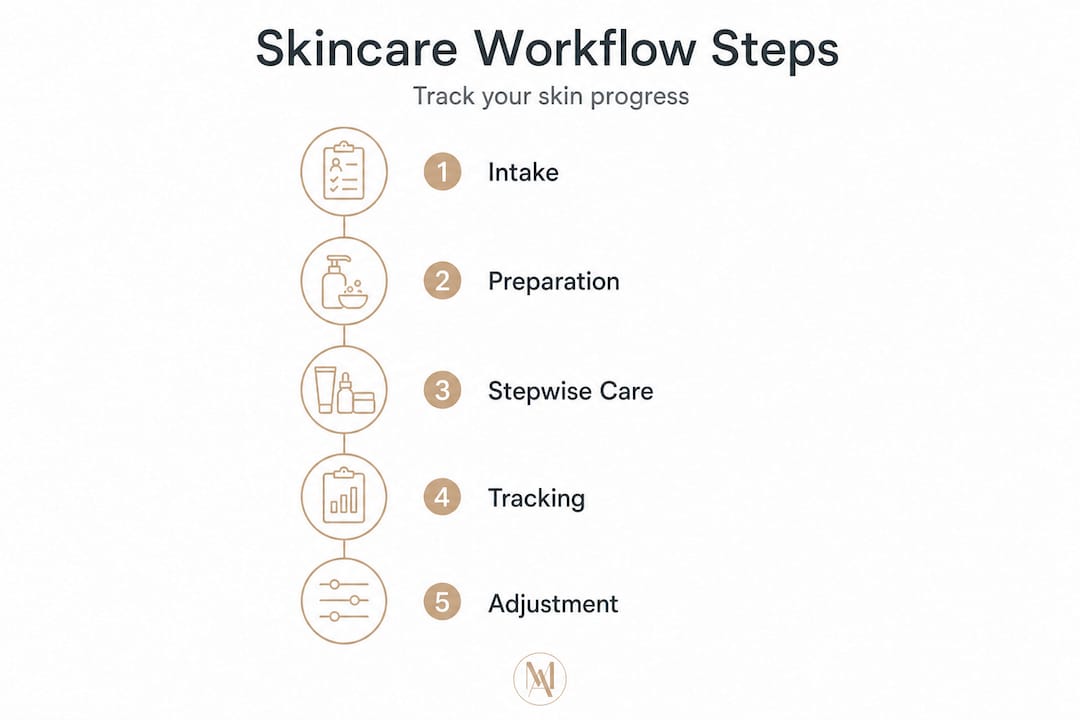
A practical workflow begins with intake, photos, and risk and eligibility review. That means gathering specific, honest information about your skin before any product selection or clinician consultation takes place.
Here’s what you’ll need to assemble in advance:
- Recent skin photographs: Take clear, well-lit images from the front, left, and right profiles. Natural light works best. These establish your baseline and make progress measurable rather than subjective.
- A written account of your concerns: Go beyond “breakouts” or “dull skin.” Note when the concern started, how often it flares, what makes it worse, and what, if anything, seems to help.
- A full product inventory: List everything you currently apply, including cleansers, toners, SPF, treatments, and any prescription products. Include how long you’ve been using each one.
- Medical and health history: Hormonal changes, medications, dietary patterns, and lifestyle factors all influence skin behaviour. A clinician needs this context to make safe, effective recommendations.
- Your skin goals, ranked by priority: Do you want to address active breakouts before tackling hyperpigmentation? Or is barrier repair your most urgent concern? Prioritising goals shapes the entire structure of your workflow.
Understanding how to choose skincare for results starts with this intake process. Without it, even the most advanced products are essentially educated guesswork. The more detailed and consistent your information, the more targeted and effective the clinician’s review will be.
| Preparation element | Why it matters |
|---|---|
| Baseline photographs | Enables objective before-and-after comparison |
| Full product list | Prevents ingredient conflicts and duplication |
| Health and medication history | Identifies contraindications and hormonal influences |
| Ranked skin concerns | Prioritises treatment sequencing correctly |
| Environmental and lifestyle notes | Factors in UV exposure, diet, stress, and sleep |

Pro Tip: Don’t edit yourself when completing a pre-consultation intake. What seems irrelevant to you, such as a recent course of antibiotics or a change in diet, may be clinically significant to your practitioner.
Step-by-step: Building your workflow
With all essentials gathered, here’s exactly how to build your streamlined, tailored workflow. This process mirrors what experienced clinicians use in practice, adapted so you can engage with it meaningfully from home or during a virtual consultation.
A strong workflow for clinical skincare follows a structured sequence, and deviating from that sequence is one of the most common reasons results are delayed or inconsistent.
-
Intake and assessment. Complete your written summary and photographs. Answer any intake questions thoroughly and honestly. This forms the clinical foundation of everything that follows.
-
Clinician review. A qualified skin clinician reviews your information, identifies your primary concerns and any contraindications, and begins to map out a strategy. This step is what separates a genuinely personalised workflow from a quiz-based product recommendation engine.
-
Stratification by phenotype and severity. This is where the clinical framework becomes especially powerful. Your skin isn’t just “oily” or “sensitive.” It has a phenotype, a combination of characteristics such as hydration level, barrier integrity, sebum production, and pigmentation tendency, that determines which ingredients will be effective and which may cause harm. Workflow structure: intake through stratification to targeted baseline to escalation is the clinically validated approach used in practices worldwide.
-
Build your baseline routine. Every effective routine starts with three non-negotiables: a gentle, pH-appropriate cleanser, a barrier-supporting emollient, and broad-spectrum SPF applied every morning without exception. These aren’t optional extras. They are the clinical foundation that makes everything else work.
-
Add targeted actives. Once the baseline is stable, layer in targeted ingredients matched to your specific concerns. For acne-prone skin, that may mean niacinamide, azelaic acid, or retinoids. For hyperpigmentation, tyrosinase inhibitors like kojic acid or tranexamic acid. For ageing and collagen support, retinol or peptide complexes. Combination regimens matching actives to your core concerns are typically most effective because they address multiple pathways simultaneously rather than targeting one mechanism in isolation.
-
Plan your escalation or follow-up step. Build in a review point at weeks four, eight, and twelve. This is when you assess progress, identify any tolerance issues, and decide whether to introduce prescription-strength products or additional interventions.
For guidance on building a skincare regimen from scratch, it’s worth understanding the difference between a single-product approach and a combination strategy before you commit to a direction.
| Approach | Benefits | Limitations |
|---|---|---|
| Single-product | Easier to tolerate, simpler to track | Addresses only one pathway; slower results |
| Combination regimen | Targets multiple mechanisms; clinically stronger outcomes | Requires sequencing knowledge; higher risk of interaction without guidance |
Pro Tip: Document your skin status with photographs and brief notes at each step. Subjective feeling is unreliable. Visual records make it far easier to identify what’s genuinely improving and what needs adjusting.
Troubleshooting and avoiding common mistakes
Even the best workflow can falter. Here’s how to keep things on track and results-focused, particularly during the first eight to twelve weeks when your skin is adapting to new actives.
The most common mistakes we see aren’t about choosing the wrong products. They’re about process failures that undermine an otherwise sound strategy.
- Skipping SPF. This single omission can undo weeks of pigmentation or redness treatment. UV exposure stimulates melanin production and perpetuates inflammation, reversing the effects of nearly every active ingredient you’re using. SPF 30 at minimum, reapplied every two hours in direct sunlight, is non-negotiable.
- Layering too many actives at once. Introducing retinol, a chemical exfoliant, and a vitamin C derivative in the same week is a reliable route to barrier disruption and reactive skin. Introduce one new active at a time, over two-week intervals at minimum.
- Abandoning the routine before results are visible. Most clinically effective actives require eight to twelve weeks of consistent use before meaningful change is observable. Patience is a clinical requirement, not merely a platitude.
- Not following up with a clinician. Without review, there’s no course correction. Skin changes, seasons change, hormones fluctuate, and a static routine will eventually stop serving your skin’s current needs.
- Confusing irritation with purging. Purging is a temporary increase in cell turnover triggered by retinoids or acids, typically confined to areas already prone to congestion. Irritation appears anywhere and involves redness, stinging, or compromised barrier function. Knowing the difference prevents unnecessary product abandonment.
The advantages of personalised skincare are most fully realised when barrier preservation sits at the heart of every decision. A compromised barrier cannot absorb actives efficiently, cannot protect against environmental aggressors, and is far more susceptible to sensitisation.
“Combination therapies that target different aspects of skin concerns are associated with better, lasting results.”
Combination therapy across multiple steps with emphasis on barrier preservation is key. Over-reliance on one product, however impressive its ingredient profile, is rarely sufficient for complex or persistent skin concerns.
Keep an eye on current skincare tips and trends to stay informed, but always filter new information through the lens of your specific skin profile and clinician-guided plan.
Pro Tip: Adjust only one element of your routine at a time. If you change your cleanser and add a new serum simultaneously, you won’t know which variable caused any reaction or improvement. Isolate changes to get clean data on your own skin.
Tracking progress and verifying results
Once you’ve run your workflow, regular tracking is essential for seeing real, lasting change. Clinical measurement isn’t just for dermatologists. You can apply the same objective rigour at home.
One of the most validated tools for measuring pigmentation change is the MASI score (Melasma Area and Severity Index), which assesses the area, darkness, and homogeneity of pigmented lesions across facial zones. Clinicians use this at baseline and at set follow-up points to determine whether a treatment is delivering measurable change. You don’t need to calculate MASI yourself, but understanding that clinically meaningful personalisation includes objective measurement and follow-up timepoints will help you engage more meaningfully with your own results.
Here’s how to track your progress systematically:
-
Establish a clear baseline. Before applying any new product, photograph your skin in identical lighting conditions, at the same time of day, with no make-up. Note any active concerns, their distribution, and their severity on a simple scale of 1 to 10.
-
Maintain a photo log and written diary. Photograph your skin every two weeks under the same conditions. Note any reactions, changes in texture, new breakouts, or visible fading. Keep records of how each product feels and any environmental factors that week, such as travel, illness, or stress.
-
Use four-week review intervals as your standard unit. Four weeks represents approximately one full skin cell cycle (keratinocyte turnover), making it the minimum meaningful interval for assessing topical treatment efficacy. Twelve weeks is the standard benchmark for confirming long-term results in most clinical protocols.
-
Adjust based on objective signs, not just how your skin feels. Skin can feel better before it looks better, and vice versa. Rely on your photographs and your written notes. If images show visible improvement at eight weeks, continue. If there is no observable change at twelve weeks, it’s time to revisit your strategy with a clinician.
Clinical note: Clinical trial protocols often require measured improvement over 12 weeks to confirm product efficacy. Aligning your personal review schedule with this standard means you’re measuring results the same way science does.
For more structured guidance, revisit the clinical workflow for skin principles that underpin each of these steps.
Why most ‘personalised’ skincare misses the mark
There’s a significant gap between marketing-led personalisation and clinically grounded skin transformation, and we think it’s important to name it clearly.
The majority of “personalised” skincare systems available today are built around short questionnaires, broad skin type categorisation, and ingredient bundles assembled by algorithm. They ask whether your skin is oily or dry, whether you sleep well, and whether you drink enough water. Then they suggest a three-step set. That’s not personalisation. That’s segmentation.
True personalisation, the kind that produces measurable, sustained results, starts with clinical evidence, measured criteria, and expert follow-up. It involves a clinician reviewing your actual skin, your medical context, and your response to treatment over time. It means stratifying by phenotype and severity, not by a broad label. It means having an escalation pathway when first-line products aren’t sufficient.
Personalisation claims gain credibility when paired with explicit clinical measurement endpoints. Without those endpoints, “personalised” is simply a marketing word.
“If your regimen doesn’t involve measurement and follow-up, it’s not truly personalised.”
We see this regularly with clients who arrive having spent considerable sums on curated skincare sets that failed to move the needle on their core concerns. Not because the products were poor, but because the matching process lacked clinical depth. Understanding what sets clinical skincare workflow insights apart from consumer-facing personalisation tools is one of the most valuable pieces of knowledge you can carry into your skincare journey.
The encouraging reality is that genuine, clinician-driven personalisation is now accessible outside a traditional clinic setting. Virtual consultations, prescription-grade formulations, and structured follow-up protocols mean you no longer need to be physically present to receive a standard of care that produces real, verifiable results.
Next steps: Get expert-guided, personalised skincare solutions
Ready to make your workflow a reality? At The M-ethod Skin, we provide structured virtual skin consultations with qualified clinicians who apply the same stratification and follow-up protocols described in this article. Whether you’re managing acne, pigmentation, barrier sensitivity, or visible ageing, our team selects evidence-based products matched to your specific skin profile. Explore targeted solutions such as the PCA Clearskin serum for blemish-prone and congested skin, or browse NEOSTRATA for skin tone correction and brightening. Every recommendation we make is grounded in clinical evidence, not guesswork. See results from real clients and take the first step towards a routine that actually delivers.
Frequently asked questions
What information should I prepare for a virtual skincare consultation?
Have recent skin photos, medical history, and your current routine details ready to ensure a precise, personalised assessment. A practical workflow starts with intake, questions, and photos, so the more specific and complete your information, the more targeted your clinician’s recommendations will be.
How do I know if my personalised regimen is working?
Track visible changes with baseline photographs and consider clinical scoring like MASI to assess measurable improvement over time. Clinical protocols include MASI scoring at baseline and follow-up points, making objective comparison far more reliable than subjective perception alone.
Should I use multiple products or stick to one?
Evidence shows that combining targeted products addressing different concerns is usually more effective than using a single product. Combination therapies matching actives to skin pathophysiology produce stronger and more lasting outcomes, particularly for concerns with multiple contributing factors.
How often should I adjust my skincare workflow?
Review progress every four to twelve weeks and adjust only one product or step at a time to accurately measure outcomes. Clinical regimens measure MASI and adjust at set timepoints, a discipline worth applying to your personal skincare practice as well.