


Measured Brow Lift: Millimeters to Choose the Right Non Surgical Fix
Yes, you can raise your brows without surgery, but expect a subtle, maintenance-level change rather than a dramatic repositioning. Peer-reviewed cohort data puts the average lift from botulinum toxin at around 1.35 mm, and similar modest gains apply across fillers, threads and energy devices. Surgery is still the answer for heavy hooding or significant excess skin, but for most people chasing a fresher, more awake look, non-surgical options do the job.
TL;DR:
- Non-surgical brow lifts typically produce a modest lift of about 1.35 mm, requiring maintenance every three to four months with neuromodulators.
- Thread lifts offer a visible physical lift lasting around six months and stimulate collagen production for additional support.
- Energy devices like HIFU mainly tighten skin gradually and are best suited for mild laxity, often used alongside other procedures.
- Success depends on identifying the primary cause of brow droop and choosing a qualified, experienced clinician with a clear safety protocol.
Table of Contents
- Non-surgical brow lift options at a glance
- Neuromodulators: how a chemical brow lift actually works
- Dermal fillers for brow support and volumetric lift
- Thread lifts: mechanical suspension with a shorter shelf life
- Energy devices: useful adjuncts, not standalone lifters
- Who is a good candidate, and how to choose between options
- What to expect: timelines, maintenance and tracking real change
- Risks, safety and what to check before you book
- When non-surgical is the right long-term strategy
- Book a consultation with the M-ethod Skin clinic
- Sources
- FAQ
Non-surgical brow lift options at a glance
Four categories cover almost every non-surgical brow lifting procedure on the market, and clinicians frequently combine them for a more complete result. Each works on a different structure, so the “right” choice depends on whether your brow droops from muscle imbalance, volume loss, or skin laxity.
- Neuromodulators (Botox, Dysport, Xeomin): relax the depressor muscles so the frontalis can lift the brow unopposed; effects last roughly three to four months.
- Dermal fillers: add structural support under the brow and temple for an immediate, more durable lift, often lasting nine to eighteen months depending on the product.
- Thread lifts: mechanically suspend tissue with fine sutures for an instant result that typically holds for around six months before fading.
- Energy-based devices (HIFU, radiofrequency): stimulate collagen for a gradual firming effect rather than an instant lift, with results building over weeks.
Combination protocols, such as neuromodulator plus filler, or threads followed by a maintenance device treatment, are common precisely because each method addresses a different cause of brow descent.
Neuromodulators: how a chemical brow lift actually works
Neuromodulators work on a simple mechanical principle: your frontalis muscle pulls the brow up, while muscles like the corrugator and orbicularis oculi pull it down. Weaken the depressors with a carefully placed injection, and the frontalis wins the tug-of-war, lifting the tail of the brow without touching a scalpel. This “muscle rebalancing” approach explains why results look natural rather than frozen when dosed conservatively, and why the technique has become the most commonly used method among the seven non-surgical eyebrow-lifting approaches reviewed by aesthetic specialists.
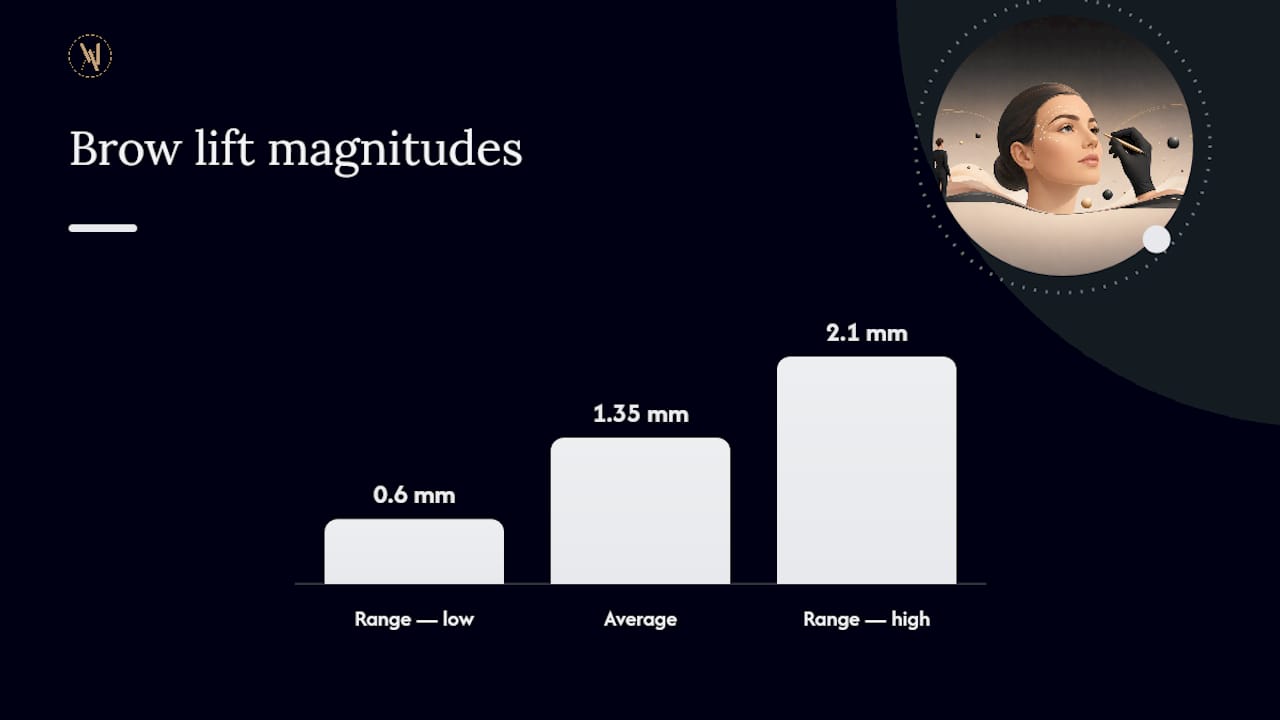
The numbers behind the lift: A 2025 cohort analysis of 460 patients measured an average brow height increase of 1.35 mm, with a range of 0.6 to 2.1 mm, and found satisfaction scores that closely matched those seen with hyaluronic acid gel at 15 days.
That range matters because it shows the effect is real but genuinely modest, not the several-millimetre repositioning some marketing implies.
- Onset typically begins within three to seven days, with full effect visible by two weeks.
- Duration usually runs three to four months before a top-up is needed.
- Precise anatomical mapping and conservative dosing near the lateral brow help avoid eyelid ptosis, a known complication when the injection strays too close to the levator muscle.
Dermal fillers for brow support and volumetric lift
Where neuromodulators rebalance muscle pull, fillers work differently: they physically prop up the brow tail by adding volume beneath it and along the temple, restoring the scaffolding that thins with age. The lift is visible immediately, and because hyaluronic acid gel doesn’t rely on muscle activity, it tends to outlast neurotoxin, often by many months depending on the product chosen.
- High-G’ (firmer) hyaluronic acid gels hold shape better under the brow, resisting migration into surrounding tissue.
- Cannula-based injection, rather than a sharp needle, reduces the risk of hitting a blood vessel in this densely vascular area.
- A structured injection planning system that maps vessel location and injection depth is now widely recommended to cut occlusion risk in the upper face.
- Fillers and neuromodulators are frequently paired, since one restores volume while the other corrects muscle imbalance.
Pro Tip: Ask your injector whether hyaluronidase is kept on-site before you book. It’s the reversal agent for hyaluronic acid filler, and its immediate availability is one of the clearest signs of a safety-conscious clinic.
Injector experience matters more here than with almost any other non-surgical treatment. The temple and brow sit close to major vessels, and this is not a region where a novice should be learning technique on a paying patient.
Thread lifts: mechanical suspension with a shorter shelf life
Thread lifts use fine, dissolvable sutures, often barbed or “cog” threads, inserted beneath the skin to physically hoist tissue upward and anchor it in place. The immediate mechanical lift is the appeal: unlike neuromodulators, which take days to show effect, threads produce a visible change on the table. They also trigger a secondary collagen response as the body reacts to the suture material, extending benefit beyond the physical lift itself.
- Outcomes are highly dependent on operator skill and thread placement, more so than with injectables.
- Floating-type cannula threads are increasingly preferred because they simplify insertion and reduce certain complication types compared with older barbed designs.
- Correct technique means tunnelling threads beneath the muscular plane and anchoring to firmer tissue, which minimises migration while avoiding the temporal branch of the facial nerve.
- A 2024 clinical case series reports typical durability of around six months before retreatment becomes necessary, alongside transient bruising and swelling as the most common side effects.
Comfort during placement is a reasonable concern, and topical numbing protocols used in adjacent brow procedures, such as those detailed in anaesthesia preparation guidance for eyebrow work, give a useful sense of what to expect before insertion.
Energy devices: useful adjuncts, not standalone lifters
HIFU and radiofrequency devices don’t reposition tissue the way threads or fillers do. They heat deeper skin layers to trigger collagen remodelling, tightening skin gradually over weeks rather than lifting it on the day of treatment. Some studies report elevation of roughly 1 to 1.7 mm at 90 days, a smaller and slower effect than neuromodulators or fillers, and the evidence base across different devices remains uneven.
- Best suited to mild skin laxity rather than significant brow descent.
- Often layered on top of injectables to extend and firm the visible result.
- HIFU treatment is the most established option in this category for forehead and brow firming.
- Results build gradually, so patience matters more here than with any other modality on this list.
Who is a good candidate, and how to choose between options
Matching the treatment to the actual cause of your brow droop is the single most useful thing you can do before booking anything.
- Identify the dominant cause. Heavy frown muscles pulling the brow down point toward neuromodulators; hollow temples or a flattened brow bone point toward filler; loose, crepey skin points toward threads or energy devices.
- Ask about training and complication management. A qualified injector should describe their approach to vascular occlusion or ptosis without hesitation, not deflect the question.
- Request before-and-after records from similar cases. Photos of brows, not just cheeks or lips, tell you whether this clinician actually has upper-face experience.
- Confirm hyaluronidase is on hand if filler is part of the plan, and ask what the emergency protocol looks like.
- Treat any promise of surgical-level results as a red flag. Non-surgical methods suit mild eyebrow ptosis; moderate to severe cases are better served by a surgical consultation, and a responsible clinician will tell you that upfront.
What to expect: timelines, maintenance and tracking real change
Onset varies by modality: neuromodulators show effect within a week, fillers and threads are visible immediately, and energy devices build over several weeks. Maintenance intervals follow the same pattern, roughly three to four months for neurotoxin, six months for threads, and nine months or longer for filler, depending on the product used.
- Take consistent, well-lit photos from the same angle each visit rather than relying on memory.
- A few millimetres of change is genuinely meaningful given the study averages, so don’t expect a dramatic before-and-after.
- Staging treatments, one modality at a time, makes it easier to judge what’s working and avoids overcorrection.
Risks, safety and what to check before you book
Bruising, swelling and temporary asymmetry are common across every category and usually settle within one to two weeks. The rarer but serious risks deserve more attention: vascular occlusion with filler, eyelid ptosis if neurotoxin migrates near the levator muscle, and nerve injury from poorly placed threads.
- Insist on written consent that names the specific risks for your chosen treatment.
- Ask whether the clinic maps vascular anatomy before injecting, not just marks injection points.
- Confirm an emergency protocol exists, and that hyaluronidase for dissolving filler is genuinely available on-site, not “on order.”
When non-surgical is the right long-term strategy
Non-surgical brow lifts work best when you treat them as maintenance, not a one-off fix. The strongest results come from pairing a proper clinical assessment with the right combination of injectables or devices, staged over time rather than rushed. Skip the DIY approach and see a qualified clinician first.
— Jess
Book a consultation with the M-ethod Skin clinic
Reading the studies is one thing; knowing which combination suits your own brow anatomy is another, and that’s where a proper clinical assessment earns its keep. The M-ethod Skin offers virtual online skin consultations with expert clinicians who assess your muscle pattern, volume loss and skin quality before recommending anything, then build a bespoke plan rather than defaulting to whatever’s easiest to sell. In-clinic, the Profhilo, Microneedling, HIFU and injectable collection in London and Athens covers the full spectrum, from HIFU for gradual firming to polynucleotide and filler-based approaches for structural support. If your brow droop comes with broader skin concerns, a peptide-based eye contour treatment can complement procedural work between clinic visits. Book a consultation to find out which combination actually fits your anatomy before you commit to anything.
This article is general information, not a substitute for advice from a qualified doctor. Consult a qualified healthcare professional about your own circumstances before acting on anything here.
Sources
- Eyebrow elevation using chemomodulation and myomodulation (Hyaluronic acid gel): A cohort analysis
- Expert opinion on non-surgical eyebrow lifting and shaping procedures
- Anatomical perspectives of brow‐lifting using threads: Clinical cases with techniques
FAQ
How do I lift my brows without surgery?
Neuromodulators, dermal fillers, thread lifts and energy-based devices each lift the brow through a different mechanism, and clinicians often combine two for a stronger result. The evidence points to a modest, millimetre-scale lift rather than a dramatic repositioning, so realistic expectations matter from the start.
Is there an alternative to a brow lift?
Non-surgical options including Botox, filler, threads and HIFU serve as effective alternatives for mild to moderate brow descent, and a systematic review confirms they suit mild ptosis specifically. Surgery remains the better route once sagging becomes moderate to severe.
What are the downsides of a brow lift?
Non-surgical treatments carry risks including bruising, temporary asymmetry, eyelid ptosis from neurotoxin migration, and vascular complications from filler. Results are also temporary, meaning most people need repeat treatment every few months to a year depending on the method chosen.
What is the least invasive brow lift option?
Neuromodulator injections are generally the least invasive choice, since they involve no incisions or implanted material and simply relax the muscles pulling the brow down. They’re also the most commonly performed non-surgical brow technique, though the lift achieved is smaller than with filler or threads.
How much does a non-surgical brow lift cost?
Cost varies significantly by treatment type, product used, and clinic location, so there’s no single figure that applies across the board. The M-ethod Skin lists current pricing for HIFU, Microneedling, Profhilo and injectable treatments directly on its clinic services page.