




Artikel: What is tranexamic acid for melasma and PIH: a UK guide

What is tranexamic acid for melasma and PIH: a UK guide
TL;DR:
- Topical tranexamic acid reduces hyperpigmentation by blocking UV-induced plasmin activity that stimulates melanin production.
- It works best with sun protection and established depigmenting agents, not as a standalone treatment.
Topical tranexamic acid is a cosmetic-grade skincare active that reduces melasma and post-inflammatory hyperpigmentation (PIH) by interrupting UV-driven plasmin signalling and lowering the inflammatory mediators that stimulate melanocytes. It is not the systemic antifibrinolytic medicine used in surgery or trauma care. This article is entirely about the topical ingredient found in serums and clinic protocols.
Used correctly, it works best as an adjunct to sun protection and established depigmenting agents, not as a standalone fix.
Who benefits most:
- People with melasma, particularly the vascular or mixed subtype
- Those managing recalcitrant PIH after acne, injury, or inflammation
- Anyone whose pigmentation has plateaued on standard actives alone
What to expect: gradual, cumulative improvement over 8–12+ weeks, not an overnight result. Relapse is common if treatment and photoprotection stop.
When to see a clinician first: pregnancy, breastfeeding, a history of clotting disorders, or any situation where oral tranexamic acid is being considered. Topical use at cosmetic concentrations carries low systemic risk, but complex pigmentation always benefits from professional assessment.
Table of Contents
- How does topical tranexamic acid work on skin pigment?
- What does the clinical evidence say about tranexamic acid?
- Is topical tranexamic acid safe, and who needs to consult a clinician?
- Home serums versus clinic protocols: what is the difference?
- How to use a tranexamic acid serum at home
- How to choose a tranexamic acid serum in the UK
- What should a UK clinic consultation cover?
- Key takeaways
- Why we use tranexamic acid at Them-ethod
- Them-ethod’s pigmentation services and medical-grade products
- Useful sources
How does topical tranexamic acid work on skin pigment?
Topical TXA reduces hyperpigmentation by blocking the interaction between melanocytes and keratinocytes through inhibition of UV-induced plasmin activity. When UV light hits the skin, keratinocytes produce plasmin, which then triggers a cascade of inflammatory mediators including arachidonic acid and prostaglandins. Those mediators signal melanocytes to produce more melanin. TXA interrupts that chain early, before the melanin is made.

A secondary mechanism matters particularly for melasma: TXA reduces dermal vascularity and mast-cell activity. Vascularised melasma, which often appears redder or more diffuse, responds partly to this anti-angiogenic effect, which is why TXA can help where purely tyrosinase-focused actives fall short.
The signalling chain, simplified:
- UV exposure activates plasmin in keratinocytes
- Plasmin releases arachidonic acid and prostaglandins
- These inflammatory mediators stimulate melanocyte activity
- Melanocytes produce excess melanin, visible as pigmentation
- TXA blocks plasmin activity, reducing the downstream signal at source
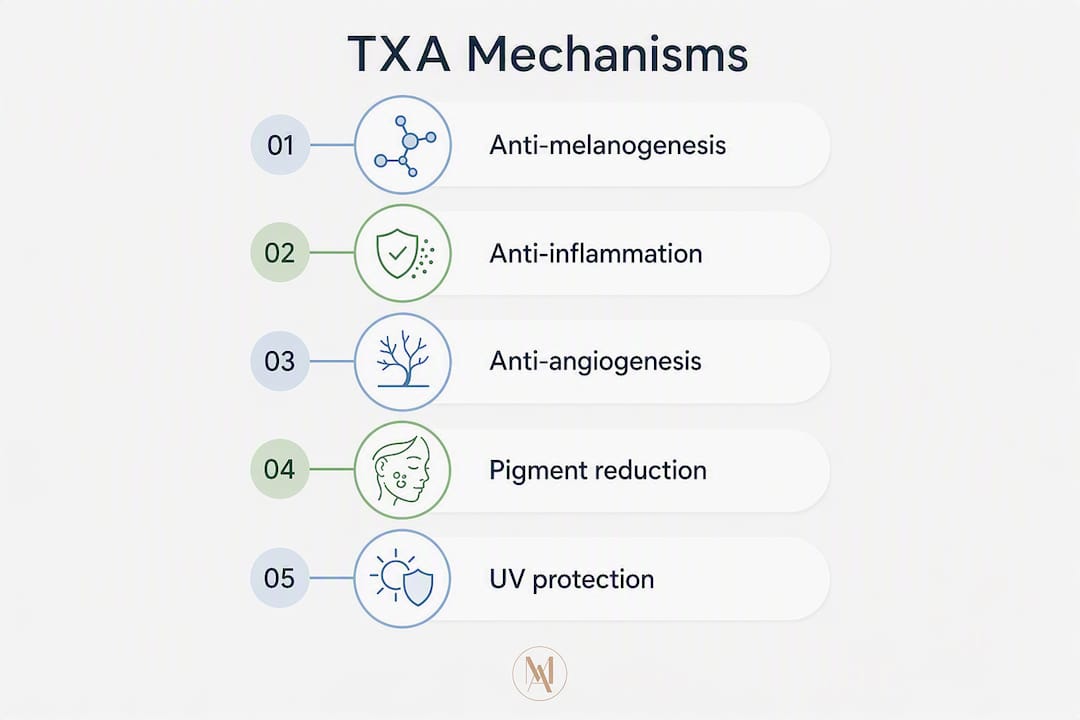
Recent dermatology reviews identify anti-melanogenesis, anti-inflammation, and anti-angiogenesis as the three mechanisms that give TXA potential across a range of hyperpigmentary and telangiectatic disorders. That breadth is why it pairs well with tyrosinase inhibitors such as azelaic acid or hydroquinone rather than competing with them.
What does the clinical evidence say about tranexamic acid?
Meta-analysis shows that TXA used alone reduces the MASI (Melasma Area and Severity Index), with additional reduction when combined with routine treatment. That incremental benefit is the clearest argument for using TXA as an adjunct rather than a replacement for established care.
| Route | Typical concentration or dose | Trial duration | Headline effect on MASI |
|---|---|---|---|
| Topical | 2–5% | 8–12 weeks | Mean MASI reduction when used alone: 1.60; further mean reduction of 0.94 when added to routine treatment (meta‑analysis). |
| Oral | 250 mg twice daily | 8–12 weeks | Largest MASI reductions; prescriber decision, off-label for melasma in many jurisdictions. |
| Intradermal | 2–10% in studies | 8–12 weeks | Consistent benefit; clinic-administered only. |
Clinical consensus frames topical TXA as an adjunct rather than a standalone cure. Melasma is a chronic, relapsing condition, and the evidence reflects that: benefit builds over weeks, and stopping treatment without maintaining photoprotection typically leads to recurrence. Trials measured improvement at 8–12 weeks, so expecting visible change in the first fortnight sets the wrong benchmark.
Key evidence points:
- Topical formulations in a low concentration range show measurable benefit with negligible systemic exposure
- Oral routes produce the largest MASI reductions but require prescriber oversight
- Adding TXA to an existing regimen consistently outperforms either approach alone
- Long-term adherence to a multi-modal strategy centred on photoprotection is what drives durable outcomes
Is topical tranexamic acid safe, and who needs to consult a clinician?
Topical TXA at cosmetic concentrations (2–5%) has a low systemic risk profile. Oral TXA is prescription-only and carries systemic considerations that are a prescriber-level conversation. This article focuses solely on topical use.
Common topical side effects:
- Mild irritation or redness, particularly on sensitive skin
- Occasional contact dermatitis in those with reactive skin
- Dryness if combined with multiple actives simultaneously
When to consult a clinician before starting:
- Pregnancy or breastfeeding
- Personal or family history of thromboembolic events (relevant if oral TXA is ever discussed)
- Complex or undiagnosed pigmentation that may need differential diagnosis
- Current use of prescription actives such as tretinoin or hydroquinone
Pro Tip: Apply a small amount of the serum to the inner forearm and leave for 24–48 hours before using it on your face. Note any redness, itching, or swelling. If a reaction occurs, stop use and consult a clinician before trying again.
Failing to tailor pigment protocols to Fitzpatrick skin type is a recognised clinical pitfall: treatments appropriate for lighter skin tones can provoke severe PIH on deeper complexions. If you have a deeper skin tone or a history of PIH after any skin treatment, professional assessment before starting a new active is genuinely worthwhile.
Home serums versus clinic protocols: what is the difference?
Topical serums are accessible, low-risk, and well-suited to daily home use. Clinic procedures, including intradermal microinjection, microneedling with TXA, and combinations with chemical peels or laser, are more intensive, supervised, and can amplify results beyond what a serum alone achieves.
| Home serum | Clinic protocol | |
|---|---|---|
| Ease of access | High — OTC or via reputable retailer | Requires booking and clinician assessment |
| Evidence strength | Meaningful, particularly as adjunct | Strong, especially for intradermal and combined routes |
| Downtime | None | Minimal to moderate depending on procedure |
| Supervision | Self-managed | Clinician-led with documented plan |
| Typical risk profile | Low | Low to moderate; managed by trained professional |
What a supervised clinic protocol typically includes:
- Baseline magnified skin analysis and Wood’s lamp assessment
- Fitzpatrick skin type documentation
- Informed consent and medical history review
- High-resolution baseline photography
- A written treatment plan with expected timeline and follow-up schedule
TXA is most effective when stacked with consistent photoprotection and other evidence-based depigmenting agents. A clinic protocol formalises that stack and monitors progress objectively. For those managing post-acne pigmentation or deeper-tone PIH, the supervised route reduces the risk of inadvertently worsening discolouration.
How to use a tranexamic acid serum at home
Use a 2–5% topical TXA serum as directed, always alongside daily broad-spectrum SPF 30+, and layer with gentler tyrosinase inhibitors or retinoids only as advised by a clinician.
- Patch test first. Apply to the inner forearm for 24–48 hours before facial use.
- Introduce slowly. Start every other evening for the first two weeks to assess tolerance.
- Layer with low-irritation actives. Niacinamide and azelaic acid pair well; avoid combining with strong retinoids or exfoliating acids on the same application if irritation occurs.
- Morning photoprotection is non-negotiable. Broad-spectrum SPF 30+ every morning, regardless of weather. A consistent pigmentation skincare routine built around photoprotection is what makes TXA work.
- Track progress with photos. Pigment changes are gradual; without documentation, early improvement is easy to miss.
- Be patient. Clinical trials measured outcomes at 8–12 weeks. Stopping at week four because you cannot see a difference is the most common reason people abandon an otherwise effective regimen.
Pro Tip: Take a weekly photo under the same natural light, same angle, same time of day. After eight weeks, compare week one to week eight side by side. Subtle cumulative change becomes visible in a way that daily observation never reveals.
How to choose a tranexamic acid serum in the UK
Prioritise medical-grade formulations with clear concentration labelling in the 2–5% range, a stable vehicle, and an ingredient list that complements photoprotection without unnecessary irritants.
What to look for:
- Concentration stated clearly (2–5% for topical use)
- Complementary actives such as niacinamide or azelaic acid
- A serum or ampoule format for better skin penetration
- Preservative system suited to sensitive skin
- Clear clinic or reputable retailer provenance to reduce counterfeit risk
Buying through a clinic or established medical-grade retailer matters. The UK market includes products of widely varying quality, and concentration claims on unverified products are not always reliable.
Brands available through Them-ethod that incorporate TXA or work within a TXA-compatible protocol include Obagi (a prescription-strength range for which Them-ethod is a UK Ambassador Clinic), Medik8 (UK-formulated, widely available through clinics), and Epionce (medical-grade, available in the UK through professional channels). Each sits within a broader pigmentation treatment programme rather than as a single-product solution.
If you are considering combining topical TXA with prescription actives such as hydroquinone, consult a clinician first. The combination can be highly effective, but the role of hydroquinone in melasma management requires professional oversight to manage safely.
What should a UK clinic consultation cover?
An appropriate consultation documents baseline pigmentation type, skin phototype, medical history, and creates objective before-and-after records before any treatment begins.
Consultation checklist:
- Magnified skin analysis to assess texture, vascularity, and pigment distribution
- Wood’s lamp examination to determine epidermal versus dermal pigment involvement
- Fitzpatrick skin type documentation (critical for safe treatment selection)
- Full medical history including contraception, clotting history, and current medications
- Review of current skincare and any previous treatments
- High-resolution baseline photography under consistent lighting
Dermal melasma responds differently to treatment than epidermal melasma; Wood’s lamp assessment is what distinguishes them. Without it, a protocol risks targeting the wrong layer. For those considering a virtual skincare consultation, the same baseline information should be gathered digitally before any product or protocol is recommended.
Pro Tip: Ask your clinician for a written plan that names the expected timeframe, the maintenance strategy once improvement is achieved, and the follow-up schedule. A verbal plan is easy to misremember at week ten when progress feels slow.
Key takeaways
Topical tranexamic acid reduces melasma and PIH by interrupting UV-driven plasmin signalling, and works best as a clinician-aligned adjunct to photoprotection and established depigmenting agents.
| Point | Details |
|---|---|
| Mechanism | TXA blocks UV-induced plasmin activity, reducing inflammatory mediators that stimulate melanocytes. |
| Timeline | Clinical trials measure improvement at 8–12 weeks; expect gradual, cumulative change, not rapid results. |
| Safety profile | Topical 2–5% formulations carry low systemic risk; oral TXA requires prescriber oversight. |
| Photoprotection | Daily broad-spectrum SPF 30+ is non-negotiable; without it, TXA’s benefit is significantly undermined. |
| Them-ethod | Them-ethod offers virtual consultations, personalised pigment protocols, and medical-grade TXA-compatible products from Obagi, Medik8, and Epionce. |
Why we use tranexamic acid at Them-ethod
We use topical TXA to lift the ceiling of what standard depigmenting care can achieve, not to replace core measures such as SPF and prescription agents. It is the ingredient we reach for when a client’s pigmentation has plateaued on azelaic acid or niacinamide alone, or when we want to add an anti-vascular dimension to a melasma protocol without immediately escalating to prescription-strength actives.
Our preference is for true melasma and recalcitrant PIH, and we always personalise by Fitzpatrick type. A protocol that works well on a Type II skin can provoke a flare on Type V, so risk stratification is built into every assessment we do. We document baseline photography at every consultation, not as a formality, but because pigment changes are subtle and cumulative. Without objective records, both clinician and client lose the thread of progress, and that is when people abandon regimens that are actually working.
The honest expectation we set: visible improvement takes time, maintenance is ongoing, and photoprotection is the one non-negotiable that no serum can replace.
Them-ethod’s pigmentation services and medical-grade products
Them-ethod brings together virtual skin consultations, personalised pigment protocols, and in-clinic procedures including SkinPen microneedling and mesotherapy, all supported by a curated range of medical-grade topical products. As a UK Obagi Ambassador Clinic, we stock prescription-compatible ranges alongside Medik8 and Epionce, giving clients access to formulations that are difficult to source reliably elsewhere.
If you are ready to move beyond trial and error, a virtual consultation with one of our clinicians is the most direct route to a documented, personalised plan. We serve clients across the UK and internationally, with in-person treatments available in London and Athens. Every protocol we build starts with a proper baseline assessment, so you know exactly what you are treating and why.
Useful sources
- Tranexamic Acid for Hyperpigmentation Disorders: A Literature Review on Efficacy and Safety in Melasma and PIH — PMC
- Tranexamic Acid for the Treatment of Hyperpigmentation and Telangiectatic Disorders Other Than Melasma: An Update — PMC
- Optimizing Melasma Management With Topical Tranexamic Acid: An Expert Consensus — Journal of Drugs in Dermatology
- Real World Use of Topical Tranexamic Acid Serum in Patients With Hyperpigmentation — Journal of Drugs in Dermatology
- How Aestheticians Treat Hyperpigmentation — Beauty and Health Institute
This article is for general information only and does not constitute medical advice. Consult a qualified clinician or your GP before starting any new treatment, particularly if you are pregnant, breastfeeding, or have a relevant medical history.