



Artikel: 3–6 Month Multimodal Plan to Soften Neck Lines Backed by Evidence

3–6 Month Multimodal Plan to Soften Neck Lines Backed by Evidence
Daily sunscreen and low-dose retinoids handle crepiness at home. Superficial hyaluronic acid micro-droplets, biostimulators, energy devices and threads handle etched lines and looseness in clinic. Most people who see lasting change use a combination plan with built-in maintenance, not a single product or a single visit.
TL;DR:
- Combining topical retinoids and daily broad-spectrum SPF 30 or higher is essential for at-home neck line improvement, with consistent use over several months.
- In-clinic treatments like hyaluronic acid micro-droplets and hyperdiluted calcium hydroxyapatite stimulate skin hydration and collagen production, lasting up to 18 months.
- Vertical neck bands respond better to botulinum toxin, while horizontal creases improve more with volumising treatments and skin-boosting procedures.
- A layered, multimodal plan over three to six months achieves more natural, sustained results compared to single-treatment approaches or DIY remedies.
- Choosing an experienced, board-certified provider with neck-specific expertise is crucial to minimize risks and ensure appropriate treatment selection.
Table of Contents
- What causes neck lines to form in the first place?
- At-home topical treatment for neck lines: what genuinely helps
- Which in-clinic procedures treat neck lines best?
- How combination treatment plans deliver more realistic results
- How do you choose a safe, qualified provider for neck treatments?
- Ready to treat your neck lines? Here’s how to start
- Selected studies and clinical reviews
- Why “complete removal” is the wrong goal to chase
- Sources
- FAQ
What causes neck lines to form in the first place?
Neck skin has fewer oil glands and a thinner dermis than facial skin, which is why it ages faster and responds to trauma more visibly. Collagen and hyaluronic acid decline with age, so the skin loses the cushioning that once smoothed out movement creases. Add years of sun exposure, and photoageing accelerates the breakdown of elastin fibres that keep skin springy.
Repetitive downward glances at phones and laptops, popularly called “tech neck,” compound this by etching horizontal creases into skin that is already thinning. Smoking accelerates collagen loss too, through reduced blood flow to the skin.
There are two anatomically distinct problems, and mixing them up leads to the wrong treatment choice:
- Horizontal dermal creases: static lines from repeated folding, worsened by thin, sun-damaged skin
- Vertical platysma bands: caused by an overactive platysma muscle pulling the skin into visible cords, especially when talking or straining
Horizontal lines respond to volumising and skin-quality treatments. Vertical bands respond to muscle relaxation. Shallow crepiness can often be softened within three to four months of consistent topical care. Established horizontal creases and muscle banding typically need in-clinic intervention, and waiting longer before addressing them usually means more sessions are needed later.
At-home topical treatment for neck lines: what genuinely helps
Sunscreen is the single most important daily habit for neck lines treatment, and it is also the most skipped. Most people apply SPF to the face and stop at the jawline, leaving the neck and décolletage exposed to the same UV rays that break down collagen everywhere else. A broad-spectrum SPF 30 or higher, reapplied every two hours outdoors, is non-negotiable if you want any topical routine to work.

Retinoids are the second pillar, backed by a prospective 84-day trial of an anti-ageing neck treatment that found meaningful improvement in horizontal fold lines, elasticity and hydration in adults aged 25 to 50. Neck skin is thinner than facial skin and irritates more easily, so dermatologists at Cleveland Clinic recommend a slower introduction than you’d use on the face.
Here’s a safe way to introduce a retinoid to the neck:
- Start with a low-strength formula, around 0.025% tretinoin or an equivalent retinol, applied once or twice weekly.
- Use the “sandwich” method: moisturiser, then retinoid, then moisturiser again, to buffer irritation.
- Increase to alternate nights only once the skin tolerates the starting frequency without flaking or redness.
- Give it 12 to 16 weeks before judging results, since collagen remodelling is slow.
Pair the retinoid with antioxidant serums such as vitamin C for tone, and a hyaluronic acid serum for hydration and plumping. Peptide-based products, explained in more depth here, can support the skin’s own collagen signalling too. Topicals reliably improve crepiness, dryness and dullness. They do not fix true skin laxity or vertical banding, which need a different toolkit entirely.
Pro Tip: Stop retinoid use around five to seven days before any in-clinic neck procedure, and wait until your provider gives the go-ahead to resume afterwards, since irritated skin heals less predictably.
Which in-clinic procedures treat neck lines best?
Clinic treatments split by what they physically do to the skin, and choosing the wrong one for your specific concern is the most common reason people feel disappointed.
- Superficial HA micro-droplets (skinboosters): an experienced injector places tiny 0.01 to 0.02 mL boluses of hyaluronic acid, roughly 2 to 3mm apart, into the superficial dermis using a fine 30 to 32 gauge needle. This hydrates and plumps horizontal lines from within, with effects typically lasting 6 to 12 months and mild, transient swelling or bruising as the main downside.
- Hyperdiluted calcium hydroxyapatite (CaHA): diluted at ratios between 1:2 and 1:4 and delivered with a blunt cannula in a fanning motion, this stimulates the skin to build its own collagen progressively over 12 to 24 weeks. Benefits run 12 to 18 months, with swelling as the main early side effect.
- RF microneedling and HIFU: both heat deeper tissue layers to trigger collagen remodelling. RF microneedling has shown a 55% reduction in crease depth in clinical use, with results building over a course of sessions and peaking around 90 to 180 days after treatment.
- Thread-lifting: absorbable PPDO threads mechanically lift tethered skin and stimulate collagen around the thread track, best suited to mild sagging rather than deep static lines.
- Surgical neck lift or platysmaplasty: reserved for significant loose skin or muscle laxity that injectables and devices cannot correct, and considered the gold standard for severe cases.
- Botulinum toxin: relaxes the platysma muscle to soften vertical bands, but it is not the right first choice for horizontal creases, which respond better to volumising treatments.
A case series combining non-crosslinked HA injections with PPDO thread-lifting reported satisfactory results for horizontal neck wrinkles with mostly mild, temporary side effects at six months, which is a useful illustration of how these tools often get paired rather than used alone.
How combination treatment plans deliver more realistic results
No single treatment addresses hydration, structural volume and surface texture simultaneously, which is why clinicians increasingly build layered plans rather than relying on one modality. Superficial HA plumps the crease itself. Biostimulators or RF microneedling rebuild dermal thickness underneath it. Topical retinoids maintain surface texture between sessions.
A typical sequence might look like this:
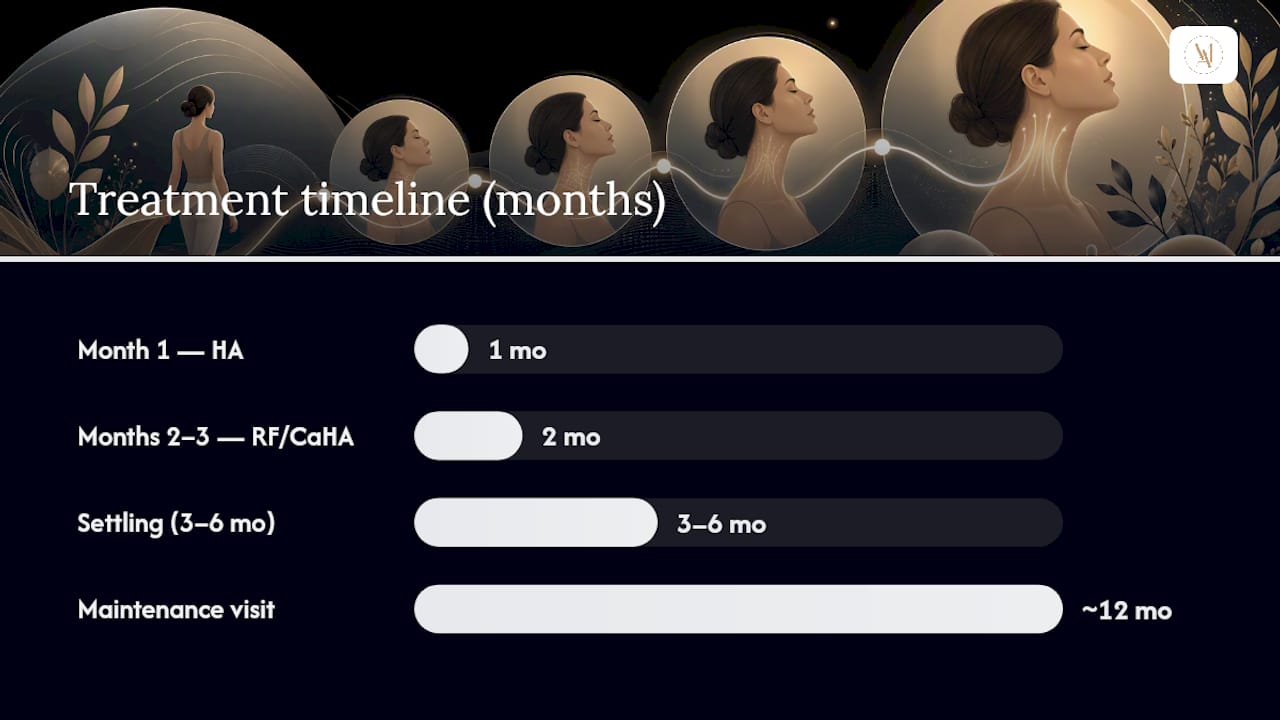
- Month 1: superficial HA micro-droplets to soften the deepest horizontal lines immediately
- Month 2 to 3: RF microneedling series, or hyperdiluted CaHA, layered in for diffuse crepiness
- Ongoing: nightly retinoid and daily SPF to maintain surface improvement between clinic visits
Pooled data from systematic reviews of neck rejuvenation techniques show consistent, clinically meaningful softening from superficial HA and skinbooster approaches, though roughly half of patients choose retreatment within 12 months to maintain the effect. That retreatment rate isn’t a failure of the treatment. It reflects how collagen naturally continues to degrade with age and sun exposure, regardless of how good the initial result was.
Budget time as much as money: a full multimodal plan often runs three to six months before you see the combined effect settle, followed by a maintenance visit roughly once a year.
How do you choose a safe, qualified provider for neck treatments?
The neck sits close to major blood vessels and has thinner skin than the face, so provider experience matters more here than almost anywhere else on the body. A poor injection depth or an inexperienced hand with a cannula carries more risk of complications than the same mistake on a cheek.
Before booking, check for:
- Board certification in dermatology or plastic surgery, with documented neck-specific experience
- Familiarity with superficial micro-droplet and cannula technique, not just facial filler
- A sterile, clinical setting with visible consent and photography protocols
A proper consultation includes a skin assessment, a discussion of which lines are horizontal creases versus muscle bands, and a proposed multimodal plan with realistic timelines. Them-ethod’s online skin consultations start here, alongside in-clinic options including Profhilo, microneedling, HIFU and polynucleotide treatments, each suited to different combinations of crepiness, volume loss and skin quality. Aftercare after any neck procedure typically means avoiding strenuous neck strain for a few days, keeping sun protection consistent, and pausing retinoids until the skin has settled.
Ready to treat your neck lines? Here’s how to start
There’s no shortage of neck creams and DIY device claims promising to erase lines overnight, but the evidence points firmly towards a personalised, multimodal plan rather than a single miracle product. Them-ethod’s approach starts with an online skin consultation, where a clinician assesses whether your lines are horizontal creases, vertical banding, or a mix of both, before proposing a realistic treatment pathway.
From there, a tailored plan might combine in-clinic options such as Profhilo, microneedling, HIFU or polynucleotides, browsable on the clinic treatments collection, with medical-grade topicals to maintain results between visits. Expect the consultation to cover your skin’s specific concerns, a suggested treatment timeline, and pricing detail specific to the procedures recommended for you. If you’d rather start at home first, Them-ethod’s neck and décolleté range offers the firming and hydrating actives worth building into a routine before or alongside clinic work. Book a consultation to find out which pathway fits your skin.
Selected studies and clinical reviews
- A rejuvenating treatment targeting “tech neck” lines and wrinkles in Chinese women
- Hyaluronic acid injections and thread-lifting for horizontal neck wrinkles
- Systematic reviews and pooled analyses on neck rejuvenation techniques
- Safety and complication profiles of cosmetic neck injections
- Fix tech neck: surgical and nonsurgical treatment options — ASPS
Why “complete removal” is the wrong goal to chase
The biggest disservice done to anyone researching neck lines treatment is the promise of total erasure. It doesn’t happen without surgery, and even surgery has its own trade-offs in downtime and cost. What the evidence actually supports is something better than a marketing claim: significant, measurable softening that holds up for months at a time when it’s maintained properly.
The people who end up disappointed are usually the ones who tried one product, expected facial-level results from a single retinoid tube, and gave up after three weeks. Neck skin is slower to respond and less forgiving of harsh actives than facial skin. The people who see real change are the ones who treat it as a slower, layered project: protect it daily, support it topically, and bring in a clinician once static lines or banding are established enough that creams alone won’t shift them.
If there’s one thing worth taking from the research, it’s that combination therapy consistently outperforms any single treatment chosen in isolation. That’s worth remembering before spending on a single “miracle” device or serum.
— Jess
This article is general information, not a substitute for advice from a qualified doctor. Consult a qualified healthcare professional about your own circumstances before acting on anything here.
Sources
- A Rejuvenating treatment targeting “tech neck” lines and wrinkles in Chinese women: A prospective, open‐label, single‐center study
- A case study: comprehensive approach for treating horizontal neck wrinkles using hyaluronic acid injections and thread‑lifting
- Systematic reviews and pooled analyses on neck rejuvenation techniques
FAQ
Can you actually get rid of neck lines?
You can significantly soften neck lines, often achieving substantial improvement on clinical scales, but complete removal without surgery isn’t realistic for most people. Combination plans using topicals, injectables and energy devices deliver the best sustained improvement.
What are the best treatments for neck lines?
For horizontal creases, superficial hyaluronic acid micro-droplets and biostimulators like hyperdiluted CaHA have the strongest evidence, alongside RF microneedling for overall skin thickness. Vertical platysma bands respond better to botulinum toxin than to fillers.
Can retinol reduce neck lines?
Yes, a prospective 84-day study found meaningful improvement in horizontal neck fold lines, elasticity and hydration with a topical anti-ageing regimen. Results build gradually over several months, and neck skin needs a slower, more buffered introduction than facial skin.
Why do I have neck lines at 20?
Neck lines can appear early due to genetics, thin skin, repetitive phone or laptop posture (“tech neck”), and early sun exposure rather than age alone. Starting daily SPF and a gentle retinoid routine early is the most effective way to slow their progression.