




Artikel: Microneedling for melasma: what the evidence actually shows
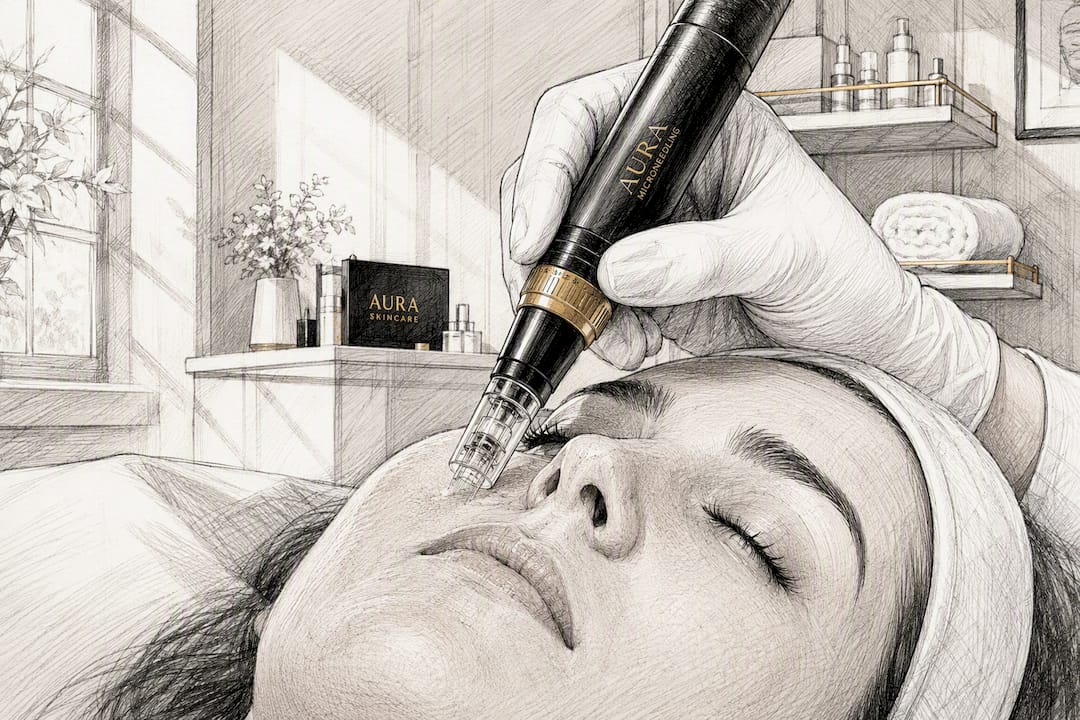
Microneedling for melasma: what the evidence actually shows
Microneedling works as an adjuvant for melasma, not a standalone cure. The strongest data supports pairing it with topical tranexamic acid, where trials report mean melasma severity score (mMASI) reductions of around 45% over eight weeks. A 2022 meta-analysis pooling 459 patients found a large treatment effect (SMD greater than 0.8) by 12 weeks when microneedling was added to topical therapy, with no serious adverse events across the included studies.
That is the encouraging part. The caveat that matters just as much: melasma sits disproportionately in Fitzpatrick skin types III to VI, and this is exactly the population most vulnerable to post-inflammatory hyperpigmentation (PIH) if needling depth, technique or aftercare goes wrong. Microneedling for melasma is not a device you buy and use unsupervised. It is a calibrated medical procedure that needs a clinician who adjusts depth to your skin type and pairs it with the right formulation, applied at the right moment.
Here is what the research actually establishes:
- Microneedling alone rarely outperforms topical treatment alone. Its real value is as a delivery mechanism.
- Combined with tranexamic acid, trials show meaningfully larger mMASI improvements than microneedling paired with metformin or a modified Kligman’s formula.
- Effects typically begin around week four and often peak between weeks 12 and 24, according to pooled meta-analysis data.
- Darker skin types need conservative depth protocols and specialist oversight to avoid triggering the exact pigmentation problem the treatment aims to fix.
Statistic to remember: in a 45-patient randomised controlled trial, microneedling with topical tranexamic acid produced a 45.3% mean mMASI reduction over eight weeks, compared with 38.2% for a modified Kligman’s formula arm and 22.1% for a metformin arm.
Key Takeaways
Microneedling works best for melasma as a delivery method for depigmenting agents like tranexamic acid, not as a standalone treatment, and darker skin types need conservative, clinician-supervised protocols to avoid triggering PIH.
| Point | Details |
|---|---|
| Microneedling is adjunctive | Its main value is enhancing penetration of actives like tranexamic acid, not acting alone. |
| TXA shows the strongest evidence | An RCT found a 45.3% mean mMASI reduction over 8 weeks with microneedling plus tranexamic acid. |
| Results build gradually | Improvements often begin around week 4 and peak between weeks 12 and 24 across pooled trials. |
| PIH is the key risk for darker skin | Fitzpatrick III to VI patients need conservative depth, patch testing and strict sun protection. |
| The M-ethod offers tailored protocols | SkinPen microneedling with clinician-selected topicals and depth planning through The M-ethod. |
Table of Contents
- How microneedling works for melasma: mesoneedling and collagen induction
- Does microneedling help melasma? What the trials show
- What treatment protocol should you expect at a consultation?
- Which actives work best with microneedling for melasma?
- What are the side effects and PIH risks of microneedling?
- Who is a good candidate for microneedling for melasma?
- How long until you see results, and how are they measured?
- What aftercare keeps microneedling results from fading?
- How The M-ethod approaches microneedling for pigmentation
- Why the microneedling conversation misses the point
- Ready to talk to a specialist about melasma treatment?
- Sources
How microneedling works for melasma: mesoneedling and collagen induction
Melasma is fundamentally a disorder of melanocyte activity, sun-triggered and often hormonally influenced, that sits within a disrupted dermal-epidermal environment. The basement membrane, the structural layer separating epidermis from dermis, is frequently damaged in melasma-affected skin, allowing pigment-producing cells to behave erratically. Microneedling’s rationale starts here.
Fine needles create controlled microtrauma across hundreds of points per square centimetre. This triggers a wound-healing cascade: platelet activation, growth factor release, and a remodelling process that stimulates new collagen and encourages epidermal thickening. A comprehensive review of 64 clinical studies found this process associated with repaired basement membrane integrity and reduced melanin density in treated skin, which helps explain why microneedling for hyperpigmentation extends beyond melasma into scarring and general tone irregularities.
The second mechanism matters more in practice than most patients realise. Microneedling creates thousands of temporary microchannels through the stratum corneum, the skin’s main penetration barrier. This is called mesoneedling, and it is arguably the more important half of the mechanism for melasma specifically. The needles do some structural work on their own, but their bigger contribution is turning the skin into a temporarily receptive surface for depigmenting agents that otherwise struggle to penetrate deep enough to reach active melanocytes.
Practitioners often stress that immediate application of clinical-grade adjuncts, within minutes of the procedure, is the procedural detail lay summaries most often skip. Wait too long, or apply the wrong formulation, and you lose much of the added benefit that makes microneedling worth doing over topical treatment alone.
There are real limits to this mechanism story. Melanocyte behaviour varies between patients: some respond to mechanical and inflammatory stimulation with reduced pigment production, others with a rebound flare. This variability is one reason outcomes differ so much between individuals even under near-identical protocols, and it is why clinician judgement, not a fixed recipe, still drives results.
- Controlled microtrauma stimulates collagen remodelling and basement membrane repair.
- Microchannels created during treatment temporarily increase absorption of topical actives by a wide margin compared with intact skin.
- Melanocyte response to microtrauma is not uniform, which explains some of the variance in trial outcomes.
- Mechanism data comes mostly from histology and small cohort studies, not large-scale mechanistic trials.
Pro Tip: Ask your clinician exactly what they plan to apply into the microchannels and how quickly after needling. If the answer is vague, that is a signal the protocol has not been thought through for melasma specifically.
Does microneedling help melasma? What the trials show
The best evidence sits in two places: a 2022 meta-analysis pooling multiple trials, and a handful of well-designed RCTs comparing microneedling against or alongside specific adjuncts. Both point the same direction, with caveats worth taking seriously.
The pooled data
The 2022 systematic review and meta-analysis published in JAAD examined 12 studies totalling 459 patients. Adding microneedling to standard topical melasma therapy produced a large pooled effect, standardised mean difference (SMD) greater than 0.8, by 12 weeks. Improvements were detectable from around week eight, and tolerability across the pooled studies was good: no serious adverse events were reported in any included trial.
A separate meta-analysis and systematic review of randomised controlled trials found a similar time course: microneedle-assisted therapy effects typically begin as early as week four and often peak somewhere between weeks 12 and 24. Patient satisfaction across these pooled trials ran high, and severe adverse events were rare. That consistency across independently conducted reviews is meaningful. It is not one study reporting a fluke result; it is the same pattern showing up in different patient pools with different specific protocols.
The strongest single RCT: TXA versus metformin versus Kligman’s formula
The most directly useful trial for anyone weighing up specific adjuncts is the 2025 randomised controlled study comparing three arms in 45 melasma patients over eight weeks:
- Microneedling with topical tranexamic acid: mean mMASI reduction of 45.3%.
- Modified Kligman’s formula (a longstanding combination depigmenting regimen): mean reduction of 38.2%.
- Microneedling with topical metformin: mean reduction of 22.1%.
Patient satisfaction tracked with efficacy, running highest in the tranexamic acid arm. This is a small trial by any standard, 45 patients split across three arms means roughly 15 per group, so treat the precise percentage gaps as indicative rather than definitive. But the direction is consistent with other work on microneedling with tranexamic acid: a scoping review of TXA delivery methods found that microneedling-based delivery often matches or exceeds other delivery routes in both efficacy and patient satisfaction, with generally mild and transient adverse effects.
Reading the limitations honestly
None of this evidence is flawless, and a comprehensive review of 64 clinical studies flagged the field’s central problem directly: protocol heterogeneity. Needle lengths across studies range from 0.25mm to 2.0mm. Session counts range from a single treatment to a dozen. Intervals between sessions range from back-to-back weekly visits to month-long gaps. When studies vary this much on the basics, comparing outcome percentages across trials becomes an exercise in approximation, not precision.
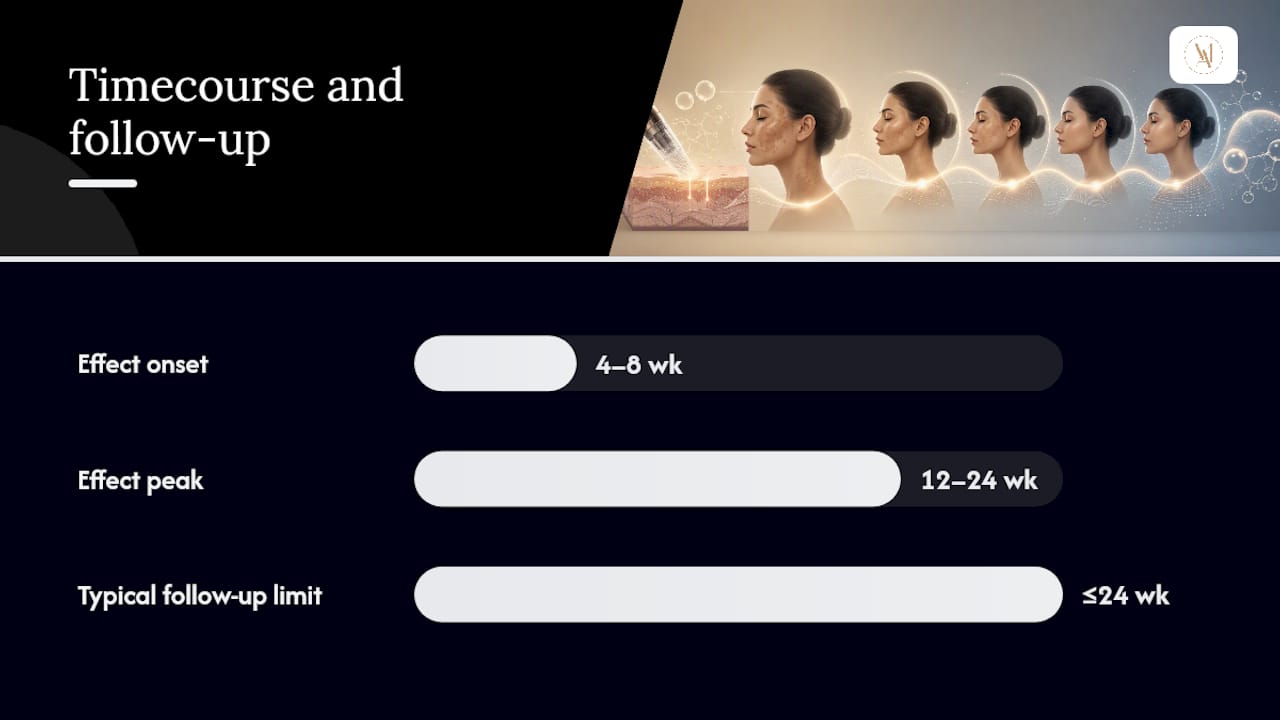
Sample sizes are another honest limitation. Most individual RCTs in this field run somewhere between 20 and 60 patients. Follow-up periods rarely extend past 24 weeks, which means the durability question, does the improvement hold at six months or a year without maintenance, remains underexplored in the published literature. What the data supports confidently is short-to-medium-term efficacy with a favourable safety profile. What it cannot yet tell you with precision is the exact percentage improvement you personally should expect, because your skin type, melasma depth (epidermal versus dermal versus mixed), and adjunct choice all shift the outcome.
The pooled effect worth remembering: SMD greater than 0.8 by 12 weeks across 459 patients in the JAAD meta-analysis, with tolerability good enough that no serious adverse events were recorded across any included study.
- Meta-analytic evidence consistently shows effects starting by weeks 4 to 8 and peaking by weeks 12 to 24.
- The strongest single-adjunct evidence favours tranexamic acid over metformin or Kligman’s formula for mMASI improvement.
- Heterogeneous protocols across the literature mean quoted percentage improvements should be read as ranges, not guarantees.
- No trial in the pooled evidence base reported serious adverse events, though sample sizes remain modest.
What treatment protocol should you expect at a consultation?
Trial protocols vary, but enough consistency exists across the literature that you can walk into a consultation knowing what reasonable practice looks like, and what should raise questions.
1. Needle depth. Across the comprehensive review of 64 studies, needle lengths ranged from 0.25mm to 2.0mm, with 1.5mm the most commonly reported depth for melasma specifically. Depth is not one-size-fits-all: thinner skin around the cheekbones and under-eye area often needs a shallower pass than the central face, and darker skin types generally warrant a more conservative starting depth regardless of area.
2. Session number and spacing. Most published protocols use somewhere between three and six sessions, spaced two to four weeks apart. This interval is not arbitrary; it gives the epidermis time to fully recover and lets clinicians assess pigment response before committing to the next pass. A clinician who proposes weekly sessions with no reassessment point is skipping a safety check the trial protocols built in deliberately.
3. Device type. Manual dermarollers and motorised microneedling pens (SkinPen is the FDA-approved device most commonly used in professional settings) both appear in the literature, but motorised pens generally allow more consistent depth control across a session, which matters more for melasma than for, say, microneedling for acne scars, where slight depth variation carries lower pigmentation risk. Sterility and single-use cartridges are non-negotiable; a clinic that reuses needle heads between patients is a hard stop.
4. Endpoint during the session. Clinicians are trained to stop at pinpoint bleeding, tiny individual blood spots, not a uniformly bleeding surface. If your skin is bleeding heavily or the practitioner keeps passing over already-reactive areas, that is over-treatment, and it is one of the more common causes of PIH in melasma patients specifically.
Watch for these red flags during or immediately after a session:
- Uniform bleeding rather than isolated pinpoints.
- Immediate, intense inflammation that looks more like a burn than mild redness.
- A practitioner who cannot explain why they chose a specific depth for your skin type.
- No mention of what will be applied into the microchannels immediately afterwards.
Pro Tip: Bring up your Fitzpatrick skin type explicitly in your consultation, even if the clinician does not ask. Depth decisions should shift meaningfully between skin types I to II and skin types IV to VI, and a practitioner who treats every patient the same way is not tailoring to the evidence.
Which actives work best with microneedling for melasma?
Microneedling is a delivery vehicle first. What you put into the microchannels immediately afterwards shapes the outcome as much as, arguably more than, the needling itself.

Tranexamic acid holds the strongest evidence. Across the RCT comparing three adjuncts, TXA produced the largest mMASI reduction at 45.3% over eight weeks, ahead of both a modified Kligman’s formula and metformin. A separate scoping review of TXA delivery routes found microneedling-based delivery frequently matches or exceeds intradermal injection and systemic TXA on both efficacy and patient satisfaction, with a favourable adverse-event profile and potentially better durability than oral TXA in some comparisons. If you read more on how this works mechanically, tranexamic acid for melasma inhibits plasmin activity in keratinocytes, reducing the signalling that stimulates melanocyte activity, which is distinct from how hydroquinone or vitamin C work.
Vitamin C and hydroquinone remain reasonable alternatives, particularly where TXA is unsuitable or unavailable. Vitamin C’s antioxidant action offers a gentler adjunct profile, useful for patients with reactive or sensitised skin, though the trial evidence specifically for microneedling-delivered vitamin C in melasma is thinner than for TXA. Hydroquinone, the modified Kligman’s formula ingredient, showed a respectable 38.2% mMASI reduction in the same RCT, making it a legitimate second-line choice rather than an inferior one.
PRP and exosome-based adjuncts are the emerging frontier, but the evidence is preliminary. Case reports combining microneedling with topical exosomes derived from sources like Panax ginseng have shown promising results for post-inflammatory hyperpigmentation, with no serious adverse events reported, but sample sizes are small and this is not yet the standard of care for melasma the way TXA is.
Formulation cautions matter as much as the active itself. Because the skin barrier is temporarily breached, pH, preservative load and irritant potential all matter more than they would with a standard topical application. A formulation that is fine on intact skin can trigger a stronger inflammatory response when driven through open microchannels, which is one reason clinical-grade formulations designed for this specific use outperform generic over-the-counter serums applied post-procedure.
- Tranexamic acid currently has the strongest RCT-level evidence for microneedling combination therapy in melasma.
- Modified Kligman’s formula remains a credible second-line adjunct with meaningful mMASI improvement.
- PRP and exosome adjuncts show early promise but lack the trial depth that TXA and hydroquinone have.
- Formulation quality, not just the active ingredient, affects both efficacy and irritation risk when applied into microchannels.
Statistic worth holding onto: in the 2025 head-to-head trial, TXA outperformed metformin by more than double (45.3% versus 22.1% mMASI reduction) over the same eight-week window.
Microneedling itself is adjunctive to the bigger picture. However good the in-clinic combination, a topical regimen sustained between and after sessions is what actually prevents relapse, which is a theme the maintenance-focused skincare routine approach addresses directly.
What are the side effects and PIH risks of microneedling?
Across the pooled trial data, most side effects are short-lived and unremarkable: erythema (redness), a burning sensation during and shortly after treatment, and transient oedema (swelling). These typically resolve within 24 to 72 hours. The 2022 meta-analysis covering 459 patients reported no serious adverse events across any included study, and that finding has held up across subsequent reviews too.
The risk that deserves real attention is post-inflammatory hyperpigmentation, and it is worth being blunt about why. PIH occurs when the skin’s inflammatory healing response overshoots and stimulates melanocytes to overproduce pigment, precisely the opposite of what the treatment is meant to achieve. This is not a rare quirk; it is a mechanistically predictable risk in any procedure that deliberately creates controlled trauma, and melasma patients are disproportionately in Fitzpatrick skin types III through VI, the groups where PIH risk runs highest.
Three factors drive most PIH cases in the published literature and in clinical practice:
- Excessive needling depth for the patient’s skin type or the treatment area, which triggers a stronger inflammatory cascade than intended.
- Technique errors, such as repeated passing over the same area or inconsistent pressure that creates deeper channels than the device setting implies.
- UV exposure shortly after treatment, when the skin’s protective barrier is compromised and freshly stimulated melanocytes are primed to react to sunlight.
Herpes simplex reactivation is a less common but recognised risk, particularly for patients with a history of cold sores, since the microtrauma can trigger a flare in latent virus around the perioral area.
Mitigation is well established in clinical practice, even where it is not always followed. Conservative depth selection for darker skin types, often starting shallower (0.5 to 1.0mm) and titrating up based on response, reduces PIH incidence meaningfully. Preconditioning the skin with topical agents like tranexamic acid or a mild retinoid in the weeks before treatment can lower background melanocyte reactivity. Strict sun avoidance for at least a week post-procedure, not just “wear SPF” but genuinely limiting exposure, is non-negotiable. For patients with a history of cold sores, antiviral prophylaxis prescribed ahead of the session prevents reactivation before it starts.
Pro Tip: If you have any history of PIH from previous treatments, acne, or waxing, say so explicitly before your first session. This history is one of the strongest predictors of how your skin will respond to microneedling, and it should change the depth and aftercare plan your clinician recommends.
Who is a good candidate for microneedling for melasma?
The best candidates have realistic expectations and a history that does not flag major risk. That generally means epidermal or mixed-depth melasma (rather than purely dermal, which responds less predictably to any pigment-targeting treatment), no active skin infection, and no recent history of severe PIH from other procedures. Patients willing to commit to a multi-session protocol, typically three to six sessions over several months, plus strict sun protection throughout, get the most out of the evidence base described above.
Contraindications clinicians take seriously:
- Recent isotretinoin use (commonly a six-month wait is advised before microneedling, though your prescribing clinician should confirm the specific interval).
- Active skin infection, including active cold sores, at the treatment site.
- Pregnancy is often treated with caution given limited safety data specific to microneedling in pregnant patients, even though melasma itself frequently worsens during pregnancy.
- Bleeding disorders or use of anticoagulant medication, which increases bruising and complicates the controlled-bleeding endpoint clinicians rely on.
- A prior history of keloid scarring, which raises the risk of an atypical healing response.
For Fitzpatrick III to VI skin, many dermatologists favour a staged, conservative approach rather than a standard fixed protocol: starting depth around 0.5 to 1.0mm, performing a small test patch, assessing the inflammatory response over several days, then titrating depth and session interval based on how that test area heals. This is slower than a one-size-fits-all protocol, but it is the approach most consistent with minimising PIH risk in the patients who need that protection most.
- Good candidates: epidermal or mixed melasma, no active infection, realistic multi-session expectations.
- Proceed with caution or delay: recent isotretinoin, pregnancy, anticoagulant use, prior keloid history.
- Darker skin types benefit from a staged test-patch approach rather than a fixed standard depth.
How long until you see results, and how are they measured?
Clinical trials track melasma improvement using the mMASI (modified Melasma Area and Severity Index), a standardised scoring system that quantifies pigment darkness and the area affected across defined facial regions. It gives clinicians and researchers an objective number to compare before and after treatment, rather than relying on subjective impression.
The time course across pooled meta-analyses is consistent: measurable improvement often begins around week four, with many trials showing peak effect somewhere between weeks 12 and 24. Do not expect a dramatic change after a single session. The mechanism, collagen remodelling plus repeated adjunct delivery, is cumulative by design.
The magnitude to expect varies significantly by adjunct. In the 2025 three-arm RCT, mMASI reductions ranged from 22.1% with metformin up to 45.3% with tranexamic acid over eight weeks, with the modified Kligman’s formula arm landing at 38.2%. Treat these as illustrative ranges from one trial rather than a universal promise, since your own result depends on melasma depth, skin type, and consistency with aftercare.
Relapse is the underdiscussed part of this story. Melasma is a chronic, UV- and hormone-sensitive condition, and even a strong initial response can fade without ongoing maintenance. Trials rarely follow patients past 24 weeks, so the published literature says little about durability at 6 or 12 months. In practice, this means booster sessions and sustained topical use are not optional extras; they are the difference between a temporary improvement and a lasting one.
Time course to remember: early changes from around week four, peak improvement typically between weeks 12 and 24, based on pooled data across multiple systematic reviews and meta-analyses.
What aftercare keeps microneedling results from fading?
The days immediately after a session matter more for melasma than for most other microneedling indications, precisely because inflamed, freshly stimulated skin is exactly the environment PIH thrives in.
- Keep the first 24 to 48 hours simple. Use a gentle, fragrance-free cleanser, avoid active ingredients like retinoids or exfoliating acids, and let the skin’s barrier begin repairing without added irritation.
- Prioritise sun protection above everything else. Broad-spectrum SPF 30 to 50, ideally a physical (mineral) formulation containing zinc oxide or titanium dioxide, reapplied every two hours if you are outdoors. This is not a suggestion you can skip for melasma patients; UV exposure on compromised skin is one of the clearest triggers for PIH and melasma rebound.
- Reintroduce your maintenance topical regimen once your clinician confirms the skin has settled, usually within a week, and keep it consistent between sessions rather than only around treatment dates.
- Book booster sessions on a schedule your clinician sets, rather than waiting for visible fading. Since relapse risk is real and under-studied past six months in the literature, structured maintenance, not reactive re-treatment, is what actually protects the gains.
Pro Tip: Treat your SPF as part of the treatment protocol, not an accessory to it. Skipping reapplication on a single sunny afternoon in the first week after a session can undo weeks of progress in melasma patients specifically.
How The M-ethod approaches microneedling for pigmentation
The M-ethod is a UK-based Obagi Ambassador Clinic offering FDA-approved SkinPen microneedling alongside prescription-grade topical formulations and clinician-led consultations, an approach that matches the personalised, evidence-based protocol this article describes rather than a generic, one-depth-fits-all treatment.
A consultation with The M-ethod typically covers:
- A risk assessment based on your Fitzpatrick skin type, melasma history, and any prior PIH.
- A tailored depth and session plan rather than a fixed protocol applied to every patient.
- Selection of the right adjunct formulation, including tranexamic acid-based topicals, matched to what the current evidence supports.
- Specialist oversight throughout the multi-session process, with reassessment built into the schedule.
Why the microneedling conversation misses the point
Most consumer coverage of microneedling for melasma treats the needles as the treatment and the topical as an afterthought. The evidence says the opposite: the delivery mechanism is doing quiet, essential work, but the choice of what gets driven into those microchannels, and how quickly, is where the real differences in outcome show up. A clinic offering microneedling without a clear, evidence-matched adjunct plan is offering half a protocol.
The other gap in conventional advice is candour about darker skin. Plenty of general skincare content treats microneedling as universally low-risk. It is not, for melasma patients specifically, because the population most affected by melasma overlaps heavily with the population most vulnerable to PIH. Anyone recommending a fixed depth or a one-size protocol without asking about Fitzpatrick type is skipping the step the safety data says matters most.
If you take one thing from this, prioritise the clinician’s willingness to individualise your plan over any specific device or brand name. The trial data behind tranexamic acid is genuinely strong, but strong evidence applied at the wrong depth on the wrong skin type still produces a poor outcome.
— Jess
Ready to talk to a specialist about melasma treatment?
If you have been weighing microneedling against laser resurfacing, chemical peels, or simply persisting with topical creams alone, the deciding factor is rarely the technology itself. It is whether the protocol gets tailored to your skin, your melasma depth, and your risk profile, rather than applied the same way to everyone who walks through the door. That is where Them-ethod’s approach differs from a generic aesthetics menu: consultations start with a clinician assessing your Fitzpatrick type and melasma history before any needle touches your skin, and the adjunct formulation, whether tranexamic acid based or otherwise, gets matched to the evidence rather than defaulted to whatever the clinic happens to stock.
Between sessions, sustaining results depends on the topical regimen you use at home, and Them-ethod’s NEOSTRATA collection offers clinical-grade formulations built for exactly this kind of pigmentation maintenance. If microneedling for melasma sounds right for your skin, book a consultation with The M-ethod to get a depth and adjunct plan built around your specific case rather than a standard template.
This article is general information, not a substitute for advice from a qualified doctor. Consult a qualified healthcare professional about your own circumstances before acting on anything here.
Sources
- Microneedling-assisted delivery of metformin versus tranexamic acid in treating melasma: a randomized controlled study
- Microneedling as an adjuvant to topical therapies for melasma: A systematic review and meta-analysis
- Review of applications of microneedling in melasma
- Efficacy of microneedle as an assisted therapy for melasma: A meta-analysis and systematic review of randomized controlled trials


...)