



Artikel: Luxury skincare devices comparison: the expert UK guide

Luxury skincare devices comparison: the expert UK guide
For corrective, long-term anti-ageing or complex skin concerns, the clinician-led plan from Them-ethod is the recommended premium route. For maintenance and convenience, the evidence-backed shortlist below organises devices by mechanism so you choose what your skin actually needs, not what looks most impressive in a flatlay.
Top picks at a glance:
- Corrective and bespoke: The M-ethod clinician-led device and treatment plan (virtual assessment, personalised protocol, prescription-grade aftercare)
- Best LED mask: CurrentBody Skin Series 2 (633nm + 830nm, extended chin and neck coverage)
- Best microcurrent: NuFACE Trinity or ZIIP Halo (muscle tone and contouring)
- Best RF: CurrentBody RF Radio Frequency Skin Tightening Device (collagen remodelling, handheld)
- Best home laser: LYMA Laser (near-infrared LLLT, premium positioning)
- Best dermaplaning: DermaFlash Luxe+ (sonic, immediate smoothing)
- Best multi-use: TheraFace PRO (massage, heat, microcurrent and LED in one wand)
Price orientation: high-end home devices typically range from approximately £300 to £1,200. Clinician-led plans sit above that band but include diagnosis, a supervised protocol, and aftercare that no standalone device provides. Selection criteria throughout this guide prioritise MHRA/CE status, published wavelengths and irradiance, and independent clinical evidence over celebrity endorsements.
Table of Contents
- How do the top luxury skincare devices compare?
- Expert reviews: every device assessed
- How we chose and evaluated these devices
- How to pick the right luxury device for your skin goals
- How to use, maintain, and get results from your device
- When does clinician guidance become non-negotiable?
- Key takeaways
- The case for evidence-first buying
- Them-ethod: clinician-led skincare that goes beyond the device
- Useful sources and further reading
How do the top luxury skincare devices compare?
| Device / Option | Technology | Best for | Price (GBP, approx.) | Clinical evidence / dosimetry | Typical results timeline | Skin types / key contraindications | Ease of use | UK availability |
|---|---|---|---|---|---|---|---|---|
| The M-ethod clinician plan | Multi-modality, clinician-supervised | Corrective anti-ageing, pigmentation, bespoke combination | POA (consultation) | Clinician-selected protocols; prescription-grade aftercare | 4 weeks depending on concern | All types; contraindications assessed at consultation | Guided; virtual + in-clinic | UK (London + Athens); virtual worldwide |
| CurrentBody Skin Series 2 | LED (633nm + 830nm) | Collagen support, anti-ageing, neck/jawline maintenance | ~£380 | clinically relevant wavelengths confirmed; independent trial commissioned | 3–5 times per week | Most skin types; avoid active photosensitivity | Hands-free mask | CurrentBody UK |
| LYMA Laser | LLLT (near-infrared cold laser) | Deeper collagen stimulation, affluent buyers | ~£1,950 | LLLT mechanism; manufacturer-cited clinical endorsements | — | Most types; avoid over active lesions | Handheld wand | LYMA UK direct |
| NuFACE Trinity | Microcurrent | Muscle tone, jawline definition, contouring | ~£325 | Long market history; microcurrent mechanism well-documented | 4 weeks daily use | Most types; avoid pacemakers, pregnancy, epilepsy | Handheld | Widely available UK |
| ZIIP Halo | Microcurrent + nano-current | Instant lift and cumulative skin texture | ~£380 | Dual-current modality; app-guided protocols | 4 weeks | Most types; same electrical contraindications | Handheld, app-guided | ZIIP UK / select retailers |
| Déesse Pro Sculpta | EMS + RF + LED | Multi-layer firming, muscle tone and collagen | ~£499 | Multi-modality; RF mechanism clinically supported | — | Most types; avoid metal implants, pregnancy | Handheld dual-probe | Select UK retailers |
| NIRA Pro+ | Fractional home laser | Surface resurfacing, pigment correction | ~£350 | Home fractional energy; CE-marked; clinician follow-up advised | — | Lighter skin tones; avoid active acne, tanned skin | Handheld | NIRA UK / select retailers |
| PMD Microderm Pro | Microdermabrasion | Surface dullness, texture | ~£150 | Mechanical exfoliation; well-established modality | 4 weeks | Most types; avoid rosacea flares, broken skin | Handheld; consumable discs | PMD Beauty UK |
| DermaFlash Luxe+ | Sonic dermaplaning | Immediate smoothness, product absorption | ~£180 | Dermaplaning mechanism; technique-dependent | Immediate + cumulative | Most types; avoid active breakouts, sensitised skin | Handheld; consumable blades | Widely available UK |
| TheraFace PRO | Multi-use (massage, heat, microcurrent, LED) | Travel, daily maintenance, depuffing | ~£350 | Low-energy multi-modality; modest cumulative effects | Immediate depuffing; cumulative effects over time | Most types; standard electrical contraindications | Handheld wand | Therabody UK |
| CurrentBody RF Radio Frequency | RF (43°C thermal) | Skin tightening, collagen remodelling | — | RF at 43°C; optimal collagen temperature cited | — | Most types; avoid metal implants, pregnancy | Handheld | CurrentBody UK |
| Medicube Age-R Booster Pro | Microcurrent + EMS + electroporation + LED (5 wavelengths) | Comprehensive multi-concern maintenance | — | multi-modalities; five LED wavelengths | — | Most types; standard contraindications | Handheld | Select UK retailers |

Transparency flag: CurrentBody Series 2 irradiance is not independently published; Omnilux publishes a measured irradiance of ~28 mW/cm² for its Contour Face. LYMA Laser does not publish irradiance figures publicly. Where irradiance is absent, treat manufacturer claims with appropriate scepticism.
Expert reviews: every device assessed
The M-ethod clinician-led device and treatment plan
The only option on this list that begins with a diagnosis rather than a device purchase. Them-ethod’s clinician pathway pairs a virtual skin assessment with a personalised protocol, selecting devices and prescription-grade actives to match your specific concern, whether that is photodamage, melasma, post-acne scarring, or laxity. In-clinic treatments in London and Athens extend the offering to HIFU, SkinPen microneedling, Profhilo, and polynucleotides.
Pros:
- Clinician oversight removes the guesswork from device selection and energy settings
- Prescription-grade aftercare (retinoids, medical-grade actives) integrated into the protocol
- Warranty on clinician-supplied devices; post-treatment review included
- Suitable for complex, multi-concern cases where a single device is insufficient
- Access to in-clinic modalities unavailable at home
Cons:
- Higher investment than a standalone device purchase
- Requires commitment to consultation and follow-up appointments
Price: POA; virtual consultation available. UK availability: London clinic and virtual worldwide.
CurrentBody Skin Series 2 (LED mask)
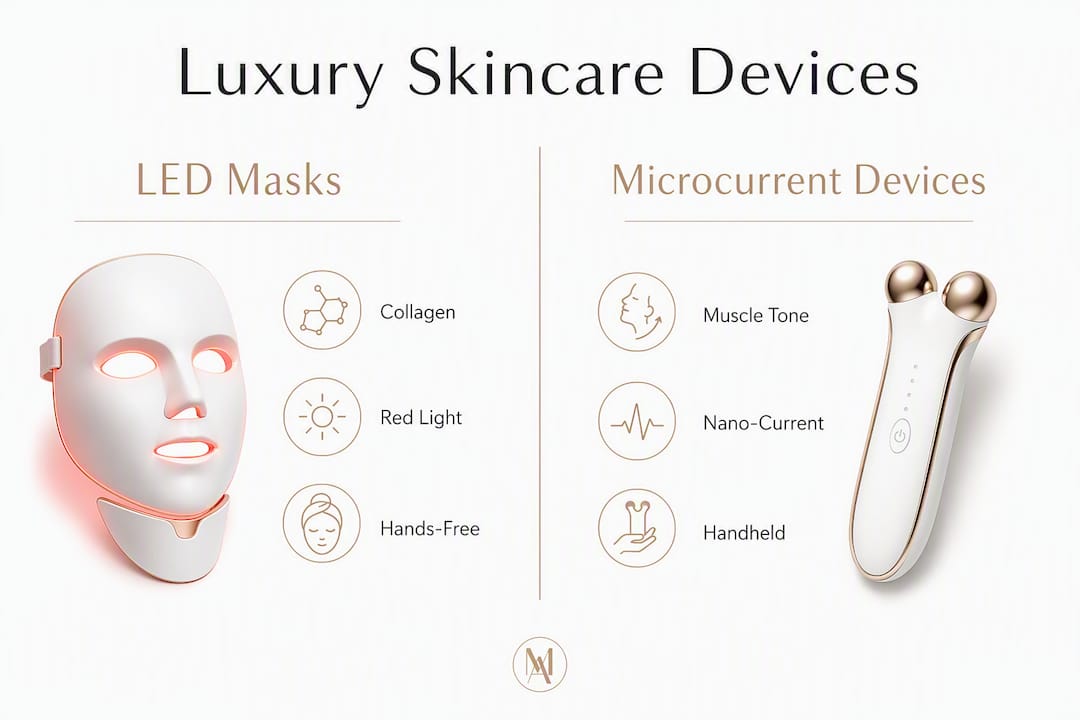
The Series 2 uses 633nm red and 830nm near-infrared LEDs — the two wavelengths with the strongest anti-ageing evidence — and extends coverage to the chin and neck, an area most masks neglect. An independent trial commissioned for the Series 2 showed improvements in plumpness and brightness. The mask is hands-free, which matters: hands-free delivery ensures consistent irradiance-to-skin distance, whereas handheld wands rely on the user maintaining the right proximity and dwell time across every zone.
Pros:
- Clinically relevant wavelengths confirmed (633nm + 830nm)
- Extended chin and neck coverage
- Hands-free; consistent dose delivery
- Independent trial evidence
Cons:
- Irradiance not independently published; Omnilux publishes ~28 mW/cm² for comparison
- Rigid frame may leave gaps on narrower faces, reducing effective dose
Price: ~£380. UK availability: CurrentBody UK direct.
Pro Tip: Pair LED sessions with a PCA Retinol Night 0.5% on alternate evenings to support collagen synthesis from two complementary pathways.
LYMA Laser
The LYMA Laser uses low-level laser therapy (LLLT) rather than broadband LED, which means it delivers coherent near-infrared light intended to penetrate past the epidermal barrier and stimulate cellular rejuvenation. Harper’s Bazaar lists it as the best home laser at approximately £1,950, with clinician endorsement in some protocols. The mechanism is credible; the price reflects premium positioning as much as technical superiority, and irradiance figures are not publicly disclosed.
Pros:
- LLLT mechanism distinct from standard LED; deeper dermal target
- Clinician-endorsed protocols available
- Premium build quality
Cons:
- ~£1,950 price point is the highest on this list for a home device
- Irradiance not published; independent verification limited
- Handheld; requires consistent manual technique
Price: ~£1,950. UK availability: LYMA UK direct.
NuFACE Trinity (microcurrent)
Microcurrent works on muscle tissue, not the dermis. The Trinity delivers low-level electrical current to stimulate the facial muscles beneath the skin, producing immediate contouring effects and cumulative tone improvement with consistent use. Its long market history means the protocol is well-refined, and it remains the reference device in its category.
Pros:
- Established microcurrent protocols; long safety record
- Immediate visible contouring before events
- Widely available in the UK
Cons:
- Contraindicated with pacemakers, during pregnancy, and in epilepsy
- Results require daily or near-daily use to maintain
Price: ~£325. UK availability: widely available via major UK retailers.
ZIIP Halo (microcurrent + nano-current)
The ZIIP Halo adds nano-current to the microcurrent modality, targeting collagen production closer to the skin surface alongside the deeper muscle-toning effect. App-guided protocols make it accessible for users who want structured treatment plans without a clinician. Harper’s Bazaar names it the best microcurrent device at approximately £380.
Pros:
- Dual-current modality covers both muscle tone and surface skin quality
- App-guided protocols reduce user error
- Cumulative texture benefits beyond immediate lifting
Cons:
- Same electrical contraindications as all microcurrent devices
- App dependency may frustrate some users
Price: ~£380. UK availability: ZIIP UK and select retailers.
Déesse Pro Sculpta (EMS/RF/LED)
The Sculpta combines EMS dual probes for muscle stimulation around the eyes, cheeks, and jaw with a radiofrequency end that heats the collagen matrix for firming. LED is included but, as Harper’s Bazaar notes, the EMS and RF are the device’s real strengths. Multi-modality devices trade single-purpose engineering for convenience; choose this one only if you genuinely need both muscle tone and dermal firming.
Pros:
- EMS and RF in a single handset
- RF effect described as comparable to clinic-grade by independent reviewers
- Covers multiple tissue layers
Cons:
- EMS intensity is strong; requires a careful introduction period
- LED component is secondary; not a substitute for a dedicated LED mask
- Contraindicated with metal implants and during pregnancy
Price: ~£499. UK availability: select UK retailers.
NIRA Pro+ (home fractional laser)
The NIRA Pro+ brings fractional laser energy to the home market for resurfacing and pigment correction. CE marking should be confirmed before purchase; clinician follow-up is recommended after any fractional energy treatment. Best suited to lighter skin tones and users who understand the recovery expectations.
Pros:
- Fractional resurfacing mechanism; addresses pigment and texture
- CE-marked (verify current status at purchase)
Cons:
- Not suitable for darker skin tones or active acne
- Clinician review recommended; adverse events possible without correct technique
- Limited independent RCT data for the home version
Price: ~£350. UK availability: NIRA UK and select retailers.
PMD Microderm Pro (microdermabrasion)
A straightforward mechanical exfoliation device using diamond-tip discs to resurface the epidermis. Effective for surface dullness and texture, but it does not address dermal laxity or pigment at depth. Consumable discs require regular replacement and strict hygiene.
Pros:
- Immediate texture improvement
- Established, low-risk modality
Cons:
- Consumable discs add ongoing cost
- Superficial only; no dermal effect
- Avoid on rosacea flares or broken skin
Price: ~£150. UK availability: PMD Beauty UK.
DermaFlash Luxe+ (dermaplaning)
Sonic dermaplaning removes vellus hair and surface dead skin cells, leaving the face immediately smoother and improving topical absorption. The effect is real but superficial; it is not a substitute for resurfacing lasers or chemical exfoliation for pigment or scarring concerns.
Pros:
- Instant smoothing; excellent product absorption primer
- Painless with correct technique
Cons:
- Consumable blades require replacement
- Microtrauma risk if technique is poor
- Avoid on active breakouts or sensitised skin
Price: ~£180. UK availability: widely available UK.
TheraFace PRO
The TheraFace PRO combines percussive massage, heat, microcurrent, and red LED in a single wand. Harper’s Bazaar notes it as an all-rounder favoured for its versatility, and it suits travellers or those wanting a single device for daily maintenance rather than a targeted corrective protocol.
Pros:
- Multiple low-energy modalities in one portable device
- Immediate depuffing and tension relief
- Red LED wavelength for modest collagen support
Cons:
- No single modality is as powerful as a dedicated device
- Cumulative effects are modest compared to specialist tools
Price: ~£350. UK availability: Therabody UK.
Additional devices covered
Several further devices appear in the broader luxury skincare device market and are worth brief orientation:
- Silk’n Facial Care Device, Shark Beauty CryoGlow LED Face Mask, Ulike ReGlow Mask, Qure Mask: LED and cryo-combination masks at varying price points; check wavelength specifications before purchase.
- ZIIP Dot Acne Device, LUSTRE ClearSkin Solo, Face Gym Acne Light Shot Device: Blue-light and electrical acne-targeted devices; useful adjuncts to prescription acne therapy.
- Foreo BEAR 2 body, Dr. Dennis Gross Spectralite Bodyware Pro: Body microcurrent and LED respectively; body-focused applications with the same mechanism principles as facial versions.
- CurrentBody Skin LED Hair Growth Helmet, CurrentBody RF Radio Frequency Skin Tightening Device: Specialist scalp LED and facial RF; the RF device heats skin to 43°C for collagen remodelling.
- SmoothSkin Pure Adapt IPL, Ulike IPL Hair Removal Device, Lumea IPL 8000 Series Prestige, Keskine IPL Hair Removal Handset, Epilaser: IPL hair reduction devices; a separate category from facial anti-ageing — confirm skin tone compatibility before use.
- Medicube Age-R Booster Pro, Medicube Booster Pro, NuFACE FIX Microwand: Compact multi-function and targeted microcurrent options for maintenance.
- DermaPore+, Nanosteamer, Skin Gym High Frequency Wand: Pore cleansing, steam, and high-frequency tools for surface hygiene and circulation support.
- Renergy Nano-Resurfacer 400 Booster, Skin Radio Frequency Device, FacialPro Glow, Precision Laser: Emerging or niche devices; verify CE status and published specifications independently before purchase.
How we chose and evaluated these devices
Our selection process follows a structured, clinically grounded framework. Devices were included only when they met all five filters below.
-
UK availability and regulatory status. Every device must be purchasable in the UK. We checked for MHRA registration or CE marking (the relevant conformity standard for consumer medical devices in Great Britain post-Brexit). Devices without clear regulatory status are flagged rather than recommended outright.
-
Published wavelengths, irradiance, or independent trial data. Total energy delivered — irradiance multiplied by session time — is the critical metric for LED effectiveness; raw LED count is a poor proxy. We prioritised devices that publish irradiance at the skin surface (mW/cm²) or that have commissioned independent trials. Where irradiance is absent, we note it as a transparency gap.
-
Mechanism-to-concern match. Microcurrent targets muscle tone; RF heats the dermis for collagen remodelling; LED supports mitochondrial function and collagen indirectly. Devices were scored on how precisely their mechanism addresses the stated skin concern, not on feature breadth.
-
Safety and contraindication transparency. Devices that do not publish contraindication guidance were downgraded. We assessed each for electrical contraindications (pacemakers, pregnancy, epilepsy), skin-tone restrictions (particularly for laser and IPL), and hygiene requirements (consumables, sterilisation).
-
User experience and realistic adherence. A device used consistently at a lower price point will often outperform an expensive device used sporadically. We assessed session time, hands-free versus handheld format, consumables cost, and warranty terms.
Limitations we acknowledge: most manufacturer-commissioned studies are not independent RCTs. Where only manufacturer data exists, we say so. Irradiance figures for several premium devices are not publicly disclosed, which limits direct comparison. We have not conducted in-house instrumental testing; assessments draw on published specifications, independent reviewer data, and clinical expertise.
How to pick the right luxury device for your skin goals
The single most common mistake in this category is buying a device for its price tag rather than its mechanism. Follow this framework before committing.
Step 1: Define your primary skin goal.
Choose one: collagen support and anti-ageing maintenance; muscle tone and contouring; skin tightening and firming; surface resurfacing or pigment correction; acne management; or hair reduction. Trying to address all concerns with one device usually means addressing none of them well.
Step 2: Match the mechanism to the biological target.
- Collagen support and anti-ageing: LED (633nm + 830nm)
- Muscle tone and contouring: microcurrent or EMS
- Dermal firming and tightening: RF
- Surface resurfacing and pigment: fractional laser or microdermabrasion
- Acne: blue-light LED or high-frequency
- Hair reduction: IPL
Step 3: Verify the dosimetry before you buy.
Ask these questions: Does the manufacturer publish wavelengths and irradiance? Is there an independent trial, or only manufacturer-funded data? For LED, is the mask hands-free with confirmed skin contact? For laser and IPL, is your skin tone within the safe operating range?
Step 4: Assess lifestyle fit.
A hands-free LED mask worn for ten minutes while reading is far more likely to be used consistently than a handheld wand requiring zone-by-zone manual passes. Consistent adherence to a scientifically supported protocol produces superior cumulative outcomes versus infrequent use of a higher-priced device.
Step 5: Check UK warranty and support.
Confirm the device carries a UK warranty (not just a US or EU one), that replacement consumables are available domestically, and that a UK repair or returns process exists.
Red flags to avoid:
- No published irradiance or wavelength data
- Clinical claims without named studies or independent verification
- No contraindication guidance
- Warranty valid only in the country of manufacture
- Premium price tags that reflect branding over technical superiority
For a structured overview of advanced skincare device selection criteria, Them-ethod’s buyer guide covers the key questions in depth.
How to use, maintain, and get results from your device
Recommended treatment schedules
| Device type | Recommended frequency | Typical results timeline | Notes |
|---|---|---|---|
| LED mask (633nm + 830nm) | 3–5×/week for —, then 2–3×/week maintenance | — | Hands-free; consistent proximity critical |
| Microcurrent (NuFACE, ZIIP) | Daily or 5×/week for 4 weeks, then taper to 3×/week | 4 weeks | Conductive gel required; results taper without maintenance |
| RF (CurrentBody RF, Déesse Pro Sculpta) | 1–2×/week for — | — | Do not exceed recommended frequency; allow skin to recover |
| Home fractional laser (NIRA Pro+) | 1×/week; follow manufacturer protocol strictly | — | Patch test first; SPF mandatory post-treatment |
| Microdermabrasion (PMD Microderm Pro) | 1×/week | 4 weeks | Replace discs per schedule; avoid broken skin |
| Dermaplaning (DermaFlash Luxe+) | Every 2–4 weeks | Immediate + cumulative | Replace blades every 1–2 uses |
| Multi-use wand (TheraFace PRO) | Daily for maintenance | Immediate depuffing; cumulative effects over time | Low energy; suitable for daily use |
Cleaning and hygiene by device class
- LED masks: wipe the inner surface with a soft, damp cloth after each use; never submerge. Store in the provided case to protect LEDs from impact.
- Microcurrent devices: clean the treatment heads with a damp cloth; remove conductive gel residue after every session. Replace gel when the bottle is finished; do not substitute with water.
- RF handsets: wipe the treatment tip with a clean cloth; apply the recommended conductive gel before each session and remove it fully afterwards.
- Dermaplaning tools: replace blades after one to two uses. Never share blades. Clean the handle with isopropyl alcohol.
- Microdermabrasion: replace diamond discs per the manufacturer’s schedule (typically every 2–3 months depending on use frequency). Clean the suction tip after every session.
- Home lasers: wipe the treatment window with a lint-free cloth; check for any residue before each session.
Charging and energy: most devices in this category charge via USB-C or proprietary magnetic connectors. Charge fully before the first use and store at partial charge if unused for extended periods. Energy consumption is low for all consumer-grade devices in this category.
Device lifespan: LED masks typically have an LED lifetime of 50,000+ hours. Microcurrent and RF handsets are designed for multi-year use with proper care. Consumables (blades, discs, gel) represent the primary ongoing cost.
Topical pairings that work with devices:
- LED sessions: apply a hydrating serum before use; avoid retinoids or acids immediately before LED
- Microcurrent: always use the brand’s conductive gel or a water-based alternative; never use oil-based products
- RF: use the device’s recommended gel; follow with a peptide or hyaluronic acid serum
- Post-dermaplaning: apply a calming serum; SPF is non-negotiable the following morning
- Post-fractional laser: use a barrier-repair moisturiser; avoid active ingredients for 48–72 hours
For practical guidance on how to use skincare devices for real results, including adherence strategies and protocol sequencing, Them-ethod’s journal covers the specifics.
When does clinician guidance become non-negotiable?
Home devices are well-suited to maintenance: supporting collagen, maintaining muscle tone, and keeping the skin surface smooth between professional treatments. They are not designed for corrective work. Professional systems allow deeper treatment depths, higher energy outputs, and strict cross-contamination safeguards that consumer devices cannot match; unsupervised use of prosumer devices can cause adverse events that negate any perceived cost saving.
The distinction matters most in these scenarios: moderate to severe photodamage, active acne requiring prescription therapy, post-inflammatory hyperpigmentation on darker skin tones, prior scarring, or any plan to combine modalities (laser plus RF plus actives). In each case, the risk of over-treatment, incorrect sequencing, or contraindication overlap is real enough to warrant a clinician’s assessment before any device is switched on.
The Them-ethod clinician pathway addresses exactly this gap. A virtual consultation with one of our expert clinicians begins with a full skin assessment, not a product recommendation. From there, a personalised protocol is built: the right device or combination of devices, the correct energy settings, a prescription-grade topical plan, and a review schedule. For buyers with complex concerns, this is not a luxury add-on; it is the difference between results and regret.
Why professional skin devices deliver superior results is a question we address in depth in Them-ethod’s journal, including the specific scenarios where home devices are insufficient and what a supervised plan looks like in practice.
Key takeaways
The most important principle in any luxury skincare devices comparison is this: match the mechanism to the biological target first, then verify the dosimetry, and only then consider the price.
| Point | Details |
|---|---|
| Match mechanism to concern | LED for collagen support, microcurrent for muscle tone, RF for dermal firming, laser for resurfacing — never choose by price alone. |
| Verify dosimetry before buying | Confirm published wavelengths and irradiance (mW/cm²); absent irradiance data is a transparency gap, not a minor omission. |
| Consistency beats price | A lower-cost device used consistently will outperform an expensive device used sporadically; build a realistic schedule before buying. |
| Clinician oversight for corrective goals | Moderate photodamage, pigmentation, scarring, or multi-modality plans require a clinician assessment, not a home device upgrade. |
| Them-ethod for bespoke results | The M-ethod clinician-led plan combines virtual assessment, personalised protocol, and prescription-grade aftercare for buyers who prioritise outcomes. |
The case for evidence-first buying
There is a pattern worth naming in the luxury device market: the most aggressively marketed devices are rarely the ones with the most transparent clinical data. A £1,950 laser with no published irradiance figures and a £380 LED mask with an independent trial are not equivalent investments, even if both carry impressive endorsements. The honest answer is that premium pricing in this category often reflects brand positioning as much as true technical difference — and the buyers most likely to be misled are precisely those with the budget to spend freely.
What actually separates a well-chosen device from an expensive ornament is specificity: knowing which tissue you are targeting, at what depth, with what energy, and on what schedule. That specificity is what a clinician brings to the table. For maintenance, a well-chosen home device used consistently is genuinely effective. For corrective work, the gap between home and clinic is not a marketing claim; it is a matter of energy levels, depth of treatment, and the aftercare that determines whether results hold.
We are also candid about the limits of any written comparison: fit, skin tone, and individual response vary in ways that no article can fully account for. If you are uncertain whether a device is appropriate for your skin type or concern, a virtual consultation is a more reliable starting point than a purchase.
Them-ethod: clinician-led skincare that goes beyond the device
Most luxury device purchases end at the checkout. Them-ethod’s approach starts there. Our clinician-led plan pairs a virtual skin assessment with a personalised device and topical protocol, giving you prescription-grade actives alongside your device investment rather than guessing which products to layer on top.
For buyers pairing devices with corrective topicals, our PCA Retinol Night 0.5% integrates directly into LED and RF protocols for collagen support, and our NEOSTRATA professional actives complement resurfacing and maintenance plans. In-clinic treatments in London and Athens extend to HIFU, SkinPen microneedling, Profhilo, and polynucleotides for buyers ready to move beyond home devices entirely.
Book a virtual consultation at them-ethod.com to receive a bespoke protocol built around your skin goals, not a generic device shortlist.
Useful sources and further reading
Clinical and independent device research:
- Omnilux vs CurrentBody Skin 2026: Which LED Mask Is Worth the Money? — RedLightTherapy.expert — wavelength data, irradiance comparison, and fit analysis for LED masks
- CurrentBody vs Omnilux vs Dr Dennis Gross: LED mask comparison (2026) — Phovea — independent irradiance measurements and evidence-first buying framework
- Solawave vs Omnilux 2026: Wand or mask? — GlowNoFilter — dose delivery comparison: hands-free masks versus handheld wands
- Lumo+ vs CurrentBody RF vs NuFACE Trinity+: A dermatologist’s honest comparison — EvenSkyn — mechanism differentiation: microcurrent, RF, and LED
- The best skincare tools, tried and tested — Harper’s Bazaar UK — editorial device reviews including LYMA Laser, ZIIP Halo, Déesse Pro Sculpta, and TheraFace PRO
- Omnilux vs CurrentBody 2025 — Forbes Vetted — side-by-side LED mask testing: setup, comfort, and efficacy
Them-ethod resources:
| Resource | What it covers |
|---|---|
| LED mask vs microneedling: which delivers more? | Technology distinctions and results comparison |
| The role of LED therapy in your skincare regimen | LED cadence, protocol integration, and skin type guidance |
| Clinically proven skincare devices for real results 2026 | Them-ethod-endorsed devices and supporting studies |
| How to select skincare devices: a 2026 guide | Updated buying criteria for 2026 specifications |
| Why invest in professional skincare devices for real results | Cost-benefit and long-term outcome perspective |
This article is general information for educational purposes. It does not constitute medical or clinical advice. Confirm device suitability for your skin type and health history with a qualified clinician before use, particularly for laser, RF, and fractional energy devices.