




Artikel: How serums transform your advanced skincare routine

How serums transform your advanced skincare routine
TL;DR:
- Serums provide targeted, potent active ingredients that penetrate beyond the skin’s surface to deliver measurable improvements.
- Choosing and layering the right serums consistently over time is essential for achieving visible skin concerns effects.
- Clinical evidence demonstrates that well-formulated serums can significantly reduce pigmentation, improve hydration, and support skin health within weeks.
Serums are frequently treated as an optional step, the kind of product you might reach for when you feel like treating yourself. That perception undersells their clinical value significantly. Research shows that well-formulated serums deliver measurable improvements in transepidermal water loss, wrinkle depth, and pigmentation when applied consistently over four to twelve weeks alongside daily SPF. For anyone already invested in high-performance skincare, understanding how to select, combine, and apply serums correctly is arguably the single greatest lever you can pull to accelerate visible results.
Table of Contents
- What makes serums vital in an advanced skincare routine?
- Choosing the right serum for your skin concern
- How clinical results set premium serums apart
- Layering serums: The science and strategy for visible results
- What most serum guides get wrong: The pitfalls of overcomplication
- Curated advanced serums for bespoke routines
- Frequently asked questions
Key Takeaways
| Point | Details |
|---|---|
| Serums target specific skin concerns | Serums deliver high concentrations of actives for visible results on concerns like pigmentation, ageing, and dryness. |
| Correct selection matters | Choosing the right serum for your unique needs maximises effectiveness and safety. |
| Layer smartly for best results | Apply serums from lightest to heaviest, limit to 2-3 layers, and allow brief intervals between applications. |
| Results require consistency | Clinically significant improvements appear after 4-12 weeks of disciplined use and good layering technique. |
| Premium options out-perform basics | Evidence-backed serums from advanced ranges deliver more reliable and significant skincare outcomes. |
What makes serums vital in an advanced skincare routine?
A serum is not simply a lighter moisturiser. Its defining characteristic is a high concentration of active ingredients delivered within a low-molecular-weight base, which allows those actives to penetrate beyond the stratum corneum and begin working at a cellular level. The texture is deliberately lightweight, and absorption is rapid, precisely because the formulation is engineered to prioritise delivery over barrier function. That job belongs to your moisturiser.
In an advanced routine, serums carry the therapeutic load. They are where specific skin concerns, whether persistent dullness, photodamage, dehydration, or loss of firmness, are targeted with precision. A well-chosen serum replaces the guesswork of expecting a moisturiser to do it all.
The key actives in high-performance serums and their primary targets include:
- Vitamin C (L-ascorbic acid): Brightens, neutralises free radicals, stimulates collagen production
- Retinol and retinoids: Accelerate cell turnover, reduce the appearance of fine lines and hyperpigmentation
- Hyaluronic acid: Draws moisture into the skin at multiple depths, visibly plumping and smoothing
- Niacinamide: Strengthens the skin barrier, minimises pore appearance, addresses post-inflammatory pigmentation
- Peptides and growth factors: Signal collagen and elastin synthesis, supporting firmness and structural integrity
- Tranexamic acid: Interrupts melanin transfer pathways, effective for stubborn pigmentation and melasma
“The most effective serums are not those with the longest ingredient list. They are formulated to deliver the right actives at the right concentration, in a base that optimises penetration and stability.”
As research confirms, matching the active to the concern matters enormously. Vitamin C is most effective in the morning when antioxidant protection is needed most. Retinol is reserved for the evening, when cell regeneration is naturally heightened. Understanding this timing is foundational to building a serum-led routine that genuinely delivers.
Pro Tip: Browse our range of NEOSTRATA serums for clinically backed options that address multiple concerns within thoughtfully engineered formulas. For targeted hydration, our hyaluronic acid serums deliver measurable improvement from the very first application.
Choosing the right serum for your skin concern
Understanding which active ingredient targets your primary concern is one thing. Building a coherent serum selection for your routine is another. The most common mistake we see is choosing serums based on ingredients in isolation, without considering how they interact or whether the combination is realistic to sustain daily.
Matching actives to skin concerns
| Skin concern | Key active | Recommended timing | Visible result timeline |
|---|---|---|---|
| Dullness and uneven tone | Vitamin C | Morning | 4–8 weeks |
| Fine lines and texture | Retinol | Evening | 8–12 weeks |
| Dehydration and dryness | Hyaluronic acid | AM and PM | 1–2 weeks |
| Acne and enlarged pores | Niacinamide or salicylic acid | AM or PM | 4–8 weeks |
| Hyperpigmentation | Tranexamic acid or vitamin C | Morning | 8–12 weeks |
| Loss of firmness | Peptides or growth factors | AM or PM | 8–12 weeks |
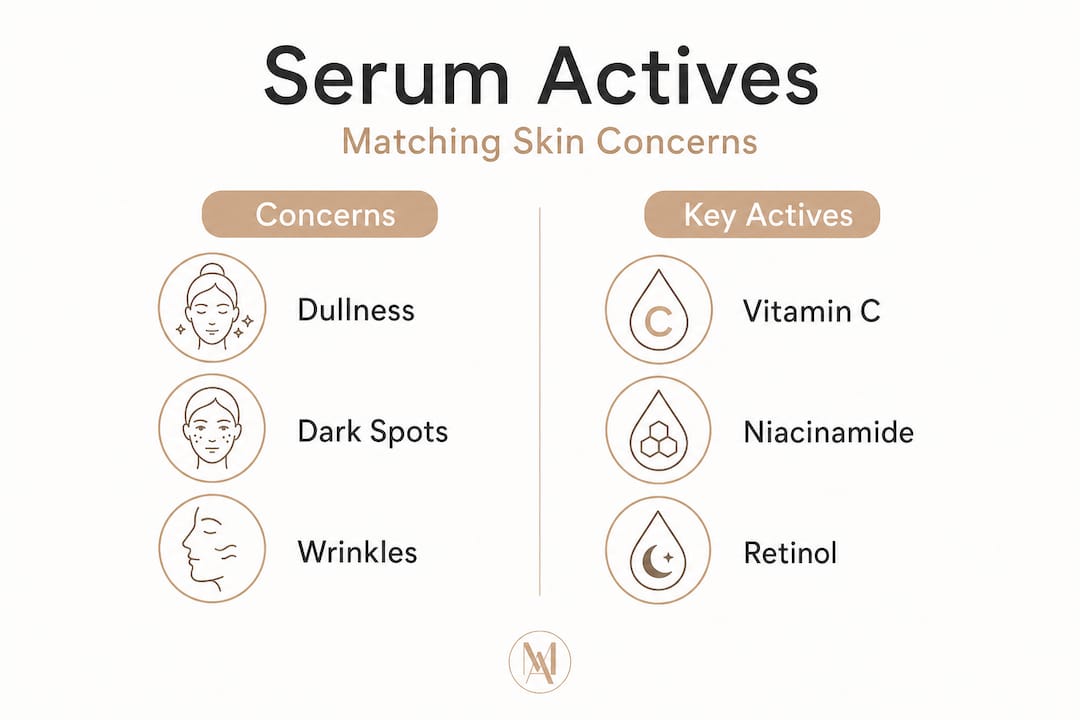
As skin type research consistently reinforces, aligning each active with the concern it is clinically designed to address is far more effective than layering multiple high-strength ingredients without a strategy.
How to build a serum routine step by step
- Assess your primary and secondary concerns. Be specific. “I want brighter skin” is less useful than “I have post-inflammatory hyperpigmentation on my cheeks and fine lines around my eyes.”
- Select your actives based on the concern table above. Begin with one or two maximum. This reduces the risk of irritation and makes it easier to assess what is working.
- Introduce each new active gradually. Start with every other evening for retinol; every morning for vitamin C. Allow two to three weeks before adding a second serum.
- Observe and adjust. Look for signs of sensitivity, purging (with retinol, this is normal and temporary), or dryness. Adjust frequency rather than abandoning the product entirely.
Pro Tip: Always patch test new serums on a small area behind your ear or inside your wrist before applying to your full face. This is especially important when introducing potent actives like retinol or salicylic acid for acne for the first time.
If you are addressing hyperpigmentation specifically, advanced serums for brightening that combine vitamin C with complementary brightening agents will outperform single-active formulas in most cases.
How clinical results set premium serums apart
The distinction between a premium, clinically validated serum and a cosmetically elegant but underpowered product is not always visible on the label. It lives in the formulation science, the concentration of actives, the stability of those actives in their delivery system, and the clinical evidence gathered through controlled studies.
What clinical studies actually demonstrate
The data here is compelling. Clinical trials on advanced serums show that a multimodal skin-tone correcting formula reduced Melasma Area and Severity Index (MASI) scores by 42 to 47% over twelve weeks. The same category of research found that a dedicated hydrating serum improved skin hydration by 72.5% and reduced dryness markers by an extraordinary 93.7% within just four weeks.
| Outcome measured | Improvement | Study duration |
|---|---|---|
| MASI score (pigmentation severity) | 42–47% reduction | 12 weeks |
| Skin hydration | +72.5% | 4 weeks |
| Dryness markers | 93.7% reduction | 4 weeks |
| Wrinkle depth | Measurable improvement | 8–12 weeks |
| TEWL (transepidermal water loss) | Significant reduction | 4–12 weeks |
These are not marketing claims. They are outcomes measured through validated clinical protocols, using instrumented assessments of the skin rather than subjective self-reporting alone.
“A 42% reduction in MASI score in twelve weeks is the kind of outcome that used to require prescription-only treatment. Today, it is achievable through consistently applied, well-formulated over-the-counter serums.”
The argument for investing in premium, clinically validated serums is straightforward. At therapeutic concentrations with stable delivery systems, these products achieve outcomes that lower-grade alternatives simply cannot replicate. For someone already spending on a considered skincare routine, using an underpowered serum is a false economy.
Tracking your own results is worth doing. Photographs taken in consistent lighting every four weeks provide an honest record of progress and help you decide whether to continue, increase frequency, or consult a clinician. For hydration and barrier-focused concerns, our hydrating serum results speak clearly through clinical backing.
Layering serums: The science and strategy for visible results
Knowing which serums to use is one challenge. Knowing how to apply them without undermining each other’s efficacy, or triggering unnecessary sensitivity, is equally important. Layering is a skill, and it follows a clear logic.
The correct order for serum application
- Cleanse thoroughly. A clean surface ensures unobstructed penetration.
- Apply toner or essence if these are part of your routine, allowing the skin to settle.
- Apply your first serum, typically the most water-based and lightest in texture. Vitamin C serums or hydrating hyaluronic acid formulas come first.
- Wait 30 to 60 seconds before applying a second serum. This prevents dilution and allows initial absorption.
- Apply your second serum (if using one) at a heavier or more emollient texture.
- Moisturise to seal in actives and maintain barrier integrity.
- Apply SPF 50 as the final morning step, non-negotiably.
As layering guidance establishes, moving from the thinnest to thickest consistency is not arbitrary. Heavier formulas applied first create a physical barrier that prevents lighter serums from reaching the skin effectively.
Key points to apply consistently:
- Water-based serums always before oil-based. Oils seal the skin surface; applying them first blocks water-soluble actives.
- Limit your routine to two or three serums maximum. More does not mean better. It frequently means irritation, interaction, or simply wasted product.
- Watch for signs of overuse: persistent redness, flaking, tightness, or a feeling of rawness indicate that the skin barrier is compromised. Step back to basics, restore barrier function, and reintroduce actives gradually.
- Do not mix vitamin C and niacinamide at high concentrations simultaneously. While some formulas manage this well, applying them separately in AM and PM routines removes the risk of interference.
- Retinol and AHAs or BHAs should not be layered on the same evening unless you have confirmed skin tolerance over a significant period.
Pro Tip: Read our detailed guide on layering serums effectively for a full breakdown of compatible combinations and timing strategies. Pair this with a broad-spectrum SPF50 finishing step every single morning to protect the investment you are making in your serums.
What most serum guides get wrong: The pitfalls of overcomplication
Here is what we genuinely believe, and it runs counter to much of what is published in the beauty space: the majority of advanced serum routines fail not because the products are wrong, but because there are too many of them.
We see this pattern regularly. A motivated skincare enthusiast reads widely, identifies multiple concerns, selects a serum for each, and stacks them into a six-step evening routine. Within three weeks, the skin is sensitised, and the person cannot identify which product caused the reaction. Everything gets shelved. Progress resets to zero.
Clinical data makes the case plainly. Evidence consistently shows that meaningful, measurable improvements occur at four to twelve weeks of consistent, daily application. The operative word is consistent. A routine you can sustain every single day, using two or three well-chosen products, will always outperform an elaborate but irregular protocol. The skin rewards repetition, not novelty.
This is where patience becomes the most sophisticated skincare tool available to you. The instinct to change products after three weeks of not seeing dramatic results is understandable, but it almost always delays the outcome you are working towards. Most actives require a minimum of eight weeks to demonstrate their full effect, particularly retinoids and tyrosinase-inhibiting brighteners.
Our honest advice: choose a maximum of three serums based on your primary and secondary concerns, follow the targeted layering approach consistently, protect with SPF daily, and allow twelve weeks before evaluating. That single discipline change, reducing complexity and increasing consistency, produces better outcomes than any product upgrade alone.
The most sophisticated routines we have seen are almost always the most restrained. Two serums, one SPF, and twelve weeks of patience. That is a clinical-grade approach.
Curated advanced serums for bespoke routines
At The M-ethod Skin, we curate our serum offering with clinical evidence at the forefront. Every product we recommend is selected because it delivers at a therapeutic level, not simply because it is beautifully packaged or heavily marketed. Whether your primary concern is stubborn hyperpigmentation, visible signs of ageing, compromised hydration, or persistent acne, we have a precisely chosen serum to match.
Our collections span targeted solutions for brightening, barrier restoration, firming, and hydration, including premium brands trusted by dermatologists and supported by peer-reviewed evidence. You can explore tranexamic acid options for pigmentation-focused routines, or work with our clinical team through a virtual consultation to receive a fully bespoke serum protocol. For those ready to shop directly, our collections are organised by concern, making it straightforward to identify the right starting point.
Frequently asked questions
Can I use multiple serums at once?
Yes, but limit to two or three serums per routine and always layer from water-based to oil-based, waiting 30 to 60 seconds between applications to allow absorption without interference.
How long does it take to see results from serums?
Most users see measurable changes after 4 to 12 weeks of consistent use, particularly with clinically validated formulas applied alongside daily SPF.
Should serums be used in the morning or evening?
Vitamin C is best in the morning for antioxidant protection, while retinol works most effectively at night; hydrating and barrier-supporting serums can be used at either time.
What does the evidence say about clinical serums actually working?
Studies show that well-formulated serums reduce pigmentation by 42 to 47% over twelve weeks and can improve skin hydration by more than 72% in just four weeks under controlled conditions.


