



Artikel: About 200 Lines: Clinician Guide to Double Chin HIFU
About 200 Lines: Clinician Guide to Double Chin HIFU
HIFU can improve the appearance of a double chin for people with mild to moderate submental laxity, tightening skin and softening fullness beneath the jaw without surgery. It works through focused ultrasound energy delivered by trained clinicians at defined tissue depths, and results build gradually over several weeks. Most people need one session to start, though some benefit from repeat treatments or a complementary filler to refine the jawline.
TL;DR:
- HIFU typically involves around 200 lines delivered across three depths: 80 at 6.0 mm for fat reduction, 60 at 4.5 mm for connective tissue tightening, and 60 at 3.0 mm for dermal firming, but numbers vary by individual and clinician judgment.
- Results develop gradually over 8 to 24 weeks, with more than 60% of patients reporting improved contour after a single session, though effectiveness depends on skin elasticity and fat volume.
- The safety profile is generally good, but practitioners must avoid direct energy within about 1 cm of the mandibular border to protect the marginal mandibular nerve from thermal injury.
- Combining HIFU with fillers can improve chin projection and neck contour, with most protocols allowing swelling to settle beforehand for optimal results.
- Proper clinician expertise, including layered, imaging-guided treatment and nerve-sparing techniques, is critical for safe and effective outcomes.
Table of Contents
- How HIFU works on the submental area
- The typical treatment protocol: lines, shots and the triple-layer regimen
- What to expect: results, timeline and realistic outcomes
- Safety, side effects and nerve protection
- Combining HIFU with other treatments
- Who benefits most, and when surgery makes more sense
- Choosing a clinician and preparing for your appointment
- The M-ethod Skin’s approach to submental HIFU
- What we think readers get wrong about double chin HIFU
- Booking a HIFU consultation with The M-ethod Skin
- Sources
- FAQ
How HIFU works on the submental area
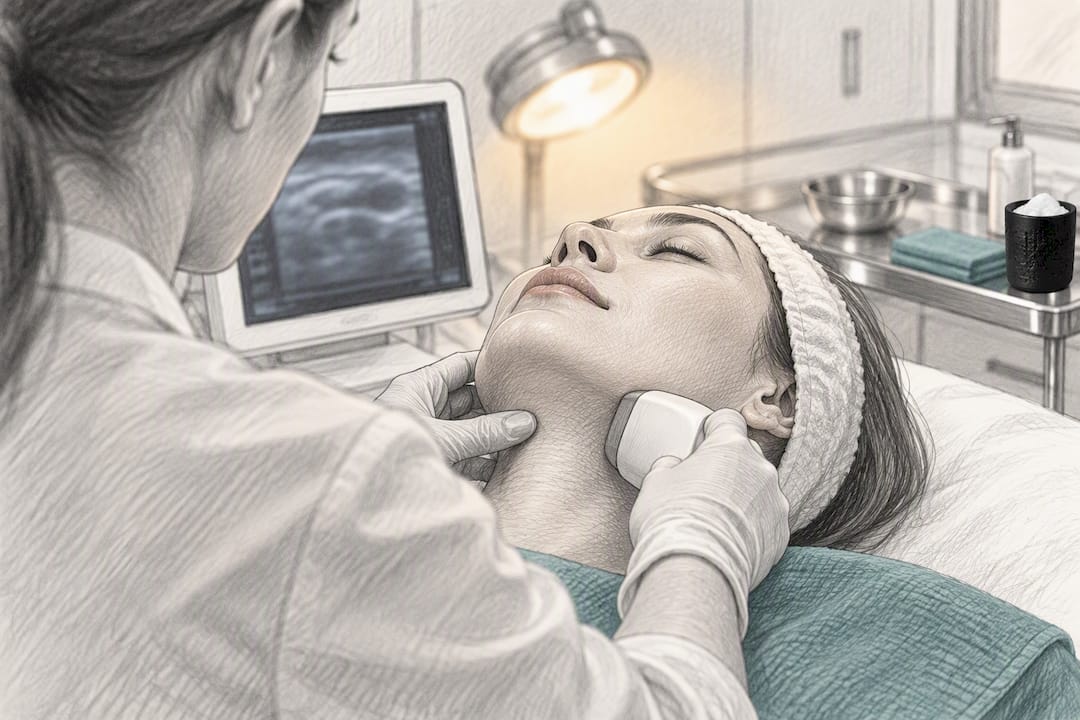
HIFU stands for high-intensity focused ultrasound, and the mechanism is more mechanical than most skincare treatments people are used to. A handheld device delivers focused ultrasound energy through the skin to create tiny points of thermal coagulation beneath the surface, without damaging the skin itself. This process, described in FDA device documentation for the Ulthera system, triggers a controlled injury response that prompts the body to remodel and tighten the treated tissue over time.
What makes submental HIFU different from a single-depth facial treatment is the layering. The chin and neck carry several tissue types stacked close together: skin, a thin subcutaneous fat layer, and connective tissue overlying muscle. Clinicians typically use more than one focal depth to address each layer in turn.
- A shallow depth (around 3.0 mm) targets the dermis, encouraging collagen contraction near the skin surface.
- A mid-depth (around 4.5 mm) works on subdermal connective tissue, tightening the structural layer beneath the skin.
- A deeper setting (around 6.0 mm) reaches subcutaneous fat, where energy delivery has been associated with measurable volume reduction alongside tightening.
This multi-depth approach exists because a double chin is rarely one problem. It is usually a mix of loose skin, weakened connective tissue, and a modest fat pocket, and treating only the surface would leave the deeper contributors untouched.
Imaging matters as much as depth. Devices such as Ulthera use a visualisation feature, marketed as DeepSEE, that lets the clinician see tissue layers to roughly 8 millimetres before firing, rather than treating blind. The Ulthera system holds FDA 510(k) clearance specifically for lifting lax submental and neck tissue, and its imaging capability is part of what supports safer, more accurate placement in an area with several sensitive structures nearby. Our own clinical approach to HIFU follows this layered, imaging-guided logic rather than a one-depth-fits-all method.

The typical treatment protocol: lines, shots and the triple-layer regimen
Readers researching double chin HIFU often want the actual numbers, not just the concept, so it helps to look at a documented clinical example rather than a vague description of “a few passes.”
A published 24-week case report on combination HIFU and hyaluronic acid for submental correction used a triple-layer protocol delivering roughly 200 lines in total, split across three transducer depths. The sequence looked like this:
- Approximately eighty lines delivered with a 6.0 mm transducer to reach subcutaneous fat.
- Approximately sixty lines delivered with a 4.5 mm transducer to tighten subdermal connective tissue.
- Approximately sixty lines delivered with a 3.0 mm transducer to firm the dermis closest to the surface.
Each line is a short pass, often around 25 millimetres long, with the device firing a series of pulses typically lasting 25 to 40 milliseconds along the way, as described in trial observations of triple-layer submental protocols. Spacing between lines and the energy setting per pulse both affect comfort and outcome, and an experienced operator adjusts these based on how the tissue responds during treatment rather than following a fixed script regardless of anatomy.
It is worth being clear that these figures are a clinical example from one documented protocol, not a universal prescription. Line counts, depths used and total session time vary by device, by how much submental tissue a person has, and by the clinician’s judgement on the day. Someone with a smaller chin area or thinner fat layer may need fewer lines; someone with more pronounced fullness may need a longer session or a follow-up.
Pro Tip: Ask your clinician which transducer depths they plan to use and roughly how many lines, not because you need to approve the plan, but because a clear, specific answer is one of the better signs you are dealing with someone who treats this area regularly.

What to expect: results, timeline and realistic outcomes
HIFU does not produce an overnight change, and setting the right timeline expectation matters more for this treatment than for almost any other non-surgical option.
- In the first days after treatment, any visible tightening is largely swelling settling and initial tissue contraction, not the main effect.
- Genuine collagen remodelling develops gradually, with most clinical protocols assessing results at follow-up windows between 8 and 24 weeks.
- Peak improvement in skin tightness and submental contour tends to appear towards the later end of that window as new collagen forms.
On how many people actually see a worthwhile change, clinical evaluations of triple-layer HIFU for submental fat report more than 60% of patients showing objective or patient-reported improvement in contour after a single session, with side effects that were mostly mild and temporary. That is a meaningful majority response, though it also means HIFU does not work equally well for everyone, and the studies behind that figure are limited by modest sample sizes and follow-up periods that rarely extend beyond several months.
A broader review of HIFU in aesthetic treatment reaches a similar conclusion: the technology is generally safe and effective for tightening and contouring the face and neck, but protocols and follow-up length vary enough across studies that results are not perfectly comparable from one trial to the next.
Durability depends on factors outside the treatment itself. Younger skin with better native elasticity tends to hold results longer. People with a larger underlying fat volume, ongoing weight fluctuation or naturally thinner, more crepey skin may see a smaller effect or need a repeat session sooner than someone with mild laxity and stable weight.
Safety, side effects and nerve protection
Submental HIFU has a generally reassuring safety profile in the clinical literature, though it sits close to structures that deserve respect from the person holding the device.
Most reactions are minor and pass on their own.
- Soreness or tenderness in the treated area for a few days.
- Mild swelling, sometimes more noticeable than expected given how little the skin visibly changes.
- Temporary numbness or tingling as nerve endings settle after thermal exposure.
- A dull jaw ache, which we cover in more detail in our piece on HIFU side effects, particularly after sessions that treat closer to the jawline.
The structure that matters most in this specific area is the marginal mandibular nerve, which runs along the lower border of the jaw and controls movement of the lower lip. Clinical guidance on submental HIFU recommends avoiding direct energy delivery within approximately 1.0 cm of the mandibular border to protect this nerve from thermal injury. This margin is a deliberate, anatomy-aware decision that experienced practitioners make when planning where lines will and will not be placed, and it is not always spelled out in consumer-facing marketing.
Documented series that follow this nerve-sparing margin report no cases of persistent nerve injury, though transient effects like a lopsided smile immediately after treatment, if they occur at all, should resolve within days rather than weeks.
Pro Tip: If you notice persistent facial weakness, one-sided drooping that does not improve after a few days, or worsening pain rather than gradual settling, contact your clinician promptly rather than waiting for a scheduled follow-up.
Combining HIFU with other treatments
HIFU alone tightens and firms, but it does not add volume or sharpen a chin’s projection, which is why some people benefit from pairing it with a filler.
- A 24-week case report combining HIFU with hyaluronic acid filler for submental correction found the combination improved both chin projection and the cervicomental angle, the visual line where the chin meets the neck, more than either treatment addressed in isolation.
- The clinical rationale is straightforward: HIFU tightens existing tissue, while filler can rebuild lost projection or definition that tightening alone cannot restore.
- Sensible sequencing matters. Most protocols allow initial swelling and inflammation from HIFU to settle before introducing filler, so the two effects can be assessed and blended without one masking the other.
- Combination is typically considered when someone has mixed concerns (some fat, some laxity, and reduced projection) rather than a single, discrete issue that HIFU alone is likely to resolve.
Our guide to non-surgical rejuvenation with HIFU covers how repeat sessions and complementary treatments fit into a longer-term plan, which is worth reading if you are weighing HIFU as a one-off versus part of an ongoing routine.
Who benefits most, and when surgery makes more sense
Not everyone with a double chin is a good HIFU candidate, and being honest about that upfront saves people time and money.
- The ideal candidate has mild to moderate submental laxity, a modest and fairly discrete fat pocket, and skin that still has reasonable elasticity, meaning it responds to pinching or movement rather than hanging loosely.
- People with a large volume of submental fat, pronounced skin excess, or significant laxity from ageing or major weight loss are typically better served by liposuction or a surgical neck lift, where a clinician can remove tissue directly rather than relying on gradual remodelling.
- Someone weighing the choice should factor in that HIFU asks for more patience (weeks to see full results, possibly more than one session) in exchange for no incisions, no general anaesthetic and far less downtime than surgery.
The trade-off is really about scale and urgency. If the change needed is modest and time is not a pressing factor, HIFU is a reasonable non-surgical route to try first. If the fat volume is substantial or the skin excess is significant, no amount of ultrasound energy will match what a surgical procedure can achieve in a single session.
Choosing a clinician and preparing for your appointment
The quality of a HIFU result depends heavily on who is holding the device, so a proper vetting process is worth the extra half hour it takes.
- Look for a practitioner with a recognised medical or aesthetic qualification and documented training on the specific device they use, not just general experience with “ultrasound treatments.”
- Ask to see clinic photography or before-and-after examples relevant to the submental area specifically, since facial and neck results do not always transfer.
- A clinician who can talk you through expected line counts, probe depths and whether their device has imaging capability (as covered in our explainer on HIFU treatment standards) is generally more reassuring than one who cannot.
- At consultation, ask about expected outcomes for your specific anatomy, how pain is managed during the session, the follow-up schedule, and what happens if a rare complication arises.
On the day, avoid heavy skincare actives, excessive sun exposure or recent injectables in the area unless your clinician has advised otherwise. Mild redness and swelling afterwards typically settle within a day or two, and most people resume normal activities immediately, though clinicians often suggest gentle cooling and avoiding intense heat (saunas, very hot showers) for the first 24 to 48 hours.
Pro Tip: Bring a specific question to your consultation, such as “how many lines would you expect to use on me,” rather than a general one. The quality of the answer tells you a lot about how personalised your treatment plan will actually be.
The M-ethod Skin’s approach to submental HIFU
The clinic offers prescription-strength, dermatologist-recommended skincare products and treatments alongside virtual consultations with experienced clinicians. Our approach to submental concerns sits within a broader remit that includes advanced, evidence-informed technologies.
- We offer FDA-approved SkinPen microneedling, polynucleotides, Profhilo and non-surgical HIFU face lift treatments as part of a considered, results-focused treatment menu.
- Our services extend across aging, pigmentation, acne, redness and sensitive skin concerns, drawing on scientifically backed products alongside in-clinic procedures.
- We deliver curated aesthetic treatments, including HIFU, across our clinics in London and Athens, Greece, with educational content that sets realistic expectations, including side effects such as jaw ache after HIFU.
- HIFU assessments follow the layered, imaging-guided principles set out above rather than a generic single-depth pass.
What we think readers get wrong about double chin HIFU
The biggest misconception is treating HIFU like a switch: one session, dramatic change, done. The evidence does not support that framing, and clinics that imply it are setting people up for disappointment.
The other thing conventional advice underplays is nerve safety. Most content focuses on results and skips the anatomy, although the marginal mandibular nerve margin is arguably the single most important technical detail in this whole procedure. If a clinician cannot explain how they protect it, that matters more than any before-and-after photograph.
Our advice: prioritise the practitioner’s technical fluency over the marketing. Ask about depths, line counts and nerve margins before asking about price. The people who can answer specifically are usually the ones getting the layering right.
— Jess
Booking a HIFU consultation with The M-ethod Skin
If you are weighing up whether double chin HIFU is right for you, the sensible next step is a proper assessment rather than guesswork from photographs online. The service offers both routes: a remote starting point and a full in-clinic pathway.
- An online skin consultation with Dr Mandy lets you discuss your submental concerns, ask about suitability and get an initial view before committing to travel or an in-clinic booking.
- Our clinic services collection, including HIFU, Profhilo, microneedling and polynucleotides, covers what an in-person assessment typically includes: examining your specific anatomy, proposing a protocol, discussing cost, and outlining aftercare.
- We will not promise results HIFU cannot deliver. If your case suggests surgery or a combination approach would serve you better, we will say so during consultation rather than after treatment.
Whether you start online or book directly, the goal of that first conversation is clarity: what HIFU can realistically do for your chin, and whether it is the right fit before you spend a penny on treatment.
Sources
The claims in this article draw on a small set of primary and peer-reviewed sources. The 24-week case report on combination HIFU and hyaluronic acid supplies the triple-layer protocol and nerve-sparing guidance. Ulthera’s FDA 510(k) documentation confirms the device’s clearance and imaging capability. A clinical evaluation of HIFU for submental fat provides the response-rate figures, and a broader review of HIFU in aesthetic treatment offers wider context on effectiveness and study limitations.
This article is general information, not a substitute for advice from a qualified doctor. Consult a qualified healthcare professional about your own circumstances before acting on anything here.
- Double Chin Correction with Combination of High Intensity Focused Ultrasound and Hyaluronic Acid: A 24-Week Case Report
- Ulthera System — FDA 510(k) documentation (K233996)
- Efficacy and Safety of High-Intensity Focused Ultrasound (HIFU) on Reduction of Unwanted Submental Fat in Asian Patients
FAQ
How much does HIFU treatment for a double chin cost?
Pricing is not consistently published as a single national figure and varies by clinic, device and the number of sessions required. At The M-ethod Skin, HIFU pricing is available on request following an assessment, since the protocol needed affects the cost.
What is the downside of HIFU?
The main downsides are transient soreness, swelling, numbness or jaw ache that typically resolve within days, and results that build gradually rather than appearing immediately. There is also a small risk of temporary nerve-related effects near the jaw, which clinical protocols manage by avoiding direct energy delivery within about 1.0 cm of the mandibular border.
How many HIFU shots are needed for a double chin?
A documented clinical protocol used around 200 lines across three depths for the submental area, roughly 80 lines at 6.0 mm, 60 at 4.5 mm and 60 at 3.0 mm. Exact numbers vary by anatomy, device and clinician judgement, so this is an illustrative example rather than a fixed rule.
Does HIFU give you jowls?
HIFU is designed to tighten and lift lax tissue rather than create new sagging, and it is FDA cleared specifically for lifting lax submental and neck tissue. Some people experience temporary swelling that can briefly alter the jawline’s appearance, but this is not the same as the treatment causing lasting jowling.