

Artikel: Defining virtual skin consultations: your complete guide

Defining virtual skin consultations: your complete guide
TL;DR:
- Virtual skin consultations vary between store-and-forward and live video models, each suited for different skin concerns. Image quality and comprehensive patient history are crucial for accurate remote diagnosis and effective treatment planning. While virtual consultations are effective for many conditions, in-person visits remain essential for complex or rapidly changing skin issues.
Not every virtual skin consultation is the same, and that distinction matters more than most people realise. Defining virtual skin consultations accurately means understanding that they span two fundamentally different models, produce outcomes that depend heavily on image quality, and serve purposes ranging from triage to full personalised care. If you have ever wondered whether a quick photo sent to a clinician is really a “consultation,” or whether a video call with a skincare professional will replace your in-person appointment, this guide will give you precise, evidence-backed answers.
Table of Contents
- Key takeaways
- What are virtual skin consultations?
- Why image quality shapes everything
- Outcomes and limitations you should know
- How virtual consultations fit into your skincare plan
- My perspective: what clients consistently overlook
- Take the next step with Them-ethod
- FAQ
Key takeaways
| Point | Details |
|---|---|
| Two distinct consultation models | Store-and-forward and live video consultations serve different clinical purposes and timelines. |
| Image quality defines outcomes | Diagnostic accuracy in virtual settings depends more on photo quality than on the clinical conversation. |
| Moderate diagnostic accuracy | Research shows a mean kappa of 0.57, meaning outcomes are good but not infallible without ideal conditions. |
| Preparation is non-negotiable | Submitting a complete image and history packet dramatically reduces the chance of referral or repeat sessions. |
| Accessibility is a genuine advantage | Virtual formats cut specialist wait times significantly, making expert skincare advice far more reachable. |
What are virtual skin consultations?
The term “virtual skin consultation” is widely used, but the clinical world uses a more specific vocabulary: teledermatology, a subspecialty of telehealth dedicated to the remote assessment, diagnosis, and management of skin conditions. Understanding this distinction matters because teledermatology carries defined clinical standards, whereas the broader phrase can refer to anything from a branded quiz on a skincare website to a fully mediated appointment with a board-certified dermatologist.
There are two main models you need to know.
Store-and-forward (asynchronous): You upload photographs, your medical history, and details of your current skincare routine. A clinician reviews everything at a later point and responds with an assessment and recommendations. Store-and-forward consultations typically have a turnaround time of 24 to 72 hours. This model works well for stable skin concerns such as acne, pigmentation, or suspected contact dermatitis, where a real-time exchange is not clinically necessary.
Live video (synchronous): You and the clinician connect in real time via a secure video platform. This mirrors the structure of a traditional appointment and allows for direct dialogue, follow-up questions, and immediate clarification. Virtual consultations typically last 30 to 45 minutes and conclude with a personalised treatment plan and follow-up guidance.
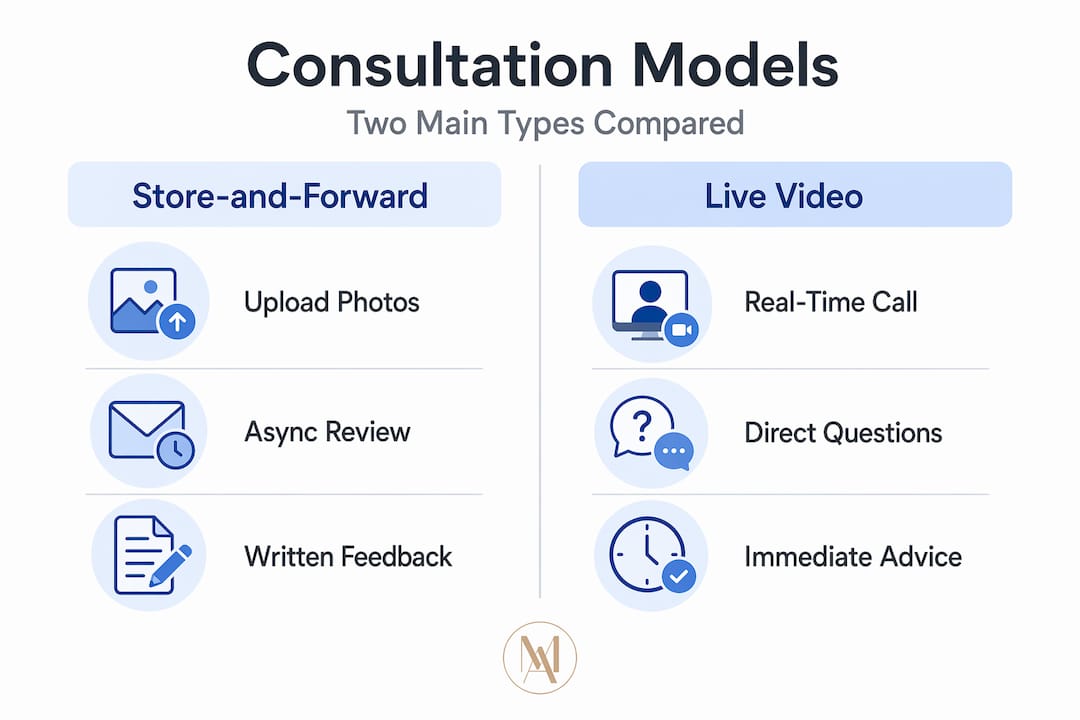
| Model | Format | Turnaround | Best suited for |
|---|---|---|---|
| Store-and-forward | Photos and history uploaded | 24 to 72 hours | Stable, non-urgent skin concerns |
| Live video | Real-time video call | Immediate | Complex cases, direct dialogue needs |
Both models are legitimate clinical services, but they are not interchangeable. Choosing the right one depends on the urgency of your concern, the complexity of your skin history, and the level of interaction you need.
Pro Tip: When exploring online skin consultations for the first time, check whether the service specifies which model it uses. A platform that does not clarify this is worth questioning before you book.
Why image quality shapes everything
Here is something most people do not expect: in teledermatology, diagnostic power relies more on image quality than on what you say during the consultation. That is not an overstatement. It is a finding that has reshaped how clinicians think about remote skincare assessments.
What qualifies as a “dermatology-grade” photograph? The standard involves three non-negotiable factors:
- Lighting: Natural daylight or a neutral white light source, positioned to avoid harsh shadows or overexposed patches. Flash photography flattens the skin texture that clinicians rely on for assessment.
- Angle and distance: A close-up shot at 90 degrees to the skin surface, complemented by a wider contextual image showing the affected area in relation to surrounding tissue.
- Resolution: Modern smartphone cameras are generally sufficient, but compressed or filtered images are not. Never apply beauty filters, colour corrections, or automatic enhancements before submitting.
Poor-quality images do not simply produce less accurate results. They trigger a specific outcome: the clinician requests a repeat submission or refers you for an in-person evaluation. This extends your wait time and defeats the purpose of choosing a virtual pathway.
Beyond photography, the completeness of your submitted history matters equally. Clinicians who receive a well-structured “image plus history” packet, covering current products, known allergies, previous treatments, diet and hormonal factors, can deliver far more precise recommendations. Incomplete submissions frequently lead to follow-up requests or escalation to in-person care.
It is also worth knowing that clinical photographs used in teledermatology are classified as patient health information, requiring proper consent and secure data handling. Any reputable service should confirm how your images are stored, who accesses them, and how long they are retained.
Pro Tip: Take your photos in front of a window during daylight hours, with no make-up on and your hair pulled back. Take at least three shots: a close-up of the specific concern, a wider angle of the face or body area, and one in natural shadow for contrast.
Outcomes and limitations you should know
Managing expectations is part of defining what virtual skin consultations can and cannot deliver. Research shows teledermatology achieves a mean diagnostic accuracy of kappa 0.57, classified as “moderate” agreement with in-person diagnosis. For the majority of common skin concerns, including acne, rosacea, eczema, and mild pigmentation disorders, this level of accuracy is clinically meaningful and actionable.
The cost picture is encouraging. The same review found average savings of US$81.31 per patient compared with traditional in-person pathways. Reduced travel, no clinic overhead, and faster triage all contribute to this. Around 26.57% of patients in this data set were willing to replace in-person visits entirely with virtual alternatives, which tells you something useful: for most people, virtual consultations work best as a complementary or entry-level pathway, not necessarily a total replacement.
One of the most practically significant findings relates to who is conducting your virtual consultation. Research published in 2026 found that e-consults handled by advanced practice providers had a 26.6% conversion rate to in-person visits, compared with 9.1% for board-certified dermatologists. This gap reflects differences in clinical experience, specialisation, and the ability to resolve complex cases remotely.
| Provider type | In-person conversion rate | Implication |
|---|---|---|
| Board-certified dermatologist | 9.1% | Higher likelihood of complete remote resolution |
| Advanced practice provider | 26.6% | Greater rate of referral to in-person care |
What virtual consultations cannot do is also clearly defined. They cannot perform a physical examination, conduct live dermoscopy, or palpate a lesion. For rapidly changing skin concerns, suspected skin cancer, or conditions requiring hands-on assessment, an in-person visit remains the gold standard. The most effective use of teledermatology is knowing when it is sufficient and when it is a stepping stone toward further care.
How virtual consultations fit into your skincare plan
A well-structured virtual skin consultation follows a logical sequence, and knowing this sequence helps you show up prepared and get the most from the experience. For a detailed walkthrough of what each stage involves, the process typically moves through these steps:
- Pre-consultation intake: You complete a structured questionnaire covering your skin type, primary concerns, current product routine, medical history, hormonal factors, and lifestyle habits such as sun exposure and diet.
- Image submission or live review: Depending on the model, you either upload photographs beforehand or share your screen or camera during the live call.
- Clinician assessment: The clinician evaluates your skin profile, identifies patterns, and considers potential triggers or contributing factors for your concern.
- Goal alignment: You discuss what you want to achieve, whether that is clearer skin, reduced pigmentation, better hydration, or managing a chronic condition like rosacea or eczema.
- Treatment and routine recommendations: The clinician recommends specific products, ingredients, or treatments, sequenced appropriately for your skin type and tolerance.
- Follow-up plan: You receive written documentation of your recommendations and, in most cases, a scheduled check-in to monitor progress.
The accessibility advantages here are substantial. Teledermatology reduced wait times in the Veterans Health Administration system from 51 days to 8 days through remote triage alone. For anyone who lives outside a major city, has a demanding schedule, or simply cannot access specialist dermatology quickly, remote skincare advice genuinely transforms what is available to them.
For clients who want to prepare thoroughly before their session, gathering product packaging, photographing any current skin reactions, and noting when symptoms first appeared all contribute to a more productive appointment.
My perspective: what clients consistently overlook
From my experience working within virtual skincare, the single most underestimated factor is not technology or clinical expertise. It is client preparation.
I have seen consultations that should have resolved cleanly in one session extend to two or three exchanges because the original photo submission was taken under artificial orange lighting with a slight blur. The clinician was not able to assess the melanin distribution accurately, and the client ended up frustrated by a process they felt was inefficient. The problem had nothing to do with the service itself.
What I have also learnt is that people often conflate all virtual consultations as equivalent, regardless of whether they are speaking with a trained aesthetic clinician or receiving an AI-generated recommendation from a skincare brand. These are not the same thing, and treating them as interchangeable leads to disappointing results. Knowing the model, knowing the provider’s qualifications, and knowing what your images need to show before you click “submit” changes everything.
The other misconception I encounter regularly is that a virtual consultation that results in an in-person referral has somehow failed. It has not. For some presentations, triage is the correct clinical response. A well-conducted remote assessment that correctly identifies the need for a physical examination is doing exactly what it should. That is not a shortcoming. That is the system working properly.
— Jess
Take the next step with Them-ethod
At Them-ethod, we offer personalised virtual skin consultations with experienced clinicians who work with medical-grade and prescription-strength skincare. Whether you are managing acne, pigmentation, premature ageing, or sensitivity, your consultation leads directly into a curated product plan built around your skin’s specific needs. Clients often find that a single session clarifies years of trial-and-error routines. Following your assessment, our clinicians may recommend targeted solutions such as the PCA Clearskin serum for acne-prone skin, the NEOSTRATA collection for visible skin renewal, or PCA Retinol Night 0.5% for anti-ageing support. Explore our virtual consultation services and take the clearest step forward for your skin.
FAQ
What exactly is a virtual skin consultation?
A virtual skin consultation, or teledermatology appointment, is a structured remote session where a clinician reviews your skin concerns, history, and current routine via video, photographs, or chat, then provides a personalised skincare or treatment plan.
How accurate are virtual skin consultations compared to in-person visits?
Research shows a mean diagnostic accuracy of kappa 0.57 for teledermatology, indicating moderate concordance with in-person diagnosis. Accuracy improves significantly when high-quality images and complete skin histories are submitted.
What is the difference between store-and-forward and live video consultations?
Store-and-forward consultations involve uploading photos and history for asynchronous review, with results returned within 24 to 72 hours. Live video consultations happen in real time and typically last 30 to 45 minutes.
Will a virtual consultation always resolve my skin concern remotely?
Not necessarily. Board-certified dermatologists resolve around 90% of virtual cases remotely, while advanced practice providers refer approximately 26.6% of patients for in-person follow-up, depending on the complexity of the concern.
How should I prepare photos for a virtual skin consultation?
Use natural daylight, no make-up, and no filters. Capture a close-up of the specific concern, a wider contextual image, and at least one shot in varying light. Clear, uncompressed images are the single most important factor in getting an accurate remote assessment.