



Artikel: Advanced skincare protocols for real, visible results

Advanced skincare protocols for real, visible results
TL;DR:
- Advanced skincare focuses on personalized, evidence-based protocols with targeted active ingredients.
- Morning routines prioritize antioxidants and SPF, while evening routines emphasize repair and regeneration.
- Technology like AI, genomics, and clinical devices enhances precision and efficacy of skincare routines.
Advanced skincare is not about owning the most products or following the most elaborate routine. The real distinction lies in precision, evidence, and personalisation. Many people assume that complexity equals effectiveness, but research consistently shows that a well-chosen, targeted protocol outperforms an overcrowded shelf every time. In this guide, we break down what separates advanced skincare protocols from standard daily routines, how to structure a science-driven regimen, and how emerging technology is raising the bar for bespoke skin health. Whether you are managing pigmentation, post-procedure recovery, or early signs of ageing, the principles here apply directly to you.
Table of Contents
- What defines an advanced skincare protocol
- Core elements of advanced skincare routines
- Personalisation for specific concerns and edge cases
- The technology edge: Devices and data-driven precision
- Why the best advanced skincare is smarter, not just stronger
- Take your skincare routine further with expert solutions
- Frequently asked questions
Key Takeaways
| Point | Details |
|---|---|
| Science-backed tailoring | Advanced protocols personalise routines by skin type, concern, and evidence—not trends. |
| Morning protects, night repairs | Segregating routines improves results, emphasising antioxidants and SPF by day, retinoids and barrier support by night. |
| Smart minimalism wins | Consistent, focused routines using 3-5 steps outperform product overload for most users. |
| Technology elevates outcomes | AI, genomics, and devices enable longer-lasting, highly targeted skincare improvements. |
| Professional guidance matters | Tailoring and adjusting advanced protocols safely is best done with expert input, especially for edge cases. |
What defines an advanced skincare protocol
Now that we have set the context of advanced skincare, it is crucial to define exactly what separates an advanced protocol from a standard daily routine. Most people begin their skincare journey with the essentials: a gentle cleanser, a basic moisturiser, and perhaps a sunscreen. These steps are necessary, but they are not sufficient for those seeking measurable, lasting results. An advanced protocol adds scientific intent to every step.
At its core, an advanced skincare protocol is built on three pillars: personalisation, evidence-based ingredient selection, and ongoing adaptation. It accounts for your skin type, your geographic environment (UV index, humidity, pollution levels), your hormonal profile, and the specific concerns you are addressing. It is not a generic routine copied from a magazine feature. It is a living framework that evolves as your skin responds and changes.
The goals of an advanced protocol differ markedly from those of a basic routine. Where a basic routine aims to cleanse and hydrate, an advanced protocol pursues four distinct objectives:
- Prevention: Protecting against UV, oxidative stress, and environmental aggressors before they cause structural damage
- Repair: Supporting cellular turnover, collagen synthesis, and barrier restoration overnight
- Rejuvenation: Targeting visible concerns such as fine lines, hyperpigmentation, and uneven texture with clinically validated actives
- Protection: Reinforcing the skin’s natural defence mechanisms for long-term resilience
One of the most important distinctions between basic and advanced routines is the intentional separation of morning and evening functions. UV exposure causes up to 90% of visible ageing, which means your morning routine must centre on antioxidant layering and broad-spectrum SPF. Your evening routine, by contrast, becomes the window for repair, using retinoids, peptides, and barrier-supportive ingredients while the skin undergoes its natural regenerative cycle.
“Advanced skincare is not about doing more. It is about doing the right things at the right time, with the right ingredients for your specific biology.”
| Feature | Basic routine | Advanced protocol |
|---|---|---|
| Step count | 2 to 4 steps | 4 to 7 targeted steps |
| Ingredient focus | Cleanse, hydrate | Actives, antioxidants, SPF, repair |
| Personalisation | Generic | Skin type, concern, environment-specific |
| Professional input | Rarely included | Core component |
| Adaptation | Static | Seasonal and response-based |
Understanding regimen building basics gives you the structural foundation to layer intelligently, rather than applying products in a random order and hoping for the best.
Core elements of advanced skincare routines
With these principles clarified, let us look at what actually makes up a science-driven advanced skincare routine. The morning and evening routines serve genuinely different biological functions, and treating them as interchangeable is one of the most common mistakes we see.
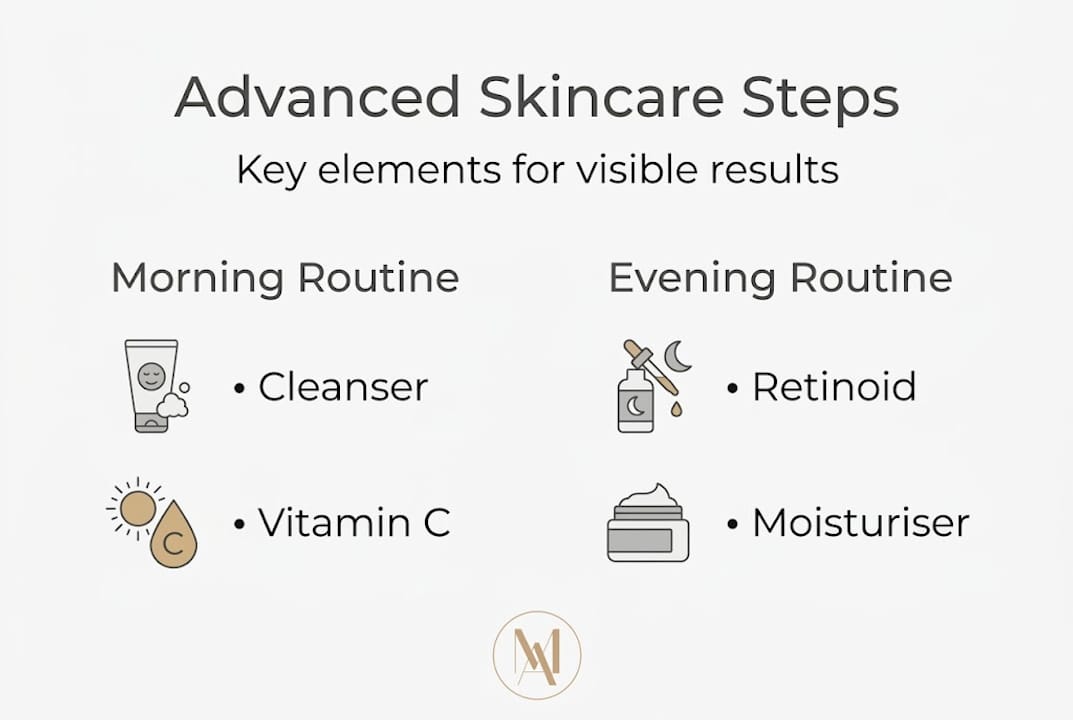
Your morning routine should focus on fortification. Begin with a gentle, pH-balanced cleanser that removes overnight sebum without stripping the barrier. Follow with a well-formulated vitamin C serum (L-ascorbic acid at 10 to 20% concentration), which neutralises free radicals, brightens the complexion, and amplifies the protective effect of your SPF. Layer a lightweight moisturiser or barrier serum before applying a broad-spectrum SPF 30 to 50 as your final step. That is it. Clean, targeted, and effective.
Your evening routine is where transformation happens. After cleansing, your skin is primed for actives with higher penetration potential and ingredients that may increase UV sensitivity. This is when retinoids work best at night, accelerating cell turnover and stimulating collagen production without sun interference. Finish with a ceramide-rich moisturiser to seal in actives and support barrier integrity overnight.

Research supports keeping things focused. Minimalist routines of three to five steps consistently outperform overloaded ones, because layering too many actives disrupts the skin’s pH balance, reduces individual ingredient efficacy, and increases sensitisation risk. Waiting 60 to 90 seconds between active layers ensures each ingredient is absorbed at the correct pH before the next is applied.
A structured advanced routine might look like this:
- Gentle pH-balanced cleanser (morning and evening)
- Antioxidant serum, vitamin C or niacinamide (morning)
- Targeted treatment serum, retinoid or peptide complex (evening)
- Lightweight hydrator or barrier serum
- SPF 30 to 50 (morning only)
- Ceramide or lipid-rich moisturiser (evening)
| Ingredient | Function | Best time to use |
|---|---|---|
| Vitamin C (L-ascorbic acid) | Antioxidant, brightening, SPF synergy | Morning |
| Retinol or retinaldehyde | Cell turnover, collagen stimulation | Evening |
| Niacinamide | Barrier support, pore minimising | AM or PM |
| Ceramides | Barrier repair, moisture retention | Evening |
| Broad-spectrum SPF | UV protection, anti-ageing prevention | Morning |
| Peptides | Collagen signalling, firmness | Evening |
Pro Tip: If you are introducing a retinoid for the first time, begin with two nights per week and increase gradually. This approach, known as retinoid buffering, significantly reduces the risk of irritation and purging while your skin builds tolerance over four to six weeks.
Personalisation for specific concerns and edge cases
Understanding general routines is only part of the story. True advancement comes with targeted personalisation, especially in complex skin situations. Not every protocol template translates cleanly to sensitive skin, skin undergoing medical treatment, or skin recovering from an aesthetic procedure. These edge cases demand a more considered approach.
Sensitive and reactive skin requires the removal of high-concentration acids and fragrance-containing formulations as a first step. Instead, the focus shifts to barrier-building ingredients such as panthenol, centella asiatica, beta-glucan, and low-percentage niacinamide. Retinoids, if used at all, should be introduced in encapsulated or bakuchiol-based formats to reduce direct irritation.
Post-procedure skin, whether after microneedling, laser resurfacing, or chemical peels, follows an entirely different protocol. Active ingredients are temporarily paused, and the focus becomes hydration, barrier repair, and protection. Hyaluronic acid, centella asiatica, zinc-based SPF, and gentle ceramide creams become the foundation. Reintroducing actives too soon after a procedure is one of the most frequent causes of prolonged redness and barrier disruption.
GLP-1 medication users (those using weight management injections such as semaglutide) represent a growing group who benefit from specific protocol adjustments. Rapid body composition changes can affect skin volume, elasticity, and hydration. Volume-restoring peptides and ceramides are particularly suitable for this group, and emerging evidence points to polynucleotide and hyaluronic acid combinations as effective adjuncts to topical care.
The same source highlights how acne scarring responds well to structured protocols. PN-HPT (polynucleotide high-performance technology) combined with hyaluronic acid improved acne scars by 46.8% on average at six months, a result that underlines how professional-grade ingredients and in-clinic interventions complement topical routines.
- Avoid physical exfoliants, alcohol-based toners, and strong AHAs on sensitive or post-procedure skin
- Introduce one new active at a time, with at least two weeks between additions
- Use patch testing as standard practice, not an afterthought
- Consult a clinician before combining prescription actives with OTC products, particularly when using oral medications such as isotretinoin or topical corticosteroids
For those managing more complex situations, retinol options range from encapsulated formats with delayed release to bakuchiol-based alternatives, giving professionals and clients alike the flexibility to match the right actives to the right skin at the right time.
Pro Tip: Always inform your clinician about any prescription medications you are taking. Certain topical and oral medications alter the skin’s barrier function, sensitivity thresholds, and healing speed, all of which directly affect which actives are appropriate and in what concentrations.
The technology edge: Devices and data-driven precision
Beyond topical actives, today’s advanced skincare protocols leverage innovative technologies to unlock bespoke solutions. The integration of devices, artificial intelligence, and genomic profiling is shifting skincare from intuition-based to data-driven, and the results are measurable.
AI and genomics now enable protocols tailored to an individual’s gene variations, identifying predispositions to collagen degradation, UV sensitivity, and inflammatory responses. This means that rather than trialling products through trial and error, a genomic skin profile can indicate with greater precision which ingredient classes will produce the strongest response for your specific biology.
Device-assisted skincare is equally transformative. The most clinically validated options include:
- LED phototherapy: Red light (630 to 660nm) stimulates fibroblast activity and collagen synthesis; near-infrared (810nm) supports deeper tissue repair and reduces inflammation
- Microcurrent devices: Deliver low-level electrical currents that tone facial muscles and improve lymphatic drainage, producing lifted, sculpted results over consistent use
- Microneedling (SkinPen): Creates controlled micro-injuries that trigger the skin’s natural repair cascade, increasing collagen and elastin production; microneedling protocols have advanced significantly with the addition of exosome serums applied immediately post-treatment for enhanced regeneration
- HIFU (High-Intensity Focused Ultrasound): Targets the SMAS layer beneath the skin for non-surgical lifting and tissue tightening
- Exosome therapies: Bioactive extracellular vesicles that signal cellular repair and reduce post-procedure inflammation when applied in conjunction with microneedling
The results from combined approaches are remarkable. An exosome and microneedling protocol demonstrated 41% sustained pore size reduction maintained for 21 months, a figure that no topical product alone could replicate over the same timeframe.
“Technology does not replace a well-formulated skincare routine. It amplifies it, creating a synergy between what you apply at home and what is achieved in clinic.”
Understanding how advanced beauty technology integrates with your daily protocol helps you make strategic decisions about when to invest in devices or clinical treatments, rather than viewing them as optional extras. For those seeking the highest level of precision and personalisation, the combination of genomic profiling, AI recommendations, and device-assisted treatments represents the current frontier of what advanced skincare can achieve.
Why the best advanced skincare is smarter, not just stronger
With innovation driving what is possible, it is worth stepping back to examine what truly creates transformation. We see it regularly: clients arriving with ten, twelve, sometimes fifteen products, convinced that more is working harder for their skin. It is rarely the case.
The uncomfortable truth is that the skincare industry profits from complexity. More products means more purchases, more confusion, and ironically, less consistent results. The skin is not a passive recipient of every ingredient you layer on it. It responds, adapts, and sometimes pushes back. Overloading it with actives increases barrier disruption, inflammation, and sensitisation, the very problems most people are trying to solve.
What genuinely drives results is a smaller number of high-impact, evidence-backed interventions applied consistently over time. Retinoids used correctly for twelve months outperform most aesthetic treatments applied once. Daily SPF, sustained for years, is the single most effective anti-ageing tool available. Personalisation matters far more than prestige packaging.
We also believe that skincare is not static. Your skin in winter is biologically different from your skin in summer. Your skin at 35 has different needs than at 45. The most advanced thing you can do is treat your protocol as a dynamic, evolving strategy rather than a fixed checklist. Technology and routine personalisation now make it genuinely possible to adapt with precision, guided by data and clinical expertise. That is the standard worth holding your routine to.
Take your skincare routine further with expert solutions
If this guide has prompted you to reconsider your current routine, the next step is accessing products and expertise that match your skin’s actual needs. At The M-ethod Skin, we offer prescription-strength and dermatologist-recommended formulations alongside virtual skin consultations with top clinicians. Whether you are addressing acne scarring, early ageing, post-procedure recovery, or sensitive skin concerns, our curated range spans clinically validated brands including Obagi, Medik8, and PCA Skin. We also offer in-clinic treatments in London and Athens, including SkinPen microneedling, polynucleotide injectables, Profhilo, and HIFU. Explore our full offering and take the first step towards a protocol that is built specifically for you.
Frequently asked questions
What is the difference between a basic and advanced skincare routine?
Advanced routines use evidence-based actives and personalised steps, incorporating professional technologies where appropriate, while basic routines focus primarily on cleansing and moisturising without targeted intervention.
How often should you change advanced skincare protocols?
Protocols should be reviewed seasonally or whenever your skin’s condition shifts significantly, ideally with professional guidance to ensure adjustments are evidence-based rather than reactive.
Is it safe to combine multiple actives like retinoids and acids?
With correct layering, appropriate waiting times, and personalisation to your barrier tolerance, combining actives is safe. Waiting between layers enhances both tolerance and efficacy, reducing the risk of sensitisation.
Are AI-based or genomics skincare protocols effective?
Emerging evidence is encouraging. AI and genomics inform protocol precision by identifying individual predispositions, though individual response still varies and professional assessment remains essential.
What is the most important anti-ageing ingredient in advanced routines?
Daily broad-spectrum SPF is the foundation, as UV exposure drives up to 90% of visible ageing. Retinoids and antioxidant serums provide significant additional support for repair, collagen stimulation, and long-term protection.