




Workflow for skin consultation: your step-by-step guide
TL;DR:
- A structured skin consultation workflow ensures clinicians accurately diagnose and personalize treatments for skin concerns. Proper preparation and active patient engagement improve assessment accuracy and treatment outcomes. Follow-up visits are essential for tracking progress and adjusting protocols over time.
A structured workflow for skin consultation is defined as a repeatable clinical sequence that moves from patient preparation through skin assessment, diagnosis, and personalised treatment planning. Without this structure, clinicians miss findings and clients leave with generic advice that does not address their actual skin biology. The most effective skin consultation process combines thorough history taking, visual examination, and staged treatment planning. At Them-ethod, we see this structured approach as the foundation of every result-driven skincare outcome, whether the concern is acne, pigmentation, or accelerated ageing.
What does a good workflow for skin consultation involve?
A well-executed skin consultation is a medically informed evaluation that balances your goals with a detailed analysis of how your skin actually functions. That distinction matters. It is not a product recommendation session. It is a clinical process that examines skin structure, barrier integrity, immune response, and lifestyle factors together.
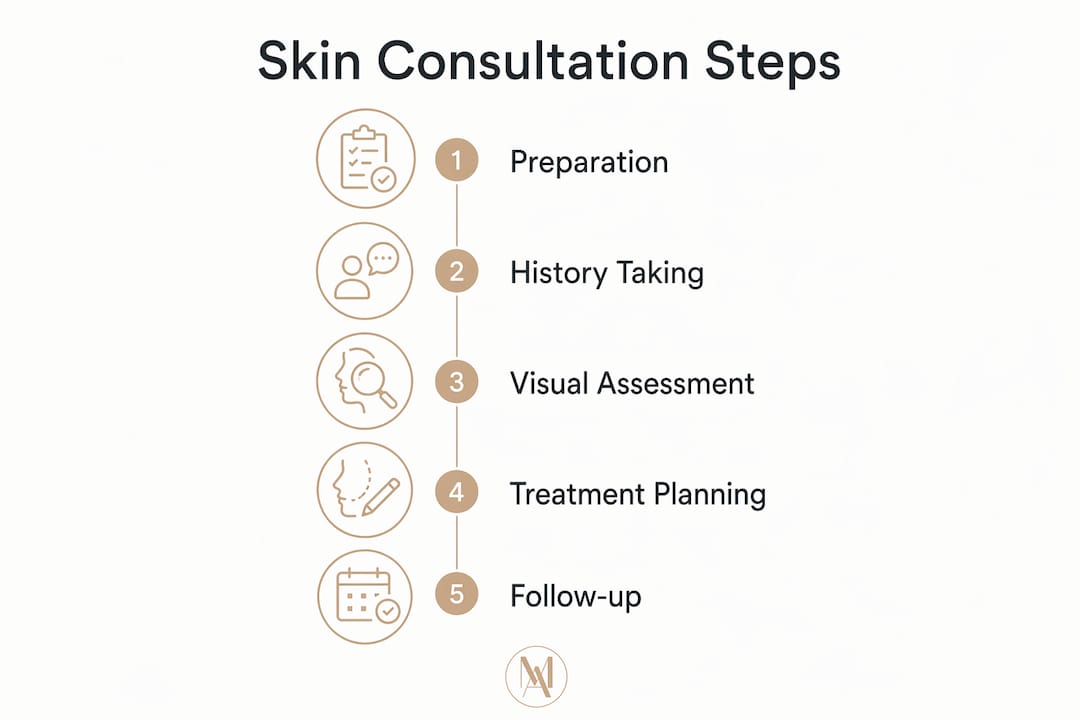
The skin consultation process has five core stages: preparation, history taking, visual assessment, treatment planning, and follow-up scheduling. Each stage builds on the last. Skipping preparation, for example, distorts the visual assessment and produces a treatment plan based on incomplete data. The steps for skin assessment used in professional settings follow this logic precisely.
Clinicians who conduct skin consultations also evaluate volume distribution and muscle movement, not just surface blemishes. This depth of analysis is what separates a genuine skincare consultation workflow from a superficial product consultation.
How should you prepare before a skin consultation?
Preparation is the stage most clients underestimate. Arriving correctly prepared directly determines how accurate your assessment will be.

Active ingredients such as retinoids, AHAs, BHAs, and benzoyl peroxide should be stopped at least 48 hours before your appointment. These ingredients alter the skin’s surface appearance and can mask redness, barrier disruption, or active breakouts that the clinician needs to see. Arriving with artificially calmed skin produces a misleading baseline.
On the day of your consultation, arrive with completely clean skin. That means:
- No makeup, tinted moisturiser, or BB cream
- No sunscreen or SPF-containing products
- No scented lotions or serums
- No heavy occlusive moisturisers applied that morning
Lifestyle factors including smoking, alcohol intake, stress levels, diet, hydration, and sun exposure history all significantly influence skin ageing and treatment response. Disclose these honestly. A clinician cannot tailor a treatment plan safely without this information.
Prepare a written summary of your current skincare routine, any medications you take, known allergies, and past treatments. Informed disclosure of autoimmune conditions, prescription medications, and previous aesthetic procedures allows your clinician to avoid contraindications and select the most appropriate protocol.
Pro Tip: Photograph your skin in natural daylight the morning of your consultation, before cleansing. This gives your clinician a reference point for your skin’s typical daily appearance rather than its post-travel or post-exercise state.
What are the steps of the skin consultation process?
A first dermatology or aesthetic appointment typically lasts 30–45 minutes and covers history taking, physical examination, diagnosis discussion, and treatment planning. That time is structured, not conversational. Each step serves a specific clinical purpose.
The core workflow steps are:
- Initial history taking. The clinician asks about your primary skin concern, how long you have had it, what makes it better or worse, and your full medical and lifestyle background.
- Visual skin examination. The clinician assesses skin type, tone, texture, pore size, pigmentation distribution, and signs of barrier compromise. Tools such as a dermoscope or digital imaging device may be used to examine deeper skin layers.
- Clinical photography. Baseline photographs are taken under standardised lighting to document current skin status and track progress over time.
- Goal and expectation discussion. The clinician clarifies what is realistically achievable, over what timeframe, and with what level of commitment from you.
- Diagnosis communication. Findings are explained clearly, including any contraindications or safety considerations.
- Treatment plan creation. The plan is built around your skin biology, not a generic protocol. Effective plans use staged and combination protocols rather than single isolated treatments, accounting for healing cycles and cumulative results.
- Follow-up scheduling. A follow-up appointment is booked before you leave to track progress and adjust the plan as your skin responds.
| Step | Clinical objective |
|---|---|
| History taking | Identify concerns, medical background, and lifestyle factors |
| Visual examination | Assess skin type, barrier function, and visible pathology |
| Clinical photography | Create a documented baseline for progress tracking |
| Goal setting | Align expectations with realistic clinical outcomes |
| Treatment planning | Build a staged, personalised protocol based on skin biology |
| Follow-up scheduling | Ensure continuity, adjustment, and long-term improvement |
Safety communication is woven throughout the process. Clinicians discuss contraindications, common and rare side effects, and post-treatment care at each relevant stage. Informed consent is not a formality. It is a clinical safeguard.
Pro Tip: Write down your top three skin concerns before the appointment and rank them by priority. Clinicians work more effectively when you can articulate what matters most to you, rather than listing every concern at once.
What mistakes should you avoid during a skin consultation?
The most common errors in the skin consultation process are avoidable. Knowing them in advance protects both the accuracy of your assessment and the quality of your treatment plan.
- Using actives the day before. Applying retinoids or AHAs the night before your appointment temporarily alters skin texture and redness levels. Your clinician sees a modified version of your skin, not its true baseline.
- Withholding medical history. Clients sometimes omit medications, supplements, or past procedures because they seem unrelated to skin. They rarely are. Hormonal contraceptives, for example, directly affect pigmentation response and acne patterns.
- Treating the consultation as a shopping appointment. Mistaking a medical aesthetic consultation for a sales appointment reduces clinical depth and leads to treatment choices driven by product availability rather than skin need.
- Expecting instant results. Skin health improvements are rarely instant. Follow-up appointments are not optional extras. They are the mechanism by which treatments are adjusted and results are achieved.
- Preparing differently for virtual consultations. Virtual skin consultations require the same clean-skin preparation as in-person appointments. Good natural lighting and a high-resolution camera are also necessary for the clinician to assess your skin accurately on screen. The virtual consultation process follows the same clinical sequence, just delivered remotely.
Openness and realistic expectations are not soft skills. They are clinical inputs that directly affect the quality of your treatment plan.
How do you apply the skin consultation workflow in practice?
Applying the skincare consultation workflow effectively means engaging with it as an active participant, not a passive recipient. Before your appointment, self-assess by noting when your skin concern first appeared, what triggers it, and what you have already tried. This preparation makes your history-taking stage faster and more accurate.
| Element | Self-led assessment | Professional consultation |
|---|---|---|
| Skin concern identification | Based on observation and symptom tracking | Clinically examined and diagnosed |
| Product selection | Trial and error | Protocol-based, matched to skin biology |
| Treatment planning | Generic routines | Staged, personalised, and safety-checked |
| Progress tracking | Subjective | Documented with clinical photography |
| Adjustment | Reactive | Scheduled and evidence-based |
During the appointment, ask specific questions. Ask why a particular ingredient or treatment is being recommended. Ask what the expected timeline is. Ask what to do if your skin reacts. Clinicians provide better guidance when clients engage with the reasoning behind their plan.
Follow-up visits are where the real work happens. Skin health improvements require consistent management over time. Attending follow-ups, reporting accurately on your skin’s response, and adhering to the prescribed routine between appointments are the three behaviours that determine whether a treatment plan succeeds or stalls.
Pro Tip: Keep a brief skin diary between appointments. Note any reactions, improvements, or changes in your environment such as travel, stress, or dietary shifts. This gives your clinician concrete data rather than impressions at your next visit.
For those preparing for their first appointment, the expert preparation checklist at Them-ethod covers every step in detail.
Key takeaways
A structured skin consultation workflow produces better outcomes than any single product or treatment because it aligns clinical findings, patient goals, and treatment planning into one coherent process.
| Point | Details |
|---|---|
| Prepare your skin correctly | Stop actives 48 hours before and arrive with clean, product-free skin. |
| Disclose your full history | Share medications, lifestyle factors, and past treatments for a safe, accurate plan. |
| Follow the clinical sequence | History taking, examination, photography, goal setting, and treatment planning each serve a distinct purpose. |
| Attend follow-up appointments | Skin improvements require adjustment over time; follow-ups are where results are built. |
| Engage actively | Ask questions, keep a skin diary, and treat the consultation as a clinical collaboration. |
Why I think most people underestimate the preparation stage
From what I have seen working within the medical skincare space, the preparation stage is where most consultations are quietly undermined. Clients arrive having used their full routine that morning, sometimes including a retinol the night before, and the clinician is then assessing a skin state that does not reflect daily reality. The findings are skewed before the appointment even begins.
The other pattern I notice is clients holding back information they consider embarrassing or irrelevant. Stress levels, alcohol intake, hormonal contraceptives, and recent sun holidays all affect how skin behaves and how it will respond to treatment. Withholding that information does not protect your privacy. It reduces the accuracy of your plan.
What I find genuinely encouraging is how much a well-prepared consultation changes the trajectory of someone’s skin health. When clients arrive with clean skin, a written history, and specific questions, the clinician can move past the basics and into real clinical depth. The treatment plan that comes out of that conversation is categorically different from one built on incomplete information. Prioritising preparation is not pedantic. It is the single most effective thing you can do before you walk through the door.
— Jess
Them-ethod products that complement your consultation outcomes
Once your clinician has identified your skin concerns and built a treatment plan, the right products make the difference between a plan that works on paper and one that delivers visible results. At Them-ethod, we stock clinically validated formulations matched to the most common post-consultation protocols. For acne-prone skin, the PCA Clearskin serum is a dermatologist-recommended treatment that targets breakouts without compromising barrier function. For clients addressing pigmentation and uneven tone, the NEOSTRATA collection offers science-backed formulations designed for visible, measurable improvement. Every product we carry is selected to support the kind of results a well-executed consultation is designed to achieve.
FAQ
What is a workflow for skin consultation?
A workflow for skin consultation is a structured clinical sequence covering preparation, history taking, visual assessment, treatment planning, and follow-up. It ensures accurate diagnosis and personalised care rather than generic product recommendations.
How long does a skin consultation typically last?
A first dermatology or aesthetic consultation typically lasts 30–45 minutes. This covers history taking, physical examination, diagnosis discussion, and treatment planning.
Should I stop using skincare products before my consultation?
Stop active ingredients such as retinoids, AHAs, BHAs, and benzoyl peroxide at least 48 hours before your appointment. Arrive with clean skin and no makeup, sunscreen, or scented products.
What is the difference between a virtual and an in-person skin consultation?
Both follow the same clinical workflow. Virtual consultations require the same clean-skin preparation, good natural lighting, and a high-resolution camera so the clinician can assess your skin accurately on screen.
Why are follow-up appointments part of the consultation workflow?
Follow-up appointments allow clinicians to track progress, adjust treatments, and respond to how your skin is changing. Skin health improvements are rarely immediate and require consistent management over time.