




Understand the skin biome for healthier, balanced skin
TL;DR:
- The skin hosts a complex, living microbiome that actively contributes to its health and barrier function. Disruption of this ecosystem, or dysbiosis, can lead to skin conditions like acne, eczema, and psoriasis. Supporting microbiome balance through gentle, site-specific skincare and personalized routines promotes resilient, healthy skin.
Your skin is not a sterile surface waiting to be purified. It is a living ecosystem, home to trillions of bacteria, fungi, viruses, and mites that work in concert to keep it healthy, resilient, and defended against external threats. As Nature Reviews Microbiology confirms, the skin microbiome functions as an active participant in skin health, not a passive bystander. Most skincare conversations still focus on cleansing away impurities, but the most forward-thinking approach recognises that nurturing this ecosystem, rather than dismantling it, is the real key to skin health. This guide unpacks what the skin biome is, how it works, and what it means for the way you care for your skin.
Table of Contents
- What is the skin biome?
- How does the skin biome vary across the body?
- Why balance matters: Dysbiosis and skin health
- How science advances our understanding of the skin biome
- How do skincare practices impact the skin biome?
- The real secret: Embracing microbiome individuality in skincare
- Discover effective microbiome-friendly skincare
- Frequently asked questions
Key Takeaways
| Point | Details |
|---|---|
| Skin biome basics | Your skin hosts diverse microbes that are essential to its health and resilience. |
| Balance protects | A well-balanced skin microbiome helps defend against skin problems and external threats. |
| Personalised care matters | Different skin sites have unique biome needs, so tailored skincare routines are key. |
| Science guides choices | Emerging research provides insight for smarter, more effective beauty practices. |
What is the skin biome?
Now that we know the skin is alive with its own ecosystem, let us clarify exactly what the skin biome includes and why it is so vital.
The term skin biome refers to the entire community of microorganisms residing on human skin. This community includes far more than bacteria alone. Its key inhabitants are:
- Bacteria: The dominant group, including genera such as Staphylococcus, Corynebacterium, and Cutibacterium.
- Fungi: Particularly Malassezia, which thrives in sebaceous (oil-rich) zones.
- Viruses: Including bacteriophages that help regulate bacterial populations.
- Mites: Most notably Demodex, which lives in hair follicles.
These organisms are not passive residents. They actively shape skin physiology by competing with harmful pathogens, metabolising sebum, producing antimicrobial compounds, and educating the local immune system. The relationship is genuinely mutualistic: your skin provides the environment, and in return, these microbes protect and regulate it.
Understanding the science of personalised skincare requires grasping this basic ecological truth. The microbiome is not an inconvenience to be sterilised away. It is an asset to be maintained.
“The skin microbiome is a diverse microbial community with roles in maintaining skin health, protecting against pathogens, and modulating immune responses.” — Nature Reviews Microbiology, 2025
Barrier function is a particularly important contribution. Commensal bacteria help maintain the acid mantle, that slightly acidic surface environment (typically pH 4.5 to 5.5) that discourages pathogenic colonisation. Disturb the biome, and you disturb the barrier. It really is that direct.
How does the skin biome vary across the body?
Knowing that the skin biome is not uniform, let us explore how these communities differ depending on body site and why this matters for both health and beauty.
Your skin is not one environment. It is dozens of distinct microenvironments, each with its own humidity, sebum output, temperature, and oxygen levels. These differences shape dramatically different microbial communities depending on where you look.
| Skin zone | Physiological character | Dominant microbes | Microbial diversity |
|---|---|---|---|
| Moist (e.g., groin, underarm) | High humidity, low airflow | Staphylococcus, Corynebacterium | Moderate to low |
| Dry (e.g., forearm, leg) | Low sebum, higher oxygen | Mixed community, no single dominant | High |
| Sebaceous (e.g., face, scalp) | High lipid content | Cutibacterium (Propionibacterium), Malassezia | Lower |
As PMC research confirms, distributions of bacteria change depending on skin-site physiology, with distinct taxa associated with moist, dry, and sebaceous environments. Sebaceous zones, for example, support lower overall diversity because the high lipid content and microaerophilic conditions strongly favour organisms that can metabolise sebum.
Why does this variability matter to you in practice? Several reasons:
- A cleanser formulated for oily, sebaceous skin may strip the microbiome on a dry forearm, causing reactivity.
- A moisturiser that works perfectly on the face may shift microbial balance on the neck where the environment differs.
- Topical antibiotic treatments target bacteria broadly, which can reduce beneficial populations alongside problematic ones.
Pro Tip: When introducing a new product, patch test not only for sensitivity but also for how your skin responds over three to four weeks. Microbiome shifts are slower to manifest than immediate irritation reactions. Knowing your skin type, and which zone you are treating, is half the battle. Consulting dermatologist-preferred skincare routines can help you calibrate your choices to your specific ecology. For those with particularly reactive skin, dermatologist insights on sensitive skin offer additional guidance on environmental influences that interact with the biome.
Why balance matters: Dysbiosis and skin health
So, what happens when this ecosystem falls out of balance? Understanding dysbiosis is key to smarter skincare.
Dysbiosis describes a state of microbial imbalance: reduced overall diversity, or the disproportionate dominance of certain organisms. In the context of skin, this is not merely a cosmetic nuisance. It can trigger or worsen genuine inflammatory conditions.
A 2025 review confirms that the skin microbiome helps maintain homeostasis by regulating immune responses, preserving barrier integrity, and inhibiting pathogen colonisation. Disruption of this system is mechanistically linked to acne, atopic dermatitis, psoriasis, and impaired wound healing.
Common triggers for skin dysbiosis include:
- Harsh cleansers and surfactants: High-pH, detergent-based formulas strip commensal bacteria alongside surface oils.
- Overuse of topical antibiotics or antifungals: These disrupt the balance of beneficial alongside harmful organisms.
- Frequent exfoliation: Physical or chemical exfoliation at excessive frequency removes protective microbes with dead skin cells.
- Environmental exposures: Pollution, UV radiation, and temperature extremes alter microbial populations measurably.
- Stress and hormonal fluctuations: Cortisol and androgen shifts alter sebum production, which directly reshapes the environment for sebaceous-zone microbes.
The downstream consequences of dysbiosis follow a recognisable pattern. Reduced microbial diversity weakens competitive exclusion, allowing opportunistic organisms such as Cutibacterium acnes in acne, Staphylococcus aureus in atopic dermatitis, or Malassezia in seborrhoeic dermatitis to proliferate. This triggers immune activation, inflammation, and barrier disruption, which compound one another in a cycle that is difficult to interrupt with surface-level interventions alone.
Key callout: Research links psoriasis, atopic dermatitis, and acne to measurable shifts in microbial populations, not merely immune dysfunction in isolation. The microbiome is a participating factor, not a bystander. Understanding the advantages of personalised skincare is increasingly inseparable from understanding dysbiosis.
How science advances our understanding of the skin biome
With the risks of imbalance clear, let us look at how science reveals new potential solutions and custom care for your skin biome.
The study of the skin microbiome has been transformed by molecular technology. Until relatively recently, scientists could only identify skin microbes that grew in laboratory cultures, a method that missed the vast majority of species. Modern approaches are far more powerful.
| Analysis method | What it reveals | Implication for skincare |
|---|---|---|
| Metagenomic sequencing | Full genetic profile of all microbes, including unculturable species | Enables identification of therapeutic targets and microbiome-based treatments |
| 16S rRNA sequencing | Bacterial community composition | Reveals which genera dominate at specific sites or in disease states |
| Untargeted metabolomics (LC-MS/MS) | Metabolites produced by microbes and skin cells | Identifies how microbial activity affects inflammation, lipids, and oxidative stress |
| Transcriptomics | Gene expression in host skin cells | Shows how skin responds biologically to microbiome changes |
As Nature Reviews Microbiology notes, metagenomic sequencing enables reconstruction of microbial species, strains, and gene pathways across cohorts, directly supporting the identification of therapeutic targets. This is significant: it means scientists can now pinpoint not just which microbes are present, but what they are doing and what happens when they are disrupted.
A compelling example of this comes from a 2025 study on psoriasis, which combined 16S rRNA sequencing with untargeted LC-MS/MS metabolomics in 29 patients and 31 healthy controls. The study identified 63 differential metabolites and found that reduced Cutibacterium and increased Staphylococcus and Corynebacterium correlated with disruptions in lipid metabolism, inflammatory pathways, and oxidative stress responses. This is real-world evidence that the microbiome and skin chemistry are deeply intertwined.
However, translating lab findings into product formulations is genuinely challenging. As outlined in a Frontiers in Microbiology analysis, methodology limits in skin biome studies mean that results from one cohort or skin site do not always generalise. Standardisation of sampling, sequencing protocols, and data analysis remains an active area of debate.
Pro Tip: When evaluating skincare products that claim to support the microbiome, look for those that reference clinical studies rather than simply marketing terms like “probiotic-infused.” The quality of the science behind bespoke skincare approaches matters enormously.
How do skincare practices impact the skin biome?
But how do these scientific principles actually change the way you choose and use products? Here is where research meets your bathroom shelf.
Every product you apply and every practice you follow exerts an effect on your skin’s microbial community. The most important insight from current research is that the effect is never universal. As PMC confirms, the same external intervention, whether cleansing, moisturisation, or antibiotic use, can produce different microbiome responses because of baseline skin-site ecology and individual variability.
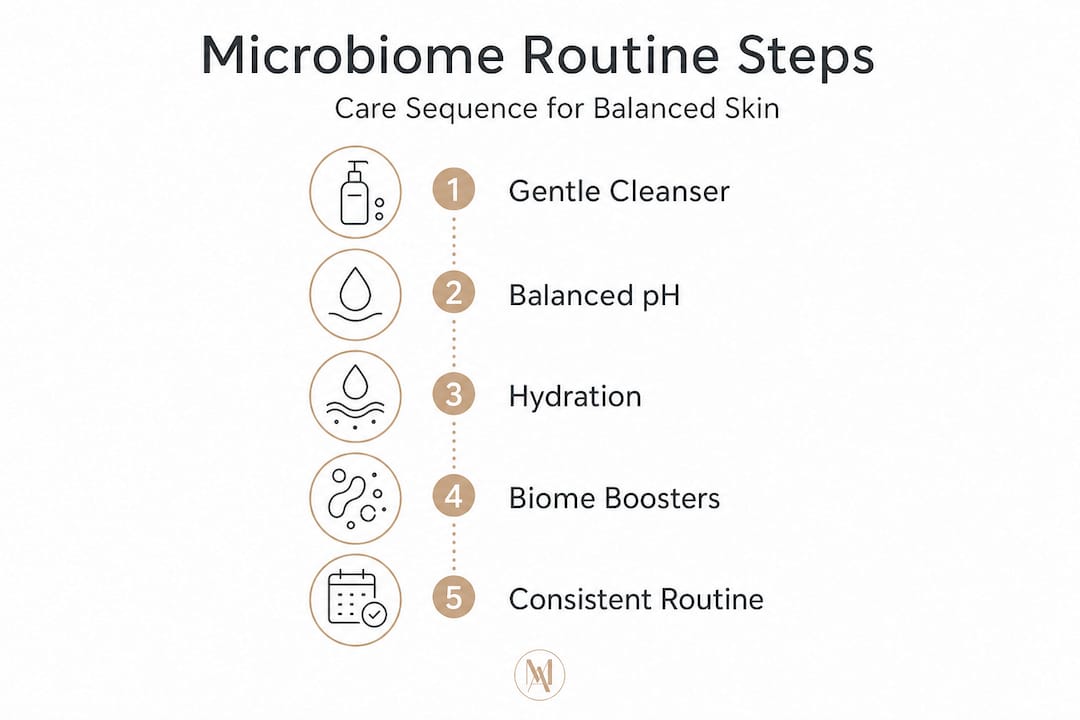
This means there is no single product that supports the microbiome for every person on every area of skin. What nurtures a healthy biome on one person’s cheek may destabilise another’s. With that critical caveat in place, here is what the evidence broadly suggests:
Practices that tend to harm the skin biome:
- Cleansing with high-pH soaps (above pH 7) which disrupt the acid mantle
- Using alcohol-heavy toners that reduce bacterial populations indiscriminately
- Applying broad-spectrum antibiotics without clinical need
- Layering multiple active ingredients without monitoring skin response
- Hot showers and heavy scrubbing, both of which alter moisture balance and remove surface microbes
Practices that tend to support the skin biome:
- Gentle, pH-balanced cleansing that preserves the acid mantle
- Using prebiotic-containing products that selectively feed beneficial bacteria
- Introducing probiotic formulations with documented strains and clinical backing
- Moisturising consistently to maintain barrier integrity and microbial habitat
- Reducing unnecessary antibiotic and antifungal use wherever possible
The ecological mindset is perhaps the most powerful shift you can make. Rather than asking “is this product clean?” ask “what will this do to the community living on my skin?” That reframing guides far smarter choices. For those committed to personalising your skincare routine, this ecological perspective is the foundation. Water quality is also worth considering: filtration for skin hydration can play a meaningful supporting role for reactive or biome-disrupted skin.
The real secret: Embracing microbiome individuality in skincare
Having seen the connection between science and routine, it is time for a candid perspective on what matters most for real-world skin health.
We see a persistent idea in skincare marketing that there is a single, correct, balanced microbiome everyone should be working towards. The science does not support this. A 2025 review makes this plain: microbiome research frames results in terms of ecological balance and site-specific dynamics rather than a single “good” microbiome for all. One person’s optimal community on their T-zone looks nothing like another’s.
The practical implication is profound. Chasing a universal “healthy microbiome” through trending products is, at best, inefficient. At worst, it disrupts a community that was already functioning well for your particular skin. We believe the smarter approach is to observe how your skin responds, prioritise site-specific care, and invest in routines built around your individual biology rather than generic ideals.
What we are also seeing, reassuringly, is that personalised skincare is catching up to this reality. The rise of personalised skincare services that account for skin type, lifestyle, site-specific needs, and product tolerance reflects exactly the kind of adaptive thinking the microbiome science demands.
The skin biome should make you curious about your own skin, not anxious about it. It is a dynamic, responsive ecosystem. Your job is not to control it, but to create the conditions for it to thrive.
Discover effective microbiome-friendly skincare
Ready to put the science to work? At The M-ethod Skin, we curate skincare solutions designed for complex, living skin. For those managing acne-prone or dysbiosis-linked breakouts, our microbiome-friendly acne serum offers a clinically grounded option that targets imbalance without stripping the skin’s natural defences. If you are looking to explore a broader range of scientifically formulated products, our NEOSTRATA skincare collection brings together treatments developed with barrier and biome integrity in mind. Whether you are beginning your microbiome-conscious skincare journey or refining a routine already in progress, we are here to guide you with evidence-backed choices and expert consultation.
Frequently asked questions
What is the difference between the skin biome and the gut microbiome?
The skin biome lives on the body’s surface and primarily protects against environmental pathogens and regulates barrier function, while the gut microbiome lives in the digestive tract and focuses on nutrient metabolism and systemic immune education. Both are diverse microbial communities, but their compositions, functions, and responses to intervention differ significantly.
Can changing my skincare routine quickly affect my skin biome?
Yes, abrupt changes, particularly those involving harsh cleansers or topical antibiotics, can rapidly disrupt your skin’s microbial balance. Research confirms that the same intervention can produce different microbiome responses depending on an individual’s baseline ecology, which is why gradual, monitored transitions are always advisable.
Is it possible to repair my skin microbiome if it becomes unbalanced?
Many people can restore microbial balance through consistent use of gentle, biome-friendly products and by reducing disruptive habits over time. However, because microbiome dysregulation is mechanistically linked to conditions such as atopic dermatitis and psoriasis, persistent or severe imbalance warrants professional clinical input.
Are probiotics or prebiotics in skincare really effective?
Some evidence is genuinely encouraging, particularly for targeted strains in documented concentrations, but the field is still maturing. Metagenomic approaches are identifying therapeutic targets, yet clinical translation remains challenging, meaning not every product labelled as probiotic or prebiotic carries meaningful benefit. Always look for transparency around the specific ingredient and the evidence supporting it.