




The clinical role of retinoids in dermatology explained
Retinoids are vitamin A derivatives, and they remain the first-line topical therapy for acne and one of the most effective agents dermatology has for photoageing. Topical forms, including tretinoin, adapalene, tazarotene and the retinol family, are used to treat acne lesions and ageing skin at the surface. Systemic forms, chiefly isotretinoin and acitretin, are reserved for severe or resistant disease. The trade-off is consistent across both: oral retinoids carry serious teratogenic risk, and topical formulations almost always cause some degree of irritation before they deliver results.
Key Takeaways
Retinoids work by binding RAR and RXR receptors to normalise cell turnover and stimulate collagen, making them the most evidence-backed treatment for acne and photoageing when introduced gradually and paired with daily sun protection.
| Point | Details |
|---|---|
| Receptor mechanism drives results | RAR/RXR binding alters gene transcription, boosting collagen and normalising cell turnover. |
| Potency varies widely | Retinol and retinaldehyde are gentler precursors; tretinoin and tazarotene are direct-acting and stronger. |
| Evidence favours prescription strength | ATRA at 0.025–0.1% has the strongest trial data for reducing wrinkles and pigmentation. |
| Pregnancy is an absolute red line | Oral retinoids like isotretinoin require strict contraception monitoring due to teratogenic risk. |
| Slow starts prevent dropout | Every-other-night use with moisturiser buffering reduces irritation-driven discontinuation. |
| Them-ethod offers a clinical next step | Virtual consultations match patients to prescription-strength or cosmeceutical retinoids based on tolerance and goals. |
This article is general information, not a substitute for advice from a qualified doctor. Consult a qualified healthcare professional about your own circumstances before acting on anything here.
Table of Contents
- How retinoids work in the skin
- What conditions do retinoids treat in dermatology?
- Which retinoid is right for your skin type?
- What does the clinical evidence show?
- Managing side effects and knowing the red flags
- How to start a retinoid without wrecking your skin barrier
- What newer research reveals about retinoid selectivity
- Ready for prescription-strength results?
- Sources
How retinoids work in the skin
Every retinoid ultimately acts on the same two receptor families: retinoic acid receptors (RAR) and retinoid X receptors (RXR). Once a retinoid binds these nuclear receptors, it switches specific genes on or off, altering how skin cells divide, mature and shed. That transcriptional shift is what separates retinoids from ordinary moisturisers or exfoliants. It changes cell behaviour rather than simply sitting on the surface.
Two effects follow from this. In the epidermis, retinoids normalise desquamation and reduce the abnormal keratinisation that blocks pores, which is why they work against comedones. In the dermis, they stimulate type I procollagen synthesis and inhibit matrix metalloproteinases, the enzymes that break collagen down. This dual action is why some studies report topical retinol at certain concentrations producing histological changes comparable to tretinoin, with better tolerability.
Not every retinoid reaches the receptor the same way:
- Tretinoin (all-trans retinoic acid) binds RAR directly, so it acts fast and strongly.
- Retinol and retinaldehyde are precursors; skin enzymes must convert them into retinoic acid first, which blunts both potency and irritation.
- Adapalene is a synthetic retinoid engineered for more selective RAR binding, aiming for efficacy with less inflammation.
That enzymatic conversion step is the main reason an over-the-counter retinol serum feels gentler, and works more slowly, than a prescription tretinoin cream.
What conditions do retinoids treat in dermatology?
Topical retinoids have earned their place across several core indications. Understanding which condition calls for which strength helps set realistic expectations before you start:
- Acne vulgaris — the primary indication, targeting comedones and reducing inflammatory lesion formation.
- Photoageing and dyspigmentation — used as an adjunct to reduce fine lines, roughness and uneven tone, with tretinoin is specifically approved for this use.
- Hyperkeratotic and off-label conditions — including keratosis pilaris and certain pigmentary disorders, where evidence is more limited.
Systemic retinoids sit a rung higher in both potency and risk. Isotretinoin is used for severe, recalcitrant, or scarring acne that has failed other treatments. Other oral agents, such as acitretin, treat psoriasis, disorders of keratinisation and selected dermatologic malignancies. Anything in the retinol-to-adapalene range is available without prescription; tretinoin, tazarotene, and every oral retinoid require one.
Which retinoid is right for your skin type?
Retinoids exist on a potency spectrum, and matching that spectrum to your skin’s tolerance is the single most useful thing to understand before buying a product. At the gentle end sit retinyl esters and retinol, both precursors that need conversion before they become active. Retinaldehyde sits one step closer to active retinoic acid, generally delivering more visible results with a moderate irritation profile. Adapalene, developed specifically for selective receptor binding, achieves meaningful anti-acne effect with comparatively low inflammation.
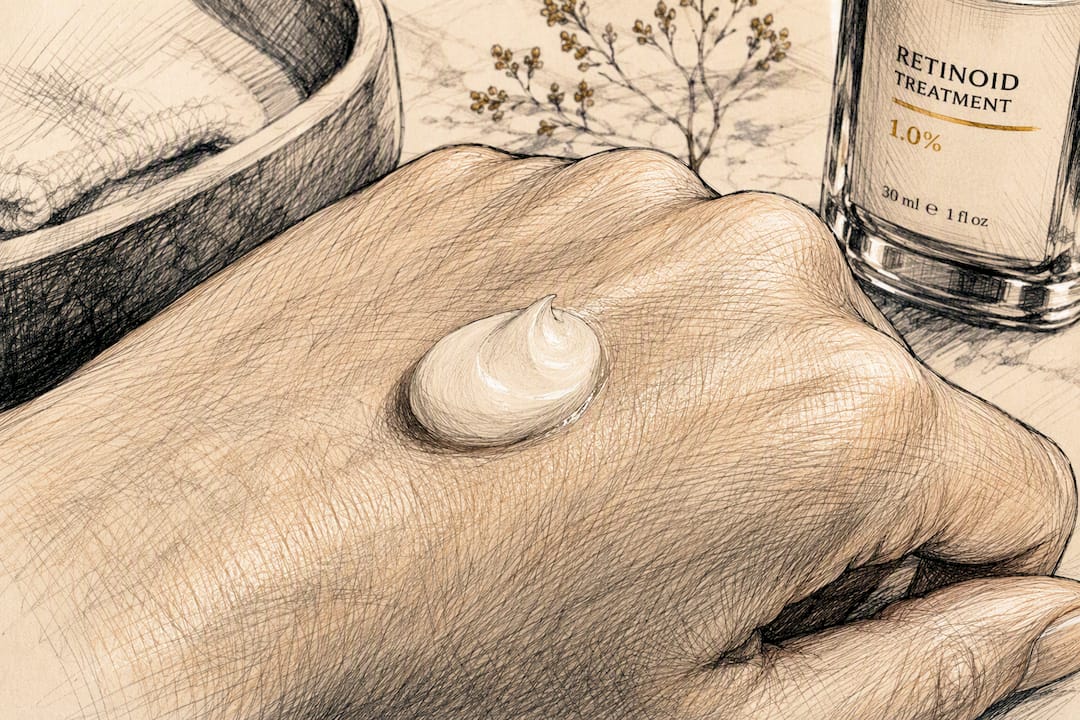
Tretinoin and tazarotene sit at the prescription end of the topical range, with tazarotene generally regarded as the most potent and often the most irritating. Oral isotretinoin, used systemically rather than on the skin, is in a different category entirely, reserved for severe disease under close medical supervision.
| Molecule | Type | Typical potency | Availability |
|---|---|---|---|
| Retinyl esters / retinol | Precursor | Low | Over-the-counter |
| Retinaldehyde | Precursor (closer to active form) | Low to moderate | Over-the-counter |
| Adapalene | Synthetic, receptor-selective | Moderate | OTC (low strength) / prescription |
| Tretinoin | Direct retinoic acid | High | Prescription |
| Tazarotene / trifarotene | Direct, selective receptor agonists | Very high | Prescription |
Clinicians often start a patient on a precursor or a selective agonist like adapalene precisely because the irritation curve is gentler, even if it means a slower path to visible change. Our guide on retinol versus retinaldehyde breaks this trade-off down further if you are weighing which strength to start with.
What does the clinical evidence show?
The evidence base for topical retinoic acid is substantial. Trials using ATRA at clinically studied concentrations have consistently shown reductions in fine and coarse wrinkling, improved texture, and diminished hyperpigmentation in photoaged skin. Over-the-counter retinol trials tend to use concentrations from around 0.1% up to 1%, with outcomes generally more modest than prescription-strength tretinoin, though not negligible.
Clinical benchmark: in controlled studies, topical retinoic acid in the 0.025–0.1% range measurably reduced wrinkle depth and hyperpigmentation over sustained daily use, one of the most consistently replicated findings in photoageing research.
For acne, the pattern is similar: higher-potency direct retinoic acid agents clear comedonal and inflammatory lesions faster, while lower-strength or precursor formulations require more patience but cause less disruption to the skin barrier along the way.
Managing side effects and knowing the red flags
Irritant dermatitis is the most common reason people stop using retinoids, and it is directly related to potency and dose. Erythema, peeling, dryness and increased photosensitivity are expected in the first weeks with almost any retinoid strong enough to work.
- Redness, flaking and dryness typically peak in weeks two to four, then settle as skin adapts.
- Higher-potency agents (tretinoin, tazarotene) cause more irritation than precursors (retinol, retinaldehyde).
- Photosensitivity means daily sun protection is not optional during retinoid therapy.
- Active eczema or rosacea warrants caution and often a lower starting strength.
- Pregnancy is an absolute contraindication for any systemic retinoid, and isotretinoin requires strict contraception counselling and monitoring, in line with programmes such as iPLEDGE in regulated markets.
Pro Tip: If your skin stings within minutes of application, you’re likely using too much or applying to damp skin. Wait 20 minutes after cleansing until skin is completely dry, and apply retinoid to a pea-sized amount for the whole face rather than dabbing it onto individual spots.
Layering retinoids with potent exfoliants such as high-strength acids can compound irritation, so most clinicians advise separating these actives across different nights rather than stacking them.
How to start a retinoid without wrecking your skin barrier
Getting the introduction right matters more than the product you choose. A rushed start is the single biggest reason people abandon retinoids after two weeks of angry, flaking skin.
- Begin every other night, not nightly, for the first two to four weeks.
- Apply a pea-sized amount across the whole face after skin is fully dry.
- Follow with a moisturiser, or apply moisturiser first as a buffer if skin feels sensitive.
- Increase to nightly use only once redness and peeling have settled.
- Apply broad-spectrum sunscreen every morning without exception.
Set your expectations around timelines, not miracles: acne lesions typically start improving within six to eight weeks, while visible photoageing changes, smoother texture, fewer fine lines, more even tone, usually take three to six months of consistent use. Our piece on starting with retinal or retinol walks through this staged approach in more depth, and layering retinol safely covers how to fit it around the rest of a routine.
What newer research reveals about retinoid selectivity
Newer reviews are increasingly focused on receptor selectivity rather than raw potency. The goal is a molecule that binds RAR strongly enough to drive collagen synthesis and cell turnover, without triggering the inflammatory cascade that causes visible irritation.
Selective RAR agonists represent an attempt to separate the therapeutic transcriptional effects of retinoids from their irritant side effects, a distinction that older, non-selective molecules cannot offer.
One nuance worth flagging: cosmeceutical retinoids are regulated as cosmetics, not medicines, so their supporting trials rarely meet the rigour of prescription drug studies, even when the results look promising on paper.
Common myths about retinoids, corrected
- “Retinoids thin the skin.” They thin the outer stratum corneum layer initially while thickening the deeper epidermis and boosting dermal collagen overall.
- “You can’t use retinoids in skin of colour.” Retinoids are widely used and effective across skin tones; the real caution is starting slowly to avoid post-inflammatory pigmentation from over-irritation.
- “Retinol is as strong as tretinoin.” Retinol is a precursor requiring enzymatic conversion, making it meaningfully weaker than direct-acting tretinoin.
A clinician-minded bottom line
Over-the-counter precursors suit patients wanting gradual improvement with minimal disruption; prescription tretinoin or isotretinoin suit those with more severe acne or established photoageing who need faster, better-evidenced results. Book a consultation if acne is severe, irritation is unmanageable, you’re planning pregnancy, or pigmentation is complex. Sunscreen and consistency decide the outcome more than the product label does.
Ready for prescription-strength results?
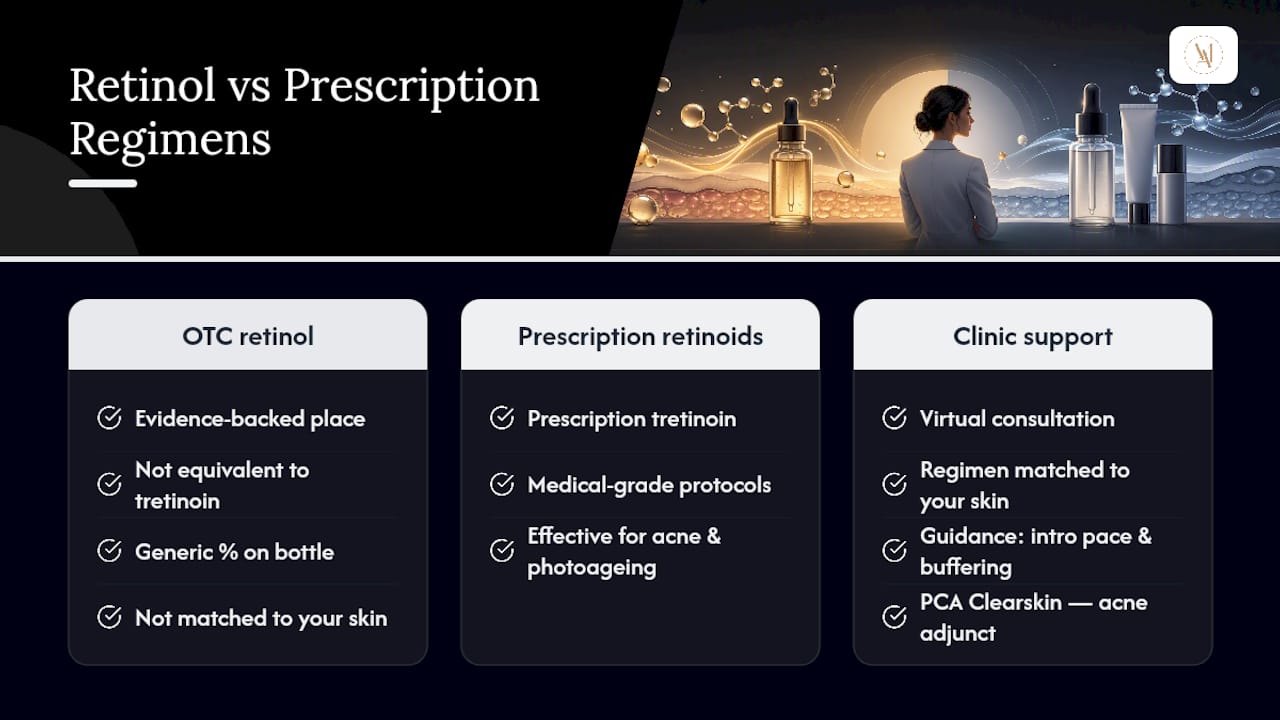
Retinol serums have a genuine, evidence-backed place in a skincare routine, but they were never designed to replicate what prescription tretinoin or medical-grade retinoid protocols achieve for acne and photoageing. That’s the gap Them-ethod exists to close. A virtual consultation with one of our clinicians gets you a regimen matched to your actual skin, not a generic percentage on a bottle, including guidance on introduction pace, buffering, and what to combine it with. For acne-prone skin needing extra support alongside a retinoid, our PCA Clearskin acne treatment serum is a clinic-recommended adjunct, while the NEOSTRATA collection offers cosmeceutical-grade options for those building tolerance before stepping up. Book a virtual consultation today and let a clinician assess what your skin can actually handle.
Sources
- Topical application of all‑trans retinoic acid (ATRA) clinical data
- PMC10669284
- Review: Current use and future potential role of retinoids in dermatology
- Oral retinoids
- Vitamin A: Its role in cosmeceuticals for anti‑aging (doi:10.1002/der2.218)