





Reveal youthful skin: The benefits of addressing ageing early
TL;DR:
- Most visible skin ageing is preventable through early lifestyle and skincare choices made in your late twenties and early thirties.
- Consistent sun protection, collagen support, and healthy habits can significantly delay the signs of premature ageing before they become visible.
Most people assume that anti-ageing skincare belongs to a later chapter of life, something to think about when the first wrinkles appear. The reality is quite different. The majority of visible skin ageing is preventable, and the decisions you make in your mid-to-late twenties and early thirties shape the condition of your skin for decades. In this article, we walk through the science behind premature ageing, the clinical evidence for early intervention, and the practical steps you can take now to build a routine that genuinely protects and preserves your skin.
Table of Contents
- What causes premature skin ageing?
- The proven impact of addressing ageing early
- Dermatologist-recommended routines for early ageing prevention
- Common mistakes and misconceptions about skin ageing
- The uncomfortable truth: Why starting early is the best investment for your skin
- Personalised skincare solutions for lasting youthfulness
- Frequently asked questions
Key Takeaways
| Point | Details |
|---|---|
| Early action prevents ageing | Most visible skin ageing is preventable with timely routines and daily SPF. |
| Collagen boosts results | Early collagen peptide use reduces wrinkles and improves hydration and elasticity. |
| Personalised routines work best | Following dermatologist-recommended steps tailored to your needs delivers lasting youthful skin. |
| Avoid common pitfalls | Waiting for visible signs or skipping SPF undermines prevention efforts. |
What causes premature skin ageing?
Understanding what actually drives early ageing is the first step towards preventing it. Many people focus on genetics or simply accept that ageing is inevitable, but the data tells a more empowering story.
UV radiation accounts for 80-90% of visible skin ageing, making sun exposure by far the leading cause of fine lines, pigmentation, loss of firmness, and uneven texture. This is referred to as photoageing, and it begins well before you notice any visible change in the mirror. UV rays penetrate deeply into the dermis, where they break down collagen and elastin fibres, the structural proteins that keep skin firm and resilient.
The good news is that consistent sun protection is one of the most effective and accessible interventions available. Products such as SPF 50 daily protection by Medik8 provide a clinical-grade barrier against both UVA and UVB rays. For those who prefer a lighter, antioxidant-rich option, a vitamin C SPF combines photoprotection with free-radical defence in one step. If you wear makeup or prefer something seamlessly wearable, tinted SPF solutions offer coverage and protection without compromise.
Beyond UV, several lifestyle factors accelerate early ageing significantly:
- Smoking reduces blood flow to the skin, starving it of oxygen and nutrients. It also directly degrades collagen and elastin at a cellular level.
- Chronic sleep deprivation disrupts the skin’s overnight repair cycle, reducing growth hormone release and impairing barrier function.
- Unmanaged stress raises cortisol levels, which breaks down collagen and triggers inflammation, contributing to dullness, sensitivity, and accelerated cell turnover breakdown.
- Poor dietary habits that are low in antioxidants and high in refined sugars promote glycation, a process where sugar molecules bind to collagen fibres and make them stiff and fragile.
- Air pollution and particulate matter generate free radicals on the skin’s surface, accelerating oxidative stress and pigmentation.
“Prevention is far more powerful than correction. The skin’s ability to respond to early, consistent care is remarkable — but that window is finite. Once collagen scaffolding breaks down significantly, rebuilding it takes considerably more effort, time, and investment.”
Genetics certainly influence the rate at which your skin ages, including how efficiently it repairs DNA damage and produces collagen. However, genetics account for a minority of overall ageing compared to environmental and lifestyle contributors. This means that your daily habits carry more weight than your family history. That is an empowering fact, and it is the reason why starting preventive care early produces such meaningful results.
The proven impact of addressing ageing early
Early intervention is not simply a marketing phrase. Clinical research supports the idea that starting preventive routines before visible signs appear produces measurably superior outcomes compared to waiting until damage is already done.

Collagen peptide supplementation has been shown in controlled studies to reduce wrinkle volume, improve skin elasticity by approximately 9%, and increase hydration levels by up to 29% within just four to eight weeks. These results were observed in women aged 35 to 55, which aligns precisely with the age group most likely to notice early signs of ageing. Crucially, the women who saw the most dramatic results were those who began supplementation before significant elasticity loss had occurred.
| Intervention | Timeframe | Key benefit | Evidence strength |
|---|---|---|---|
| Daily SPF (broad spectrum) | Ongoing | Prevents up to 90% of photoageing | Very strong (NIA) |
| Collagen peptides | 4 to 8 weeks | +9% elasticity, +29% hydration | Randomised controlled trial |
| Retinol night treatment | 8 to 12 weeks | Stimulates cell renewal and collagen | Extensive clinical literature |
| Vitamin C serum | 4 to 6 weeks | Brightens, neutralises free radicals | Multiple peer-reviewed studies |
To put this in practical terms, here is the progression that early intervention supports:
- Weeks one to four: Skin barrier strengthens, hydration retention improves, and surface texture becomes smoother.
- Weeks four to eight: Collagen production is stimulated, reducing the appearance of fine lines and improving bounce.
- Months three to six: Cumulative SPF use prevents new photoageing damage, preserving clarity and firmness.
- Year one and beyond: Consistent routines produce compounding benefits, with skin appearing visibly younger than peers who began later.
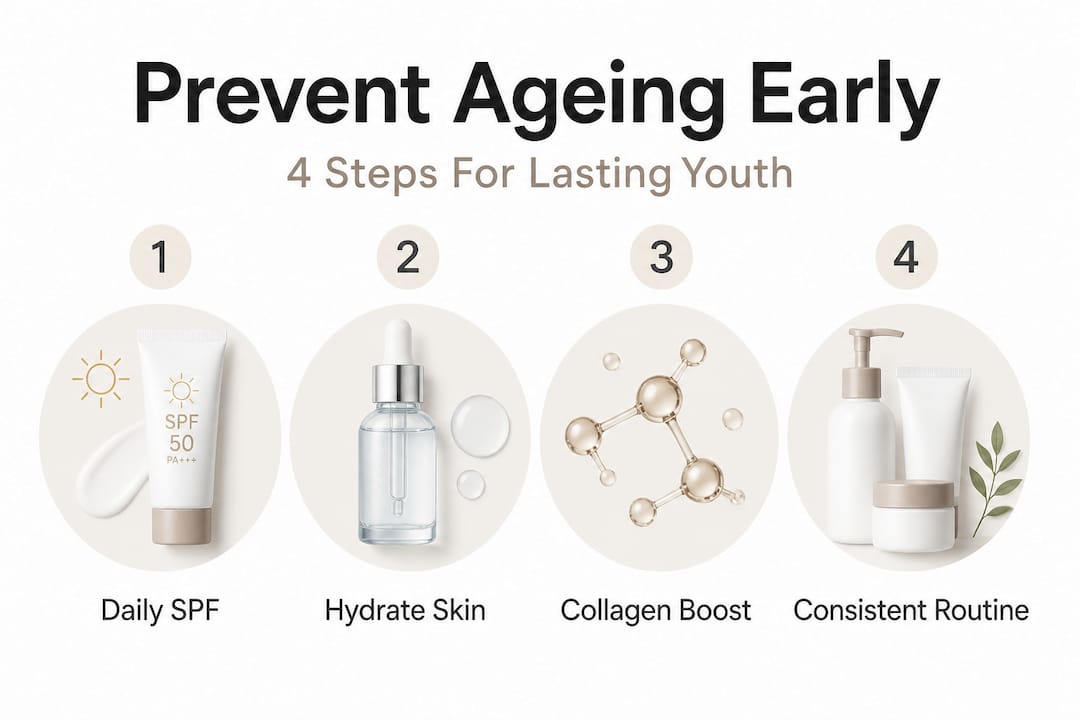
Pro Tip: Even incorporating a single daily SPF and a well-formulated collagen hydrator creates a foundation that pays dividends. Consistency is more valuable than complexity. Begin with two or three evidence-backed steps and build from there. The collagen hydrator by PCA Skin is an excellent starting point, combining deep hydration with collagen-supporting ingredients.
Daily SPF use, as the research confirms, is the single most impactful daily habit you can adopt for long-term skin health. Explore a structured anti-ageing skincare approach to understand how to layer these interventions effectively.
Dermatologist-recommended routines for early ageing prevention
Building an effective anti-ageing routine does not require an overwhelming number of products. What it does require is consistency, the right active ingredients, and a routine tailored to your skin type and lifestyle. Here is how a clinically grounded routine looks in practice.
Core morning routine:
- Step 1: Gentle cleanser — removes overnight debris without stripping the skin barrier.
- Step 2: Antioxidant serum — vitamin C is the gold standard, neutralising free radicals before they cause oxidative damage during the day.
- Step 3: Moisturiser with peptides — supports collagen synthesis and maintains hydration throughout the day.
- Step 4: SPF 30 or 50 — non-negotiable, every morning, regardless of weather or season.
Core evening routine:
- Step 1: Double cleanse — removes SPF, pollution, and sebum thoroughly.
- Step 2: Retinol or retinoid treatment — the most clinically validated ingredient for accelerating cell turnover and stimulating collagen production.
- Step 3: Hydrating night cream or barrier-repair moisturiser — supports overnight skin repair.
Pro Tip: The eye area is among the first places to show signs of ageing, yet it is frequently neglected in early prevention routines. Incorporating eye SPF protection into your morning routine addresses a genuinely vulnerable area before fine lines develop.
The table below illustrates how SPF and collagen supplementation serve different but complementary roles:
| Concern | Primary intervention | Secondary support |
|---|---|---|
| Fine lines and wrinkles | Collagen peptides and retinol | SPF to prevent new damage |
| Uneven tone and pigmentation | SPF and vitamin C | Chemical exfoliation |
| Loss of firmness and elasticity | Collagen peptides and peptide serums | Hydration and barrier care |
| Dryness and dehydration | Hyaluronic acid and ceramides | Collagen hydrators |
Personalising your routine matters considerably. Oily or acne-prone skin may not tolerate the same formulations as dry or sensitive skin, and the active concentrations that suit a 28-year-old differ from those appropriate at 42. The anti-aging science insights emerging from longevity research reinforce that a bespoke approach consistently outperforms a generic one. Understanding your skin’s individual behaviour is central to selecting the right combination of steps, and that is precisely where a personalised skincare routine for early ageing consultation adds real value.
Both UV exposure and declining collagen production begin affecting the skin well before visible changes occur. This is why a proactive approach, grounded in clinical evidence and collagen peptide research, delivers superior outcomes to reactive correction.
Common mistakes and misconceptions about skin ageing
Even well-intentioned skincare routines can fall short if they are built on inaccurate assumptions. These are the most common errors we encounter, and how to correct them.
- Waiting for visible signs before acting. This is the most costly mistake. By the time wrinkles, pigmentation, or sagging become apparent, significant structural damage has already accumulated. Prevention works best before the first signs appear.
- Skipping SPF on cloudy or cold days. UV rays penetrate cloud cover and glass. Photoageing damage accumulates every day you step outside without protection, not just on sunny beach days. This is a particularly common error in the UK.
- Assuming genetics control everything. Genetics influence your baseline, but environmental contributions to ageing are substantial. The overwhelming majority of visible skin ageing is addressable through lifestyle and topical interventions.
- Overlooking hydration as a preventive tool. Chronically dehydrated skin accelerates the appearance of fine lines and impairs barrier function, making it more vulnerable to environmental stressors.
- Over-relying on a single product. No serum or cream works in isolation. A layered routine that addresses multiple pathways, including UV protection, collagen support, antioxidant defence, and hydration, is consistently more effective.
- Neglecting the neck, décolletage, and hands. These areas age at a similar rate to the face but are frequently left out of anti-ageing routines, resulting in a visible discrepancy over time.
“The most advanced skincare science cannot fully reverse damage that has accumulated over years. But it can dramatically slow the rate at which new damage occurs, if you give it the chance to work before the signs appear.”
Staying informed about emerging approaches is also valuable. Exploring 2026 skincare trends highlights how the field is moving towards increasingly personalised, prevention-first methodologies that align with what the clinical evidence has supported for years.
The uncomfortable truth: Why starting early is the best investment for your skin
Here is what we rarely say directly enough: most people who wish they had started sooner are not talking about starting at 45. They are talking about the years between 26 and 35, when skin was resilient enough to respond brilliantly to consistent care, but they were not yet motivated because nothing looked visibly wrong.
The skincare industry is partly to blame. Marketing tends to target correction. Dramatic before-and-after imagery sells products, and prevention does not photograph as compellingly as transformation. But clinically, prevention is where the real value lies. A consistent SPF habit started at 27 costs far less, financially and biologically, than treating significant photoageing at 48.
There is also the question of compounding. Small, consistent actions accumulate in ways that mirror financial investment. A modest daily routine maintained for five years builds a structural advantage in your skin that no treatment, however advanced, can fully replicate after the fact. This does not mean aggressive or expensive routines from an early age. It means choosing a handful of evidence-backed steps and committing to them without interruption.
We also see a tendency to reach for trending ingredients without building the fundamentals first. Exotic peptides and cutting-edge actives have their place, but not before you have daily SPF, adequate hydration, and a targeted collagen support strategy in place. Master the fundamentals, then layer sophistication on top.
The professional skincare wisdom we share consistently points towards the same conclusion: your skin’s future is shaped more by your habits in your late twenties and thirties than by any single treatment later on. Starting early is not vanity. It is one of the most rational, evidence-based health investments you can make.
Personalised skincare solutions for lasting youthfulness
At The M-ethod Skin, we have curated a selection of dermatologist-backed products that address early ageing precisely where it begins. For targeted overnight renewal, the retinol night treatment by PCA Skin delivers 0.5% pure retinol to stimulate cell turnover and collagen synthesis without overwhelming the skin. For those managing breakouts alongside early ageing concerns, the ClearSkin serum by PCA Skin addresses both simultaneously. Our full Neostrata collection spans from gentle glycolic acid formulations to advanced barrier-support treatments, offering a personalised path regardless of your skin’s current needs. Virtual skin consultations with our clinical team ensure that every product recommendation is tailored to your individual skin concerns, lifestyle, and goals, so you never invest in the wrong solution.
Frequently asked questions
How early should I start an anti-ageing skincare routine?
Starting in your mid-twenties is ideal, as this is when collagen production begins to slow and the cumulative impact of daily UV exposure starts to accumulate invisibly within the skin.
Does daily sunscreen use really prevent wrinkles?
Yes. Because UV radiation causes the vast majority of visible skin ageing, consistent broad-spectrum SPF use is the single most effective preventive step you can take, even before wrinkles develop.
Is collagen supplementation effective for younger skin?
Clinical research confirms that collagen peptide use improves elasticity and hydration within four to eight weeks, with the most meaningful results seen in those who begin before significant collagen loss has occurred.
Can genetics be overcome with preventative skincare?
Genetics influence your skin’s baseline, but since environmental factors drive the majority of visible ageing, a well-designed preventive routine can significantly delay and reduce the signs that many assume are simply inherited.