




Clinical-grade vitamin c: what it really means
TL;DR:
- Clinical-grade vitamin C is an unregulated marketing term that does not guarantee product quality or efficacy. To ensure effective results, consumers should evaluate formulation details, ingredient concentration, packaging, and supporting clinical evidence rather than relying on the label. Consistent use of stable, high-potency formulas over 8 to 12 weeks provides proven benefits in skin brightening and anti-aging.
Clinical-grade vitamin C is a marketing term used by skincare brands to describe topical vitamin C formulations positioned as superior in potency, purity, or efficacy. The phrase sounds authoritative, and brands like Obagi and SkinCeuticals use it to signal premium quality. Yet understanding what clinical-grade vitamin C actually means requires separating the science from the label. This article explains the term, compares it to regulated standards, and gives you practical guidance on choosing a vitamin C serum that genuinely delivers results for ageing, pigmentation, and overall skin health.
What is clinical-grade vitamin c in skincare?
Clinical-grade vitamin C is not a regulated category. No legal or regulatory body defines what qualifies a topical vitamin C product as “clinical-grade”. The term carries no enforceable standard, no required testing protocol, and no independent verification process. Any brand can print it on a bottle.

This matters because consumers reasonably assume “clinical-grade” implies something measurable. In pharmaceuticals, “pharmaceutical-grade” references United States Pharmacopeia (USP) or National Formulary (NF) specifications, meaning the ingredient has been tested for identity, potency, and purity. Pharmaceutical-grade vitamin C meets verifiable quality benchmarks. Clinical-grade, by contrast, is an unregulated marketing label with no equivalent standard behind it.
That does not mean every product using the term is ineffective. It means you cannot rely on the label alone. The more reliable signals are clinical trial data published in peer-reviewed journals, third-party ingredient verification, and transparent formulation details. Brands like Obagi and SkinCeuticals do publish supporting research, which is the kind of evidence worth seeking out.
Pro Tip: When evaluating any “clinical-grade” product, look for published clinical studies, USP-verified ingredients, or dermatologist endorsement rather than the label itself.
How “clinical-grade” compares to other quality claims
| Term | Regulatory Status | Quality Verification |
|---|---|---|
| Pharmaceutical-grade | Regulated (USP/NF standards) | Independent testing required |
| Medical-grade | Partially defined in some markets | Often sold via clinics; some oversight |
| Clinical-grade | No legal definition | No required verification |
| Cosmetic-grade | Cosmetic regulations apply | Safety testing, not efficacy |
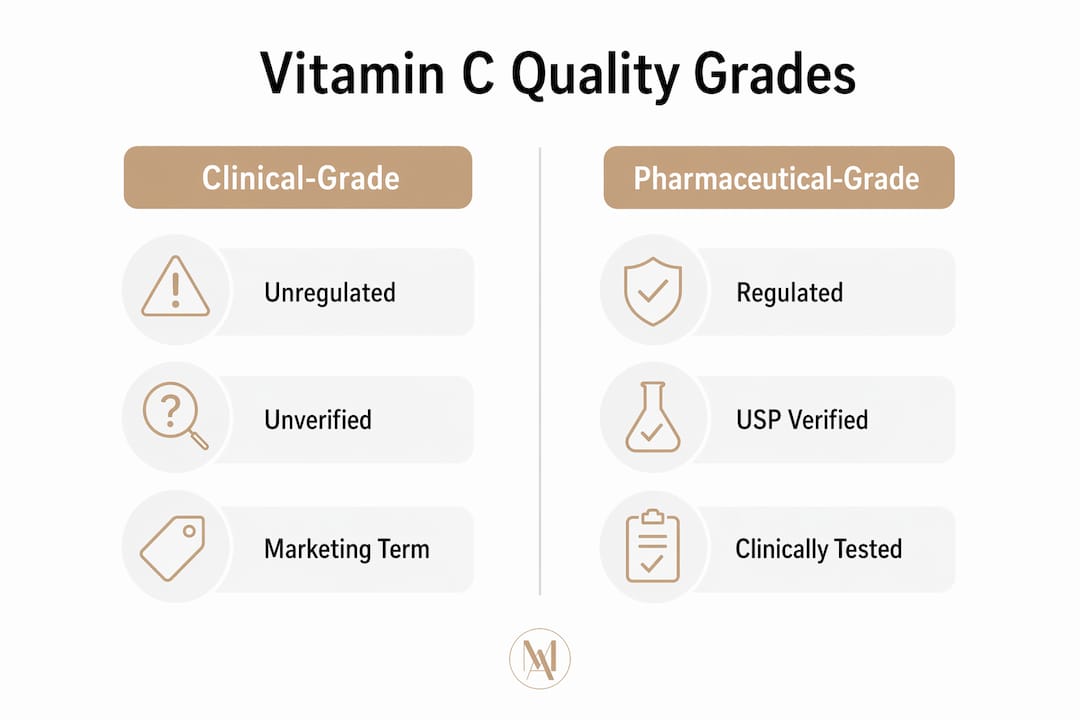
The table above shows why “clinical-grade” sits in an ambiguous position. Clinical skincare products backed by genuine clinical studies showing benefits on collagen production, pigmentation reduction, and barrier repair are meaningfully different from products that simply use the term as a descriptor. The distinction is evidence, not language.
How does clinical-grade vitamin c differ from other types?
The active ingredient in most high-potency vitamin C serums is L-ascorbic acid. It is the form of vitamin C with the most clinical evidence behind it. L-ascorbic acid is the primary active in many products marketed as clinical-grade, often stabilised to improve shelf life and skin absorption.
The challenge with L-ascorbic acid is stability. It oxidises rapidly when exposed to light, air, or heat, which reduces its potency before it even reaches your skin. Derivatives were developed to address this. Common vitamin C derivatives include:
- Ascorbyl glucoside: Water-soluble, stable, and gentler on sensitive skin; converts to L-ascorbic acid after absorption
- Sodium ascorbyl phosphate: Stable at neutral pH; well-tolerated and suitable for acne-prone skin
- Ascorbyl tetraisopalmitate: Oil-soluble; penetrates lipid-rich skin layers effectively
- Magnesium ascorbyl phosphate: Stable and hydrating; less potent than L-ascorbic acid but less irritating
Products marketed as clinical-grade typically use L-ascorbic acid at higher concentrations because the evidence base for this form is strongest. Derivatives offer stability and tolerability advantages, but their conversion rate to active L-ascorbic acid in the skin varies. Formulation matters as much as the ingredient itself. A well-formulated derivative serum can outperform a poorly stabilised L-ascorbic acid product.
Comparing vitamin c types: stability and potency
| Vitamin C Form | Stability | Potency | Best For |
|---|---|---|---|
| L-ascorbic acid | Low (oxidises quickly) | Highest | Anti-ageing, pigmentation |
| Ascorbyl glucoside | High | Moderate | Sensitive skin, brightening |
| Sodium ascorbyl phosphate | High | Moderate | Acne-prone, oily skin |
| Ascorbyl tetraisopalmitate | Very high | Moderate-high | Dry skin, deeper penetration |
| Magnesium ascorbyl phosphate | High | Lower | Reactive or compromised skin |
The Obagi Professional-C portfolio is a useful reference point for understanding how concentration and formulation interact in practice. Obagi’s serums use L-ascorbic acid at concentrations ranging from 10% to 20%, with formulation designed to maintain stability and maximise epidermal delivery.
What are the proven benefits of topical vitamin c for skin?
Topical vitamin C is one of the most studied actives in skincare. Clinical studies show that vitamin C reduces fine lines, brightens skin tone, and provides photoprotection by neutralising free radicals generated by UV exposure. These are not marketing claims. They are outcomes documented in peer-reviewed research.
The core mechanisms are well established:
- Antioxidant protection: Vitamin C neutralises reactive oxygen species, reducing oxidative stress that accelerates skin ageing
- Collagen synthesis: It is a co-factor in the hydroxylation of proline and lysine, two amino acids essential for stable collagen formation
- Melanin regulation: Vitamin C inhibits tyrosinase, the enzyme responsible for melanin production, which reduces hyperpigmentation and uneven skin tone
- Photoprotection: Used alongside SPF, vitamin C enhances protection against UV-induced damage, though it does not replace sunscreen
The bioavailability of topical vitamin C is the critical variable. Skin absorption depends on concentration, pH, formulation, and the condition of the skin barrier. Effective clinical-grade vitamin C products have concentrations between 10–20% and must be formulated to penetrate skin effectively. Below 10%, the evidence for meaningful anti-ageing benefit weakens considerably.
For pigmentation concerns specifically, consistent daily use over 8–12 weeks is typically required before visible brightening occurs. Vitamin C does not produce overnight results. Its value is cumulative, and that is precisely why formulation stability matters so much. A serum that has oxidised in its bottle delivers little of the benefit you are paying for.
How to choose and use vitamin c products effectively
Selecting a genuinely effective vitamin C serum requires looking beyond the label. Here is a practical framework for making the right choice.
- Check the concentration: Look for L-ascorbic acid at 10–20%. Products below 10% are unlikely to produce meaningful anti-ageing results. Products above 20% increase the risk of irritation without proportional benefit.
- Assess the formulation: The serum should have a pH between 2.5 and 3.5 for optimal L-ascorbic acid absorption. This information is not always on the label, but reputable brands publish it.
- Evaluate the packaging: Opaque or airtight containers are vital to maintain vitamin C stability. Clear glass bottles or jars expose the product to light and air, degrading potency rapidly. Choose dark glass or airless pump dispensers.
- Look for supporting ingredients: Vitamin E and ferulic acid significantly enhance the stability and efficacy of L-ascorbic acid. SkinCeuticals’ C E Ferulic is the most cited example of this combination in clinical literature.
- Apply in the correct order: Vitamin C serum goes on clean, dry skin before moisturiser and SPF. Applying it to damp skin can dilute the concentration and alter absorption.
- Introduce gradually: Start with three to four applications per week, particularly if your skin is reactive. Increase to daily use once tolerance is established.
Pro Tip: Store your vitamin C serum away from direct sunlight and heat. A bathroom cabinet is often too warm and humid. A bedroom drawer or a cool, dark shelf preserves potency far better.
Mixing vitamin C with retinol or AHAs in the same application can cause irritation for some skin types. The Revision Skincare Vitamin C Lotion 15% is a well-formulated option that balances potency with tolerability, making it suitable for those new to higher-concentration vitamin C.
Avoid products where the serum has turned yellow, orange, or brown. Oxidised vitamin C is not just less effective. It can generate free radicals rather than neutralise them, which is counterproductive for skin health.
Key takeaways
Clinical-grade vitamin C is a marketing term, not a regulated standard, so product quality must be judged by formulation evidence, concentration, and packaging rather than the label alone.
| Point | Details |
|---|---|
| No regulatory definition | “Clinical-grade” has no legal standard; seek USP-verified ingredients or published clinical data instead. |
| L-ascorbic acid leads on evidence | It is the most clinically studied form; effective at 10–20% in a stable, low-pH formulation. |
| Packaging preserves potency | Opaque, airtight containers prevent oxidation and maintain the serum’s active concentration. |
| Benefits are cumulative | Consistent daily use over 8–12 weeks is required to see measurable improvements in pigmentation and fine lines. |
| Derivatives offer alternatives | Stable derivatives like ascorbyl glucoside suit sensitive skin but vary in conversion rate and potency. |
The term “clinical-grade” tells you less than you think
I have spoken with clients who assumed “clinical-grade” meant a product had been through the same rigorous testing as a prescription treatment. That assumption is understandable, and it is also incorrect. The term is borrowed from the language of medicine to imply rigour, but it carries none of the regulatory weight.
What concerns me more is the confusion between topical vitamin C serums and high-dose intravenous vitamin C therapies. IV vitamin C is a distinct medical procedure involving pharmacological doses that require screening for conditions like G6PD deficiency to avoid serious risks including haemolysis. Topical clinical vitamin C focuses on epidermal antioxidant protection and collagen synthesis. These are entirely different interventions, and conflating them leads to poor decisions.
My honest recommendation is this: stop reading the front of the bottle and start reading the ingredient list, the concentration, and the published evidence. A serum with 15% L-ascorbic acid in a stable, low-pH formulation with ferulic acid will outperform a “clinical-grade” product with no published data every time. If you are uncertain about which formulation suits your skin concerns, a consultation with a qualified skincare clinician is the most efficient path to a genuinely effective routine. We see this regularly at Them-ethod, where personalised guidance consistently produces better outcomes than self-selecting based on marketing language.
— Jess
Explore clinically backed vitamin c at Them-ethod
At Them-ethod, we curate vitamin C products based on formulation quality, published evidence, and clinical performance rather than marketing claims. For those managing pigmentation and uneven skin tone, the NEOSTRATA collection offers science-backed antioxidant protection with a strong focus on skin renewal. For acne-prone skin where vitamin C plays a supporting role alongside targeted treatment, PCA Clearskin combines skin-clarifying actives with antioxidant support. If you are unsure which formulation suits your skin type and concerns, our virtual consultations connect you directly with experienced clinicians who can build a personalised routine around your goals.
FAQ
What does “clinical-grade” mean on a vitamin c serum?
“Clinical-grade” is an unregulated marketing term with no legal definition. It does not guarantee clinical testing, pharmaceutical standards, or independent verification of ingredients.
Is l-ascorbic acid the best form of vitamin c for skin?
L-ascorbic acid has the strongest clinical evidence for anti-ageing and brightening benefits, particularly at concentrations of 10–20%. Derivatives offer better stability and tolerability but vary in potency.
How long does vitamin c take to improve pigmentation?
Consistent daily use over 8–12 weeks is typically required before visible brightening and pigmentation reduction occur. Results depend on concentration, formulation quality, and skin type.
Can i use vitamin c with retinol in my routine?
Using vitamin C and retinol in the same application can cause irritation for some skin types. Apply vitamin C in the morning and retinol in the evening to avoid potential sensitivity.
How do i know if my vitamin c serum has oxidised?
A serum that has turned yellow, orange, or brown has oxidised and lost its efficacy. Store vitamin C in a cool, dark place and replace it if the colour changes significantly.