



Άρθρο: Why personalised skincare works: science, results & expert insights

Why personalised skincare works: science, results & expert insights
TL;DR:
- Personalized skincare, based on genetic and biometric data, delivers measurable skin improvements in weeks. Most routine results improve through ongoing, clinician-guided adjustments over time. Not all personalized products are scientifically validated, so expert supervision is crucial.
Across 22 randomised controlled trials, personalised skincare routines consistently produced better outcomes than their generic counterparts. Yet most people still reach for off-the-shelf products formulated for a mythical “average” skin type that simply does not exist. The truth is that your skin is shaped by a unique combination of genetics, microbiome activity, hormonal patterns, and environmental exposure. A moisturiser that transforms one person’s complexion may do very little for yours. This guide breaks down the science behind personalised skincare, examines what the clinical evidence actually shows, and explains how you can move beyond guesswork to achieve real, measurable results.
Table of Contents
- How does personalised skincare work?
- What the evidence shows: measured benefits of bespoke routines
- The genetic and environmental factors shaping your skin
- Limitations, ethical concerns, and the placebo effect
- Our perspective: what most people miss about personalised skincare
- Discover your prescription-strength solution
- Frequently asked questions
Key Takeaways
| Point | Details |
|---|---|
| Tailored for your biology | Personalised skincare uses genetic, biometric, and environmental data to create optimal regimens unique to you. |
| Evidence of real results | Clinical studies and case reports show major improvements in hydration, elasticity, pigmentation, and oil balance with bespoke routines. |
| Require expert oversight | Look for clinically supervised, prescription-strength solutions to ensure real effectiveness and avoid marketing-only claims. |
| Limitations and caution | Not all personalised products are scientifically validated; ensure your choice is backed by trials and suited to your unique skin. |
How does personalised skincare work?
With the need for more effective solutions clear, let’s uncover how personalised skincare actually functions at a scientific level.
At its core, personalised skincare replaces the broad-stroke approach of mass-market formulations with something far more precise. Rather than targeting a generalised skin type, it uses genetic, biometric, and environmental data to build a custom solution that reflects your biology. This might include single nucleotide polymorphisms (SNPs, which are tiny variations in your DNA that influence how your skin behaves), your skin’s microbiome profile, sebum production rates, and even your local climate.
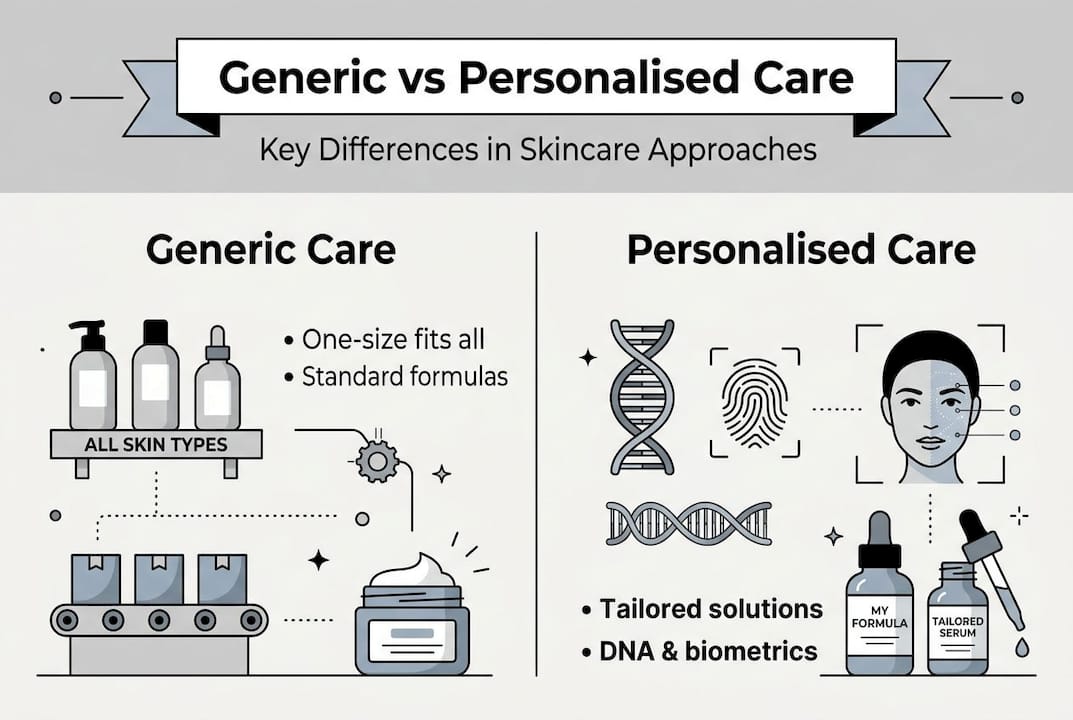
Artificial intelligence plays an increasingly central role. Advanced imaging tools can assess pore size, pigmentation distribution, hydration levels, and fine line depth with a level of accuracy that no visual consultation alone can match. These data points feed into algorithms that recommend or formulate targeted products. It is why personalised skincare use among dermatologists has grown so significantly in recent years.
Generic vs. personalised skincare: a comparison
| Feature | Generic skincare | Personalised skincare |
|---|---|---|
| Formulation basis | Broad skin type categories | Individual biometric and genetic data |
| Ingredient selection | Standardised actives | Targeted actives matched to your biology |
| Outcome tracking | Subjective, self-reported | Measurable, data-driven |
| Adjustment over time | Rarely updated | Reviewed and refined regularly |
| Clinician involvement | Minimal | Central to the process |
The key technologies powering this field include:
- Artificial intelligence and machine learning for pattern recognition across large skin datasets
- Genomic analysis to identify inherited skin traits and sensitivities
- Biometric imaging to map skin texture, tone, and hydration in real time
- Microbiome sequencing to understand the bacterial balance on your skin’s surface
- Environmental sensors that factor in UV index, pollution levels, and humidity
Together, these tools allow clinicians and formulators to move well beyond “oily” or “dry” and into genuinely individualised territory.
What the evidence shows: measured benefits of bespoke routines
Now that you understand the mechanisms, it is important to see what the real evidence says about results.
The clinical data is striking. One 28-day bespoke formula case study recorded improvements across every major biometric marker measured. Sebum production increased by more than 100% in dehydrated zones, skin elasticity rose from 25% to 44%, and hyperpigmentation coverage reduced from 7.2% to just 2.3%. These are not incremental gains. They represent a meaningful transformation in skin health within less than a month.

Biometric improvements after 28 days of bespoke skincare
| Skin metric | Baseline | After 28 days | Change |
|---|---|---|---|
| Skin elasticity | 25% | 44% | +76% |
| Hyperpigmentation coverage | 7.2% | 2.3% | -68% |
| Sebum balance (dehydrated zones) | Low | Normalised | >100% increase |
For those managing acne, hyperpigmentation, or premature ageing, these figures carry real weight. You can explore bespoke skincare case studies that illustrate how targeted regimens address specific concerns with far greater precision than standard products.
Key trial outcomes and their timelines include:
- Week 1 to 2: Improved hydration and reduced surface sensitivity as the skin barrier begins to respond to targeted ingredients.
- Week 3 to 4: Measurable shifts in elasticity and pigmentation as active compounds reach deeper skin layers.
- Month 2 to 3: Sustained sebum regulation and visible reduction in fine lines with continued use.
- Month 4 onwards: Long-term microbiome stabilisation and reinforced collagen production with ongoing clinician-guided adjustments.
Understanding a transforming complexion with bespoke regimens means recognising that results are cumulative, not instantaneous. For the latest skin tips and trends relevant to your concerns, staying informed is part of the process.
The genetic and environmental factors shaping your skin
Behind these impressive outcomes lies the fact that no two skins are truly alike. Let’s look at why that is the case.
Genetics account for an estimated 60% of inter-individual variation in how skin ages. Several key genes have measurable, documented effects on visible skin outcomes:
- ELN (elastin gene): influences skin firmness and how quickly fine lines develop
- FLG (filaggrin gene): governs the integrity of the skin barrier and moisture retention
- MC1R: determines pigmentation response and UV sensitivity
- COL1A1: regulates collagen production and structural skin support
- MMP1: affects the rate of collagen breakdown under environmental stress
Environmental factors do not act independently. Sun exposure, air pollution, humidity, and temperature interact directly with your genetic profile to either accelerate or slow visible ageing. Someone with a particular MC1R variant living in a high-UV environment will age differently to someone with the same variant in a temperate climate. This interaction is why blanket sun protection advice, while valid, is only part of the picture.
“In cases involving compromised or post-oncology skin, personalised formulations have shown exceptional value, offering gentle, clinically validated support where standard products often fall short.”
Understanding how technology and skin genetics intersect is increasingly accessible. Genetic assessments and biometric skin scans are no longer reserved for research settings.
Pro Tip: Before starting any personalised skincare programme, ask your provider whether they incorporate genetic or environmental assessments into their recommendations. This is the difference between a truly bespoke regimen and a questionnaire-based product selector.
Limitations, ethical concerns, and the placebo effect
Personalised skincare is not without its caveats. Here is where you should look carefully before committing.
Not every product or service marketed as “personalised” is clinically valid. The field is growing faster than regulation can keep pace with, and some brands use the language of personalisation as a marketing tool rather than a scientific standard. Validation remains incomplete, with limited data on darker phototypes and a clear need for greater regulatory oversight.
Key limitations to be aware of:
- Lack of diversity in clinical studies: Most trials have been conducted on lighter skin phototypes, leaving darker skin tones underrepresented in the evidence base.
- Overreliance on self-reported outcomes: Many studies depend on participants rating their own skin improvements, which introduces subjectivity.
- Minimal regulatory oversight: There is currently no universal standard governing what qualifies as clinically personalised skincare.
- Placebo effect: Feeling that a product is tailored to you can itself improve perceived results, independent of the formula’s actual efficacy.
- Alternative therapies in skincare rarely have high-quality randomised controlled trial support, making caution essential.
Clinician involvement is not optional in a genuinely personalised approach. It is the mechanism that separates evidence-based treatment from well-packaged guesswork. A qualified professional can interpret your skin data, adjust your regimen as your skin evolves, and flag when a product is not delivering the expected outcome.
Pro Tip: Prioritise prescription-strength, clinician-supervised solutions over self-directed personalisation tools. If a brand cannot tell you which clinical trials support their approach, that is a significant red flag.
Our perspective: what most people miss about personalised skincare
After examining the broader landscape and evidence, here is what our real-world experience has revealed.
The conversation around personalised skincare tends to focus on the technology: the AI, the genomic data, the imaging. And while those tools are genuinely exciting, they are not the whole story. In our experience, the clients who see the most sustained transformation are those who maintain an ongoing dialogue with their clinician, not just those who receive the most sophisticated initial assessment.
Skin changes. Hormones shift. Seasons change. A formula that works brilliantly in autumn may need adjusting by spring. This is why we believe that real personalisation is not a one-time event but a continuous process. As we have seen with clients who work with dermatologists experienced in bespoke care, the results compound over time when regimens are reviewed and refined regularly.
“The most impressive skin transformations we witness are rarely the result of a single breakthrough product. They are the result of consistent, expert-guided adjustment over months and years.”
Expect a journey, not a shortcut. That is the honest truth that the marketing rarely tells you.
Discover your prescription-strength solution
Ready to experience what clinical-grade personalisation can do for your skin? Here is your next step.
At The M-ethod Skin, we offer prescription-strength, clinician-curated skincare that goes well beyond the standard shelf product. Whether you are managing persistent acne, uneven pigmentation, or the early signs of ageing, our experts build regimens grounded in clinical evidence. Explore professional acne treatment or browse our NEOSTRATA prescription skincare range for targeted, results-driven options. For a truly bespoke experience, consult our experts for a virtual skin consultation with one of our top clinicians. Your skin deserves more than guesswork.
Frequently asked questions
How long does it take to see results from personalised skincare?
Most clients notice improvements in hydration and texture within 2 to 4 weeks, with more significant biometric changes, such as improved elasticity and reduced pigmentation, measurable by day 28 with bespoke formulas.
Do genetics really make a difference in skincare outcomes?
Absolutely. Genetic variants in genes such as ELN, FLG, and MC1R have measurable impacts on elasticity, moisture retention, and pigmentation, explaining up to 60% of the variation in how skin ages between individuals.
Is all personalised skincare backed by science?
Not all of it. Some marketed routines lack proper clinical trial support, so it is essential to seek services supervised by qualified clinicians who reference recognised diagnostics. Caution with alternative therapies is always advised.
Can personalised skincare benefit darker skin tones?
Personalised approaches show real promise across all skin tones, but diverse phototypes remain underrepresented in current clinical trials, meaning broader, more inclusive research is still needed to strengthen the evidence base.