



Άρθρο: The role of hyaluronic acid in hydration explained

The role of hyaluronic acid in hydration explained
TL;DR:
- Hyaluronic acid primarily hydrates the skin by drawing water into the extracellular matrix and reducing water loss. Its effectiveness depends on molecular weight, with multi-weight formulations providing comprehensive hydration across skin layers. Consistent, proper application—especially on damp skin and sealing with moisturizer—enhances hydration and supports skin health.
Hyaluronic acid (HA) is defined as a naturally occurring polysaccharide and humectant that binds water molecules within the skin’s extracellular matrix, making it the body’s primary moisture-retention compound. GP Tracey Purnell confirms that HA’s main role is hydration, with limited broad anti-ageing capabilities beyond the short-term plumping and smoothing effects it delivers. Found naturally in connective tissue, the eyes, and the skin, HA can hold up to 1,000 times its own weight in water. That single property explains why it has become the most widely used humectant in clinical skincare formulations worldwide. Understanding how it works, and why molecular weight matters, is the difference between choosing a product that genuinely hydrates and one that simply sits on the surface.
How does hyaluronic acid hydrate the skin?
Hyaluronic acid hydrates by drawing water from the surrounding environment and locking it within the skin’s tissue. It does this through a honeycomb-like molecular structure that traps and holds water molecules, creating a hydrated microenvironment within the extracellular matrix. This is not passive moisture retention. HA actively maintains the water balance that skin cells depend on for normal function.

As a core component of the extracellular matrix, HA supports the passage of nutrients to skin cells while simultaneously keeping the tissue hydrated. When HA levels decline, as they do with age and UV exposure, the matrix loses its structural integrity and the skin’s ability to retain moisture drops significantly. The result is visible: dryness, fine lines, and a loss of plumpness.
Topically applied HA functions as a humectant, pulling moisture from the air into the upper layers of the skin. This reduces transepidermal water loss (TEWL), which is the rate at which water evaporates through the skin barrier. Lower TEWL means the skin retains more of its own moisture, which is the foundation of a healthy, resilient barrier.
Key hydration mechanisms of topical HA include:
- Humectant action: Draws atmospheric moisture into the stratum corneum, the outermost skin layer.
- TEWL reduction: Slows water evaporation through the skin barrier, particularly relevant for dry and compromised skin.
- Matrix support: Maintains the hydrated scaffold that keeps skin cells functioning and communicating effectively.
- Surface film formation: High-molecular-weight HA creates a thin, occlusive-like film on the skin surface that locks in existing moisture.
Pro Tip: Apply your HA serum to slightly damp skin, not dry skin. HA needs available water to bind to. On completely dry skin in a low-humidity environment, it can draw moisture upward from deeper layers instead, which may worsen dryness over time.
What impact does molecular weight have on HA’s hydration properties?
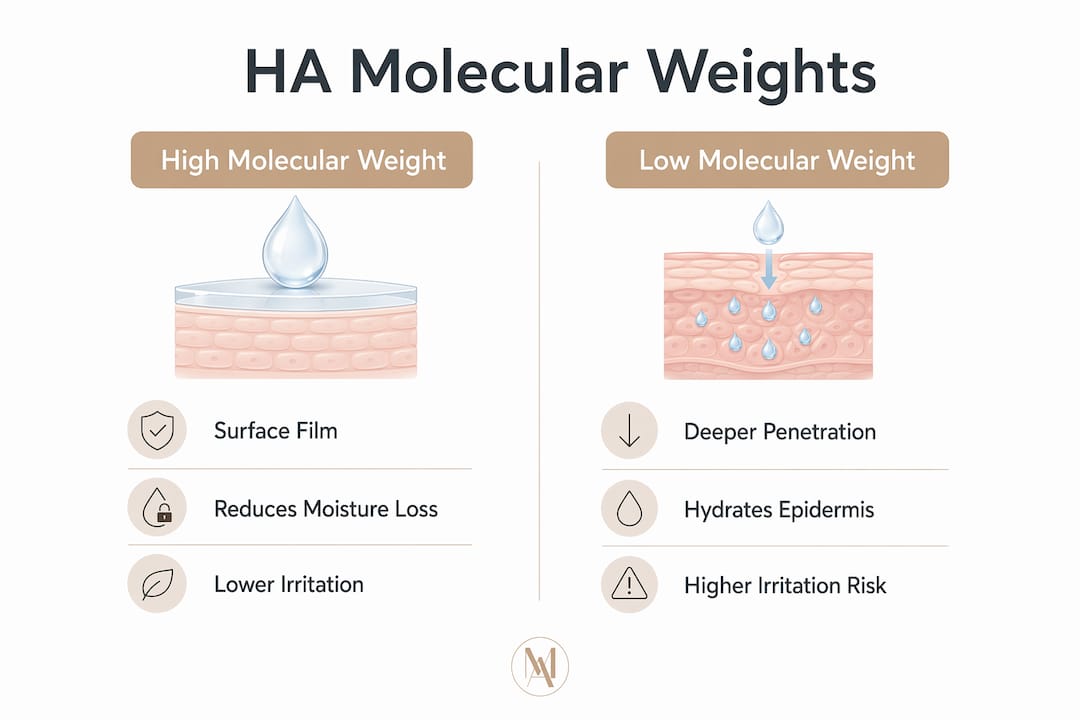
Molecular weight is the single most important variable in how hyaluronic acid performs on the skin. Not all HA molecules are equal, and the size of the molecule determines where it acts and what it achieves.
Multi-weight HA formulations are designed to engage different skin layers simultaneously, combining surface film formation with upper epidermal penetration for broader hydration coverage. This is why the most clinically effective products rarely rely on a single molecular weight.
| Molecular weight | Skin penetration | Primary hydration effect | Irritation risk |
|---|---|---|---|
| High (HMW-HA) | Surface only | Forms protective film, reduces TEWL | Very low |
| Medium | Upper epidermis | Balances surface and deeper hydration | Low |
| Low (LMW-HA) | Deeper epidermis | Targets cellular hydration, supports repair | Moderate |
| Hydrolysed (nano-HA) | Deepest penetration | Intense cellular hydration | Higher in sensitive skin |
High-molecular-weight HA sits on the skin’s surface and forms a breathable film that reduces moisture loss without penetrating the barrier. This makes it particularly well-suited to sensitive or reactive skin types. A 2025 human keratinocyte study found that HMW-HA accelerated wound closure in approximately 30 hours, linked to localised hydration effects and transient pericellular swelling rather than direct cellular stimulation. The implication is significant: surface hydration alone can support tissue repair at a cellular level.
Lower-molecular-weight HA penetrates into the upper epidermis, delivering hydration to deeper skin layers. The trade-off is a slightly elevated risk of irritation in sensitive skin types, particularly with nano-HA or hydrolysed variants. For most skin types, a multi-weight formulation resolves this by distributing hydration across all layers without concentrating any single molecular size.
Pro Tip: If you have reactive or redness-prone skin, prioritise products that list high-molecular-weight HA first on the ingredient list. If your concern is persistent dryness or a compromised barrier, look for formulations that explicitly combine two or more molecular weights, such as Medik8’s HYDR8 B5 range.
What does the research say about HA’s role in skin hydration?
Clinical evidence for hyaluronic acid’s hydration benefits is well-established and measurable. Researchers use objective devices, specifically the corneometer (which measures skin hydration levels) and the Tewameter (which quantifies TEWL), to produce data that goes beyond subjective skin feel assessments.
A 2025 randomised controlled trial involving 150 adults found that oral sodium hyaluronate at 120 mg per day significantly improved facial skin hydration, elasticity, and barrier function, with reductions in TEWL measured objectively over the trial period. The dose-dependent nature of the results confirms that HA’s hydration effects are not incidental. They scale with concentration and delivery method.
| Study type | Measurement tool | Key finding |
|---|---|---|
| 2025 oral HA RCT (150 adults) | Corneometer and Tewameter | 120 mg/day improved hydration, elasticity, and reduced TEWL |
| 2025 keratinocyte cell study | Scratch assay and microscopy | HMW-HA completed wound closure in ~30 hours via hydration-mediated effects |
| Topical HA clinical trials | Corneometer | Consistent improvement in stratum corneum hydration with regular use |
In vitro studies on human keratinocytes add another layer of understanding. The same 2025 research that tracked wound closure also demonstrated that HA-induced cellular repair operates through hydration-mediated mechanical effects rather than biochemical signalling pathways. This distinction matters because it means HA’s benefits are primarily physical and hydration-driven, not pharmacological.
One critical limitation the research highlights is degradation rate. HA has a half-life of under 24 hours in skin tissue, which means its hydrating effects are inherently short-lived without consistent reapplication or a sustained-delivery formulation. This is not a flaw in the ingredient. It is a property that informs how you use it.
How to use hyaluronic acid effectively for optimal hydration
Getting the most from hyaluronic acid requires attention to formulation, application method, and layering strategy. The ingredient itself is well-tolerated across skin types, but its performance varies considerably depending on how it is used.
-
Choose a multi-weight formulation. Single-weight HA products hydrate only one skin depth. Products combining high, medium, and low molecular weights, such as the PCA Hyaluronic Acid Serum from Them-ethod, deliver hydration across the full thickness of the epidermis.
-
Apply to damp skin. As noted earlier, HA requires available water to bind to. Applying it immediately after cleansing, while the skin is still slightly moist, maximises its water-binding capacity.
-
Seal with a moisturiser or occlusive. HA is a humectant, not an occlusive. Without a follow-up moisturiser or barrier cream, the water it attracts can evaporate. The PCA Collagen Hydrator works well as a sealing layer over HA serums.
-
Use it twice daily. Given that HA degrades within 24 hours in skin tissue, twice-daily application maintains a more consistent hydration level than once-daily use.
-
Consider oral supplementation for deeper hydration. The 2025 RCT data on oral sodium hyaluronate demonstrates that supplementation at 120 mg per day produces measurable improvements in hydration and barrier function. This is particularly relevant for individuals with chronically dry skin who find topical application alone insufficient.
One common misconception worth addressing directly: hyaluronic acid is not an anti-ageing ingredient in the traditional sense. It does not stimulate collagen production, inhibit enzymes that break down elastin, or alter gene expression in skin cells. What it does is hydrate, and hydrated skin looks plumper, smoother, and more youthful. That is a meaningful benefit, but it is a hydration benefit, not a structural one.
Pro Tip: In very dry or cold climates, layer a hydrating serum containing HA under a richer moisturiser and finish with a facial oil or occlusive balm. This three-step approach prevents HA from drawing moisture out of deeper skin layers when environmental humidity is low.
Key takeaways
Hyaluronic acid delivers its most significant benefits through consistent, correctly layered application of multi-weight formulations that hydrate across all epidermal depths.
| Point | Details |
|---|---|
| Primary function is hydration | HA is a humectant that binds water and reduces TEWL, not a structural anti-ageing ingredient. |
| Molecular weight determines depth | High-MW HA hydrates the surface; low-MW HA penetrates deeper but carries a higher irritation risk. |
| Clinical evidence is strong | A 2025 RCT confirmed measurable hydration and barrier improvements with oral HA at 120 mg/day. |
| Degradation requires consistency | HA has a half-life under 24 hours in skin, making twice-daily application the standard for sustained results. |
| Formulation and layering matter | Seal HA with a moisturiser or occlusive to prevent the humectant from drawing moisture out in dry conditions. |
Why I think we overcomplicate hyaluronic acid
Hyaluronic acid is one of the most researched ingredients in skincare, and yet it is also one of the most misrepresented. Brands position it as a solution for ageing, pigmentation, and loss of firmness. Clinically, it does none of those things directly. What it does, it does exceptionally well: it hydrates.
What I find most interesting, having worked with clients across a range of skin concerns, is that the molecular weight conversation is almost entirely absent from consumer-facing marketing. A product can list hyaluronic acid prominently and deliver almost no meaningful hydration if it uses only one molecular weight at a low concentration. The difference between molecular weights is not a minor technical detail. It is the difference between a product that genuinely changes how your skin feels and one that simply feels nice on application.
The other point I consistently make to clients is about environment. HA performs differently in a humid climate than in a dry one. In London in January, applying HA without sealing it is a mistake many people make repeatedly without realising why their skin still feels tight. The ingredient is not failing. The application method is.
My honest recommendation: stop looking for HA to do more than it is designed to do. Use it correctly, twice daily, sealed with a moisturiser, and you will see real, consistent improvement in skin texture and hydration. That is not a small thing. Chronically dehydrated skin ages faster, responds poorly to active ingredients, and feels uncomfortable. Fixing hydration is foundational, not supplementary.
— Jess
Discover expert-curated hyaluronic acid skincare at Them-ethod
At Them-ethod, we have curated a selection of clinically formulated hyaluronic acid products from brands trusted by dermatologists and aesthetic clinicians. Whether you are addressing persistent dryness, a compromised barrier, or simply looking to build a more effective hydration routine, our range covers every molecular weight and delivery format. Browse our full hyaluronic acid collection to find formulations matched to your skin type and concerns. You can also read verified experiences from real clients on our testimonials page to see how these products perform in practice.
FAQ
What is the role of hyaluronic acid in skin hydration?
Hyaluronic acid functions as a humectant, binding water molecules within the skin’s extracellular matrix to maintain hydration and reduce transepidermal water loss. Its primary benefit is moisture retention and short-term plumping, not structural anti-ageing.
Does molecular weight affect how well HA hydrates?
Yes. High-molecular-weight HA forms a surface film that reduces moisture loss, while lower-molecular-weight HA penetrates deeper into the epidermis for cellular hydration. Multi-weight formulations deliver both effects simultaneously.
How often should you apply hyaluronic acid for best results?
Twice daily is the clinical standard, as HA degrades in skin tissue within 24 hours. Consistent reapplication maintains a steady hydration level rather than allowing the skin to cycle between hydrated and depleted states.
Can hyaluronic acid help with dry skin specifically?
Hyaluronic acid and dry skin are well-matched when the product is applied correctly. HA applied to damp skin and sealed with a moisturiser significantly reduces TEWL and improves stratum corneum hydration, which directly addresses the core mechanism of dry skin.
Is oral hyaluronic acid effective for skin hydration?
A 2025 randomised controlled trial found that oral sodium hyaluronate at 120 mg per day produced measurable improvements in facial hydration, elasticity, and barrier function in 150 adults. Oral supplementation is a clinically supported option for those seeking systemic hydration support alongside topical use.