



Άρθρο: Does Red Light Therapy for Hair Loss Work?
Does Red Light Therapy for Hair Loss Work?
If your part line looks wider under bright bathroom lighting or your ponytail feels thinner than it did a year ago, you are not imagining it. Hair thinning is often gradual, emotionally loaded, and frustratingly easy to dismiss until it becomes difficult to ignore. That is exactly why red light therapy for hair loss has gained so much attention - it offers a non-invasive, clinically studied option for people who want more than cosmetic camouflage.
What red light therapy for hair loss actually is
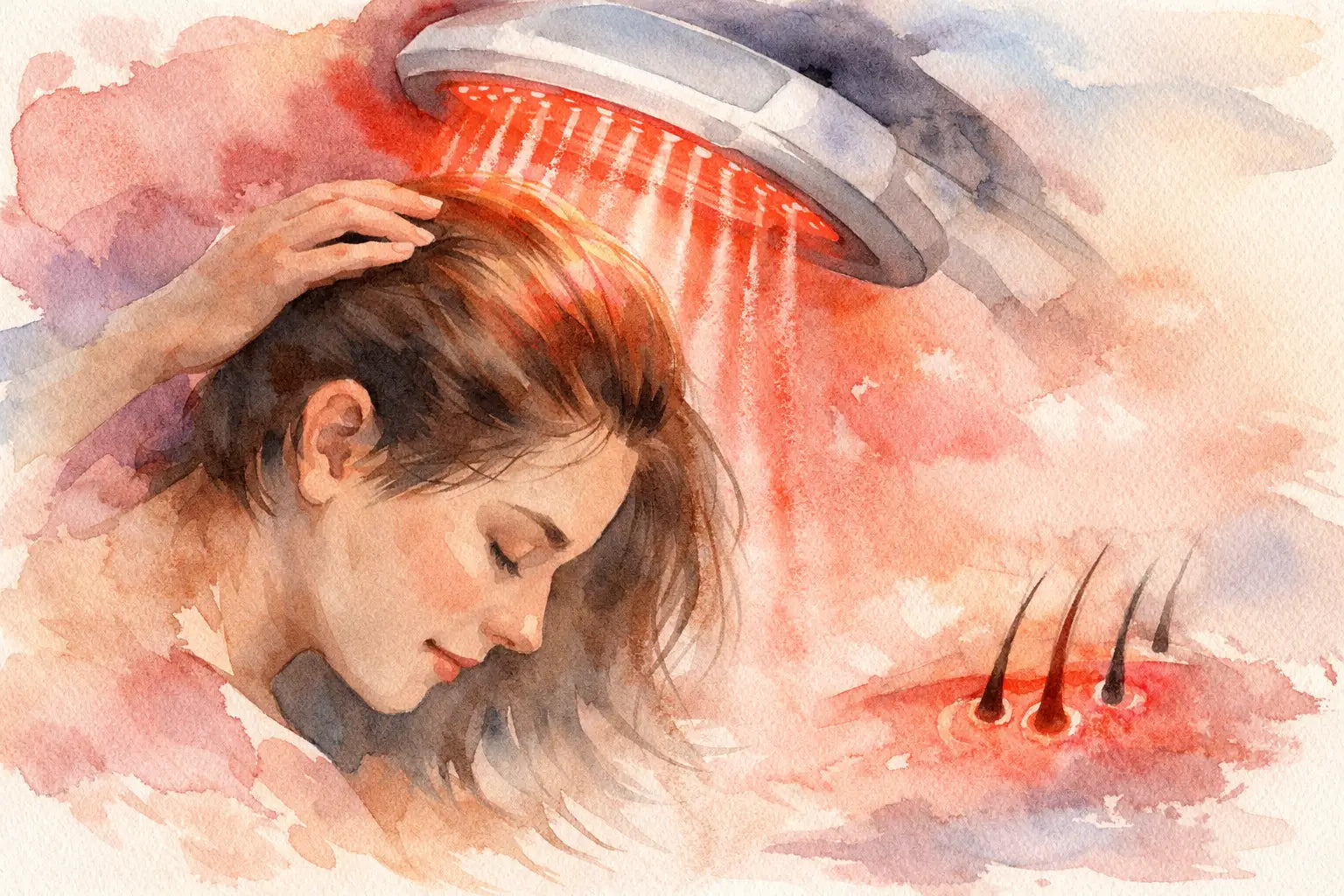
Red light therapy for hair loss refers to low-level light therapy, often shortened to LLLT. It uses specific wavelengths of red light, typically delivered through a cap, helmet, band or comb, to expose the scalp to low-energy light for a set number of minutes several times a week.
The goal is not to heat the scalp or create an aggressive treatment response. It is a gentler, cumulative approach designed to support the hair follicle environment. In clinical settings and at-home devices, the light is usually directed at areas affected by thinning, particularly in cases of pattern hair loss.
This category sits in an interesting space. It is more advanced than a topical cosmetic, but less intensive than in-clinic procedures such as PRP or hair transplantation. For many patients, that is precisely the appeal.
How does red light therapy for hair loss work?
The proposed mechanism is centred on cellular energy. Red light is thought to penetrate the scalp and influence the mitochondria within cells, helping improve adenosine triphosphate production - the energy currency cells use to function. In hair follicles, this may help support follicles that are miniaturising or sitting in a less active phase.
There is also evidence that low-level light therapy may improve microcirculation and reduce inflammatory stress around the follicle. Healthier follicle surroundings can matter just as much as the follicle itself, especially when thinning is linked to androgenetic alopecia, chronic scalp irritation, or recovery after shedding episodes.
That said, this is not a miracle wavelength that overrides every cause of hair loss. If shedding is driven by iron deficiency, thyroid dysfunction, significant hormonal fluctuation, medication changes, or active scalp disease, red light may be supportive but it is unlikely to be sufficient on its own.
What the evidence says
The best evidence for red light therapy sits with male and female pattern hair loss, also called androgenetic alopecia. Several studies have shown improvements in hair density, hair counts and perceived thickness with consistent use over a period of months. That is the key phrase: consistent use.
This treatment does not deliver overnight transformation. Most people who respond begin to notice early changes after around 12 to 16 weeks, with more meaningful visible improvement closer to the six-month mark. The changes are often subtle at first. Less shedding, better coverage at the crown, and finer hairs appearing stronger are more realistic early signs than dramatic regrowth.
It is also worth being precise about what “works” means. In many cases, success means slowing progression, supporting thicker-looking growth, and helping maintain follicle activity for longer. That is valuable, but it is different from reversing advanced hair loss completely.
Who tends to see the best results?
Patients with early to moderate thinning usually see the greatest benefit. When follicles are still alive but underperforming, light-based stimulation has more to work with. If an area has been completely smooth and inactive for years, expectations need to be much more conservative.
Women with diffuse thinning along the part or crown can be particularly strong candidates, especially if they want a non-drug option or a treatment that complements the rest of their hair regimen. Men with pattern loss at the vertex may also respond well.
Where red light therapy becomes more nuanced is telogen effluvium. If your hair loss followed stress, illness, rapid weight change, post-partum recovery, or surgery, you may improve naturally once the trigger settles. In those cases, red light may support recovery, but identifying the cause remains the priority.
What to expect from an at-home LED device
Most high-quality home devices are designed for convenience because adherence matters more than ambition. A beautifully engineered helmet used three times a week will outperform an impressive-looking device abandoned after ten days.
Treatment sessions are usually short, often between 10 and 30 minutes depending on the device. You wear or position the device over clean, dry hair and scalp, following the manufacturer’s schedule. More use is not automatically better. Light therapy follows a dosing principle, and overusing a device does not guarantee faster results.
Premium devices differ in design, diode count, wavelength precision, comfort and ease of use. Those details matter. A poorly designed device that does not deliver adequate, even scalp exposure is unlikely to justify the investment. For a premium customer, this is one category where curation and clinical credibility matter far more than trend appeal.
Red light therapy is rarely the whole plan
This is where many people go wrong. They buy a device, use it inconsistently, and expect it to compensate for every other unchecked factor. Hair restoration rarely works that way.
The strongest results usually come from combination therapy. Depending on the cause and severity of thinning, that may include topical growth support, oral supplementation where deficiencies are present, prescription treatment when appropriate, scalp health management, and attention to hormonal or metabolic triggers. If the scalp is inflamed, excessively oily, heavily built up with product, or compromised at barrier level, you are not giving the follicle an ideal environment.
A more sophisticated approach is to treat hair thinning as a biological process, not simply a styling problem. That means asking better questions: Is this miniaturisation? Is shedding acute or chronic? Is the scalp healthy? Is this age-related, post-partum, stress-induced, or androgen-driven? Once those answers are clearer, red light therapy becomes easier to place correctly within a regimen.
Is it safe?
For most people, yes. Red light therapy is generally well tolerated and non-invasive, which is one of its strongest advantages. It does not usually require downtime, and side effects are relatively uncommon when a device is used correctly.
Some people may notice temporary scalp sensitivity, mild dryness or a warming sensation, although the treatment is not meant to feel hot. Eye safety guidance should always be followed, particularly with stronger devices or if instructed by the manufacturer.
The bigger safety issue is not usually the light itself. It is delay. If someone has sudden patchy hair loss, scalp pain, scaling, severe shedding, or signs of a medical condition, relying on an LED cap alone can postpone the right diagnosis.
How to tell if a device is worth buying
This market includes excellent technology and a fair amount of noise. A premium price does not always mean premium engineering, and generic beauty-device claims are not enough.
Look for devices with clear technical specifications, evidence of appropriate wavelength ranges, realistic treatment protocols, and clinical backing tied to hair growth rather than vague wellness benefits. Comfort also matters more than most people expect. If a device is heavy, awkward, noisy or difficult to fit into your routine, consistency tends to collapse.
This is also one of those categories where authorised retail matters. A clinically proven device sold through a credible aesthetic platform gives you a very different level of confidence than an anonymous marketplace listing with inflated claims.
Common mistakes that limit results
The first is poor consistency. Skipping weeks at a time and restarting when you remember is unlikely to deliver meaningful change.
The second is expecting red light therapy to regrow hair where follicles are no longer viable. It can support function, but it cannot reliably resurrect long-inactive follicles.
The third is ignoring the wider picture. Low ferritin, thyroid imbalance, elevated androgens, nutritional restriction and scalp inflammation can all sit underneath thinning. If those are left untouched, progress may stall.
The fourth is stopping too soon. Because hair grows slowly, many users quit just before they might have started to see visible gains.
Is red light therapy worth it?
For the right patient, yes. Red light therapy for hair loss can be a worthwhile investment if you value non-invasive treatment, understand that results are gradual, and are willing to be consistent. It is especially attractive for those who want a clinically proven adjunct to a broader, results-driven hair strategy.
What it is not is a shortcut. The best outcomes tend to come from disciplined use, realistic expectations and expert-led product selection. That is very much in line with how we approach advanced aesthetics at The M-ethod Aesthetics: fewer gimmicks, better evidence, and a regimen that respects both biology and results.
If your hair is thinning, the smartest next step is not to panic-buy the first device you see. It is to look at the cause, choose quality over hype, and give your follicles the kind of support that makes sense for the long term. Hair restoration is rarely instant, but when approached properly, it can be meaningfully improved.