







Topical vs Oral Probiotics for Skin: Which Route Suits You
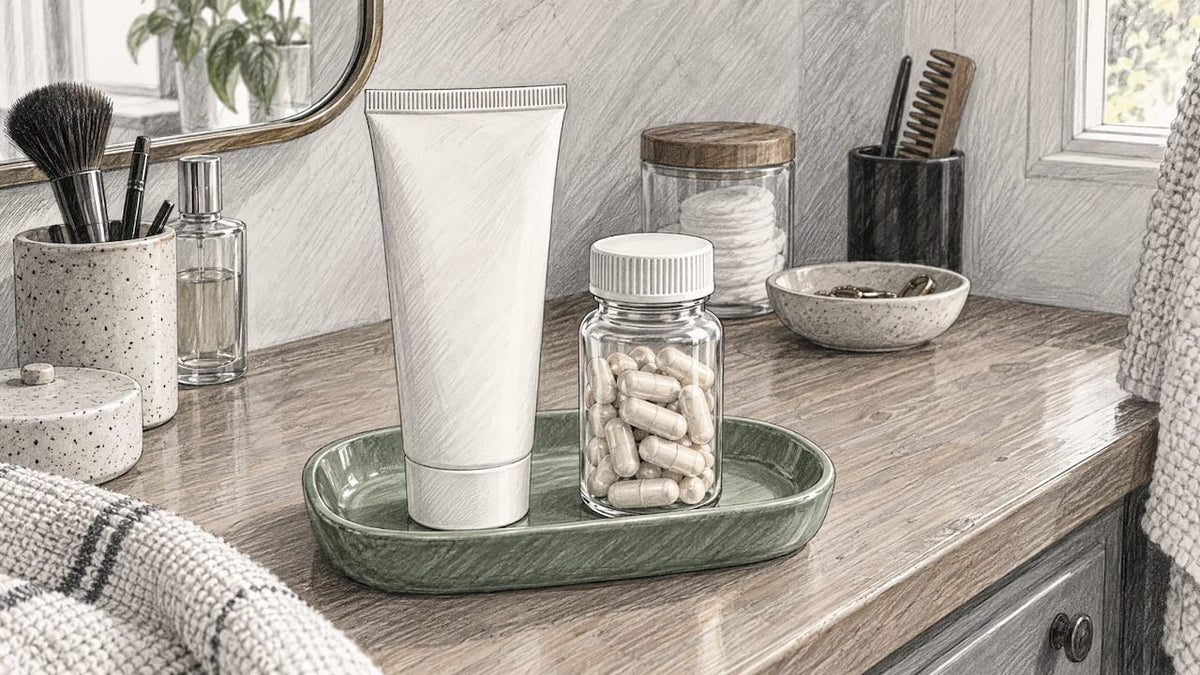
Oral probiotics work from the inside, through the gut and the immune system. Topical probiotic skincare works where you apply it, on the skin’s surface microbiome and barrier. Researchers increasingly treat the two as complementary routes rather than rivals, and the most useful question is which one fits your skin concern, your medicines and your routine. At M-ethod Skin we are a UK-based Obagi Ambassador Clinic with virtual consultations, and this is how we help clients think it through.
TL;DR
- Oral probiotics act systemically via the gut–skin axis. Topical probiotic products act locally on the skin’s microbiome and barrier.
- A February 2026 systematic review of 33 acne studies reported a pooled total lesion reduction of 45.2% for probiotics (oral and topical studies combined), with no serious adverse events.
- Whichever route you choose, read the label: strain names, the type of ingredient (live culture, ferment or lysate) and, for supplements, genus, species and strain with CFU counts.
- Oral probiotics deserve extra care if you are immunocompromised or seriously ill, so speak to your doctor first.
- If you are not sure where to start, a personalised skin consultation can match the route to your concern.
Table of Contents
- How the two routes differ
- What the research says about acne
- What topical probiotics offer beyond acne
- How to read a topical probiotic label
- How to read an oral probiotic label
- Safety, medicines and who should check first
- Which route fits which concern
- Our perspective
- Get a plan matched to your skin
- FAQ
- Sources
How the two routes differ
The skin carries its own community of bacteria, fungi and other microorganisms, known as the skin microbiome. The gut carries another, far larger one. The two seem to talk to each other through immune signalling, an idea called the gut–skin axis. Oral and topical probiotics each try to influence skin health through one of these communities.
A January 2025 review of probiotic supplements and topical applications for acne describes the split clearly. Oral probiotics are thought to reduce systemic inflammation and pro-inflammatory cytokines (the chemical messengers that drive inflammation), which in turn may lower sebum production. Topical probiotics, by contrast, are described as competing with C. acnes (the bacterium involved in acne) locally, supporting the skin barrier and hydration, and calming irritation at the lesion site.
A 2025 review by Nowicka and colleagues adds that oral strains such as Bifidobacterium infantis and Lactobacillus pentosus rebalance Th17/Treg immune responses and reduce systemic TNF-α and IL-6 in atopic dermatitis and psoriasis. The same review reports that topical probiotics modulate local immune responses, enhance antimicrobial peptide synthesis, inhibit pathogen colonisation and support barrier regeneration.
In practice:
| Oral probiotics | Topical probiotic skincare | |
|---|---|---|
| Where it acts | Gut, then immune system | Skin surface and barrier |
| Main proposed benefit | Lower systemic inflammation | Barrier support, hydration, local microbial balance |
| Best matched to | Inflammatory conditions with a systemic component | Surface concerns, dryness, irritation, blemish-prone skin |
| Regulated as | Dietary supplement | Cosmetic |
| Key label check | Genus, species, strain, live CFU count | Strain named, ingredient type stated |
What the research says about acne
Acne is the concern where the evidence is richest, and it is the reason most people search for this topic.
The strongest recent piece is a February 2026 systematic review of prebiotics, probiotics and postbiotics for acne vulgaris. It pooled 33 studies covering 2,112 patients, with treatment lasting 4 to 25 weeks. Probiotics, mostly Lactobacillus and Bifidobacterium with some Bacillus blends, produced a pooled mean total lesion reduction of 45.2%, with inflammatory lesions falling by 88.3%. Postbiotics (products made from what probiotic microbes leave behind) reached 49.5%, and prebiotics (ingredients that feed beneficial microbes) 37.2%. No serious adverse events were reported across any of these approaches. The review included 13 oral and 11 topical probiotic studies, and it noted no significant difference between routes of administration. In one study, L. plantarum MH-301 enhanced the effect of isotretinoin, with a 71% total lesion reduction.
That last point matters for how you use probiotics. They are typically studied as an adjunct, meaning an addition to a core acne plan. The US National Center for Complementary and Integrative Health notes that a 2020 review found probiotics used as adjunct therapy, topical or oral, can play an effective role in managing acne, and it calls for larger studies with longer follow-up.
One oral trial is often cited. In a 45-woman randomised trial reported by Practical Dermatology, a combination of L. acidophilus, L. delbrueckii bulgaricus and B. bifidum achieved a 67% lesion reduction after 12 weeks, comparable to minocycline, with fewer side effects. Combining the two did better still.
We cover the acne evidence in more depth in our guide to probiotics for acne and what the research shows.

What topical probiotics offer beyond acne
Topical products are not only for blemishes. A 2024 cosmeceutical review by Theodorou and colleagues looked at 14 clinical trials in healthy skin using defined probiotic and postbiotic strains. Treated skin stayed well hydrated with an intact epithelial tone, showed increased radiance and reduced wrinkle depth, and the skin’s commensal (resident, friendly) microbiota were normalised.
This is why topical products suit people whose priorities are barrier comfort, hydration and a calmer, more even-looking complexion. If you are dealing with redness or sensitivity, the barrier-supporting role is the relevant one. Our readers with rosacea often pair this thinking with a clinician-guided plan, such as the one in our piece on azelaic acid for rosacea.
How to read a topical probiotic label
The word “probiotic” on a skincare label does not tell you what is in the jar. A 2021 review of probiotics in cosmetic and personal care products examined 50 US products. None stated strain designations and only 8% named the species. Most of the microbial ingredients listed were ferments, extracts, filtrates or lysates (the contents of broken-down microbial cells) rather than live cultures. The same review explains that cosmetics are expected to stay below 500 CFU/g for eye-area products and 1,000 CFU/g for others, so skincare typically works with these non-living preparations rather than live bacteria at supplement levels.
That is not a flaw to worry about. It is simply how the category is built, and it is the reason a few checks help you choose well:
- Look for a named strain or species. The more precisely a brand identifies what it uses, the easier it is to match it to published research.
- Check what kind of ingredient it is. A ferment or lysate is a different thing from a live culture, and each is used for a different purpose.
- Match the product to a concern. Barrier support, blemish-prone skin and sensitivity each call for a different formula around the probiotic ingredient.
- Look at the whole formula. Cleansers, moisturisers and sunscreen all shape how your microbiome and barrier behave, so a probiotic cream works best inside a considered routine.
If you want a body-focused option designed around this idea, we stock the Eu-Skin Probiotic Anti-Acne Body Cream. For a broader view of building a routine around clinically minded products, see our guide to selecting dermatologist skincare.
How to read an oral probiotic label
In the US, oral probiotics are sold as dietary supplements. Under the 1994 Dietary Supplement Health and Education Act, a regulatory overview explains, manufacturers are responsible for safety and for substantiating their claims, and the FDA does not approve supplements before they reach the market. Labels must identify the genus, species and strain of each microorganism, and CFU counts measure live organisms only.
So the checklist for a supplement is different:
- Full strain name. Research findings are strain-specific. The NIH Office of Dietary Supplements notes that effects of probiotics on skin conditions vary by strain, timing and patient age.
- CFU count at the end of shelf life. Live organisms are what the studies used.
- Dose and duration that resemble the research. The acne trials ran from 4 to 25 weeks, with many at around 12, so judge any product over a similar period rather than a few days.
- Match to the studied strains. Lactobacillus and Bifidobacterium species dominate the acne literature.
Dermatologist Steven Daveluy of Wayne State University makes the same point about strain: it matters which specific strains a study used, because acne bacteria also live deep in hair follicles and most studies only sample the surface.
Safety, medicines and who should check first
For most healthy people, probiotics are well tolerated. The NIH Office of Dietary Supplements reports that harm is unlikely in healthy people, with usually minor and self-limiting digestive effects such as gas. It also notes that probiotic use has been linked to bloodstream infections and severe infections, mostly in people who are severely ill or immunocompromised. The World Gastroenterology Organisation, cited in the same fact sheet, advises that people with compromised immune function or other serious underlying disease should restrict probiotic use to strains and indications with proven efficacy.
In plain terms: if you are immunocompromised, have a serious underlying illness, are pregnant, or take prescription medicines, speak to your doctor or pharmacist before starting an oral probiotic. This applies to the supplement route in particular. Topical products are a separate matter, although the 2025 Nowicka review notes that long-term safety data is limited for children and immunosuppressed people, so the same conversation is worth having if that applies to you.
A common situation is taking a probiotic alongside or after a course of antibiotics, which many acne patients do. If that is your case, this overview of probiotics after antibiotics, with strains and timing sets out how people commonly approach it. Your prescriber should still confirm the timing for your own medicine.
One regulatory point is also worth knowing. A 2024 evidence-based review of probiotics in dermatology notes that the FDA classes probiotics as foods, dietary supplements or cosmetics, and that no topical probiotic is currently approved as a drug. That means a skincare product should be chosen as a skincare product, to support the skin, and not as a replacement for prescription acne treatment. Prescription options such as tretinoin are decisions for a clinician.
Which route fits which concern
There is no single winner, and the reviews do not claim one. Here is a practical way to think about it.
Blemish-prone or acne skin. Both routes have been studied. A topical product acts where the lesions are and sits easily in a morning or evening routine. An oral supplement addresses the inflammatory side. Many people combine them with a core treatment plan. Our guide to dermatologist-recommended routines for clear skin and our round-up of acne skincare picks show how the pieces fit together.
Dryness, tightness and a reactive barrier. Topical is the natural starting point, since the proposed benefits are local: barrier support, hydration and reduced irritation.
Inflammatory conditions such as eczema or psoriasis. The gut–skin research is most developed here, and it is best handled with your dermatologist or doctor, who can advise on both oral and topical options.
Healthy skin and general glow. Topical products have the clinical trial data on hydration, radiance and fine lines in healthy skin.
To see results fairly, give any new product or supplement a consistent run of around 12 weeks, introduce one change at a time, and keep sun protection in place, as sunscreen remains the foundation of any routine.
Our perspective
We approach probiotics the way we approach all skincare: as one tool inside a plan built around the person, not as a standalone fix.
The research gives us a sensible framework. Oral probiotics speak to the inside, through the gut–skin axis. Topical probiotics, prebiotics and postbiotics speak to the surface, supporting the barrier and the skin’s own microbial balance. The 2026 acne review found benefit across the probiotic, prebiotic and postbiotic approaches, with no serious adverse events, and it did not find a meaningful difference between routes. For our clients that is reassuring: you can choose the route that suits your skin and your lifestyle.
What matters most is fit. Someone with persistent breakouts, someone managing redness, and someone who wants prescription-strength care such as tretinoin or hydroquinone each need a different conversation. That is why we offer one-to-one virtual consultations, so you can bring your whole routine, your medicines and your goals, and leave with a plan rather than a shopping list.
Our range focuses on medical-grade, dermatologist-recommended skincare, including prebiotic and probiotic-inspired formulas, and our clinicians are happy to explain where each one belongs in your routine.
Jess
Get a plan matched to your skin
If you are weighing up probiotic skincare, supplements and prescription options, our online skin consultation with Dr Mandy lets you talk it through with a UK-trained doctor from wherever you are, and we ship internationally. You can also browse our medical-grade skincare categories, from serums and moisturisers to cleansers and sunscreen, to build a routine around your plan.
FAQ
Are topical or oral probiotics better for acne?
The 2026 systematic review found no significant difference between routes of administration, so neither has been shown to beat the other. Topical products work locally on the skin barrier and microbial balance, while oral ones act through the gut and inflammation. Many people use both alongside a core acne treatment.
Can I use topical probiotics and take an oral probiotic together?
Yes, the two work through different pathways and are commonly combined. Introduce them one at a time, a couple of weeks apart, so you can see what each is doing. If you take prescription medicines or have a condition affecting your immunity, check with your doctor before adding the supplement.
How long do probiotics take to improve skin?
The acne studies in the 2026 review ran for 4 to 25 weeks, and many trials used around 12 weeks. A consistent run of about three months is a fair window to judge a new product, and results vary by person and strain.
Is a probiotic supplement safe to take with antibiotics or other medicines?
Probiotics are generally well tolerated in healthy people, but the NIH notes serious infections have occurred mostly in people who are severely ill or immunocompromised. Ask your prescriber or pharmacist about timing alongside antibiotics or any other medicine, and see your doctor first if you have a serious underlying condition.
What should I look for on a probiotic skincare label?
Look for a named strain or species, a clear statement of whether the ingredient is a ferment, lysate or live culture, and a formula designed for your concern. Our clinicians can walk you through this in an online consultation.
Sources
- Efficacy of probiotic supplements and topical applications in acne (Dove Press, 2025)
- Topical probiotics as a novel approach in the treatment of skin disease (Nowicka et al., 2025)
- Prebiotics, probiotics and postbiotics for acne vulgaris (systematic review, 2026)
- NCCIH: Skin conditions and complementary health approaches
- Practical Dermatology: Which probiotic for which disease, part 2
- Cosmeceuticals: a review of clinical studies (Theodorou et al., 2024)
- Probiotics in cosmetic and personal care products (2021)
- Probiotics regulatory overview (September 2024)
- NIH Office of Dietary Supplements: Probiotics health professional fact sheet
- MedCentral: Probiotics for adult acne
- Probiotics in dermatology: an evidence-based approach (2024)