



Article: Skincare for Frequent Flyers: A Practical Long-Haul Routine
Skincare for Frequent Flyers: A Practical Long-Haul Routine
The best skincare for frequent flyers is a short, consistent routine built around hydration and barrier protection. Cleanse gently, layer a hydrating serum under a rich moisturiser before you board, and add mineral sunscreen for daytime flights. In the air, reapply moisturiser and lip balm rather than trying anything new. Pause strong exfoliating actives around travel. Below, we explain why cabin air is so hard on skin and give you a routine for every stage of a long-haul trip.
TL;DR
- Cabin air is extremely dry, and skin loses water quickly, especially on the cheeks. Hydration and a sealed-in moisturiser matter more than any extra step.
- Before boarding: gentle cleanse, hydrating serum (hyaluronic acid or glycerin), barrier-rich moisturiser, and SPF 30 or higher for daytime flights.
- In flight: reapply moisturiser, lip balm and hand cream. Use mists only if you seal them in. Skip strong actives and heavy makeup.
- Stick to products your skin already knows. A flight is the wrong moment to experiment.
- After landing: cleanse, replenish, and reintroduce retinoids and acids gradually.
Table of Contents
- What cabin air does to your skin
- Before you board: the pre-flight routine
- In the air: what to do on a long-haul flight
- The frequent flyer’s carry-on kit
- Skin types that need extra care
- After you land
- Our perspective
- Build your travel routine with us
- FAQ
- Sources
What cabin air does to your skin
The air at cruising altitude is very dry. The UK Civil Aviation Authority’s Physiology of flight guidance puts typical cabin humidity at 10 to 20%, compared with 40 to 50% in most buildings. A 2018 review of the aircraft cabin environment explains that the conditioned air entering the cabin at 30,000 feet has a relative humidity of under 1%. Moisture from passengers’ breath raises the average to roughly 6% to 10%.
Skin responds quickly. In a study of skin hydration during long-haul flights, cabin humidity fell below 10% within two hours of take-off and stayed there. Skin capacitance, a measure of surface hydration, dropped most on the cheeks, by as much as 37%.

Timing matters too. An earlier study on low humidity and cabin air quality found that the effects of low humidity are generally not noticeable below about three to four hours of exposure. That is why a short hop rarely bothers your skin, while a long-haul flight can leave it tight and dull.
Dr. Mona Foad, a board-certified dermatologist, explains in Forbes that water evaporates from skin faster in these conditions. That weakens the moisture barrier and can lead to tightness, flaking, irritation and sensitivity. She adds that people with conditions such as eczema or rosacea often feel the effects more intensely.
Keep it in proportion
The flight itself will not do anything dramatic to your skin. Dr. Bruce Brod, clinical professor of dermatology at the University of Pennsylvania, tells USA Today that dryness is the biggest danger, so moisturisers and face sprays are your best first defence. Frequent flyers, though, repeat that dryness again and again. A routine that protects the barrier consistently is what keeps skin comfortable over months of travel.
Before you board: the pre-flight routine
The most useful work happens before you reach the airport. A Forbes inflight skincare guide from April 2026 describes an ideal pre-flight routine as a gentle cleanser, a hydrating serum with hyaluronic acid or glycerin, a barrier-rich moisturiser, mineral SPF for daytime travel, and lip and eye hydration.
Step by step
- Cleanse gently, as close to boarding as you can. Dr. Nikolov, a plastic surgeon, advises cleansing thoroughly just before boarding and avoiding makeup for the flight. Choose a creamy, non-stripping formula.
- Apply a hydrating serum. Dr. Tsippora Shainhouse, a Beverly Hills dermatologist, suggests a hydrating serum before heading to the airport, followed by a moisturising cream. Humectants such as hyaluronic acid and glycerin draw water into the outer layers of skin.
- Seal with a rich moisturiser. Ceramides, glycerin and hyaluronic acid are the ingredients Dr. Foad names as excellent for retaining moisture. The moisturiser is the step that keeps the serum’s water from evaporating.
- Add sunscreen for daytime flights. More on this below.
- Prepare lips, eyes and hands. These areas dry out quickly, so start the flight with balm and a little eye cream already on.
If you want a closer look at how hydration actually works in skin, our guides on how to get hydrated skin that lasts and building a hydration routine go through layering and ingredient choices in more detail. A well-formulated option for the serum step is a hydrating serum from Revision Skincare.
What to pause before you fly
Dr. Foad notes that products that exfoliate or raise sun sensitivity, such as stronger retinoids, glycolic acid and high-percentage AHAs, need caution when travelling. If you already use retinoids regularly, she says you may continue but should reduce the frequency. Dr. Nikolov goes further and suggests stopping retinoids and exfoliating acids ideally five days before the flight.
The two views are compatible. The right approach depends on how well your skin tolerates your actives. If your skin is easily irritated, build in a break. If it is well adapted, reduce frequency rather than changing everything at once. For help with scheduling, see our guides on layering retinol safely, using AHAs alongside retinol and preventing retinoid peeling. If you use a prescription retinoid and are unsure how to adjust it around a trip, ask your prescriber or book a consultation before you travel.
Do not experiment on the way
Dr. Brod warns that trying a new routine while travelling carries more risk than reward. Pack the products you already use and know your skin tolerates. Dr. Jeanine Downie of Image Dermatology makes the same point to AFAR: travel throws your body off-kilter, so sticking with your regular regimen helps.
In the air: what to do on a long-haul flight
In-flight skincare should be minimal. The Forbes guide notes that dermatologists see things go wrong when people do too much. The common missteps are relying on mists alone, wearing heavy makeup on a long flight, and using strong actives mid-flight.
Moisturiser, mists and masks
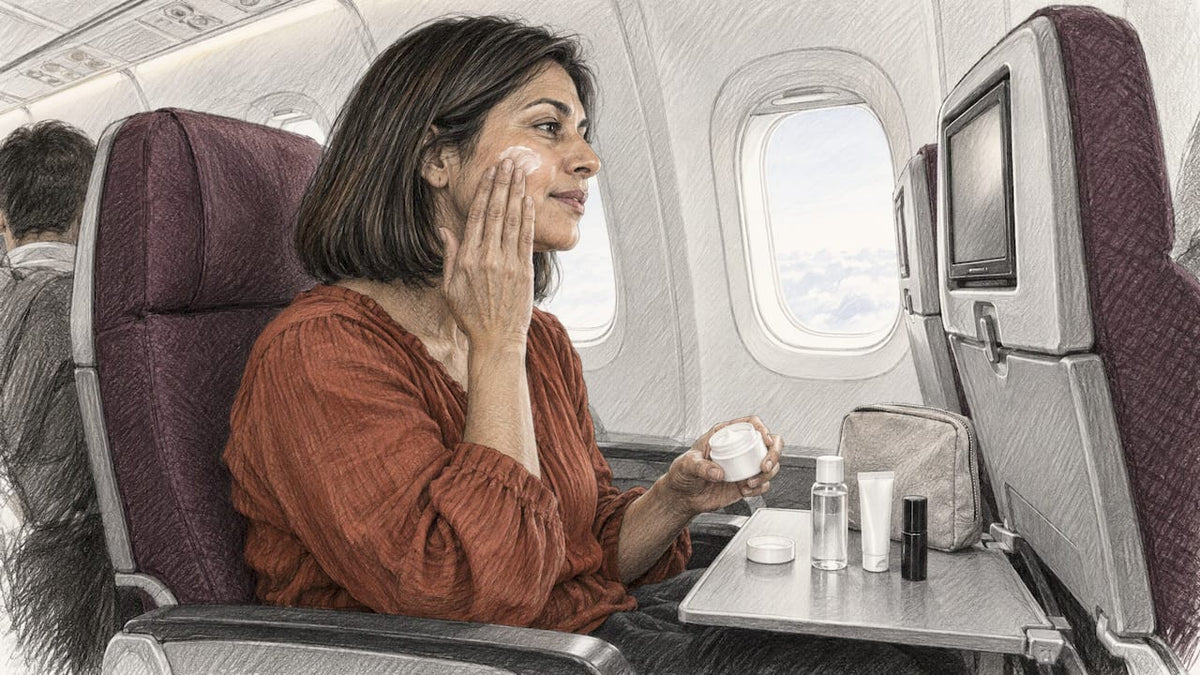
Dr. Foad suggests that on longer flights you reapply a gentle moisturiser, or use a facial mist or thermal spring water spray for a soothing effect. The key detail is sequence. A mist on its own can worsen dryness if it is not sealed with moisturiser, so mist lightly, then press moisturiser over the top.
Dr. Shainhouse adds that on long-haul flights you can apply a leave-on hydrating mask, which keeps providing moisture without needing to be rinsed off.
Lips and hands
Lips and hands lose moisture fastest. Dr. Foad recommends lip balm and hand cream, and Dr. Shainhouse suggests applying a rich, greasy lip balm before boarding and repeating it several times in flight. Keeping your mouth comfortable matters as well. A portable oral spray for fresh breath is a small, carry-on-friendly way to stay fresh when you are sipping coffee in a dry cabin and cannot brush your teeth.
Hands first
Cabin surfaces are shared. A dermatologist interviewed by E! News advises sanitising your hands before applying products, avoiding dipping fingers into open jars, and using travel-sized pump bottles. It is a simple habit that keeps in-flight skincare from becoming a source of irritation.
Makeup
Dr. Brod advises removing makeup, particularly on long overnight flights, and suggests a gentle, TSA-compliant makeup removing wipe. Dr. Justine Kluk explains that flight-related spots often come from failing to remove makeup and cleanse on board, so oil, dirt and dead skin cells build up and block pores. If you want to wear makeup to board, plan to take it off once you are settled.
Sunscreen at the window
Sun exposure at altitude is easy to overlook. Dr. Margaret Schwarz, a dermatologist, says airplane windows typically block UVB rays, which cause sunburn, but let a significant amount of UVA through. She recommends broad-spectrum sunscreen with SPF 30 or higher.
The American Academy of Dermatology recommends a broad-spectrum, water-resistant sunscreen of SPF 30 or higher on all skin not covered by clothing, reapplied every two hours or after swimming or sweating. It also advises seeking shade, including lowering the window shade on a plane. For a daytime long-haul, sit away from direct window light where possible and reapply as the AAD suggests. A powder format, such as ZO Skin Health Sunscreen + Powder Broad Spectrum SPF 30, is one way to top up over moisturiser without a messy reapplication.
The frequent flyer’s carry-on kit
Keep a small, repeatable kit packed at all times so you are not assembling it before each trip. Containers must meet the airline’s liquids rules, so decant into travel sizes.
| Item | Why it earns its place | When to use it |
|---|---|---|
| Gentle cleanser or cleansing wipes | Removes makeup, oil and grime before and during the flight | Before boarding, and on board for overnight flights |
| Hydrating serum (hyaluronic acid or glycerin) | Draws water into the outer layers of skin | Before boarding |
| Barrier-rich moisturiser with ceramides | Seals in hydration and supports the barrier | Before boarding and every few hours in flight |
| Mineral or broad-spectrum SPF 30+ | Protects against UVA coming through windows | Daytime flights, reapplied every two hours |
| Lip balm | Lips dry out fastest | Before boarding and repeatedly in flight |
| Hand cream | Counters dryness and frequent sanitising | Throughout |
| Facial mist or thermal water | Soothing, when sealed with moisturiser | Occasionally on long legs |
| Leave-on hydrating mask | Extra moisture on overnight flights | Once, early in the flight |
Skin types that need extra care
Dr. Foad says dry cabin air is felt more intensely by people with eczema or rosacea. A few adjustments help.
- Sensitive or acne-prone skin: Dr. Foad recommends mineral sunscreens with zinc oxide or titanium dioxide for these skin types. For acne-prone skin, she says the best way to prevent travel-related breakouts is to keep your routine as consistent as possible.
- Irritated skin: a soothing moisturiser with ceramides, niacinamide or colloidal oatmeal can calm things down, according to Dr. Foad.
- Rosacea-prone skin: the dermatologist quoted by E! News advises avoiding aggressive exfoliation, chemical peels and strong new actives right before travel.
- Retinoid users: adjust frequency as described earlier, and keep sun protection consistent. Our guide to building a retinoid routine explains how to make that adjustment without losing progress.
After you land
Landing is the point where many travellers swap into a new time zone and a new climate, so keep the first day gentle. Our own approach, based on the same principles of barrier support, runs like this.
- Cleanse. Remove sunscreen, sanitiser residue and any wipes’ residue with a gentle cleanser.
- Replenish. Use your hydrating serum and a generous layer of moisturiser. Your skin has had hours of low humidity, so it can take a little extra.
- Protect. If it is daytime at your destination, apply sunscreen as the AAD advises, reapplying every two hours when outdoors.
- Reintroduce actives slowly. If you paused retinoids or acids, restart at a lower frequency and build up as your skin feels comfortable. Our article on starting tretinoin every two to three nights shows what a gradual build can look like, and our guide on mixing retinol and acids covers combinations.
- Drink water and sleep. Hydration from the inside will not replace topical care, but it supports how you feel after a long journey.
If redness, peeling or breakouts persist for more than a few days after a trip, speak with a dermatologist or your prescriber.
Our perspective
Frequent flyers often ask us what the one product is that fixes travel skin. We tend to answer with a system. The skin barrier is what cabin air stresses, so the products that matter are the ones that support it: a good hydrating serum, a well-formulated moisturiser and daily sun protection.
What we see most is people changing everything when they travel. They buy a new mask for the flight, or they keep strong actives going without adjusting. We encourage the opposite: a stable routine that your skin already tolerates, with small, deliberate adjustments around the flight itself.
This is also where personalised guidance helps. Someone using a prescription retinoid, managing rosacea or flying every fortnight needs a different plan from someone flying twice a year. That is the thinking behind our online consultations with Dr. Mandy, and behind the clinical-grade ranges we choose to stock.
Jess
Build your travel routine with us
If you fly often and want a routine that fits your skin and your schedule, you can book an online skin consultation with Dr. Mandy. Our team can help you decide what to keep, what to pause and what to pack. You can also browse our moisturisers, serums, cleansers and sunscreens to put together a compact travel kit. We ship internationally, so your routine can meet you wherever you are.
FAQ
Should I wear moisturiser and serum on the plane?
Yes. Apply a hydrating serum and a rich moisturiser before boarding, and reapply moisturiser during a long flight. Dermatologists quoted by Forbes and AFAR recommend this sequence because it counters the very dry cabin air. Keep the layers light and use products your skin already tolerates.
Is a face mist enough on a long-haul flight?
Not on its own. Dermatologists cited by Forbes warn that mists alone can worsen dryness if they are not sealed with moisturiser. Use a mist for a refreshing, soothing effect, then press a moisturiser over your skin to lock the water in.
Do I need sunscreen on a plane?
On a daytime flight, yes. Airplane windows typically block UVB but let a significant amount of UVA through, according to Dr. Margaret Schwarz. The American Academy of Dermatology recommends broad-spectrum SPF 30 or higher, reapplied every two hours, plus lowering the window shade.
Should I stop using retinol before a flight?
It depends on your skin. Dr. Foad says regular retinoid users may continue but should reduce frequency, while Dr. Nikolov suggests stopping retinoids and exfoliating acids ideally five days before. If you use a prescription retinoid, ask your prescriber how to adjust it for your trip.
Should I wear makeup on a long flight?
It is better to go without. Dr. Brod advises removing makeup, especially on overnight flights, because leftover makeup, oil and dirt can block pores. If you do wear it to board, take it off on board with a gentle, TSA-compliant wipe.
Sources
- Physiology of flight, UK Civil Aviation Authority
- The Aircraft Cabin Environment, PMC
- Skin surface hydration decreases rapidly during long-haul flights
- Low relative humidity and aircraft cabin air quality
- Top Skin Care Tips To Use When Traveling, Forbes
- Do you need skin care on a flight? USA Today
- Inflight Skincare Guide, Forbes
- The Best Ways to Care for Your Skin While Flying, AFAR
- A Plastic Surgeon’s advice for in-flight skincare routine
- 7 travel skin care tips from dermatologists, American Academy of Dermatology
- Skincare at 30,000 Feet, E! News