




Role of customs in skincare delivery: 2026 guide
TL;DR:
- Customs enforces compliance and classification rules that determine whether skincare products cross borders lawfully and promptly. Accurate documentation and HTS classification are essential to avoiding shipment delays, fines, or reclassification as drugs. Using a customs broker and choosing temperature-controlled air freight improves the likelihood of a smooth and timely delivery.
Customs is the regulatory gatekeeper that determines whether your skincare products cross borders lawfully, safely, and on time. The role of customs in skincare delivery goes far beyond collecting duties. It enforces compliance with safety standards, verifies documentation accuracy, and applies classification rules that directly affect what you pay and how long you wait. Regulations like the Modernisation of Cosmetics Regulation Act (MoCRA), the Harmonized Tariff Schedule (HTS), and FDA oversight all shape every international skincare shipment. Understanding these frameworks is no longer optional for consumers who import premium, clinically active products.
How does customs classification affect skincare imports?
Customs classification is the foundation of every international skincare shipment. Most skincare products fall under HTS heading 3304, which covers beauty and skin-care preparations. The specific subcategory within 3304 determines the applicable duty rate, and even small classification errors carry significant consequences.
Tariff rates fluctuate by origin country and active legislation. For example, the Section 122 tariff of 10% applied to certain imports in early 2026, with expiry expected mid-year. Trade agreements such as KORUS (the US-Korea Free Trade Agreement) can reduce or eliminate duties on qualifying products, making accurate classification financially meaningful.
Misclassification does not just cost money. It triggers shipment holds, fines, and in some cases, returned goods. A serum classified under the wrong subcategory may face a duty rate several percentage points higher than intended. Customs authorities cross-reference product descriptions, ingredient lists, and declared values, so inconsistencies surface quickly.
| Region | Common HTS heading | Typical duty range | Key agreement |
|---|---|---|---|
| USA (MFN) | 3304.99 | 0–6.5% | KORUS reduces Korean imports |
| European Union | 3304.99 | 0–6.5% | EU-Korea FTA |
| United Kingdom | 3304.99 | 0–4% | UK Global Tariff |
| Australia | 3304.99 | 0–5% | AUSFTA |
The table above reflects general ranges. Actual rates depend on precise product composition and current trade policy. Always verify with a licensed customs broker before shipping.
What documentation do skincare shipments require?
Proper documentation, not formulation quality, is the primary barrier to smooth customs clearance. A product can be perfectly formulated and fully compliant with safety standards, yet still be detained because of a paperwork error.
In the United States, MoCRA became enforceable on 1 July 2024. It mandates facility registration and product listing for cosmetics entering the US market. 79 batches were refused in september 2025 alone due to non-compliance with these requirements. That figure reflects how seriously US Customs and Border Protection now enforces MoCRA filings.
Beyond MoCRA, every skincare shipment requires a precise set of documents. Missing or inaccurate paperwork is the single most common cause of shipment detention.
Essential documents for customs clearance include:
- Commercial invoice with accurate product descriptions, declared values, and country of origin
- Packing list detailing quantities, weights, and dimensions
- INCI ingredient list (International Nomenclature of Cosmetic Ingredients) for every product
- Certificate of free sale or certificate of conformity where required by the destination country
- MoCRA facility registration number for US-bound shipments
- Labelling compliant with destination market standards (font size, language, net content, warnings)
- Safety data sheets for products containing regulated ingredients
Minor paperwork errors such as mismatched product names between the invoice and the physical label cause shipment rejections even when the product itself is fully compliant. Customs officers compare every field. A product listed as “brightening serum” on the invoice but labelled “vitamin C serum” on the bottle creates a discrepancy that flags an inspection.
Pro Tip: Use the exact product name from the physical label on every customs document. Even minor wording differences between your invoice and your packaging can trigger a hold.
Engaging a customs broker before shipping reduces these risks substantially. Brokers verify HTS codes, review documentation for consistency, and confirm regulatory filings are current. For prescription-strength or dermatologist-recommended products, this pre-shipment review is particularly valuable because the regulatory stakes are higher.
How does customs affect shipping timelines and product integrity?
Customs clearance directly shapes how long your skincare products take to arrive and whether they arrive in usable condition. The mode of transport you choose determines both the baseline timeline and the exposure to customs-related delays.

Ocean freight from Korea to the USA takes 30–55 days in total, including approximately 15 days of preparation, 11–18 days of transit, and 1–2 days for last-mile delivery. Air freight covers the same route in 12–20 days. The cost difference is significant, but for temperature-sensitive or time-critical products, air freight is the standard choice.
Customs inspections add unpredictable time to either mode. A routine inspection may add 2–5 days. A detailed examination triggered by documentation errors or flagged ingredients can hold a shipment for weeks. For skincare products with active ingredients like retinoids, vitamin C derivatives, or peptides, extended holds at ambient temperature can degrade efficacy.
Temperature-sensitive skincare products require storage at 15–25°C to maintain stability. Customs warehouses do not always provide controlled environments. Products held for inspection at incorrect temperatures may degrade before they reach the consumer, making air freight and pre-clearance documentation the most reliable combination for high-value clinical skincare.
Specialised transport with temperature control is available for premium shipments, but it requires advance planning and accurate customs declarations to avoid inspection delays that negate the benefit of controlled handling.
Pro Tip: For medical-grade or prescription-strength skincare, always choose air freight with temperature-controlled packaging and submit pre-arrival documentation to the destination customs authority where the option exists.
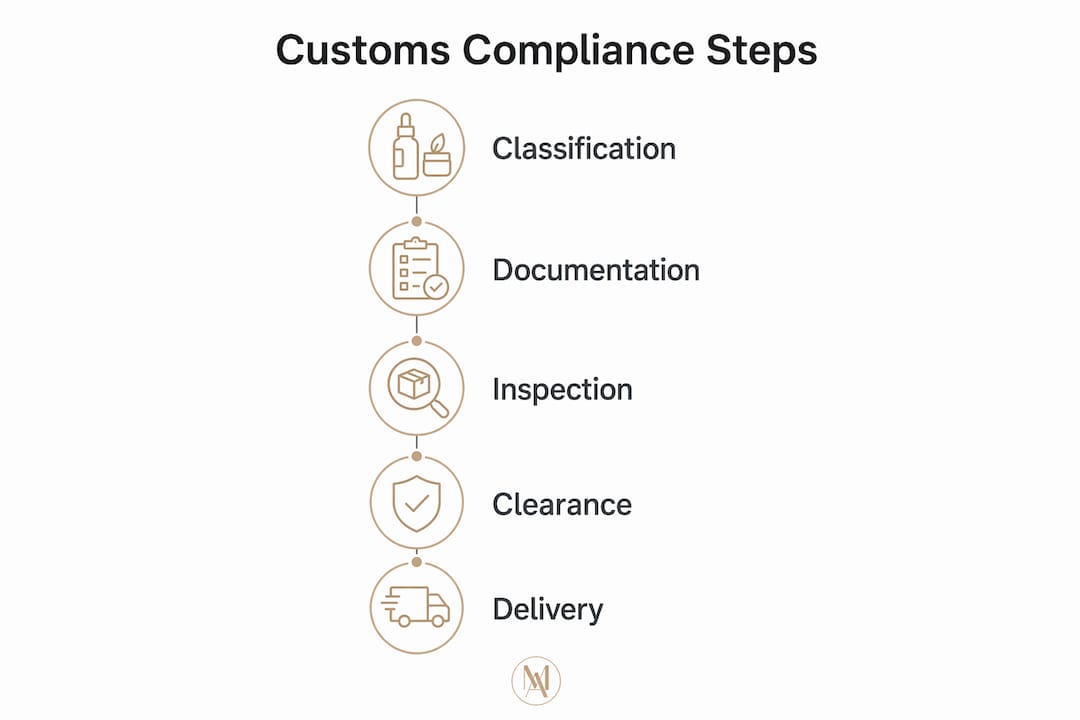
A typical compliant air freight shipment follows this sequence:
- Pre-shipment documentation review and HTS code verification
- Export customs clearance in the origin country (1–2 days)
- Air transit (1–3 days for most international routes)
- Import customs declaration filed on arrival
- Customs examination or release (1–5 days depending on risk profile)
- Last-mile delivery to the consumer (1–2 days)
What are the most common customs pitfalls for skincare consumers?
Shipment failures most commonly stem from incorrect labelling, documentation errors, or wrong HTS codes rather than product safety issues. This is a critical distinction. Your product can be clinically excellent and still be stopped at the border.
The drug versus cosmetic classification issue is one of the most consequential pitfalls. Products with medicinal claims risk being reclassified as drugs by customs authorities, triggering FDA drug approval requirements and significantly longer clearance times. A moisturiser marketed as “treating eczema” crosses the line from cosmetic to drug under US law. The language on your label and in your marketing materials matters as much as the formulation itself.
Misdeclared values create a separate category of risk. Under-invoicing to reduce duty liability is a customs offence. AI-powered customs systems now cross-check declared values against market prices, flagging shipments where the declared value appears inconsistent with the product type. These systems catch irregularities that manual checks previously missed.
Practical guidance for consumers importing skincare products:
Do:
- Verify the correct HTS code with a customs broker before placing an order
- Confirm the retailer or brand holds current MoCRA registration for US-bound products
- Check that all product labels comply with destination country language and content requirements
- Declare the accurate retail value on all customs forms
- Request a certificate of free sale from the supplier for markets that require it
Do not:
- Accept shipments where the declared value appears artificially low
- Order products with drug-like claims unless you have confirmed their regulatory status
- Assume a product sold legally in one country is automatically compliant in another
- Ignore customs notifications. Respond promptly to avoid automatic return or destruction of goods
Prescription skincare products face additional scrutiny at customs because they may require import permits or physician authorisation in the destination country. Knowing this before you order prevents costly surprises.
Key takeaways
Customs compliance is the single most important factor in whether international skincare shipments arrive on time, at the correct cost, and in full regulatory compliance.
| Point | Details |
|---|---|
| Classification accuracy | Correct HTS 3304 subcategory determines duty rate and prevents costly shipment holds. |
| MoCRA compliance | US-bound skincare must include facility registration and product listing since July 2024. |
| Documentation precision | Invoice and label wording must match exactly. Minor discrepancies trigger inspections. |
| Shipping mode choice | Air freight with temperature control is the most reliable option for clinical skincare. |
| Broker engagement | A customs broker pre-shipment review reduces the risk of detention and fines significantly. |
Customs in 2026: what I’ve learnt from watching the system evolve
The most underestimated shift in cross-border skincare delivery right now is the speed at which customs authorities are adopting AI screening. AI-powered systems now detect suspicious declarations from small importers with a level of accuracy that simply did not exist three years ago. This changes the risk calculation entirely. The assumption that a small personal order flies under the radar is no longer reliable.
What I find genuinely concerning is how many consumers still believe that documentation is the retailer’s problem alone. It is not. When you import a product, you are the importer of record in most jurisdictions. That means the compliance obligation sits with you, not just the brand you ordered from. Choosing a retailer who understands international skincare shipping and handles documentation correctly is one of the most practical decisions you can make.
The drug versus cosmetic classification issue will only grow more complex as active ingredient concentrations in consumer skincare increase. Retinol at 1%, niacinamide at high concentrations, and prescription-adjacent ingredients like tretinoin sit in a regulatory grey area that customs authorities are scrutinising more closely. Getting this wrong does not just delay your order. It can result in product destruction and a formal customs record against your name.
My honest advice: treat customs compliance as part of your skincare investment, not an afterthought. The products worth importing are worth importing correctly.
— Jess
Them-ethod and compliant international skincare delivery
Them-ethod sources and ships medical-grade skincare from brands with full regulatory compliance, accurate HTS classification, and documentation that meets destination country requirements. Every product in the range is selected with customs-compliant delivery in mind, so you receive what you ordered without unexpected holds or additional charges. For consumers managing acne, the PCA Clearskin Acne Treatment Serum ships with complete compliance documentation. The NEOSTRATA collection offers clinically validated formulations backed by the same standard of compliant international delivery. When the product is this good, the paperwork should be too.
FAQ
What is the role of customs in skincare delivery?
Customs acts as the regulatory checkpoint for all international skincare shipments, verifying safety compliance, documentation accuracy, and correct tariff classification before allowing products to enter a country.
Which HTS code applies to most skincare products?
Most skincare preparations classify under HTS heading 3304, with subcategories determined by product type. The exact subcategory affects the applicable duty rate and must be verified before shipping.
What is MoCRA and does it affect my skincare order?
MoCRA is the Modernisation of Cosmetics Regulation Act, enforceable in the US from 1 july 2024. It requires facility registration and product listing for cosmetics entering the US market. Non-compliance leads to shipment detention.
Can a skincare product be reclassified as a drug at customs?
Yes. Products carrying medicinal or therapeutic claims risk reclassification as drugs under FDA rules, triggering stricter import controls and significantly longer clearance times.
How can I avoid customs delays when ordering skincare internationally?
Confirm the retailer holds current regulatory filings, verify the correct HTS code, check that labels comply with your country’s requirements, and declare the accurate product value on all customs forms.