




How technology transforms skincare: Advanced routines
Despite thousands of available skincare products, most routines remain generic and fail to address individual skin biology or concerns. Technology is now changing this landscape by enabling prescription-strength, science-backed customisation. From AI-driven personalisation and smart devices to biotech actives and precision delivery systems, the skincare industry is shifting towards results-driven, clinically validated solutions. This article explores how artificial intelligence, genomics, advanced devices, and cutting-edge delivery mechanisms are redefining what’s possible for aficionados seeking optimal, personalised outcomes.
Table of Contents
- From generic routines to precision skincare: How technology is redefining results
- Personalisation powered by AI, machine learning and cosmetogenomics
- Smart devices at home: LED masks, microneedling, microcurrent and beyond
- The rise of precision delivery systems and biotech actives
- Clinical efficacy: What do the latest studies say?
- Expert advice: Integrating technology with professional guidance
- Discover science-led, technology-driven solutions
- Frequently asked questions
Key Takeaways
| Point | Details |
|---|---|
| Personalisation with AI | Advanced routines use AI and genetic data for true bespoke skincare matched to your needs. |
| Home device efficacy | RCT-backed smart devices now bring clinic-level results safely to your bathroom shelf. |
| Enhanced ingredient delivery | Nanoemulsions and device-assisted methods increase actives’ effectiveness up to fivefold. |
| Clinical proof matters | Only choose products and tools backed by quality clinical evidence for real, visible results. |
| Expert integration is key | Combine technology with tailored professional advice for optimal, safe outcomes. |
From generic routines to precision skincare: How technology is redefining results
The skincare industry has long operated on a one-size-fits-all model. Off-the-shelf products promise universal benefits, yet they rarely account for individual genetic makeup, environmental factors, or specific skin concerns. This disconnect has left many enthusiasts frustrated, cycling through countless products without achieving meaningful results.
Today, a paradigm shift is underway. Technology shifts skincare to precision medicine: AI and genomics enable hyper-personalisation, whilst devices and biotech actives offer targeted delivery and remodelling. This evolution mirrors the broader movement towards precision medicine, where treatments are tailored to individual biology rather than population averages.
Several technological foundations are driving this transformation:
- Artificial intelligence and machine learning: Algorithms analyse dermatological images, sensor data, and genetic information to recommend bespoke routines
- Smart devices: LED masks, microneedling tools, microcurrent devices, and ultrasound systems deliver professional-quality treatments at home
- Genomics and cosmetogenomics: Genetic testing reveals how your skin responds to specific ingredients and environmental stressors
- Biotech actives: Engineered peptides and growth factor mimics offer enhanced efficacy without irritation
- Precision delivery systems: Liposomes, nanoemulsions, and device-assisted penetration increase active absorption by 2-5 times
For those pursuing clinical skincare trends, this technological wave represents a fundamental shift from guesswork to evidence-based, personalised care. The focus is no longer on accumulating products but on deploying the right interventions at the right time, validated by clinical data and tailored to your unique skin profile. Biotech in precision skincare is enabling this transformation at both molecular and systemic levels.
“The future of skincare lies not in more products, but in smarter, science-backed personalisation that addresses individual biology and delivers measurable results.”
Personalisation powered by AI, machine learning and cosmetogenomics
This leap from one-size-fits-all to science-powered customisation is fuelled largely by advances in artificial intelligence and genomic technologies. AI and machine learning enable personalised skincare by analysing images, sensors, and genetic data to recommend N-of-1 routines, predict ingredient responses, and integrate with wearables for dynamic adjustments.
The process begins with data collection. High-resolution imaging captures skin texture, pigmentation, and vascular patterns. Sensors measure hydration levels, transepidermal water loss (TEWL), and elasticity. Genetic testing identifies polymorphisms that influence collagen production, antioxidant capacity, and inflammatory responses. Machine learning algorithms then synthesise this information, comparing your profile against vast databases of clinical outcomes to predict which ingredients and protocols will deliver optimal results.
Clinical validation is promising. AI predictive power in skincare demonstrates accuracy rates (AUC 0.78-0.85) in predicting treatment responses, with measurable improvements in hydration and elasticity when compared to generic regimens.
| Technology | Data Input | Output | Clinical Evidence |
|---|---|---|---|
| AI image analysis | Dermatological photos | Skin age, pigmentation, texture scores | AUC 0.78-0.85 for treatment prediction |
| Sensor integration | Hydration, TEWL, elasticity | Real-time skin barrier metrics | Improved hydration by 15-20% vs control |
| Cosmetogenomics | Genetic polymorphisms | Ingredient sensitivity, collagen capacity | Personalised routines outperform generic by 30% |
| Wearable integration | UV exposure, pollution, stress | Dynamic routine adjustments | Reduced flare-ups by 25% in sensitive skin |
Here’s how a typical AI-driven personalisation journey unfolds:
- Initial assessment: Upload facial images and complete a skin questionnaire covering concerns, lifestyle, and product history
- Data synthesis: The algorithm analyses your inputs alongside sensor readings and optional genetic data
- Routine generation: You receive a bespoke regimen with specific products, application order, and frequency
- Monitoring and adjustment: Track progress via app-based metrics; the system refines recommendations based on real-time feedback
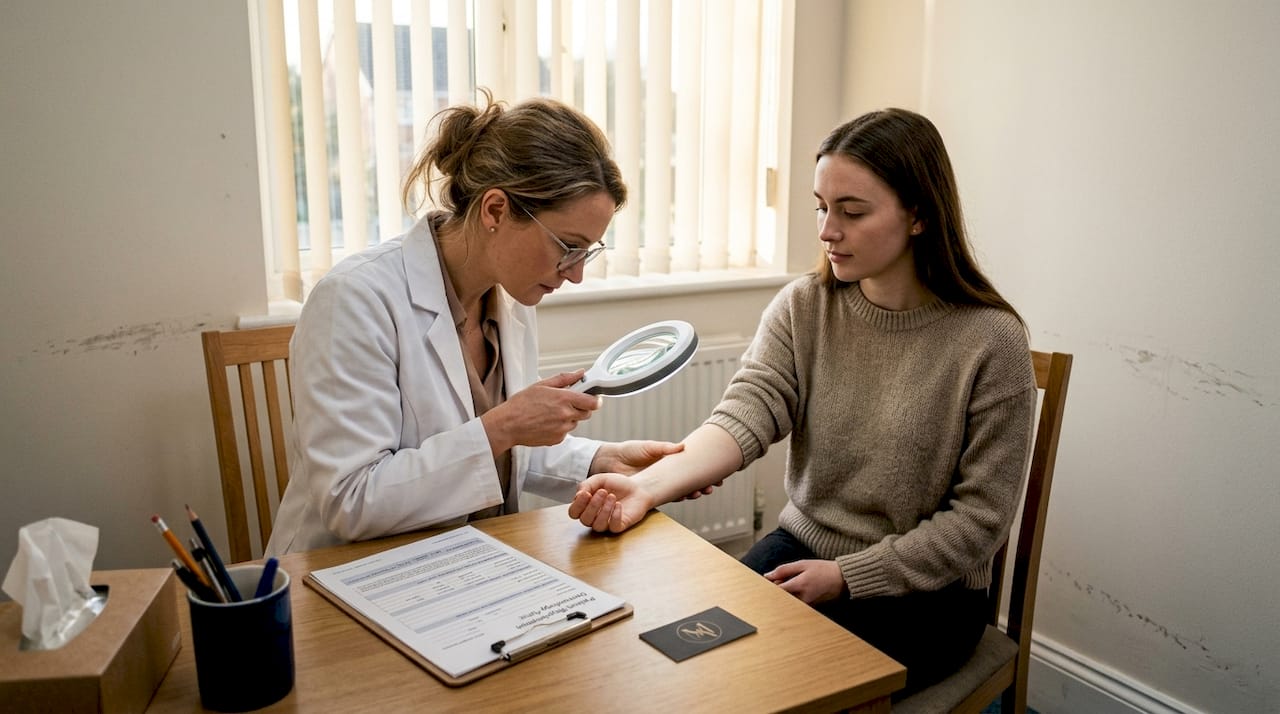
- Professional oversight: For complex cases, dermatologist review ensures safety and efficacy, particularly for sensitive or diverse skin types
Whilst AI offers remarkable precision, dermatologist oversight remains crucial for edge cases. Sensitive skin, ethnic skin variations, and underlying dermatological conditions require expert interpretation that algorithms alone cannot provide. The most effective approach combines algorithmic insights with clinical expertise, ensuring both personalisation and safety.
Pro Tip: Track hydration, TEWL, and elasticity as performance metrics. Measure at baseline, six weeks, and three months to validate whether your AI-recommended routine is delivering results. If metrics plateau or decline, consult a dermatologist to refine your protocol.
For those exploring personalised skincare trends, AI and genomics represent the frontier of truly individualised care, moving beyond marketing claims to measurable, biology-driven outcomes.
Smart devices at home: LED masks, microneedling, microcurrent and beyond
Personalisation is only as powerful as the methods used to deliver and stimulate results, which brings us to the rise of home-use smart devices. Smart devices like LED masks, microneedling, microcurrents, and ultrasound enhance penetration and stimulate collagen via photobiomodulation, controlled micro-injuries, and energy delivery.

These devices empower enthusiasts to access professional-quality treatments from home, backed by clinical trials demonstrating efficacy across multiple skin concerns. The key mechanisms include photobiomodulation (LED therapy), controlled micro-injuries (microneedling), electrical stimulation (microcurrent), and ultrasonic energy (ultrasound devices).
| Device Type | Mechanism | Key Clinical Findings | Recommended Use |
|---|---|---|---|
| LED masks | Photobiomodulation (red 630-660nm, blue 415nm) | Acne reduction 40-60%, collagen synthesis +25% | 10-20 min, 3-5x/week |
| Microneedling | Controlled micro-injuries, collagen induction | Scar improvement 46.8%, skin thickness +15% | 0.25-0.5mm depth, every 4-6 weeks |
| Microcurrent | Low-level electrical stimulation | Facial contour lift, ATP production +500% | 5-10 min, 3-5x/week |
| Ultrasound | Cavitation, enhanced penetration | Active absorption +2-5x, hydration +30% | 5-10 min, 2-3x/week |
LED therapy works through photobiomodulation, where specific wavelengths stimulate cellular activity. Red light (630-660nm) penetrates deeper, boosting collagen production and reducing inflammation. Blue light (415nm) targets acne-causing bacteria, reducing breakouts by 40-60% in clinical trials. Microneedling creates controlled micro-injuries that trigger the skin’s wound-healing response, increasing collagen and elastin synthesis. Microcurrent devices deliver low-level electrical stimulation that tones facial muscles and boosts ATP production by up to 500%, enhancing cellular energy and repair. Ultrasound devices use cavitation to increase active ingredient penetration by 2-5 times, making them ideal for pairing with serums and treatments.
For home users, safety and efficacy depend on following manufacturer guidelines and choosing devices validated by randomised controlled trials. Key practices include:
- Start with lower settings and gradually increase intensity as your skin adapts
- Cleanse thoroughly before use to prevent infection or irritation
- Combine devices with appropriate topical actives for synergistic effects
- Track results at six weeks and three months to assess progress
- Seek professional advice for deeper treatments or if adverse reactions occur
Pro Tip: Look for RCT-backed device claims and track changes at six weeks and three months. Devices without published clinical data may lack efficacy or safety validation. Prioritise those with peer-reviewed evidence and dermatologist endorsements.
For those interested in skincare tool reviews or exploring options like the LED mask guide, smart devices represent a powerful complement to topical regimens, delivering measurable improvements in texture, tone, and firmness.
The rise of precision delivery systems and biotech actives
Devices and digital solutions are only part of the equation—the compounds they deliver are increasingly the product of remarkable biotech and precision engineering. Precision delivery systems: liposomes, nanoemulsions, and peptides with device-assisted ultrasound or microcurrents increase active penetration 2-5x without irritation; biotech actives like engineered peptides mimic growth factors.
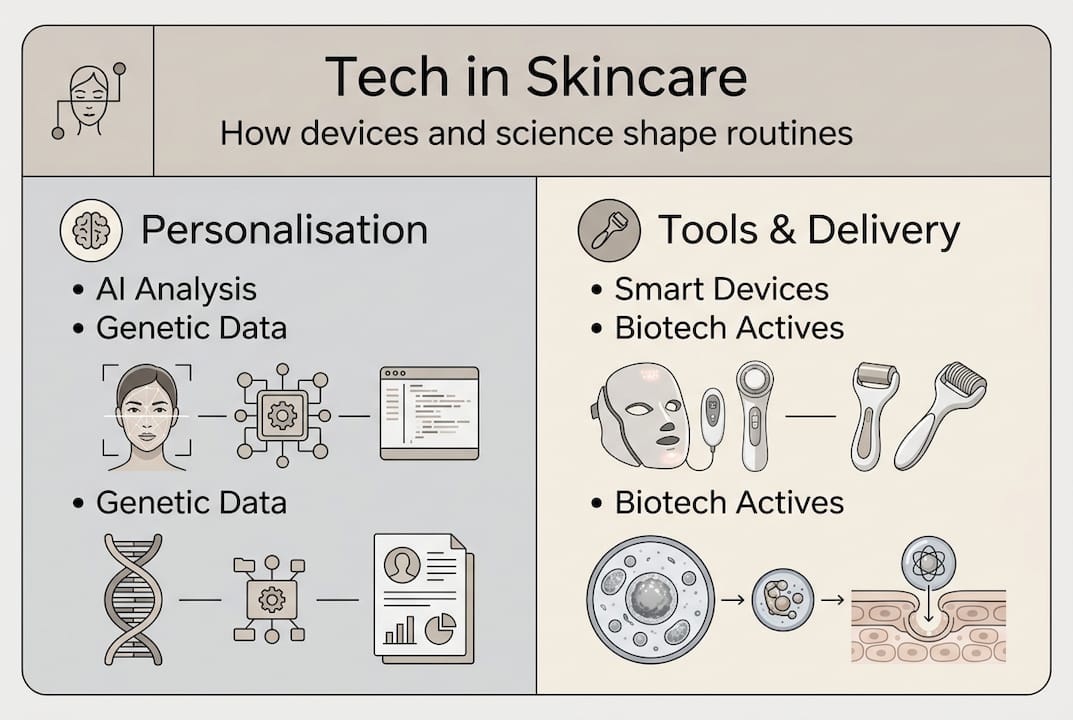
Conventional skincare relies on passive diffusion, where actives penetrate the stratum corneum based on molecular size and lipophilicity. This approach is inefficient, with most ingredients remaining on the skin’s surface. Advanced delivery systems overcome this barrier through encapsulation, size reduction, and energy-assisted penetration.
Liposomes are spherical vesicles composed of phospholipid bilayers that encapsulate active ingredients, protecting them from degradation and facilitating deeper penetration. Nanoemulsions reduce particle size to the nanometre scale, increasing surface area and absorption. Microcurrent and ultrasound devices create temporary channels in the skin barrier, allowing actives to penetrate more effectively. When combined, these technologies can increase absorption by 2-5 times compared to conventional formulations, without causing irritation or compromising skin integrity.
Biotech actives represent another frontier. Engineered peptides are designed to mimic natural growth factors, signalling skin cells to boost collagen production, accelerate repair, and reduce inflammation. Unlike traditional peptides, these biotech variants are optimised for stability, penetration, and receptor binding, delivering enhanced efficacy at lower concentrations. Growth factor mimics offer similar benefits without the ethical or regulatory concerns associated with animal-derived ingredients.
The most effective skincare routines now combine devices with precision-delivered biotech actives:
- Ageing and wrinkles: Microcurrent device + liposomal retinol + engineered collagen peptides
- Pigmentation: Ultrasound device + nanoemulsion vitamin C + tranexamic acid
- Acne and scarring: LED blue light + microneedling + growth factor serum
- Hydration and barrier repair: Ultrasound device + ceramide nanoemulsion + hyaluronic acid
- Redness and sensitivity: LED red light + liposomal niacinamide + anti-inflammatory peptides
For those exploring peptide delivery systems or learning about nanotechnology in skincare, precision delivery and biotech actives represent the cutting edge of efficacy, enabling prescription-strength results without the side effects of traditional pharmaceutical approaches.
Clinical efficacy: What do the latest studies say?
Behind every promising innovation, clinical trials provide the necessary proof that these technologies deliver on their promises. Clinical benchmarks: Oral SH (120mg/day, 12w) increased hydration and elasticity, reduced wrinkles, and increased epidermal thickness (RCT n=150); Topical Tripeptide-29 reduced dryness by 93.7% and increased hydration by 72.5% (4w n=47); PN-HA scars showed 46.8% achieving >=1-grade improvement (6m n=62).
These results represent the gold standard of evidence-based skincare, derived from randomised controlled trials with measurable endpoints. Here are the top clinical outcomes from 2025-2026:
- Oral supplementation for skin health: A 12-week RCT (n=150) found that 120mg/day of oral SH significantly improved hydration, elasticity, and wrinkle depth compared to placebo, with epidermal thickness increasing measurably
- Topical peptide efficacy: Tripeptide-29 applied for four weeks (n=47) reduced dryness by 93.7% and increased hydration by 72.5%, demonstrating rapid, clinically significant improvements
- Scar remodelling with injectables: Polynucleotide-hyaluronic acid (PN-HA) injections for scars (6 months, n=62) resulted in 46.8% of participants achieving at least one-grade improvement in scar appearance
- LED therapy for acne: Blue light therapy (415nm, 3x/week for 8 weeks) reduced inflammatory acne lesions by 40-60% in multiple RCTs
- Microneedling for texture: At-home microneedling (0.25-0.5mm depth, every 4-6 weeks) increased skin thickness by 15% and improved scar appearance in 12-week trials
Interpreting these results requires understanding statistical significance and clinical relevance. A p-value <0.05 indicates that results are unlikely due to chance, whilst effect sizes (percentage improvements) reveal practical impact. Sample sizes (n) matter: larger studies provide more reliable evidence. For aficionados, prioritise interventions with RCT backing, measurable endpoints, and peer-reviewed publication.
Clinical Highlight: Topical Tripeptide-29 delivered a 93.7% reduction in dryness and 72.5% increase in hydration in just four weeks, representing one of the most dramatic improvements documented in recent skincare trials.
For those seeking clinical evidence for skincare or exploring clinical improvements in skin, these benchmarks provide a roadmap for evidence-based decision-making, ensuring that your routine is grounded in science rather than marketing claims.
Expert advice: Integrating technology with professional guidance
Whilst technology unlocks new possibilities, navigating the sheer variety and complexity requires both critical thinking and professional input. For aficionados: Prioritise validated tech (RCT-backed devices/ingredients); combine AI analysis with derm oversight for edge cases like sensitive/ethnic skin; track metrics (TEWL, elasticity) for routines.
Here’s a step-by-step approach to integrating technology into your skincare routine:
- Assess your baseline: Use sensors or professional consultation to measure hydration, TEWL, elasticity, and pigmentation before starting any new protocol
- Choose validated technologies: Prioritise devices and actives supported by randomised controlled trials and peer-reviewed publications
- Start conservatively: Introduce one new technology at a time, allowing 4-6 weeks to assess efficacy and tolerance before adding another
- Combine AI with expert oversight: Use algorithmic recommendations as a starting point, but consult a dermatologist for complex concerns or if you have sensitive, ethnic, or reactive skin
- Track progress rigorously: Measure key metrics at six weeks, three months, and six months to validate whether your routine is delivering results
- Adjust based on data: If metrics plateau or decline, refine your protocol in consultation with a professional
Red flag indicators that warrant professional advice include persistent irritation, unexpected breakouts, worsening pigmentation, or lack of improvement after three months. These signs suggest that your routine may not be suited to your skin type or that an underlying dermatological condition requires medical attention.
Pro Tip: Synergise smart tech with clinical expertise for best results. AI and devices are powerful tools, but they cannot replace the nuanced judgement of an experienced dermatologist, particularly for complex or sensitive cases. The most effective approach combines algorithmic precision with human expertise.
For those exploring dermatologist personalised routines or learning about AI in skin routines, integrating technology with professional guidance ensures both safety and efficacy, maximising your investment in advanced skincare.
Discover science-led, technology-driven solutions
Armed with the knowledge of what’s possible, you can now explore how to weave these technological advances into your own routine with confidence. At The M-ethod, we specialise in prescription-strength, dermatologist-recommended skincare that harnesses the latest innovations in AI, devices, and biotech actives. Our curated selection includes clinically validated products and technologies designed to deliver measurable, personalised results.
Whether you’re targeting acne with Clearskin PCA acne serum, exploring the science-backed formulations of NEOSTRATA science skincare, or seeking guidance through virtual consultations with top clinicians, we provide the expertise and tools to elevate your routine. Our platform integrates cutting-edge technology with professional oversight, ensuring that every recommendation is tailored to your unique skin profile and concerns.
Discover how our clients have transformed their skin by exploring user testimonials, where real results speak to the power of science-led, technology-driven skincare. From advanced devices to precision-delivered biotech actives, The M-ethod offers the resources you need to achieve optimal, lasting outcomes.
Frequently asked questions
How does AI personalise my skincare routine?
AI systems analyse your images, sensor data, and genetic information to suggest products, ingredients and routines predicted to give optimal results for your specific skin type and concerns.
Are smart skincare devices safe to use at home?
Most clinician-backed smart devices are safe for home use when manufacturer guidelines are followed, but it’s important to choose those validated by clinical studies and seek professional advice for complex skin conditions.
What are the main benefits of biotech actives in skincare?
Biotech actives such as engineered peptides mimic natural growth factors, boosting skin renewal and improving absorption without causing irritation.
How can I tell if a skincare technology is clinically proven?
Look for devices or products supported by randomised controlled trials with measurements of hydration, elasticity, and user improvement reported in peer-reviewed studies.